
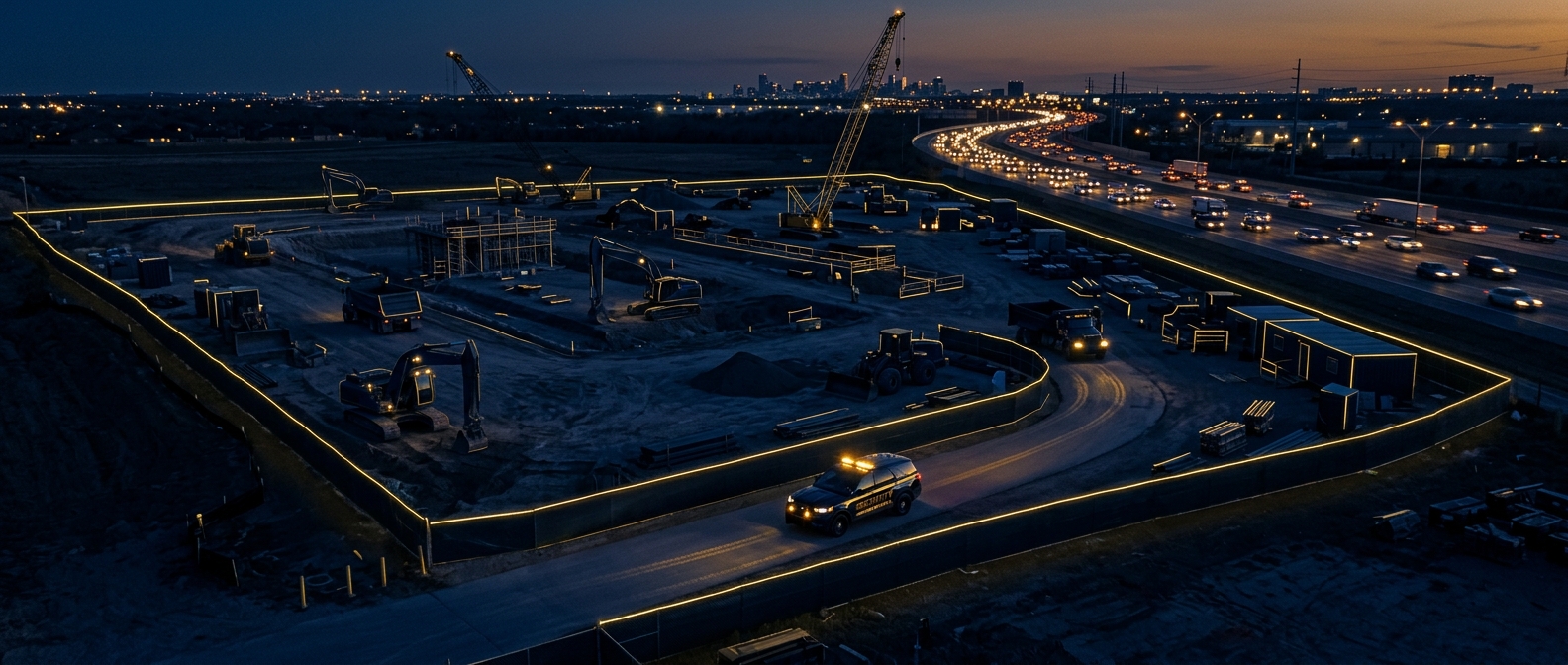
Construction jobsite theft is driven by predictable, well-documented factors — unattended equipment, weak perimeter control, and low reporting rates — that make prevention far cheaper than recovery. Insurers and equipment registries report recovery rates for stolen heavy equipment far below those for vehicles, and FBI crime data does not track equipment theft as its own category. Along Arizona’s I-10 corridor, a layered framework of access control, tracking, and guard presence outperforms any single control alone.
Want a written estimate for your own site? Start with our construction site security services page.
Construction sites are, by design, temporary, exposed, and full of high-value, easily moved assets — which is exactly why they are disproportionately targeted compared to almost any other commercial property type. Unlike a retail store or office building, a jobsite has no walls for much of its life, changes personnel constantly, and often sits unattended for sixteen or more hours a day. For developers, general contractors, and property owners along Arizona’s I-10 corridor — from the West Valley through Casa Grande and Tucson — that exposure is compounded by long build timelines, remote parcels, and a highway corridor that gives organized theft crews an efficient route in and out. This guide synthesizes what public data actually shows about construction-site crime risk, the prevention framework that measurably reduces it, and how to weigh the cost of security against the cost of loss.
What does public crime data actually show about construction-site theft?
Getting a precise national figure for construction-site theft is harder than it should be, and that data gap is itself a well-documented industry frustration. The FBI’s Uniform Crime Reporting (UCR) Program and its successor, the National Incident-Based Reporting System (NIBRS), capture burglary and larceny-theft offenses reported by participating law enforcement agencies nationwide, but neither program isolates “construction equipment” or “jobsite theft” as its own offense category — those incidents are folded into general property-crime statistics, undercounted by inconsistent local reporting, and further diluted because many contractors do not file a police report for smaller losses at all.
That gap is why insurers and industry groups fill in with their own tracking. The National Insurance Crime Bureau (NICB) and the National Equipment Register (NER) have published heavy-equipment theft data for years, and their consistent finding is that recovery rates for stolen construction equipment run well below recovery rates for stolen automobiles — heavy equipment is harder to track, often lacks a standardized VIN-equivalent registry, and can cross state or national borders before an owner even realizes it is missing. Equipment without an active telematics or GPS system is disproportionately represented in the equipment that is never recovered at all.
On the exposure side, Bureau of Labor Statistics data for the construction sector shows an industry employing several million workers nationally across hundreds of thousands of establishments, with Arizona ranking among the faster-growing state construction markets over the past decade — meaning more active sites, more equipment in the field, and more total dollar exposure at any given time, even without a precise per-incident theft figure to point to.
What actually drives theft and vandalism risk at a jobsite?
Across the sites we assess, the same risk drivers appear again and again, largely independent of project size:
| Risk driver | Why it matters | Typical exposure window |
|---|---|---|
| No active perimeter control | Open access lets anyone drive or walk onto the site unchallenged | Nights, weekends, before fencing is complete |
| Equipment left fueled and keyed | Ready-to-run machines are the fastest, highest-value theft target | Every non-working hour |
| No GPS or telematics on major equipment | Stolen equipment without tracking is rarely recovered | Entire equipment lifecycle on-site |
| High material turnover (copper, rebar, fixtures) | Scrap-value materials attract opportunistic theft, not just organized crews | Delivery-to-install lag |
| Remote or highway-adjacent parcels | Fast ingress/egress with limited witnesses; common along the I-10 corridor | Duration of the project |
| Inconsistent subcontractor access control | Rotating crews and unbadged visitors make unauthorized presence hard to detect | Active construction phase |
Notice that almost none of these drivers require a sophisticated criminal operation to exploit — most construction-site loss is opportunistic, which is exactly why basic, consistently applied controls close most of the exposure.

What does a proper jobsite security framework include?
Elite jobsite security is layered — no single control is sufficient on its own, because every control has a known workaround. The framework that measurably reduces loss combines:
- Perimeter control. Fencing installed at the start of the project, not after the first incident, with controlled, monitored access points.
- Lighting. Adequate illumination across equipment yards and material laydown areas — the single cheapest deterrent against opportunistic entry.
- Camera coverage with active monitoring. Recorded footage alone deters far less than footage a monitoring center or patrol can act on in real time.
- Equipment tracking and immobilization. GPS/telematics on major machines, and simple measures such as removing keys, disabling fuel access, and locking hydraulic controls overnight.
- Material and inventory control. Logging deliveries against installation schedules so high-scrap-value materials are not staged on-site longer than necessary.
- On-site security guard presence. Physical patrol and access verification during non-working hours, when the overwhelming majority of jobsite loss actually occurs.
- Incident documentation and reporting discipline. Every loss, however small, reported and logged — feeding both insurance claims and the underlying crime data that the industry needs more of.
Arizona-licensed security guard services are the layer that closes the gap the other controls cannot: a camera records a theft, a guard prevents it. On active I-10 corridor sites — Casa Grande, the West Valley, greater Phoenix, and Tucson — on-site patrol and access verification during off-hours consistently produces the largest single reduction in loss of any individual control.
How should an owner or GC weigh security cost against loss risk?
The cost-versus-risk decision comes down to a straightforward comparison: the fully loaded cost of a security program (guards, cameras, monitoring, fencing, tracking hardware) against the realistic cost of a loss event, including replacement cost, schedule delay, insurance-deductible exposure, and the compounding effect of insurance premiums rising after a claim history develops.
Heavy equipment theft losses are rarely limited to the replacement cost of the machine itself. A stolen excavator or skid steer typically triggers schedule delay while a replacement is sourced or rented at a premium, insurance-claim friction, and — if the theft happens more than once on a project — a materially harder insurance renewal. Owners who model security spend only against equipment replacement cost consistently underestimate the true exposure.
A useful framework: security spend that runs a low single-digit percentage of on-site equipment and material value, sustained for the duration of active construction, is the norm among owners who report the fewest loss events. Cutting security spend to zero during slower project phases — exactly when sites are least staffed and most exposed — is the single most common false economy we see in post-loss reviews.
What should a jobsite security assessment actually evaluate?
A serious assessment goes well beyond walking the fence line. At minimum, it should evaluate:
- Perimeter integrity and every point of vehicle and pedestrian access, including gaps created by adjacent undeveloped land.
- Lighting coverage across equipment yards, material storage, and access points, identified by a night walk rather than a daytime review.
- Camera placement, coverage gaps, and whether footage is actively monitored or only reviewed after an incident.
- Equipment inventory, keying practices, and the presence or absence of GPS/telematics on major machines.
- Material staging practices relative to installation schedule, particularly for copper, wiring, and other scrap-value items.
- Subcontractor access-control practices and whether unbadged or unverified personnel can move through the site unchallenged.
- Historical incident data for the site and immediately surrounding area, including any prior theft or trespass reports.
The output should be a prioritized, cost-ranked set of recommendations — not a generic checklist — because the highest-risk gap on one site is frequently a non-issue on another. A mid-rise build in central Phoenix with tight, well-lit boundaries and constant foot traffic carries a very different risk profile than a sprawling logistics-park build near the I-10/I-8 interchange with long unlit perimeters and no adjacent occupied structures — and the security program should look meaningfully different on each.
How does insurance factor into the cost-vs-risk decision?
Insurance is a backstop, not a substitute for prevention, and treating it as the latter is one of the more expensive mistakes owners make. Most commercial property and inland marine policies covering construction equipment carry deductibles that make small-to-mid-size equipment losses only partially reimbursed, and a claims history — even a small one — routinely drives renewal premiums up across an entire portfolio of projects, not just the site where the loss occurred.
Underwriters increasingly ask about the same controls covered above before binding or renewing coverage: documented perimeter security, GPS/telematics on major equipment, and evidence of an active guard or monitoring program. A site that can point to a documented security program is frequently able to negotiate better terms than one that cannot — meaning the security spend partially pays for itself through the insurance line item alone, independent of any loss it prevents outright.
When a loss does occur despite reasonable precautions, prompt, well-documented incident reporting — serial numbers, photographs, timestamps, and a clear account of the last verified sighting of the equipment — meaningfully improves both the recovery odds and the speed and completeness of the resulting claim. Sites with no documentation beyond “it was here yesterday” routinely see both recovery and claims outcomes suffer as a result.
Honeybadger Solutions provides Arizona-owned, in-house security guard services and jobsite risk assessments across the I-10 corridor — Casa Grande (HQ), Phoenix, and Oro Valley — along with nationwide investigative and digital forensics support when a loss event requires recovery, insurance claim support, or law-enforcement coordination. Our Arizona guard force is our own — supervised, licensed, and commanded from our home offices, not subcontracted through a third-party staffing network.
Frequently asked questions
How much does construction jobsite security typically cost?
Cost depends heavily on site size, project duration, and which controls are already in place (fencing, lighting, cameras). A layered program — guard patrol, monitored cameras, and equipment tracking — is the standard baseline for active sites carrying meaningful equipment and material value; a formal risk assessment is the fastest way to get a cost figure specific to a given site rather than a generic industry average.
Is construction equipment theft tracked by the FBI or another government agency?
The FBI’s UCR/NIBRS programs capture general burglary and larceny-theft data reported by local law enforcement, but neither program breaks out a distinct construction-equipment-theft category, and reporting rates for smaller losses are inconsistent. Industry bodies such as the National Insurance Crime Bureau and the National Equipment Register fill much of that data gap through their own tracking of insurer and registry data.
Does GPS tracking actually improve equipment recovery after a theft?
Yes — equipment fitted with active GPS or telematics is meaningfully more likely to be located and recovered than equipment with no tracking at all, and tracked equipment is also a less attractive target to begin with once a theft crew identifies the hardware. It is one of the highest-return controls available relative to its cost.
When during a construction project is theft risk highest?
Risk rises sharply once major equipment and high-scrap-value materials such as copper wiring arrive on-site, and stays elevated through any period when the site sits unattended overnight, on weekends, or between subcontractor phases. Sites without permanent fencing in the early mobilization phase, and sites approaching project completion when security spend is often cut prematurely, are consistently the highest-risk windows.
About Honeybadger Solutions
Honeybadger Solutions is an Arizona-licensed security and investigations firm delivering intelligence-led forensics, investigations, and cyber services to executives, general counsel, families, and organizations nationwide and internationally. Digital forensics, cybersecurity, financial investigations, and background intelligence are handled in-house, so every step runs under a single accountable chain of custody and command. Our Arizona guard operations are owned and operated in-house across the I-10 corridor, backed by nationwide investigative and forensic capability.
Offices: Casa Grande (HQ), Phoenix, and Oro Valley, Arizona.
Phone: Book a consultation online
Confidential consultation: request a jobsite security assessment or discuss a loss event with our command team.
Browse by topic
Security guard services · Private investigations · Cybersecurity · Digital forensics · Financial fraud investigation · Executive protection · All articles