
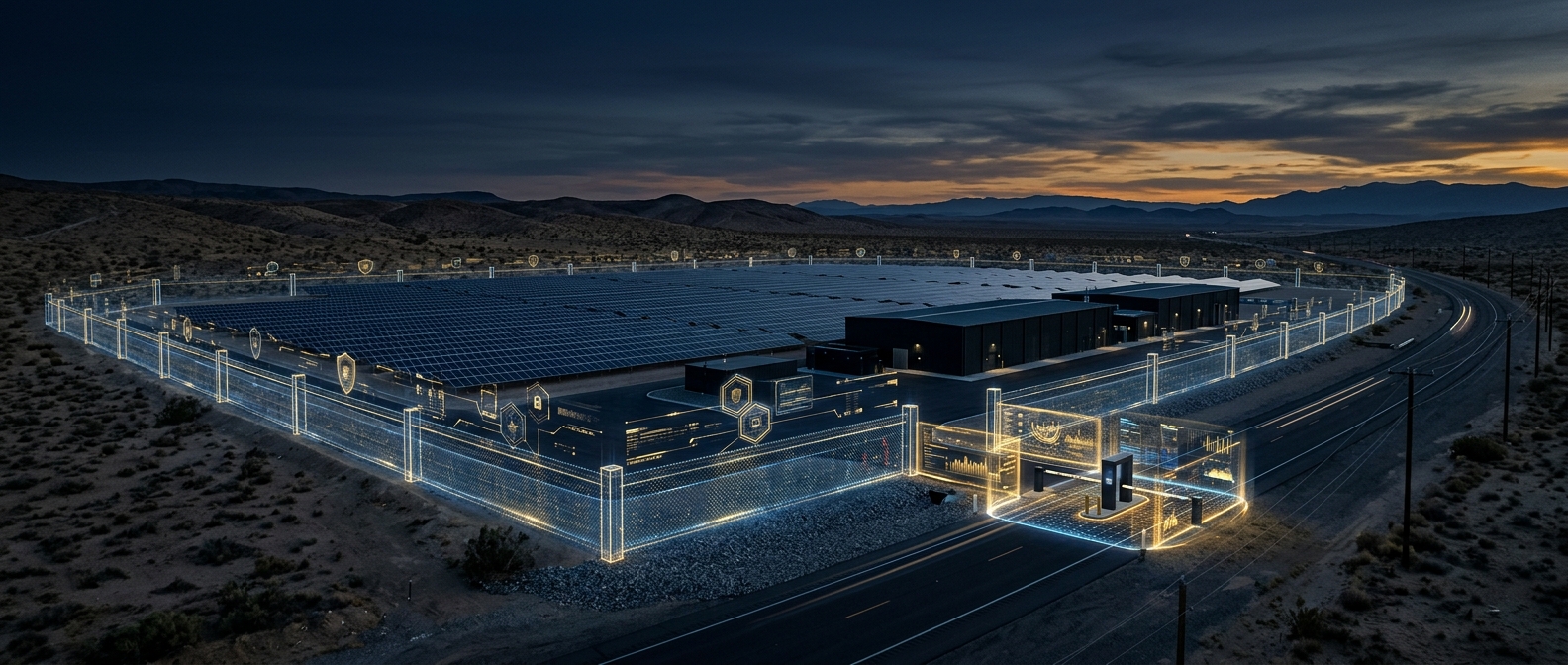
Pinal County’s I-10 corridor — Casa Grande, Coolidge, Eloy, and Florence — has become one of Arizona’s fastest-growing zones for data centers, utility-scale solar farms, and warehouse and logistics development. These sites share a hard security problem: large, often remote perimeters holding high-value copper, equipment, and critical infrastructure, far from a fast law-enforcement response. Protecting them takes layered perimeter control, credentialed access management, and consistent mobile or static patrol — run by a licensed firm that can physically respond from nearby.
The stretch of Interstate 10 between Phoenix and Tucson has quietly turned into one of Arizona’s most active industrial-development corridors. Cheap land, ready utility capacity, highway logistics access, and proximity to two major metros have pulled data centers, solar generation, advanced manufacturing, and enormous distribution warehouses into Pinal County towns that were farmland a decade ago. Every one of those facilities represents tens or hundreds of millions of dollars in assets sitting on a sprawling site — and each one needs protection during construction and long after it goes live. Honeybadger Solutions is an Arizona-licensed security and investigations firm headquartered in Casa Grande, in the middle of this corridor, and this guide lays out what data center, solar farm, and logistics security actually requires in Pinal County — and why a local command matters more here than almost anywhere else in the state.
Why is Pinal County a hotspot for data centers and solar farms?
The I-10 corridor through Casa Grande, Coolidge, Eloy, and Florence sits in a sweet spot for large-footprint industrial projects: abundant, comparatively affordable land; strong solar irradiance and open desert ideal for utility-scale photovoltaic arrays; expanding electrical and water infrastructure; and direct freight access between the Phoenix and Tucson markets and on to California and Texas. That combination has drawn hyperscale and colocation data centers, large solar generation projects, advanced manufacturing plants, and major distribution and fulfillment warehouses to the county. The pattern is consistent across the corridor: very large sites, frequently on the edge of town or in unincorporated desert, holding assets far more valuable and more sensitive than the sparse surroundings suggest. That is precisely the profile that attracts theft, trespass, and opportunistic crime — and precisely why generic, one-guard-at-the-gate coverage falls short.
What security threats do these sites actually face?
Large industrial and infrastructure sites in Pinal County face a distinct threat mix that differs sharply from a downtown storefront:
- Copper and metal theft. Solar farms, substations, and construction sites are prime targets for copper wire, grounding conductors, and transformer components. A single theft can cause damage and downtime worth far more than the scrap value taken.
- Construction-phase loss. Before a site is even operational, staged equipment, tools, fuel, materials, and heavy machinery sit exposed across an active build — a well-known target during the long construction window.
- Trespass and vandalism. Remote perimeters invite unauthorized entry, from curiosity-seekers and off-roaders to deliberate sabotage, each carrying liability and operational risk.
- Perimeter breach on vast footprints. Miles of fence line around a solar array or logistics yard are impossible to watch from a single fixed post.
- Insider and access risk. High contractor and vendor traffic during build-out and operation makes credential control and access logging essential.
- Slow law-enforcement response. On the edge of town or in unincorporated desert, response times are longer — so an on-site security layer is often the only immediate presence when something happens.
What does data center security require?
Data centers are critical infrastructure, and their physical security is held to a higher standard than most commercial sites — often driven by client uptime commitments and compliance obligations. That means credentialed, logged access control at every entry point; visitor and contractor management with verified identity and escort protocols; 24/7 staffed posts because there is no acceptable coverage gap; patrol of the building envelope, generator yards, and equipment areas; and disciplined incident documentation that stands up to a client audit. The guards on a data center post need to understand that they are protecting continuity of operations, not just a building — a professional, well-supervised program with rigorous access logging and clear post orders, not a rotating stranger from a call center. Because these facilities run continuously, the coverage model is almost always dedicated static posts, frequently combined with perimeter patrol.
What does solar farm security require?
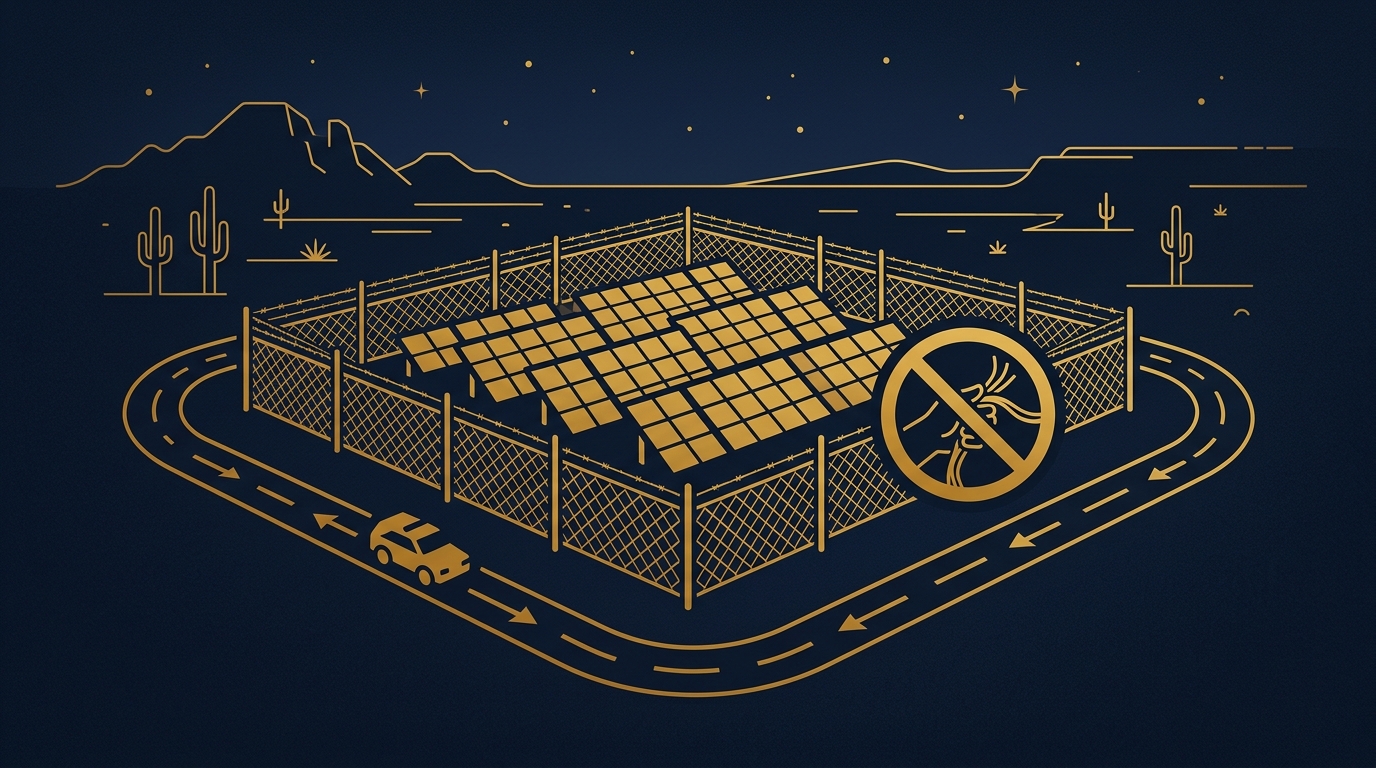
Utility-scale solar is almost the opposite profile from a data center: a very large, low-built, sparsely-staffed site where the assets — panels, inverters, transformers, and above all copper wiring and grounding — are spread across hundreds of acres. You cannot protect that footprint by parking one guard at the entrance. Effective solar farm security combines a hardened perimeter (fencing, gates, signage, and lighting where feasible), scheduled and randomized mobile patrol that varies its timing so it can’t be predicted and evaded, and coordination with any electronic detection or camera systems the operator has installed. Copper theft is the dominant, recurring threat, and it spikes during construction and after commissioning alike. The right model for most solar sites is mobile patrol — often overnight when theft risk peaks — sometimes with a static gate post during active work hours. A visible, unpredictable patrol presence is the single most cost-effective deterrent for a remote array.
What about warehouse and logistics sites on the I-10 corridor?
The same corridor pulling in data centers and solar is filling with distribution centers, fulfillment warehouses, and trucking and cold-storage facilities that ride the freight advantage of I-10. Their security needs blend access control (gate and dock management, driver and vehicle verification), loss prevention across high-volume inventory, yard and trailer patrol, and after-hours coverage of large parking and staging areas. Cargo and equipment theft, unauthorized yard access, and dock-door vulnerabilities are the recurring risks. Because these operations run on tight logistics schedules, security has to move goods-flow along, not block it — which again favors a program built for the specific site over a generic guard.
How do guards and security technology work together on these sites?
On sprawling corridor sites, cameras, motion sensors, thermal detection, and gate automation are force multipliers — but technology alone does not stop a theft in progress. A camera records the copper walking off the site; a guard is what interrupts it. The most effective programs treat the two as one system: detection technology extends a limited number of guards across a perimeter no crew could watch continuously, and trained personnel provide the verification, judgment, and physical response that a sensor cannot. In practice that means guards monitoring and responding to alarms rather than staring at empty fence line, patrol routes informed by where detection has flagged activity, and clear protocols for what a guard does when a sensor trips at 3 a.m. — assess, document, escalate, and coordinate response. For an operator, the takeaway is that spending on cameras without a human response layer often just produces a well-recorded loss. Guards and technology are complementary investments, and a security partner should be able to integrate with whatever detection systems you already have rather than treating them as separate silos.
Which security model fits which Pinal County site?
Different corridor facilities call for different coverage. The table below maps the common Pinal County site types to their dominant risks and the coverage model that typically fits.
| Site type | Primary risks | Typical coverage model |
|---|---|---|
| Data center | Access control, uptime/continuity, insider & contractor risk | 24/7 static posts + credentialed access management + perimeter patrol |
| Utility-scale solar farm | Copper/metal theft, vast remote perimeter, vandalism | Mobile patrol (randomized, often overnight) + hardened perimeter, static gate during work hours |
| Construction phase (any of the above) | Equipment, tool, fuel & material theft; trespass | Static gate + overnight patrol; access logging for trades |
| Warehouse / logistics | Cargo & inventory theft, dock & yard access | Gate/dock access control + yard patrol + after-hours coverage |
| Substation / critical utility | Copper theft, sabotage, breach | Perimeter patrol + rapid local response coordination |
How should you build a security program for a corridor site?
Whether you’re a developer, EPC contractor, facility manager, or operator, a defensible program for a Pinal County data center, solar farm, or logistics site follows the same layered sequence:
- Assess the site and its phase. Map the perimeter, entry points, high-value assets, lighting, and whether you’re securing an active build or an operational facility — the risks differ.
- Harden the perimeter. Confirm fencing, gates, signage, and lighting, and identify the blind spots that patrol or technology must cover.
- Control and log access. Establish credentialed entry, contractor and visitor verification, and an access log that stands up to an audit or a claim.
- Choose the coverage model. Match static posts, mobile patrol, or a blend to the site type and threat window — heavier overnight where theft peaks.
- Write site-specific post orders. Document exactly what the guard checks, patrols, and reports for this site — not a generic template.
- Define escalation and local response. Establish who the guard calls, how fast a supervisor responds, and how law enforcement is coordinated given corridor response times.
- Document and review. Require patrol logs and incident reports, and review them so the program adapts as the site moves from construction to full operation.
Why does a Casa Grande HQ firm respond faster?
Distance is a security variable, not just a logistics one. When a national security broker in another state subcontracts a Pinal County post, the guard on your remote site is at the end of a long, thin chain — supervision routes through a call center in a different time zone, backup for a call-off comes from wherever a sub can find someone, and no one from the company can physically reach your site quickly when it matters. Honeybadger Solutions is headquartered in Casa Grande, in the heart of the I-10 corridor, with additional Arizona offices in Phoenix and Oro Valley. Our guards are our own in-house, AZDPS-licensed and registered personnel, supervised locally — not a subcontracted patchwork. That means faster deployment to Casa Grande, Coolidge, Eloy, Florence, and the surrounding corridor; supervisors who know the area and can respond in person; and reliable backup coverage that doesn’t depend on a stranger being available three states away. On a remote site where law-enforcement response is already slower, a genuinely local security command is the difference between a fast response and a long wait.
Secure your Pinal County site with a local licensed team
From construction through full operation, Honeybadger Solutions builds site-specific security programs for data centers, solar farms, substations, and warehouse and logistics facilities across Pinal County and the I-10 corridor. Our security guard services in Arizona combine credentialed access control, perimeter and mobile patrol, and 24/7 static posts, and our security division coordinates directly with our investigations team when a theft, breach, or insider incident needs a licensed investigator rather than a patrol response — a handoff a broker simply cannot offer. As a firm headquartered right here in Casa Grande, we respond locally. Book now with our AI chat agent on this site to arrange a site assessment and quote.
Frequently asked questions
How do you secure a large solar farm perimeter in Pinal County?
A utility-scale solar site is too large for a single fixed guard, so effective coverage layers a hardened perimeter (fencing, gates, lighting, signage) with scheduled and randomized mobile patrol — often concentrated overnight when copper theft risk peaks — plus coordination with any camera or detection systems the operator has installed. A visible, unpredictable patrol presence is the most cost-effective deterrent for a remote array.
What is the biggest security threat to Arizona solar farms and substations?
Copper and metal theft is the dominant, recurring threat. Wiring, grounding conductors, and transformer components are targeted for scrap value, and the resulting damage and downtime often cost far more than the metal taken. The risk is high during both the construction phase and after commissioning, which is why consistent overnight patrol and a hardened perimeter matter so much.
Do data centers need 24/7 security guards?
Yes. Data centers are critical infrastructure with no acceptable coverage gap, so they typically run dedicated 24/7 static posts combined with perimeter patrol and credentialed, logged access control. Client uptime commitments and compliance obligations usually require rigorous visitor and contractor management and disciplined incident documentation that can stand up to an audit.
Why hire a local Casa Grande security firm instead of a national company?
On remote corridor sites where law-enforcement response is slower, a local command means faster deployment, supervisors who can respond in person, and reliable backup coverage. A national broker typically subcontracts the post, routing supervision through an out-of-state call center. Honeybadger is headquartered in Casa Grande with in-house AZDPS-licensed guards, so response and accountability stay local.
About Honeybadger Solutions
Honeybadger Solutions is an Arizona-licensed security and investigations firm headquartered in the I-10 corridor. In Arizona, our armed and unarmed security guards and our private investigators are our own in-house, AZDPS-licensed personnel — not subcontracted. Digital forensics, cybersecurity, financial investigations, and background intelligence are handled in-house and serve clients nationwide. This article is educational and describes representative security approaches, not a guarantee of any specific outcome.
Offices: Casa Grande (HQ), Phoenix, and Oro Valley, Arizona — serving all of Pinal County, Arizona, and nationwide clients.
Phone: Book a consultation online
Site assessment: book now with our AI chat agent on this site or call to arrange a walkthrough and quote.
Sources and further reading
- Arizona Department of Public Safety — Licensing Unit — The state authority that licenses security guard agencies, private investigators and individual registrations in Arizona, including current requirements and fee schedules.
- ASIS International — Standards and Guidelines — ANSI-accredited standards covering physical asset protection, security risk assessment, investigations, executive protection and workplace violence prevention.
Honeybadger Solutions runs covert operations and TSCM bug sweeps in person across Arizona. Bug sweeps can travel to other states on request, and covert field work outside Arizona goes through vetted, locally licensed partners. Corporate & due diligence research is done in-house for clients anywhere in the United States and internationally.
Browse by topic
Security guard services · Private investigations · Cybersecurity · Digital forensics · Financial fraud investigation · Executive protection · All articles