
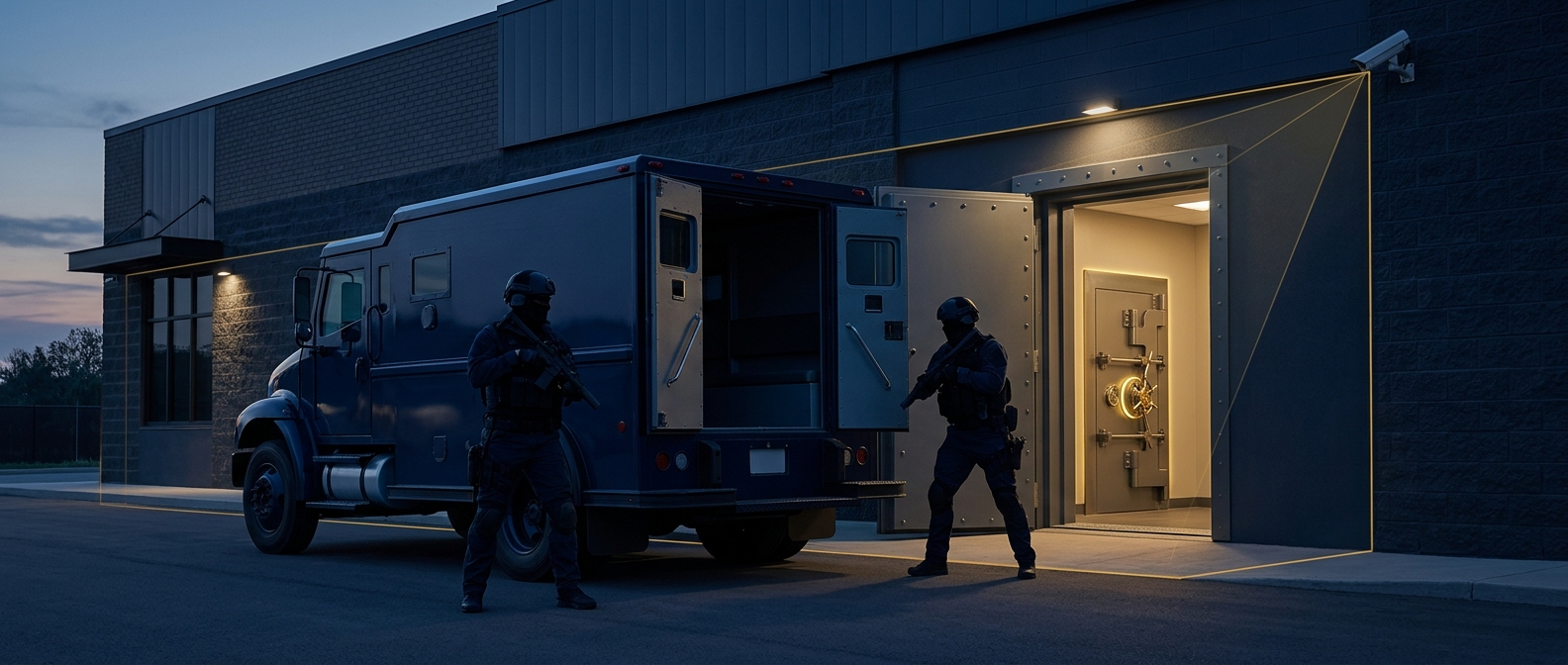
Cannabis cash transport and vault security in Arizona means moving dispensary currency between the sales floor, the vault, and the bank under Arizona Administrative Code R9-17-318 (and its adult-use counterpart, 9 A.A.C. 18) vault, video, and alarm rules, escorted by DPS-licensed armed officers under A.R.S. Title 32, Chapter 26. Honeybadger Solutions fields its own Arizona-licensed, in-house armed officers for every leg of that chain inside Arizona — never a subcontractor. Get the vault wrong and a regulator can suspend the license. Get the transport wrong and someone gets hurt. This guide covers both.
Arizona dispensaries hold two things a criminal wants and a bank will barely touch: cannabis inventory and a disproportionate volume of physical currency. Federal Schedule I status keeps most national banks and card networks at arm’s length from marijuana-related businesses, so a store that would ordinarily deposit its receipts nightly instead accumulates cash on-site and has to move it under its own security program. Arizona’s medical and adult-use rules answer half of that problem — vaults, cameras, alarms, retention — but they say almost nothing about the moment the money actually leaves the building. That gap is where robberies happen, and it is the gap this article closes: how a dispensary vault should be built and run under Arizona’s rules, and how a cash run should be staffed, armed, and executed so it survives both a criminal’s attention and a DPS audit.
Why is cash-in-transit the single riskiest moment in a dispensary’s day?
Every other cannabis security control — cameras, badge access, a locked vault — protects a fixed point that an attacker has to break into. Cash in transit is different: for the minutes it takes to walk currency from the vault to a vehicle, and for the drive from the store to the bank or the cash-processing facility, the money is not behind a wall at all. It is carried by one or two people along a route that, if it is not deliberately varied, becomes entirely predictable to anyone watching the store from across the parking lot. Criminal crews that target cannabis cash almost always conduct surveillance first — clocking the day, the time, the vehicle, and the number of people involved — because a predictable run is a solved problem for them before they ever act.
The mitigation is not a bigger vault. It is treating the transport leg as its own discipline, with its own staffing, scheduling, and armed-response standard, rather than an afterthought tacked onto closing procedures. That is precisely why Arizona’s licensed cannabis operators increasingly contract the cash run to a dedicated, licensed security provider instead of sending an assistant manager to the bank in a personal car — the exposure during transport is categorically different from the exposure at rest, and it deserves a categorically different control.
What does Arizona’s R9-17-318 actually require for vault and video security?
Arizona Department of Health Services rules for medical marijuana dispensaries (Arizona Administrative Code Title 9, Chapter 17, Article 3, specifically R9-17-318) and the mirrored adult-use rules in 9 A.A.C. 18 set the security floor every Arizona dispensary must clear. Confirm the current rule text directly, since ADHS revises these provisions periodically, but the baseline an operator should expect includes:
- Limited-access-area video coverage: every entrance to and exit from a restricted area, and every entrance and exit of the building itself, recorded at a resolution sufficient to identify activity.
- Point-of-sale identification cameras: a camera at each register capable of identifying the patient, customer, or caregiver completing the transaction.
- 30-day minimum video retention: Arizona’s floor is 30 calendar days — noticeably shorter than several other legal states, which is exactly why a disciplined operator holds footage longer than the state minimum rather than to it.
- Intrusion detection: a monitored signal system — cellular, private radio, or another electronic method — capable of detecting unauthorized entry.
- Failure notification: an audible and visual alert the moment any part of the electronic monitoring system goes down, so a camera or recorder outage cannot go unnoticed.
- Battery backup: sufficient reserve power to keep cameras and recording equipment running for at least five minutes through a power outage.
Notice what the rule does not specify: it says nothing about vault construction standard, nothing about cash-handling procedure, and nothing about how currency is moved off-site. That is deliberate — Arizona regulates the electronic-monitoring and access-control floor and leaves the operational security program, including the vault build and the transport protocol, to the operator’s own judgment. An operator that treats R9-17-318 as the entire security plan, rather than the floor of one, is the operator that gets robbed.
What vault and safe standard actually stops a burglary or an inside job?
A compliant vault and an effective vault are not automatically the same thing. Above the state floor, the standard that actually holds against a determined attacker — and against an employee with a key — looks like this: a UL-rated safe (TL-15 or better for a standalone unit; a full concrete-and-steel vault room for higher cash volumes) installed inside an already-restricted, badge-only area, never in a space any employee can wander into unsupervised. Bulk currency sits under time-lock or dual control, so opening it always requires either a programmed delay an offender cannot wait through or two authorized people acting together — either one defeats the lone-actor threat, whether that actor is an armed robber or a trusted manager.
Day-to-day cash handling matters as much as the box itself. Registers should clear into a drop safe the cashier cannot reopen, so the sales floor never accumulates more currency than the day’s trade requires. The vault or bulk safe should be counted against point-of-sale and track-and-trace figures on a fixed daily cadence, because a shortfall that surfaces immediately is a lead; a shortfall that surfaces after weeks of drift is usually unrecoverable. And the vault room itself should sit inside the building’s most reinforced envelope — hardened door, frame, and adjoining walls, since forced entry into a cannabis vault after hours routes through the roof or a shared wall far more often than through the front door.

Who is legally allowed to carry a firearm on an Arizona cash run?
This is where operators most often get exposed without realizing it. Under Arizona Revised Statutes Title 32, Chapter 26, every individual who works as a contract security guard in Arizona — armed or unarmed — must hold a current registration certificate (the “guard card”) issued by the Arizona Department of Public Safety’s Security Guard and Private Investigator Licensing Unit, and the agency employing them must separately hold an agency license. An “armed security guard” under A.R.S. §32-2601 is specifically defined as a registered guard who wears, carries, possesses, or has access to a firearm during the course of employment — a definition broad enough to capture an officer who simply keeps a sidearm in the transport vehicle. Anyone meeting that definition must additionally complete the DPS-approved 16-hour firearms training course for armed guards before ever carrying on the job.
The practical failure mode is an operator who assigns an untrained store manager, or a friend with a personal handgun, to carry cash to the bank. That arrangement is not a security control — it is an unlicensed armed-guard violation waiting for a DPS complaint, and it is exactly the kind of finding that can jeopardize the underlying cannabis license, not just the transport program. A cash run is a security-industry function under Arizona law, and it has to be staffed by properly registered, agency-licensed personnel, armed or unarmed, exactly as the statute requires.
In-house officers or a subcontracted armored carrier — which actually performs better?
Operators generally choose between three models: send an employee (the unlicensed, exposed option above), contract a national armored-car carrier built for banks and retail chains, or retain a dedicated Arizona security firm that fields its own licensed officers for cannabis-specific cash and vault work. The table below compares the two legitimate options.
| Dimension | National armored-car carrier | Dedicated in-house-model security firm |
|---|---|---|
| Route flexibility | Fixed schedule, shared across many stops | Randomized timing and route built around your store |
| Personnel continuity | Rotating crews, unfamiliar with your site | Consistent, vetted officers who know the property |
| Cannabis familiarity | Generalist, bank/retail-oriented | Built around AAC R9-17-318 and A.R.S. Title 32 compliance |
| Vault + investigations tie-in | Transport only | Coordinated with vault design and internal-theft investigation |
| Licensing accountability | Carrier’s own compliance program | Direct, auditable Arizona DPS guard-card and agency licensing |
How should a compliant cash-transport run actually be executed? A nine-step protocol
The details below reflect the discipline a properly run Arizona cash-transport program follows on every single run, not just the ones that feel risky.
- Verify licensing before the first run. Confirm every officer holds a current DPS guard card, and every armed officer has completed the 16-hour firearms course, with the employing agency’s own license current and on file.
- Randomize the schedule. Never move currency at the same time, on the same day pattern, or by the same route twice in a row — predictability is the single greatest vulnerability in cash transport.
- Staff a two-person minimum. One officer never carries and drives alone; a second person on the run, in the vehicle or covering the door, cuts the ambush window and gives a duress response somewhere to go.
- Reconcile before departure. Count and log the currency against the vault and point-of-sale figures before it leaves the building, so any discrepancy is caught before the money is in motion, not after.
- Use an unmarked, secured vehicle. No branding, no obvious cash-transport signage — the vehicle should look like nothing worth robbing.
- Maintain continuous communication. A dispatch check-in at departure, at the bank, and on return, with a defined escalation if a check-in is missed.
- Brief the duress protocol before every run. Every officer knows the signal, the response, and the standing order that currency is never worth a confrontation.
- Complete dual-custody deposit verification. Two authorized signatures confirm the deposit at the receiving institution, closing the chain of custody on the currency.
- Log and review every run. Route, timing, personnel, and any anomaly go into a record that feeds the next risk assessment — a program that does not review its own runs cannot improve them.
How does Honeybadger secure cannabis cash and vaults across Arizona?
Honeybadger Solutions builds and staffs Arizona cannabis cash-transport and vault programs as one integrated capability rather than a hardware install and a hired driver. Our security practice designs the vault, the restricted-area access control, and the transport protocol together, and — because Arizona physical security and guarding are delivered by our own licensed, supervised in-house officers, never a subcontractor — the same DPS-registered, agency-licensed personnel who staff your site can carry your cash run, armed where the assignment calls for it and trained to the 16-hour DPS standard. When a shortfall or a suspicious pattern surfaces in the vault reconciliation, our in-house investigations team and our financial investigations services group pick it up immediately, correlating cash records, access logs, and footage rather than leaving the operator to guess.
Headquartered in Casa Grande with offices in Phoenix and Oro Valley, Honeybadger serves cannabis operators across all of Arizona, with financial-investigation and digital-forensics capability extending nationwide. Every Arizona guard-card holder we assign is verifiable against DPS licensing records, and every cash-transport program we build is designed to satisfy an ADHS inspection and defeat an actual criminal at the same time. Operators standing up a new location, or auditing a transport program run by an untrained employee or a generalist carrier, can request a confidential assessment through our Phoenix office.
Frequently asked questions
Can a dispensary employee legally carry cash to the bank in Arizona?
Not as a security function. Under A.R.S. Title 32, Chapter 26, anyone performing contract security-guard work in Arizona, including cash transport, must hold a current DPS registration certificate, and an employing entity must hold its own agency license. An untrained employee moving cash under an informal arrangement is not a licensed security control, and if that employee carries a firearm during the run, the arrangement can constitute an unlicensed armed-guard violation that exposes both the individual and the dispensary.
How long must Arizona dispensaries keep security video?
Arizona Administrative Code R9-17-318 sets a 30-calendar-day minimum for medical dispensaries, with the adult-use rules in 9 A.A.C. 18 following a comparable standard. That is a floor, not a target — because losses and disputes often surface weeks after the fact, disciplined operators retain footage well beyond 30 days and store it on a secured, access-controlled recorder that only authorized personnel can reach.
What training must an armed guard complete before a cannabis cash run in Arizona?
Beyond the standard DPS guard-card registration required of every security guard in Arizona, anyone who wears, carries, possesses, or has access to a firearm during the assignment — meeting the statutory definition of an armed security guard under A.R.S. §32-2601 — must additionally complete the DPS-approved 16-hour firearms training course for armed guards. Both the individual officer and the employing security agency must hold current, verifiable licenses.
Should a dispensary use a national armored-car service or a dedicated security firm?
A national armored carrier is built for high-volume, fixed-schedule bank and retail routes, which works against the randomized, unpredictable schedule that actually deters a cash-transport attack. A dedicated Arizona security firm that fields its own licensed officers can build a route and schedule around your specific store, keep continuity of personnel who know the site, and tie the transport program directly into vault design and, if a loss ever occurs, an in-house investigation.
About Honeybadger Solutions
Honeybadger Solutions is an Arizona-licensed security and investigations firm delivering intelligence-led physical security, armed and unarmed guarding, investigations, and financial-forensic services to cannabis operators statewide. Within Arizona, cash transport, vault security, and guarding are provided by our own DPS-licensed, supervised in-house officers, never a subcontractor; digital forensics, cybersecurity, and financial investigations are handled in-house and delivered nationwide.
Offices: Casa Grande (HQ), Phoenix, and Oro Valley, Arizona.
Phone: Book a consultation online
Confidential consultation: discuss an armed, in-house cash-transport and vault security program for your Arizona dispensary.
Browse by topic
Security guard services · Private investigations · Cybersecurity · Digital forensics · Financial fraud investigation · Executive protection · All articles