
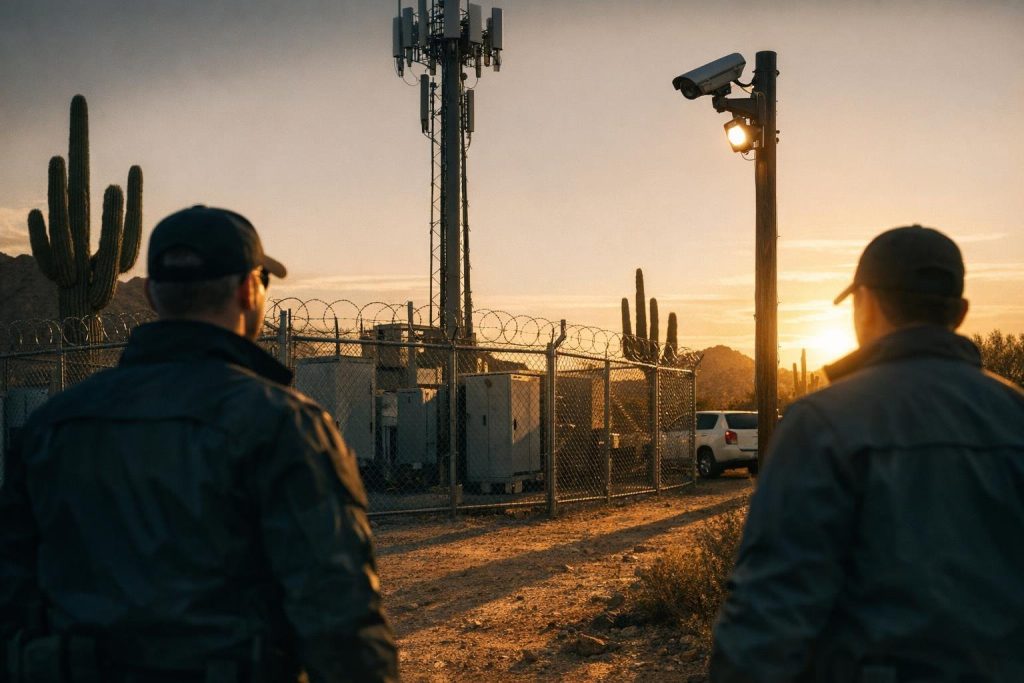
You stop battery, copper and generator fuel theft at unstaffed cell sites with four things working together: tight control over who can get into each compound, alarm points on the exact equipment thieves take, cameras that a live operator watches and can talk through, and records good enough to hand to a detective and a prosecutor. A fence and a padlock alone do not do it. The thieves who cause the most damage often know the site, hold a key or a code, and look like they belong there.
This guide is for tower owners, carriers, fiber operators and rooftop landlords in Arizona. It covers insider theft, alarm points, talk-down video, cluster patrol and how Arizona law treats these crimes. If you want coverage built around your own site list, see our telecom and cell site security service.
The problem is growing. A joint industry report released in June 2026 counted 18,327 theft and vandalism incidents against communications networks in 2025, affecting 11.8 million customers, a 59% increase over 2024. The same release estimated the outages imposed $294 million to $1.47 billion in societal costs in 2025, many times the value of the stolen copper and equipment.
Key takeaways
- Insider and former-contractor theft is a major risk at cell sites. Pull badges, keys and codes the day someone leaves a vendor.
- Alarm the battery cabinet, the generator enclosure and the fuel tank level, not just the shelter door.
- Remote video with talk-down works best when the operator has a written protocol and a named responder for every site.
- Patrol clusters of sites on a randomized schedule, and check a site again after every maintenance visit.
- Under Arizona law, damage to communications utility property of $5,000 or more is a class 4 felony, and posted signage can make trespass at a fenced site a felony.
- Serial numbers, photos, repair invoices and footage turn a theft report into a case that can move forward.
What thieves take, and why the outage costs more than the loot
Four things go missing from cell sites over and over. Backup battery strings are heavy, valuable and easy to resell. Copper ground bars, ground wire and cable have scrap value. Generator diesel can be pumped out in minutes.
The resale value is small next to the damage. In a Phoenix-area case charged in 2025, police said a former tower contractor stole more than 900 backup batteries from 66 cell sites between August 2024 and February 2025. ABC15 reported the batteries are worth about $300 or more each when new, and that the thefts cost the carrier about $330,000 in replacement and repair. Trade press coverage of the indictment reported he sold them for about $20 apiece. The charges are allegations, but the pattern is typical: the thief gets pennies on the dollar, and the network loses its backup power.
In Arizona, monsoon storms knock out commercial power, so a site with stolen batteries or a drained tank goes dark exactly when people need it.
| Target | How it is usually taken | Detection that works | Record to keep |
|---|---|---|---|
| Battery strings | Shelter or cabinet opened with a key, code or pry bar; batteries loaded into a truck | Cabinet door contact, battery or DC power alarm, camera on the cabinet | Serial numbers, photos, marking on each case |
| Copper ground bars and cable | Cut at the base of the tower, the shelter wall or the fence line | Fence sensors, video analytics on the compound, patrol photos | Photos of the grounding system, cable marking, repair invoices |
| Generator fuel | Tank cap or fill port opened and pumped into drums | Fuel level alarm on sudden drops, generator enclosure contact | Fuel delivery tickets, level history, run-time logs |
| Keys and access | Kept by a former contractor or copied | Access logs compared against work orders | Key and code issue log, revocation dates |
Start with insider risk and key control
The Phoenix case is a lesson in access control. Police said the suspect knew how to get into the sites from his contract work. Reporting by the Arizona Republic, as summarized by Wireless Estimator, said he had been let go by his employer in October 2023 yet still had his company ID badge and jacket, which he allegedly used when selling the batteries. Outsiders rarely have that kind of access, so start by closing the doors you control.
- Same-day revocation. Require every tower services vendor to notify you the day a technician leaves. Pull site codes, electronic credentials and physical keys that day.
- Collect the uniform, too. Badges, branded jackets and vehicle magnets let a former worker look legitimate to a neighbor or a scrap buyer.
- Rotate combinations on a schedule and after any vendor change. A code that has not changed in three years has been shared more widely than you think.
- Tie entry to a ticket. Every visit should match a work order or trouble ticket. If your network operations center sees a door open with no ticket, that is an alarm, not a note.
- Review access logs monthly. Look for night visits, repeat visits to the same site and visits by people whose vendor contract has ended.
- Watch every outlet. In the Phoenix case, police recovered about 500 batteries from a battery business, not a scrap yard. Stolen batteries and copper move through more than one kind of buyer.
When the evidence points at someone with legitimate access, handle it quietly. Our guide on how to investigate employee theft discreetly covers how to protect the evidence and avoid tipping off the subject before police are involved.
Put alarm points on what gets stolen
A contact on the shelter door tells you someone opened it, not whether a technician is working or a thief is loading batteries. Add points on the targets themselves:
- Battery cabinet doors on outdoor cabinets, with their own alarm separate from the shelter.
- DC power alarms. Most sites already report battery and rectifier status to the network. Make sure a sudden battery disconnect at 2 a.m. is routed to someone who acts on it, not just logged.
- Fuel level. If your tank monitor reports level remotely, set an alert for a drop that does not match generator run time. A slow drop is consumption. A fast drop with the generator off is theft or a leak.
- Generator enclosure doors and fill ports, with locking caps that need a tool to remove.
- Gates and fence lines at sites with repeat cutting, using sensors or camera analytics.
Each alarm point needs a named responder and a written escalation path. An alarm that lands in a shared inbox overnight is no alarm at all.
Remote video with talk-down: what it can and cannot do
Remote video monitoring puts a live operator on your cameras. When analytics flag a person or vehicle in the compound, the operator looks, decides, and speaks through an on-site speaker: “You are on camera at a monitored site. Police are being called.” Many intruders leave at that point. If they do not, the operator calls police with a live description and alerts your network operations center.
It works well when the site has:
- Cameras on the gate, the shelter door, the battery cabinets and the generator pad
- Lighting or infrared that shows faces and plates at 3 a.m., not just shapes
- Housings and mounts that survive summer heat and a monsoon dust storm, with a cleaning schedule
- A written protocol: what the operator says, who they call and in what order
It cannot physically stop a determined crew, and it cannot make police arrive faster at a site an hour from the nearest patrol car. What it can do is shorten the time between the first cut and the first call, and it gives investigators clear video. Our article on remote video monitoring and virtual guarding explains how monitored video differs from recorded-only cameras.
Installation work is performed and contracted by our licensed Arizona ROC contractor partner. Honeybadger Solutions LLC is not a licensed contractor.
Patrol site clusters, not single towers
Thieves work in clusters. If one site in a valley was hit, the sites within a short drive are next. Patrol plans should follow the same logic: group sites by geography and risk, then run randomized checks so the timing cannot be learned.
Use this checklist at every patrol stop:
- Gate locked, chain intact, no new cuts in the fence fabric or bottom tension wire
- Shelter and cabinet doors closed and locked, no pry marks
- Ground bars and visible ground wire in place at the tower base and shelter wall
- Generator enclosure closed, fuel cap locked, no fresh spills near the fill port
- No staged items: cut cable, batteries or drums near the fence
- Lights working, cameras unobstructed
- Time-stamped, GPS-tagged photos of the gate, doors and generator pad
Add a check after every maintenance visit. Doors left unlocked by crews are a common gap. Officers stay outside shelters unless the carrier authorizes entry with an escort, and they do not climb structures or enter RF exclusion zones. In summer, patrol routes in remote desert stretches need water, shade breaks and check-in times built in.
Build the record a prosecutor can use
Arizona law treats these crimes more seriously than many owners realize. This is general information, not legal advice, so confirm how it applies to your sites with counsel.
- Utility property. Under A.R.S. 13-1601, a “utility” includes any enterprise that provides communications services. A.R.S. 13-1602 makes recklessly damaging utility property a class 4 felony when the damage is $5,000 or more, and intentional tampering a class 4 felony when it causes an imminent safety hazard.
- Metal theft value. A.R.S. 13-1802 says the value of stolen ferrous or nonferrous metal includes the damage caused by the theft. Repair costs count, not just scrap weight.
- Posted sites. A.R.S. 13-1501 defines a “critical public service facility” to include a structure or fenced yard used by a telecommunications carrier that is posted with signage saying it is a felony to trespass, or warning of high voltage. Entering or remaining unlawfully there is first-degree criminal trespass, a class 5 felony under A.R.S. 13-1504. Check that your signs are posted and legible.
- Scrap dealer records. Under A.R.S. 44-1642 and 44-1644, scrap metal dealers record the seller’s identification, a photo, a fingerprint and the delivery vehicle plate, report most purchases to the Department of Public Safety within 24 hours, and hold copper for seven days after reporting. A fast report with photos of your marked material gives investigators a window to match it.
When you find a theft, work through these steps in order:
- If anyone is still on site, call 911. Do not send employees to confront them.
- Keep people out of the compound until photos are taken, unless restoring service is a safety need.
- Export the original video for the full window, not just the clip that shows the theft.
- List what is missing with serial numbers, quantities and photos from your last inspection.
- File a police report and give the report number to your loss team and insurer.
- Pull access logs, work orders and vendor visit records for the past 90 days.
- Track every repair cost: parts, labor, generator rental, outage duration.
How Honeybadger Solutions helps
Honeybadger Solutions is a veteran-led firm based in Casa Grande. Our cell site security program starts with your site list and incident history. We rank sites by exposure and distance, then match each one to remote video monitoring, randomized patrol checks or both. Our officers and patrols work in Arizona. For sites in other states, we coordinate vetted, locally licensed partner agencies under one reporting standard.
We also place unarmed officers at compounds during outages, storm restoration and generator swaps, review sites for lighting, lock and alarm gaps, and design camera and alarm layouts that our licensed contractor partner installs. When losses point to an insider, our licensed private investigators (Arizona DPS agency license No. 1759795) review access records and footage and document findings for your legal team and police.
Every engagement is quoted in writing before any work starts. Request cell site security online, or book a confidential consultation. For a break-in in progress, call 911 first, then use our urgent intake form.
Frequently asked questions
Why do thieves steal cell tower batteries if they sell for so little?
Because they are easy to move and someone will buy them. In the Phoenix-area case charged in 2025, batteries worth about $300 new were reportedly sold for about $20 each, while the carrier’s loss was about $330,000. The thief’s profit is small, but the outage risk is large.
Is stealing from a cell site a felony in Arizona?
Often, yes. Damage of $5,000 or more to communications utility property is a class 4 felony under A.R.S. 13-1602, and theft is graded by value under A.R.S. 13-1802, which counts the damage caused by metal theft. This is general information, not legal advice.
Can your officers stop someone they catch at a site?
Our officers are private persons, not police. They observe, document, use talk-down where it is installed, and call 911. Police make arrests.
How quickly should a vendor’s departing technician lose site access?
The same day. Build that requirement into your vendor contracts, and collect badges, keys and branded clothing along with electronic credentials.
Do scrap yards have to report copper purchases in Arizona?
Yes. Scrap metal dealers must record seller details and report most purchases to the Department of Public Safety within 24 hours, and they must hold copper for seven days after reporting. Marked and photographed material makes a match far more likely.
Sources: Wireless Infrastructure Association, Rising attacks on critical networks (June 2026), USTelecom, Protecting the Nation’s Critical Communications Infrastructure (June 2026), ABC15 Arizona, cell tower battery theft case, Wireless Estimator, insider theft case (March 2025), A.R.S. 13-1601, A.R.S. 13-1602, A.R.S. 13-1802, A.R.S. 13-1501, A.R.S. 13-1504, A.R.S. 44-1642, A.R.S. 44-1644
Browse by topic
Security guard services · Private investigations · Cybersecurity · Digital forensics · Financial fraud investigation · Executive protection · All articles