


Jury background intelligence is the lawful, disciplined research of publicly available records and open social signals on venire members so trial counsel can exercise challenges on evidence rather than instinct. Done to standard, it surfaces undisclosed litigation history, conflicts, and worldview indicators—never juror contact, never deception. Reputable providers work only from public data and honor every court and bar rule governing juror research.
A trial is frequently decided before opening statements. The panel that hears your case governs how every exhibit is read, whose credibility survives, and how damages are weighed in the deliberation room. In bet-the-company litigation, catastrophic-injury defense, high-exposure plaintiff work, and reputation-sensitive matters, the margin between a favorable verdict and an eight-figure loss often traces back to a single seated juror who should have been struck. Instinct built over a career is valuable—but instinct alone, applied to strangers in a two-hour voir dire, is not a strategy. Verified information is.
What is jury background intelligence, and how does it differ from jury consulting?
The two disciplines are complementary, not interchangeable. A trial consultant interprets attitudes, designs supplemental questionnaires, models venue demographics, and reads courtroom body language. Background intelligence supplies the verified factual substrate that makes those interpretations reliable—confirming what a prospective juror actually did, said publicly, and failed to disclose, so counsel is not building strike decisions on self-reported answers alone.
| Dimension | Jury Background Intelligence | Trial / Jury Consulting |
|---|---|---|
| Core function | Verify facts and public signals on real venire members | Interpret attitudes, strategy, and courtroom dynamics |
| Primary inputs | Public records, court dockets, open social media | Mock trials, focus groups, questionnaires, demographics |
| Deliverable | Per-juror dossier with sourced findings and flags | Profiles, strike recommendations, theme testing |
| Timing pressure | Real-time, during panel and recesses | Weeks pre-trial plus in-court read |
| Governing limit | No juror contact; public data only; bar and court rules | Same contact prohibition; methodology standards |
Elite trial teams use both. The intelligence function confirms the ground truth; the consulting function decides what to do with it. Honeybadger Solutions operates the intelligence side—structured, sourced, and defensible—so that whatever consulting or in-house judgment sits on top of it rests on a firm foundation.
What does lawful juror research actually surface?
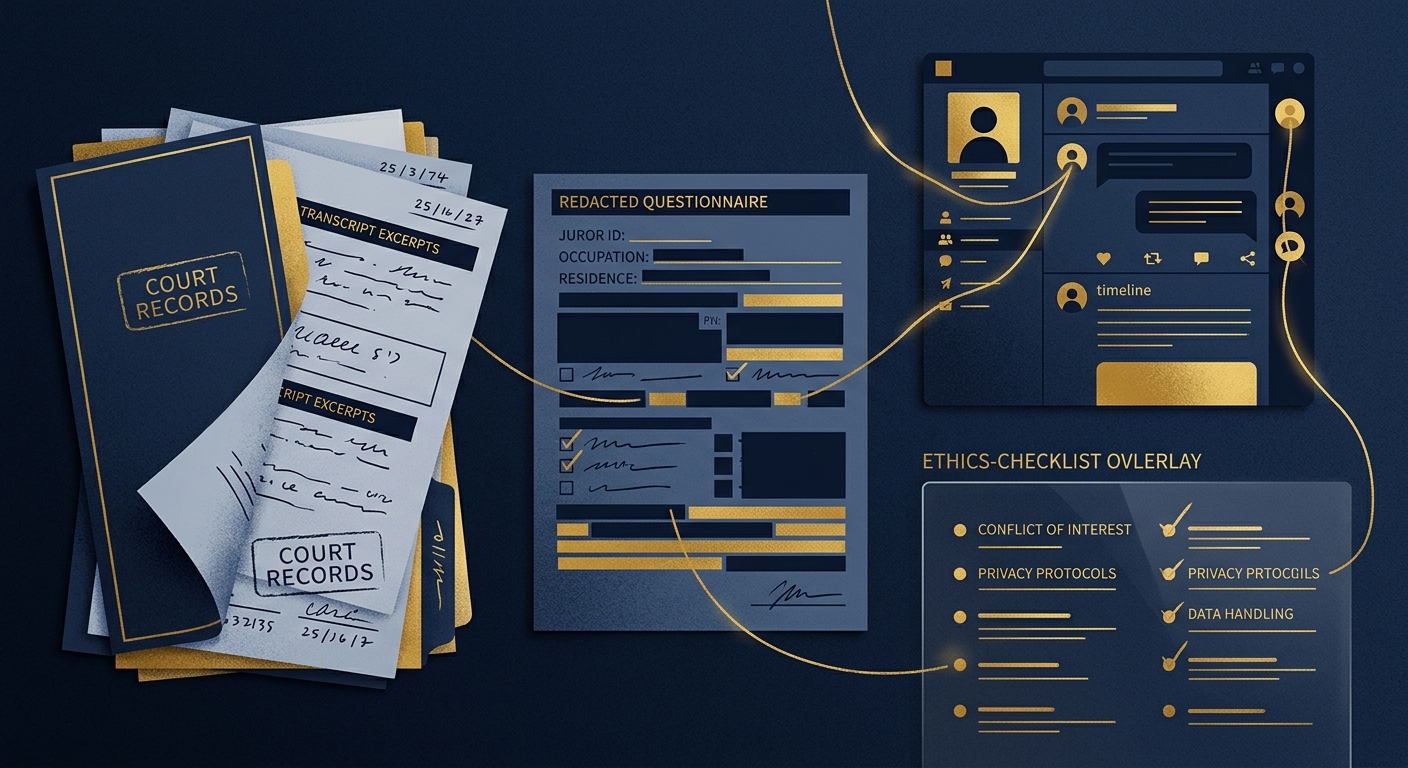
The objective is never to influence a juror. It is to identify risk factors, undisclosed conflicts, and worldview indicators that bear directly on fairness and case fit—information a candid answer in open court might not reveal. Working only from publicly accessible sources, disciplined analysts develop a small number of high-value signals:
- Undisclosed litigation and claim history. Prior lawsuits, prior service, arrests, or complaints tied to the same subject matter—often not surfaced by a standard questionnaire.
- Conflict and relationship signals. Public ties to parties, witnesses, competing firms, or industry stakeholders that create actual or apparent bias.
- Worldview and advocacy indicators. Openly stated positions for or against corporations, law enforcement, the medical system, insurers, or other groups material to the case theory.
- Financial-stress markers. Public indicators—where lawfully available—that may shape how a juror weighs damages or liability.
- Candor and consistency checks. Meaningful gaps between what a prospective juror states under oath and what the public record shows, which can support a challenge for cause.
Read together, these signals let counsel distinguish a genuinely neutral juror from one predisposed—favorably or adversely—toward the client or the case type, and to deploy limited peremptory and for-cause challenges where they matter most.
Where are the ethical and legal lines—and why do they matter?
This is the discipline that separates a professional intelligence firm from a liability. The governing principle is settled: reviewing a juror’s public online presence is permissible, but any communication with a prospective or sitting juror—direct or indirect—is prohibited. The American Bar Association’s Formal Opinion 466 draws the bright line clearly: a lawyer may review a juror’s public social-media presence, but may not send an access request or take any action that causes the juror to become aware of the review, and may not use deception or a third party to do what the lawyer cannot do directly.
A world-class program is built around these non-negotiables:
- No contact, ever. No friend requests, follows, connection requests, messages, or any act that could notify a juror of the research. Passive review of genuinely public content only.
- No pretext or deception. No fake profiles, no misrepresentation, no circumventing platform privacy controls. What is not public stays out of scope.
- No prohibited categories. Research is confined to lawful, case-relevant signals—not protected characteristics used as a proxy for unlawful discrimination in strikes (see Batson and its progeny).
- Court-order compliance. Jurisdictions and individual judges vary; some restrict or prohibit juror internet research or require disclosure. The court’s standing orders and the venue’s rules control, always.
- Documented sourcing. Every material finding is tied to its public source so it can be relied on—and, if necessary, defended—without exposing counsel to a misconduct claim.
- Inadvertent-notification protocol. If a platform auto-notifies a juror of a profile view, that risk is engineered out in advance; jurisdictions treat such notifications differently, and the safe posture is to prevent them.
Handled correctly, juror research strengthens the record and the client’s position. Handled carelessly, it invites mistrials, sanctions, and bar complaints. The value is inseparable from the discipline.
How does the process work under trial-day time pressure?
Jury selection is one of the most time-compressed events in litigation. A venire list may arrive the morning of trial, with names to research and cross-reference before the panel is seated by lunch. Speed without rigor is worthless; rigor without speed misses the window. Elite delivery reconciles both through preparation and a repeatable workflow:
- Pre-trial staging. Scope, jurisdiction rules, the court’s standing orders, and case-relevant signal criteria are locked in before the venire list issues, so the clock starts on research, not planning.
- Rapid intake. The panel list is ingested and identity-resolved against public records to reduce false matches—critical where common names generate noise.
- Structured public-record and open-source review. Court dockets, public filings, and openly visible social activity are reviewed against the pre-set criteria, with contact controls enforced throughout.
- Real-time flagging. Findings are triaged into clear risk tiers and pushed to counsel in a scannable, per-juror format usable at the rail during voir dire.
- Live supplementation. As jurors answer questions, analysts confirm, contradict, or deepen the picture during recesses—turning a static list into a working intelligence feed.
- Sourced hand-off. Each material flag carries its source, so counsel can act with confidence and articulate a lawful, non-discriminatory basis for any strike.
Because our digital forensics, cybersecurity, financial investigations, and background intelligence capabilities are in-house and remote-by-design, this work is delivered nationwide without waiting on a local subcontractor—an operational advantage when the venire list lands hours before selection.
What separates a world-class provider from a mediocre one?
Any vendor can run a name through a search engine. The difference shows in identity resolution, ethical discipline, and defensibility. A mediocre report confuses two people with the same name, relays rumor as fact, or—worst of all—crosses a line that taints the trial. A world-class program resolves identity rigorously, sources every claim, enforces the no-contact rule at the tooling level, and understands that the deliverable may be scrutinized by opposing counsel or the court.
Cost drivers are straightforward: panel size, jurisdiction complexity, the depth of public-record review required, and turnaround. The largest hidden cost is not price—it is a report that is either useless (unverified) or dangerous (unethical). Counsel should insist on documented methodology, explicit ABA-aligned contact rules, and clear sourcing. For adjacent needs—witness vetting, asset and financial tracing, or forensic review of digital evidence—an integrated firm that also delivers digital forensics and full-spectrum investigations avoids the seams and inconsistencies of stitching multiple vendors together.
Representative scenario: the undisclosed advocate
Consider a representative product-liability defense. During voir dire, a prospective juror states no strong feelings about the defendant’s industry. Lawful review of openly public posts, however, shows sustained public advocacy against that exact industry and participation in a related public campaign—none of it disclosed on the questionnaire. That gap between sworn answer and public record is precisely the kind of sourced, case-relevant signal that supports a challenge for cause or a well-founded peremptory strike. This is an illustrative scenario, not a named matter or claimed outcome; it shows the category of value, delivered within the ethical lines above.
Why does jurisdiction change everything?
There is no single national rule for juror research; there is a patchwork, and the venue controls. Some federal and state judges issue standing orders that restrict or prohibit online juror research, or require that any research be disclosed to the court and opposing counsel. Others are silent, leaving the ABA framework and local ethics rules to govern. A few jurisdictions treat a platform’s automatic “someone viewed your profile” notification as prohibited contact—meaning a technically passive view can still cross the line if the tooling is not configured to prevent it. Access to public records also varies: docket transparency, criminal-history availability, and property or financial filings differ from one county to the next, which changes what can lawfully be developed and how quickly.
This is why a competent program begins with the venue, not the venire. Before a single name is researched, we confirm the court’s standing orders, the applicable ethics opinions, and the platform-notification risk for that jurisdiction, then calibrate scope accordingly. A national footprint is only an asset if it is paired with venue-specific discipline; the same panel, researched under two different judges’ orders, can require two very different postures. Getting this wrong does not merely weaken a report—it can hand opposing counsel a mistrial motion.
How do findings translate into strike decisions?
Intelligence is only useful if it maps cleanly onto the two instruments counsel controls: challenges for cause and peremptory strikes. A sourced contradiction between a sworn questionnaire answer and the public record is the strongest currency for a for-cause challenge, because it speaks to candor and disqualifying bias rather than mere preference. Softer worldview and advocacy signals more often inform the limited pool of peremptory strikes, where counsel must prioritize the highest-risk seats against a fixed number of challenges. The discipline is triage: not every flag warrants a strike, and spending a peremptory on a marginal signal can leave a genuinely adverse juror seated.
One constraint governs all of it. Peremptory strikes may not be exercised on the basis of race, ethnicity, or sex; the Batson line of authority requires a neutral, articulable reason for a strike when challenged. Sourced, case-relevant intelligence is precisely what lets counsel articulate that neutral basis—an undisclosed lawsuit, a documented public position on the exact issue in dispute—rather than a hunch a court could read as pretext. Used this way, background intelligence does more than sharpen selection; it insulates the strike record. That is the difference between information that wins the panel and information that survives appeal.
Frequently asked questions
Is researching jurors’ social media legal and ethical?
Yes—when confined to genuinely public content and conducted without any contact. ABA Formal Opinion 466 permits reviewing a juror’s public online presence but prohibits access requests, deception, and any act that notifies the juror. We work strictly within those limits and honor each court’s standing orders, which can be stricter.
Do you ever contact prospective jurors?
Never. No messages, connection requests, follows, or any indirect communication. All work is passive review of public records and openly visible information, with tooling configured to prevent inadvertent notifications. The no-contact rule is absolute.
How fast can you turn a venire list around?
Jury selection is time-compressed, so we stage scope and criteria before the list issues and then work in real time—delivering tiered, sourced per-juror flags during the panel and supplementing them through recesses as answers come in.
Do you support trials nationwide?
Yes. Our background intelligence is remote-by-design and delivered across all U.S. jurisdictions and internationally, from our Arizona home command. We tailor each engagement to the venue’s specific rules on juror research.
About Honeybadger Solutions
Honeybadger Solutions is an Arizona-licensed security and investigations firm delivering litigation-support and background intelligence to trial teams nationwide and internationally. Our digital forensics, cybersecurity, financial investigations, and background-intelligence capabilities are in-house and remote-by-design, with a rigorously ethical, court-aware research posture. We operate three Arizona offices—Casa Grande (headquarters), Phoenix, and Oro Valley—and support engagements across all Arizona venues, every U.S. jurisdiction, and abroad. For related matters we also provide background checks and full investigative services.
Ready to select on evidence, not instinct? Book a consultation online to brief a litigation-intelligence lead before your next trial. Confidential. Ethical. Nationwide.
Authoritative references: ABA Standing Committee on Ethics & Professional Responsibility (Formal Opinion 466) and the National Center for State Courts on juror privacy and jury management.
Browse by topic
Security guard services · Private investigations · Cybersecurity · Digital forensics · Financial fraud investigation · Executive protection · All articles