
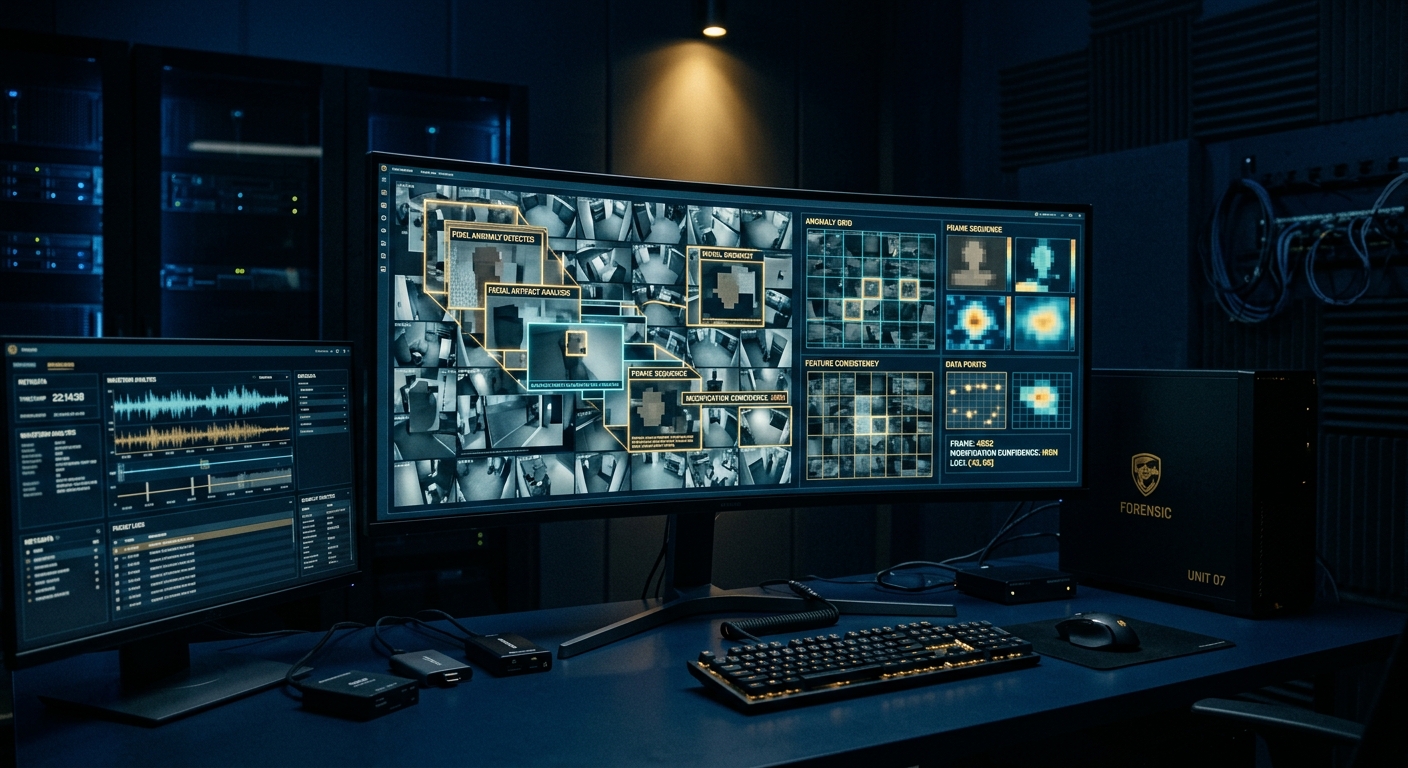
Forensic deepfake detection determines whether a video or audio file was captured by a real camera and microphone or generated or altered by AI, using pixel-level artifact analysis, biological-signal checks, provenance metadata, and platform content credentials, then documenting every step so the finding survives cross-examination. No single tool proves authenticity alone; a defensible conclusion requires converging methods, an unbroken chain of custody, and a qualified expert who can explain the limits under oath. As synthetic media grows more convincing, the gap between “looks real” and “is authenticated” is where fraud, litigation, and reputational damage actually get decided. Honeybadger Solutions provides in-house digital forensics nationwide for exactly this problem.
What Actually Counts as a “Deepfake” Today?
The term gets applied loosely, but forensically it matters where a piece of media sits on the manipulation spectrum. At one end are cheapfakes — genuine footage that is slowed down, cropped, mislabeled, or clipped out of context. No AI is involved; the deception is editorial. Further along are face-swap and reenactment deepfakes, where a real person’s likeness is mapped onto someone else’s performance, or an existing clip of a real person is manipulated to say or do something they did not. At the far end is fully synthetic media — video or audio generated from a text prompt or a few seconds of reference material, with no underlying real capture at all.
What changed the risk calculus is speed and accessibility. Voice-cloning models now need only seconds of clean reference audio to produce a convincing clone. Diffusion-based video generators produce short synthetic clips with correct lip-sync and plausible lighting on consumer hardware. None of this requires the technical sophistication that “deepfake” implied even three or four years ago — which means the exposure is no longer limited to nation-state disinformation. It now reaches executive impersonation, family emergency scams, custody disputes, insurance claims, and boardroom-level extortion.
For a business, a law firm, or a family, the practical question is rarely “is deepfake technology impressive.” It is “did this specific file actually happen the way it appears to,” and that question only gets answered through digital forensics — not by eyeballing a video and deciding it looks convincing.
How Do Forensic Examiners Actually Detect a Deepfake?
Detection is layered by design, because generative models are trained specifically to defeat the most obvious tests. A defensible finding rests on multiple independent methods converging on the same answer, not one flashy indicator.
- Container and metadata forensics. Examiners check encoder signatures, codec fingerprints, and file-structure traits against what the claimed source device or platform actually produces. A file lacking expected camera metadata, or carrying traces of a generation or editing pipeline, is a red flag before a single frame is inspected. Where present, C2PA Content Credentials — the emerging provenance standard some cameras and platforms now embed — are checked for an intact, unbroken signing chain.
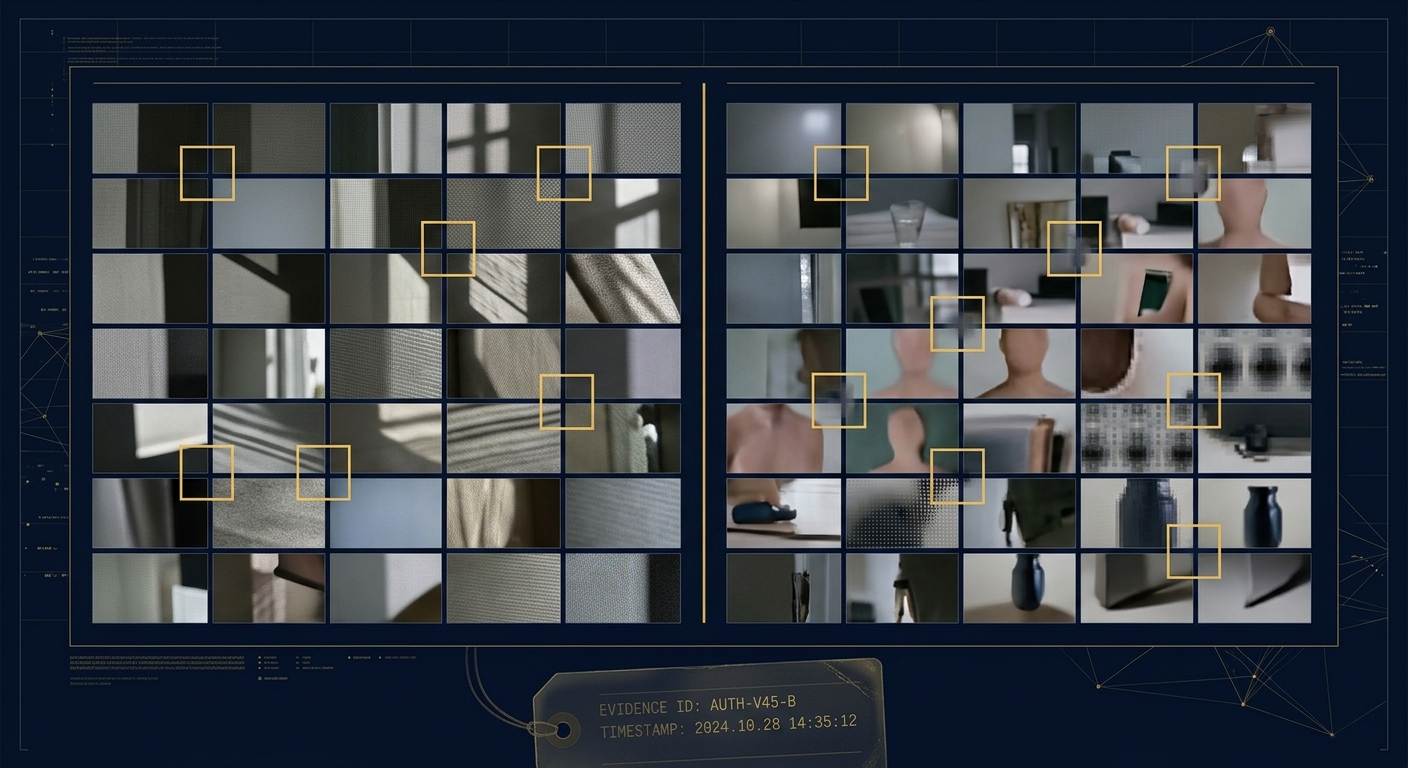
- Pixel- and frequency-domain analysis. Generative models leave statistical fingerprints invisible to the eye but detectable under frequency-domain and compression-artifact analysis — inconsistent noise patterns between a face region and its background, blending seams at the edge of a swapped face, or double-compression signatures that indicate a file was decoded, altered, and re-encoded.
- Biological and physiological signal checks. Real human faces carry subtle involuntary signals that generative models struggle to reproduce consistently: natural blink rate and timing, micro-expression sequencing, and even the faint, rhythmic color shift in skin driven by the pulse (a signal known as remote photoplethysmography). Inconsistency or absence of these signals is meaningful corroborating evidence, not a standalone verdict.
- Lighting and physics consistency. Shadow direction, reflections in eyes and glasses, and specular highlights should all trace back to a single, physically consistent light source. Synthetic composites frequently break this consistency in ways a trained examiner can isolate frame by frame.
- Audio-specific analysis. Cloned voices carry neural-vocoder artifacts, unnatural breathing or prosody patterns, and — for edited or spliced files — waveform discontinuities and, where a usable trace exists, Electric Network Frequency inconsistencies used in forensic audio authentication generally.
- Audio-visual synchrony. Lip movement, jaw articulation, and speech timing are cross-checked frame by frame; reenactment deepfakes frequently show millisecond-level drift that is imperceptible on casual viewing but measurable under analysis.
No credible examiner reports a finding from one of these tests in isolation. Detection models also degrade quickly as generators improve, so a rigorous lab treats automated detector output as one input among several, never as the conclusion itself.
Deepfakes, Cheapfakes, and Ordinary Editing: Where Is the Line?
Not every altered file is equally consequential, and treating them all the same wastes time and money. The table below reflects how a forensic lab actually triages incoming media.
| Category | What It Is | Forensic Treatment |
|---|---|---|
| Cheapfake / context manipulation | Genuine footage, deceptively clipped, slowed, or mislabeled | Source-tracing and context verification; no synthetic-media analysis needed |
| Selective editing of real footage | Real recording with cuts, splices, or reordering | Waveform/frame continuity analysis, metadata review, editing-software trace detection |
| Face-swap / reenactment deepfake | A real person’s likeness mapped onto an altered or fabricated performance | Full multi-layer analysis: pixel artifacts, biological signals, lighting physics, A/V sync |
| Fully synthetic media | Generated from a prompt or brief reference sample; no underlying real capture | Provenance/metadata triage plus generative-fingerprint and frequency-domain analysis |
| Legitimate enhancement or restoration | Noise reduction, color correction, stabilization of a genuine file | Documented, non-destructive, reversible — verified against the preserved original |
The category determines both the cost and the defensibility of the answer. Misclassifying a cheapfake as a technical deepfake case burns a client’s budget on the wrong analysis; misclassifying a genuine synthetic composite as “probably just edited” can let fabricated evidence into a case file unchallenged.
What Are the Real Fraud and Reputational Stakes?
Synthetic media stopped being a novelty the moment it became cheap enough to run at scale against ordinary people and mid-market companies, not just celebrities and heads of state.
- Executive and vendor impersonation fraud. Cloned voices and, increasingly, real-time video impersonation are used to authorize wire transfers, redirect payroll, or pressure finance staff into urgent off-process payments — a modern variant of business email compromise that our cyber services team sees converging with classic social-engineering fraud.
- Family emergency and grandparent scams. The FTC has specifically warned that scammers now use short AI voice clones — sometimes pulled from a few seconds of public social media audio — to impersonate a relative in distress and demand immediate payment.
- Extortion and sextortion using synthetic imagery. Fabricated explicit or compromising imagery is used to coerce payment or compliance, often targeting minors and employees, a threat federal law enforcement has flagged as a fast-growing case category.
- Corporate reputation and market risk. A fabricated statement attributed to an executive, a fake product-recall clip, or a synthetic “leaked” video can move public perception — and in some cases stock price — long before it can be debunked. Joint NSA, FBI, and CISA guidance now treats deepfakes as a distinct organizational risk category, not a novelty concern.
- Fabricated litigation and insurance evidence. Custody disputes, employment claims, harassment allegations, and staged-incident insurance claims increasingly involve video or audio whose authenticity is disputed. Opposing counsel who cannot authenticate a file should expect it challenged before it is ever weighed on its content — which is exactly the work our investigations team is engaged to perform.
The common thread across every scenario above is the same: the decision that matters — pay the wire, believe the recording, admit the exhibit, run the story — gets made in the minutes or hours after the file surfaces, long before a forensic report can be produced. That is why the preservation step described below has to happen immediately, by whoever first receives the file, not weeks later once counsel is engaged.
Why Does Chain of Custody Decide Whether the File Matters at All?
A forensic finding is only as strong as the handling history of the file underneath it. This is the step most non-experts get wrong, and it is often irreversible once mishandled.
The moment a suspect video or audio file is identified, it should be acquired from its original source — the original device, the original platform export, the original message thread — never a screenshot, a screen recording, or a forwarded copy that has already been re-compressed. Every re-encoding pass strips metadata and introduces new compression artifacts that can mask or mimic the very signatures an examiner is looking for. The original is then cryptographically hashed to create a verifiable fingerprint, sealed, and never touched again; all analysis happens on a verified working copy. Every tool, version, and parameter used in that analysis is logged so another qualified examiner could, in principle, repeat the work and reach the same conclusion.
This documentation discipline is what separates a forensic finding from an opinion. It is also what lets a report withstand the single most common defense tactic in these matters: attacking not the conclusion, but the collection process that produced the evidence being analyzed.
Will a Deepfake Finding Actually Hold Up Under Expert Testimony?
A technically correct finding that cannot be defended on the stand is worth little to a client. Two evidentiary hurdles matter, and elite practice is built around clearing both.
First, the file must be authenticated as what it is claimed to be under rules like Federal Rule of Evidence 901 — provenance, continuity, and the chain-of-custody record described above. Second, any expert opinion about manipulation must satisfy the reliability standard under Rule 702 and the Daubert line of cases: a documented, generally accepted, reproducible methodology — not a proprietary “black box” score with no disclosed basis.
That means a credible expert report never claims certainty it cannot support. Automated detection tools carry real false-positive and false-negative rates, and those rates should be disclosed, not hidden. The strongest reports state a conclusion in terms of the specific tests performed, what each one showed, what it did not test for, and how confident that combination of evidence supports the finding — leaving nothing for opposing counsel to characterize as overreach. That candor is precisely what makes the testimony survive cross-examination rather than collapse under it.
The Honeybadger Deepfake Forensics Workflow
Every engagement follows the same disciplined sequence, whether the matter is a suspected fraud call, a disputed litigation exhibit, or a corporate reputational threat.
- Immediate acquisition and preservation. Secure the file from its original, unaltered source, hash it, and lock the original before any analysis begins.
- Provenance and metadata triage. Review container structure, encoder signatures, and any available Content Credentials to establish where the file plausibly came from and whether that story holds together.
- Multi-layer technical analysis. Run pixel- and frequency-domain checks, biological-signal analysis, lighting-physics review, and audio-specific tests as applicable — never relying on a single detector’s output.
- Cross-validation. Require independent methods to converge before a finding is reported; a single anomalous signal is treated as a lead for further testing, not a conclusion.
- Context and source corroboration. Trace the file’s publication and distribution history where relevant — a capability that draws on the same open-source and background-intelligence tradecraft used across our investigative work.
- Reporting with disclosed limitations. Produce a written report stating methodology, results, confidence level, and what the analysis could not determine — reproducible by another qualified examiner.
- Expert declaration and testimony. Provide sworn declarations and courtroom or deposition testimony that can withstand cross-examination on both the science and the handling of the evidence.
Nationwide In-House Digital Forensics — Why That Matters Here
Deepfake evidence rarely respects jurisdictional lines — the video was recorded somewhere, forwarded through a platform hosted somewhere else, and now needs to hold up in a courtroom in a third state. Honeybadger Solutions runs digital forensics, cybersecurity, financial investigations, and background intelligence entirely in-house, built to operate remotely by design. Files can be securely transmitted and preserved for examination regardless of where an incident occurred, without handing sensitive media to a subcontractor.
That in-house nationwide capability is distinct from our licensed physical operations. Where a matter also requires Arizona field investigation, surveillance, or executive protection, those services are delivered by our own AZ-licensed personnel; where a matter requires physical work outside Arizona, we command a vetted field-partner network in established theaters. Digital forensics, by contrast, does not require boots on the ground — it requires a secure chain of custody, which our team maintains from intake through testimony, coordinated from our home command in Casa Grande and our Phoenix and Oro Valley offices.
Frequently Asked Questions
Can forensic analysis prove a video is 100% real or 100% fake?
Rarely in absolute terms. A rigorous analysis reports a confidence level based on which tests were run, what they found, and what they could not evaluate — never a bare “real” or “fake” with no disclosed basis. Detection tools also have measurable false-positive and false-negative rates, and a defensible report accounts for them rather than hiding behind a single score.
What should I do the moment I suspect a video or audio file is a deepfake?
Stop forwarding, screenshotting, or re-saving it, and preserve the file from its original source in its original format if at all possible. Every re-compression or screen recording strips metadata and adds artifacts that can compromise later analysis. Engage a qualified examiner before anyone attempts to “clean up” or otherwise alter the file.
How is a deepfake investigation different from a typical fraud investigation?
It adds a technical authentication layer in front of the traditional investigative work. Before financial records, timelines, or witness accounts are analyzed, the media itself has to be authenticated — otherwise the entire narrative built on top of a fabricated recording collapses. That authentication step requires the pixel-, metadata-, and signal-level tools described above, not general investigative experience alone.
Can deepfake detection tools be fooled?
Yes, and any lab that claims otherwise is overselling its own tooling. Generative models are frequently trained specifically to defeat known detectors, which is why a credible finding never rests on one automated tool. Convergent evidence across metadata, pixel-level, biological-signal, and — where applicable — audio analysis is what makes a conclusion defensible, and each method’s limitations should be stated in the report.
About Honeybadger Solutions
Honeybadger Solutions is an Arizona-licensed security and investigations firm delivering elite digital forensics, cybersecurity, financial investigations, and background intelligence in-house and by design for remote, nationwide engagement. We maintain three offices — our headquarters in Casa Grande, plus Phoenix and Oro Valley — and serve clients across all of Arizona, nationwide, and internationally. Our digital forensics practice pairs conservative, multi-layer methodology with courtroom-ready reporting and expert testimony for deepfake, audio, video, and digital-evidence matters.
To discuss a suspected deepfake, disputed recording, or evidence-authentication matter, call Book a consultation online or visit our digital forensics practice. When a video or recording is about to decide a fraud case, a courtroom outcome, or a company’s reputation, verify it before you rely on it.
Browse by topic
Security guard services · Private investigations · Cybersecurity · Digital forensics · Financial fraud investigation · Executive protection · All articles