
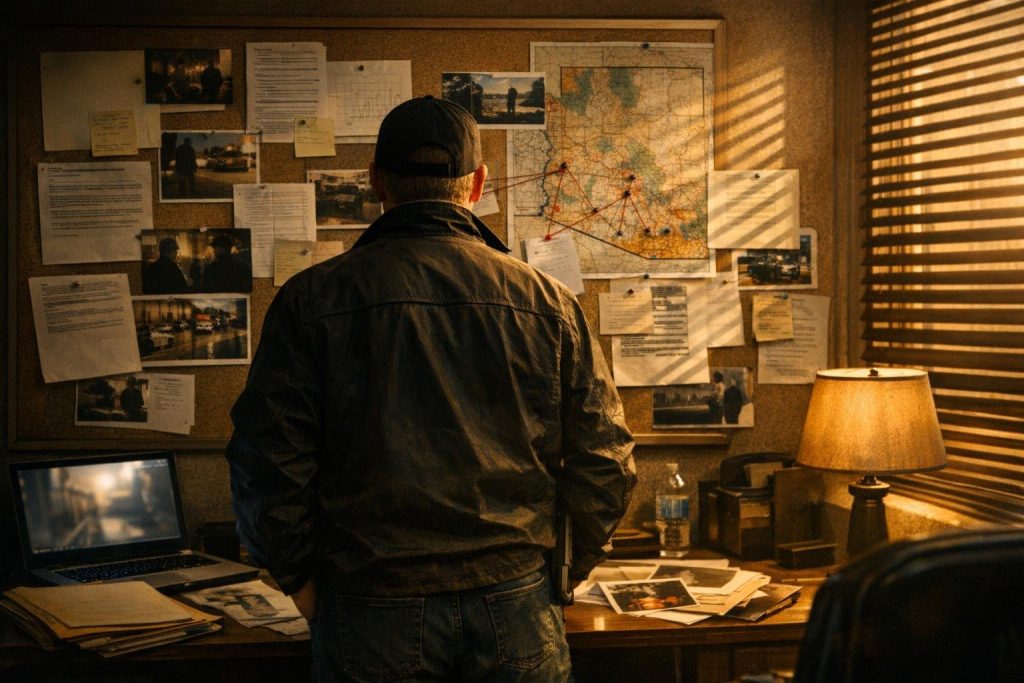
A criminal defense investigator is the person who goes back over the state’s case for the defense: the scene, the witnesses, the video, the records and the digital evidence. In Arizona that work is done for, and directed by, the defendant’s attorney. The investigator finds facts. Counsel decides what those facts mean and what to do with them.
Used well, an investigator catches evidence before it disappears and gives counsel facts for motions, plea talks and trial. Used poorly, an investigator creates interview notes the prosecutor ends up reading, or a victims’ rights problem. This guide explains what the job covers, where Arizona law draws the lines, and how attorneys get the most from criminal defense investigations. Family members: have the lawyer make the call.
This is general information, not legal advice. Rules and case law change, and counsel should apply them to the specific case.
Key takeaways
- A defense investigator works at the direction of defense counsel, and the attorney controls scope, reports and what gets disclosed.
- Under A.R.S. 13-4433, the defense and its agents may contact a crime victim only through the prosecutor’s office, and the victim can refuse.
- Arizona’s Rule 15.4 counts a written summary of a witness’s words as a “statement,” so how interviews are written up matters if the witness is later disclosed.
- Business video is often the first evidence lost. Preservation requests should go out before witness interviews.
- A non-victim witness who refuses an interview can sometimes be deposed under Rule 15.3, and the investigator’s record of the refusal supports that motion.
- Families should route requests through the defense attorney so the work stays coordinated and protected.
What a defense investigator actually does
The police report is one account, written by one side, usually under time pressure. A defense investigator tests that account against the physical world and the people in it. Most assignments fall into five kinds of work.
- Witness work. Locating people named only by a nickname or a partial plate, interviewing those who agree to talk, and checking prior statements and possible bias of prosecution witnesses.
- Scene work. Photographs, measurements, sight lines, lighting and obstructions, documented at the same time of day and, ideally, the same season as the incident.
- Video and records. Canvassing businesses and homes for cameras, sending preservation requests and collecting records that confirm or contradict a timeline, such as receipts, timecards, gate logs and rideshare trips.
- Review of the state’s evidence. Reading the disclosure with fresh eyes, especially the digital pieces, and listing what is missing or does not match.
- Testimony. Testifying about what the investigator personally did: the photos taken, the measurements made, the chain of custody of items collected and what a witness said in an interview.
An investigator does not give legal opinions, decide strategy or take direction from the defendant or family without the attorney’s approval.
Working through counsel: why it is not optional
Arizona’s ethics rules make the lawyer responsible for the conduct of nonlawyers who help on a case. ER 5.3 of the Arizona Rules of Professional Conduct requires lawyers to make reasonable efforts to ensure that assistants act in a way that is compatible with the lawyer’s own obligations, including confidentiality. ER 4.3 bars a lawyer dealing with an unrepresented person from implying that the lawyer is disinterested. An investigator acting for the lawyer works under the same expectations: identify who you work for, never pretend to be neutral, and never pretext.
Working through counsel also protects the work itself. Under Arizona Rule of Criminal Procedure 15.4(b)(1), a party does not have to disclose reports or memoranda to the extent they contain the opinions, theories or conclusions of counsel or members of the defense’s legal or investigative staff. That protection is far easier to maintain when the attorney retained the investigator, set the scope and received every report.
For families: if a loved one is charged, ask the defense attorney whether an investigator is needed and let the attorney make contact. Independent digging by relatives can create witness-contact problems or statements the defense would rather not have. With a public defender, ask how that office handles investigation.
Victims’ rights: where the limits are
Arizona’s Victims’ Bill of Rights (Ariz. Const. art. 2, sec. 2.1) gives a crime victim the right to refuse an interview, deposition or other discovery request by the defendant, the defendant’s attorney or any other person acting on the defendant’s behalf. A defense investigator acts on the defendant’s behalf, so the right applies.
A.R.S. 13-4433 sets out the procedure:
- The defense and its agents may initiate contact with the victim only through the prosecutor’s office, which tells the victim about the request and the right to refuse.
- If the victim agrees, the prosecutor’s office passes along the time, place and any conditions the victim sets. The victim may end the interview or refuse any question.
- Unless the victim directs otherwise, the prosecutor may attend. If the interview is recorded or transcribed, the prosecutor can request a copy.
- For a minor victim, the prosecutor must have actual notice at least five days ahead, even if a parent initiated contact.
- Except after a dismissal with prejudice or an acquittal, the right to refuse continues beyond final disposition.
A.R.S. 13-4434 adds privacy protections. Victims’ identifying and locating information (date of birth, Social Security number, ID numbers, address, phone, email and workplace) is redacted from discovery. If a court orders it disclosed to defense counsel, counsel may share it only with staff and a designated investigator, and may not give it to the defendant without specific court authorization.
In practice, a careful investigator never approaches a victim directly, never uses a third party to get around the rule, and keeps anything learned about a victim’s location inside the defense team.
Witness interviews that hold up later
Witnesses who are not victims may talk to the defense or decline. How the interview is written up matters.
Arizona’s disclosure rules shape this. Under Rule 15.2, the defense must disclose the names of witnesses it intends to call and any written or recorded statements of those witnesses. Rule 15.4(a) defines “statement” broadly to include a recording, a transcript, or a written record or summary of a person’s oral communications. A detailed summary of a favorable witness may therefore be disclosed if that witness is called. Counsel should decide in advance how interviews are documented.
A practical approach many defense teams use:
- Counsel and investigator agree on goals, topics and the documentation format before the interview.
- The investigator identifies who they work for at the start and does not suggest neutrality.
- If the witness has a lawyer, contact goes through that lawyer.
- Recording, if any, is disclosed to the witness. Arizona is a one-party consent state for recording conversations (A.R.S. 13-3005), but telling the witness avoids credibility fights later.
- When possible, two people attend, so a prior inconsistent statement can be proved by someone other than the attorney. Arizona Rule of Evidence 613 governs how that kind of statement is used at trial.
- The investigator notes refusals with date, time and the words used. Under Rule 15.3(a)(2), a court may order the deposition of a material witness who was not a witness at the preliminary hearing and who will not cooperate in granting a personal interview. A clean record of the refusal helps counsel make that motion.
Scene work and video preservation
Scenes change and video is overwritten. The order of operations matters.
Video first. Business DVRs and home cameras record over older footage on a cycle set by storage size and settings, and on some systems the window is only days. The first step is a written preservation request to every business or homeowner along the route, followed by collection in the system’s native format, with the player software if needed, plus notes on the system clock offset. Questions about edits, missing frames or timestamps go to a forensic examiner. Our guide to recovering CCTV and DVR footage covers the technical side.
Scene second. Good scene work answers specific questions from counsel: could the witness see the driver’s face from that bus stop, how long does it take to walk from the bar to the parking lot, was the streetlight working? In Arizona, conditions vary sharply. A July evening in Phoenix brings heat shimmer and late sunsets. Monsoon season brings blowing dust that can cut visibility on Pinal County roads in minutes. Sunrise and sunset times for the incident date are available from the U.S. Naval Observatory, which helps match lighting.
| Evidence | Why it disappears | First step |
|---|---|---|
| Business or home video | Rolling overwrite cycles | Written preservation request, then native-format collection |
| Scene conditions | Construction, new lighting, removed signs or vegetation | Dated photos and measurements early in the case |
| Witnesses | Moves, phone changes, fading memory | Locate and interview as soon as counsel approves |
| Third-party records | Retention schedules at businesses and carriers | Counsel sends preservation letters and plans legal process |
| 911 and dispatch records | Agency retention periods | Counsel’s written request under Rule 15.1(e) |
Records, subpoenas and the state’s disclosure
Investigators can gather public records and records that people or businesses agree to hand over. Anything else requires legal process that counsel obtains. Arizona’s rules give the defense several tools, each with limits.
- The state’s disclosure. Under Rule 15.1, unless the court orders otherwise, the state must make its core disclosure in superior court no later than 30 days after arraignment. On written request, the state must also make available related 911 calls the custodian can reasonably find.
- Court-ordered disclosure. Rule 15.1(g) lets a court order any person to provide material if the defense shows substantial need and cannot get the equivalent elsewhere without undue hardship.
- Subpoenas. Under A.R.S. 13-4071, the clerk issues blank subpoenas for defense witnesses, but those blank subpoenas may not be used to obtain discovery, including a victim’s records.
An investigator’s job here is to find out what exists, who holds it and how long they keep it, so counsel can pick the right tool. Process service for trial subpoenas can be handled by our process serving team.
Reviewing the state’s digital evidence
Phone extractions, social media returns, body-worn camera footage and surveillance video are routine in disclosure. A first-pass review helps counsel spot problems early:
- Does the extraction report cover the full date range that matters, or only a narrow window?
- Was a full extraction produced, or only a filtered report? Are hash values and tool versions listed?
- Do message timestamps line up with call logs, location data and the narrative report?
- Is any body-worn camera or dash camera footage referenced in the report but missing from disclosure?
- Was surveillance video provided in native format or only as a screen recording?
When the answers point to a deeper problem, full analysis goes to a forensic examiner. See our mobile and tablet forensics service for that step.
Checklist: how attorneys get the most from an investigator
- Bring the investigator in soon after arraignment, while video and witnesses are still reachable.
- Share the full disclosure, not just the police report. CAD logs and supplements often hold the best leads.
- Write a short tasking memo: questions, priorities and what not to do.
- Decide the interview documentation format before the first interview.
- Confirm in writing that all victim contact goes through the prosecutor’s office.
- Ask for a preservation list in the first week.
- If the investigator may testify, keep their reports factual and separate from strategy notes.
- Get a written scope and quote before work starts, especially on appointed cases.
How Honeybadger Solutions helps
Honeybadger Solutions is a veteran-led investigations firm based in Casa Grande, licensed by the Arizona Department of Public Safety under agency license No. 1759795. Our defense investigation service works only through counsel: the attorney retains us, sets the scope and receives every report.
Arizona field work, including witness location and interviews, scene documentation and video canvasses, is done by our own investigators. Out-of-state field work is coordinated through vetted, locally licensed partners. Records research, OSINT and review of digital evidence can support cases anywhere in the US. Our witness location and litigation support team handles hard-to-find witnesses. We give counsel a written quote before any work starts.
Attorneys can request a defense investigation online or book a confidential consultation. If video or a scene is about to be lost, use our urgent intake form.
Frequently asked questions
Can a defense investigator talk to the victim?
Only if the victim agrees, and the request must go through the prosecutor’s office under A.R.S. 13-4433. The victim can refuse, set conditions or end the interview at any time. A careful investigator never contacts a victim directly.
Will the prosecutor see our investigator’s interview notes?
It depends on how they are written and whether the witness is called. Rule 15.4 treats a written summary of a witness’s words as a “statement,” while opinions and conclusions of the defense team are protected work product. Counsel should set the documentation format before interviews begin.
What if a witness refuses to talk to the defense?
A non-victim witness can decline. The investigator should record the refusal accurately, because Rule 15.3 allows counsel to ask the court for a deposition of a material witness who will not grant a personal interview, if the rule’s conditions are met.
Can our family hire an investigator directly?
The work should be arranged through the defendant’s attorney. That keeps the investigation coordinated with the defense strategy, keeps reports with counsel and avoids problems with victim or witness contact.
Can an investigator testify at trial?
Yes, about what they personally did and observed: photographs, measurements, items collected and their chain of custody, and what a witness said in an interview. Good reports are written with that testimony in mind, so the work is court-ready.
Sources: Arizona Constitution, Article 2, Section 2.1, A.R.S. 13-4433, A.R.S. 13-4434, A.R.S. 13-4071, A.R.S. 13-3005, A.R.S. 32-2401, Ariz. R. Crim. P. 15.1, Ariz. R. Crim. P. 15.2, Ariz. R. Crim. P. 15.3, Ariz. R. Crim. P. 15.4, Ariz. R. Evid. 613, Arizona ER 4.3, Arizona ER 5.3, U.S. Naval Observatory sun and moon data