
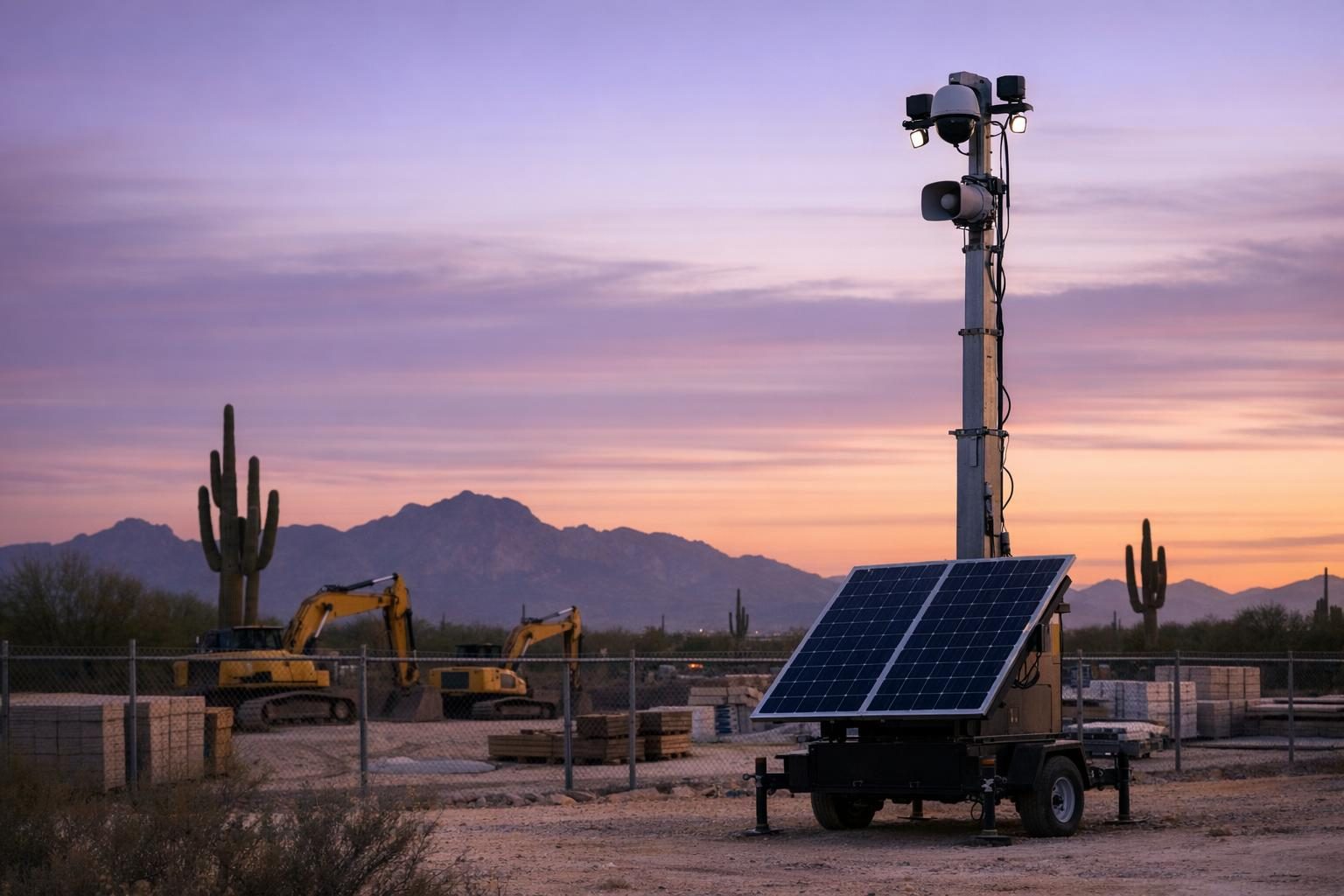
Remote video monitoring puts a trained operator behind your cameras in real time, so trouble is spotted while it is happening instead of discovered on a recording the next morning. For Arizona businesses with closed lots, active job sites or empty buildings after hours, it is often the most practical way to get around-the-clock watch without paying for a guard on every corner.
This guide explains how live virtual guarding works, how it compares with CCTV, on-site guards and mobile patrol, where it fits, what Arizona law says about audio, and what to ask a provider. Our remote and virtual guarding service page describes how Honeybadger Solutions runs it.
Honeybadger Solutions is a veteran-owned security firm based in Casa Grande, licensed as an Arizona security guard agency, and our physical security work covers the Phoenix metro, Pinal County and the Tucson area.
Key takeaways
- Remote video monitoring means live operators watching your cameras, speaking through on-site speakers and escalating on a written protocol, not just recording.
- It is strongest at closed, fenced or vacant sites at night: construction yards, car lots, self-storage, multifamily common areas and retail after closing.
- It detects and deters; it cannot physically stop someone who ignores a warning, so pair it with patrol, a key holder or police response.
- Video-verified alarms give responders better information, and in Phoenix false burglar alarms beyond the first in 365 days can cost $96 each (as of October 2026).
- Arizona is generally a one-party consent state for recording conversations, so treat audio recording carefully and post clear camera notices.
- Ask every provider for a written response-time target, operator workload, retention period and a sample event report.
Where this guidance comes from. We used the Arizona Revised Statutes on interception of communications and surreptitious recording (A.R.S. 13-3001, 13-3005, 13-3012 and 13-3019) and on security guard registration (A.R.S. 32-2601 and 32-2621), the City of Phoenix alarm ordinance information page, the Partnership for Priority Verified Alarm Response and its material on the TMA-AVS-01 alarm validation standard, and U.S. Bureau of Labor Statistics wage data. The practical advice reflects our team’s field experience running guard posts, patrol routes, alarm response and monitored sites in Arizona.
How remote video monitoring works
A live remote guarding program has five parts, and the service is only as strong as the weakest one.
1. Cameras that see the approaches
Cameras need to cover the routes an intruder uses: gates, fence lines, yard entrances, loading doors and parking approaches. Night imaging matters more than resolution on paper, because the operator has to recognize a person, not a blur.
2. Analytics that flag activity
Analytics software watches for people or vehicles in defined zones and pushes those clips to an operator. It sorts events; it should not make the decision. A person still judges whether a figure at the fence is a trespasser or the cleaning crew.
3. Live operators
The operator is what separates a live watch from a recorder. The operator checks the live view against the site’s expected people and vehicles and decides what to do. Many programs also run virtual guard tours, scheduled and randomized sweeps of every camera.
4. Talk-down speakers
Speakers near the places people stop, like a gate or an equipment line, let the operator speak directly to an intruder. A live voice describing the person is harder to ignore than a siren.
5. Escalation and dispatch
A written protocol tells the operator which events get a talk-down, a call to the key holder, a patrol officer or police. Our alarm response and dispatch officers can handle the physical check and key holder role when an event needs boots on the ground.
Remote video monitoring vs CCTV, on-site guards and mobile patrol
| Factor | Recorded CCTV only | Remote video monitoring | On-site guard | Mobile patrol |
|---|---|---|---|---|
| Who is watching | No one in real time | Off-site operator, live | Officer on the property | Officer during each visit |
| When problems are found | After the fact, on review | As they happen, on camera | As they happen, in person | During a pass, or after |
| Can intervene | No | Yes, by voice and escalation | Yes, in person | Yes, while on site |
| Physical response | None | Needs patrol, key holder or police | Immediate | When dispatched or on the route |
| Coverage gaps | Total, until someone looks | Areas without cameras | Breaks, one person, one spot | Time between visits |
| Best fit | Evidence and investigations | Closed or vacant sites, after hours | Open sites with people, customers or access control | Multiple sites, visible presence, alarm checks |
| Main cost drivers | Equipment and storage | Cameras, hours, events, response plan | Staffed hours, armed or unarmed, overtime | Visits per night, route size |
The short version: recorded CCTV is a witness, a guard is a presence, a patrol is a moving presence, and remote guarding is a live watch that needs a response partner. Many Arizona sites end up with remote monitoring for the constant watch and marked mobile vehicle patrol for the physical check when the operator sees something real.
What does remote video monitoring cost compared with a guard?
Pricing varies by site, so start with the arithmetic. A 24/7 guard post means 8,760 staffed hours a year. The U.S. Bureau of Labor Statistics reports that the highest-paid 10 percent of security guards earned more than $58,840 a year in May 2025, about $28.29 an hour. At that level, the kind of officer you want alone on a site overnight, wages alone for one round-the-clock post come to about $248,000 a year, before payroll taxes, overtime, supervision, insurance and the agency’s margin.
Live monitoring is priced differently because one operator can watch several sites. The main cost drivers are:
- Number of cameras and speakers to be monitored
- Hours of coverage, such as overnight only, weekends, or 24/7
- Whether new cameras, speakers, a camera tower, internet service or battery backup are needed
- The response plan, including patrol visits or key holder dispatch
To compare a guard post against monitoring for your own hours, our security guard cost estimator gives a starting figure for the staffed side of the comparison.
Ready to have your cameras reviewed? You can request remote video monitoring online with your address, hours and camera setup, or book a consultation online to talk through whether it fits your site. If anyone is in immediate danger, call 911.
Which Arizona properties are the best fit?
Live monitoring works best where a property is closed for long stretches, has a defined perimeter, and anyone present after hours is either expected or out of place.
Construction sites
Job sites hold copper, wire, tools, fuel and heavy equipment behind temporary fencing. Solar camera towers with speakers cover yards without permanent power, while daytime gate control still takes a person; see our construction and development security page.
Car lots and dealerships
Inventory sits outside in rows, exposed to wheel theft, parts theft and break-ins. Cameras along the rows and entrances, plus speakers, cover the hours the lot is closed.
Self-storage facilities
Storage sites have gated access, fixed hours and long fence lines. An operator can spot someone climbing a fence or lingering at units after hours. Coverage focuses on gates, drive aisles and the perimeter.
Multifamily common areas
Apartment communities monitor parking, pool decks after hours and trash enclosures. With residents present, cameras stay on common areas and away from windows. See our guide to multifamily apartment security and crime liability.
Retail after hours
After closing, the storefront, loading dock and rear doors become targets that an operator can watch. During open hours, a store usually needs an on-site person.
Video verification and police response priority
A burglar alarm says a sensor tripped, not whether a person is there. Video verification adds that piece: an operator checks the cameras before anyone is dispatched.
The Partnership for Priority Verified Alarm Response (PPVAR), an industry group, promotes verification using video, audio and other technology. It states that video and audio verified alarms are seen by law enforcement as crimes in progress. PPVAR also promotes the TMA-AVS-01 Alarm Validation Scoring Standard, which received ANSI approval in January 2023. It scores intrusion alarms from Level 0 (no call for police response) to Level 4 (confirmed threat to life), with Level 2 for confirmed or highly probable human presence and Level 3 for a confirmed threat to property.
How much priority a verified alarm gets is up to each police department. Ask your provider how it reports verified events to the agency covering your address.
False alarms also cost money. The City of Phoenix states that a permit is required for alarm systems, whether monitored or not. Without a permit, each burglar alarm activation police respond to may be assessed $96. The city can also assess excessive false alarms: after more than one false burglar alarm in a consecutive 365-day period, later ones can cost $96 each (as of October 2026). Verifying events on camera before calling police helps keep false runs down. Check your own city’s ordinance, since rules differ.
Privacy and audio recording in Arizona
Arizona law treats video and audio differently. This section is general information, not legal advice; confirm your setup with counsel.
Audio: Arizona’s one-party consent rule
Under A.R.S. 13-3005, it is a class 5 felony to intentionally intercept a conversation or discussion at which you are not present without the consent of a party to it. A.R.S. 13-3012 exempts interception made with the consent of a party to the communication or a person who is present during it. That is why Arizona is commonly called a one-party consent state.
A camera with an active microphone can capture private conversations among people who never consented. A.R.S. 13-3001 covers oral communications spoken with a justified expectation that they are not being intercepted. A cautious approach is to keep microphones off and use speakers only for one-way talk-down.
Video: where cameras should not point
A.R.S. 13-3019 makes it unlawful to secretly photograph or record a person without consent in a restroom, bathroom, locker room, bedroom or similar place where they have a reasonable expectation of privacy while they are undressing or in similar circumstances. The statute exempts security recording where notice of the equipment is clearly posted. Keep cameras on your property and its approaches, out of restrooms and changing areas, away from neighbors’ windows, and post clear monitoring signs.
Retention and footage handling
Decide how long footage is kept and who can export it. Too short a window can erase footage before an insurer or detective asks for it. Our article on recovering CCTV and DVR footage explains why original files matter.
Remote video monitoring checklist: what to ask a provider
Get these answers in writing; they define the service you are buying.
- Response time. What is the written target from event to operator review, and to talk-down, and how is it reported?
- Operator workload. How many sites or cameras does one operator handle at peak hours?
- Live versus analytics. Is a person watching, or does software decide what reaches one?
- Escalation protocol. Who gets called, in what order, and what triggers a patrol or police response?
- Physical response. Who drives to the site? Arizona requires security guards to be registered under A.R.S. 32-2621.
- Retention and export. How long is video kept, and how fast can you get a clip?
- Reporting. Ask for a sample log of verified events.
- Outages. A lost feed should be treated as an event in itself.
- Equipment. Who maintains cameras, speakers and backup power through Arizona heat and monsoon dust?
How Honeybadger Solutions provides remote video monitoring in Arizona
Our remote guarding program is staffed by trained security operators watching feeds 24/7 or after hours, with real-time voice talk-downs through on-site speakers, virtual guard tours, remote alarm verification and escalation to dispatch on written protocols. The monitoring is backed by the same veteran-led firm licensed under Arizona’s private security guard law for our on-site work, so when an event needs a physical response it comes from a licensed operation.
Onboarding follows a set order: we review each camera view day and night, define the hours and expected activity, write the response protocol, test every speaker and contact end to end, and then review the event logs after the first weeks to tighten coverage. It often runs on existing cameras; where coverage falls short, our security systems and technology team can address the gaps without replacing equipment that works.
For job sites we add temporary solar camera towers and patrol, and every verified event is documented for insurers and police reports.
To get started, submit a service request online with your property address, the hours you need covered and what you have for cameras today, or book a consultation online to walk through the options with our team. If anyone is in immediate danger, call 911.
Why the online intake is faster than a phone call: it takes about two minutes, and your answers are routed straight to the specialist team that handles your kind of matter, whether that is cyber and forensics, investigations or field security. That team sees the full picture before it replies, so you skip phone tag and get a real answer and next steps sooner. If it cannot wait for business hours, use the urgent intake form, which is read seven days a week.
Frequently asked questions
What is remote video monitoring?
It is a service where trained operators watch a property’s cameras live from off site, usually after hours. When they see activity that does not belong, they warn the person through on-site speakers and escalate to a key holder, patrol officer or police under a written protocol. Ordinary CCTV only records footage for later review.
Is remote video monitoring cheaper than an on-site security guard?
For many closed or vacant sites it is, because one operator can watch several sites. A 24/7 post needs 8,760 staffed hours a year; at the pay of the top 10 percent of security guards, about $28.29 an hour (BLS, May 2025), that is roughly $248,000 in wages alone. Monitoring prices depend on cameras, hours and the response plan, so get a written quote.
Do police respond faster to video-verified alarms in Arizona?
It depends on the agency. PPVAR states that video and audio verified alarms are seen by law enforcement as crimes in progress, and the TMA-AVS-01 standard scores alarms by confirmed threat. Each Arizona police department sets its own dispatch priorities.
Is it legal to record audio on business security cameras in Arizona?
Arizona is generally a one-party consent state under A.R.S. 13-3005 and 13-3012, so intercepting a conversation you are not part of, without a participant’s consent, can be a felony. A cautious approach is to keep microphones off and use speakers for talk-down only. This is general information, not legal advice; confirm with counsel.
Can remote video monitoring work with my existing cameras?
Often, if the cameras cover the approaches, produce usable night images and connect over a reliable internet link with backup power. Talk-down speakers may need to be added. A camera review before go-live shows which views work and where the blind spots are.
What happens when the operator sees an intruder?
The operator confirms what the camera shows, issues a voice warning and follows the written escalation protocol: calling the key holder, sending a patrol officer or contacting police. Each verified event should be logged with the time, what was seen and what was done. If anyone is in immediate danger, call 911.
Sources and further reading
- A.R.S. 13-3005, Interception of wire, electronic and oral communications — Felony to intercept a conversation without a party’s consent.
- A.R.S. 13-3012, Exemptions — Exemption for interception with the consent of a party or a person present.
- A.R.S. 13-3001, Definitions — Definitions of intercept and oral communication.
- A.R.S. 13-3019, Surreptitious photographing and recording — Limits on recording in private places and the posted-notice security exemption.
- A.R.S. 32-2601, Definitions (private security) — Definition of a security guard under Arizona law.
- A.R.S. 32-2621, Necessity of security guard registration — Requirement that security guards be registered.
- Partnership for Priority Verified Alarm Response (PPVAR) — Industry position that verified alarms are treated as crimes in progress.
- PPVAR: TMA-AVS-01 Alarm Validation Scoring Standard — ANSI approval in January 2023 and the Level 0 to 4 scoring.
- PPVAR: AVS-01 for Public Safety — How scored alarms help 911 centers and police decide on response.
- City of Phoenix: Preventing False Alarm Systems — Alarm permit requirement, $96 false burglar alarm assessment and false alarm definition.
- U.S. Bureau of Labor Statistics: Security Guards and Gambling Surveillance Officers — Highest 10 percent earned more than $58,840 a year, May 2025.
Written and reviewed by the Honeybadger Solutions security and investigations team, a veteran-led Arizona firm (Arizona DPS private investigation agency license No. 1759795). Facts checked against the cited sources on October 2, 2026. This article is general information, not legal advice.
Browse by topic
Security guard services · Private investigations · Cybersecurity · Digital forensics · Financial fraud investigation · Executive protection · All articles