
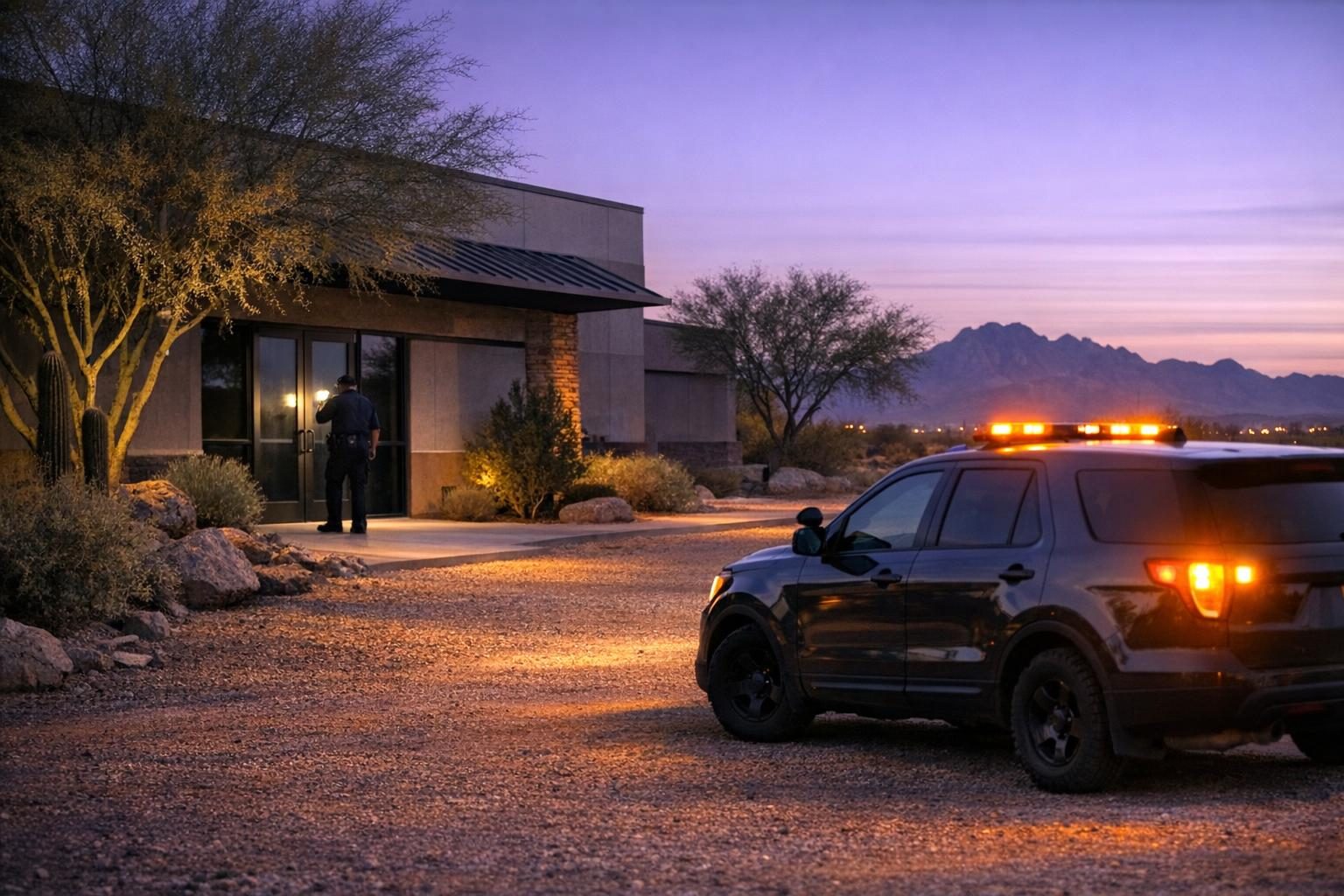
An alarm panel tells you that something tripped. It does not tell you whether it was a burglar, a loose door contact or a balloon drifting past a motion sensor. Alarm response services close that gap: a licensed officer goes to the site, checks it, secures it and documents what was found, so your owner or night manager does not drive in alone at 2 a.m.
In Arizona the stakes are also financial. Phoenix, Mesa, Scottsdale, Chandler and Tucson require alarm permits or registration and assess fees when police respond to false alarms. This guide covers those rules as of October 2026, how guard response works, what drives response time and how it compares with police, video verification and patrol. Honeybadger Solutions provides alarm response, keyholding and dispatch in Arizona, and we describe that service exactly as it is set up.
If anyone is in immediate danger, call 911. A private officer does not replace police, fire or medical response.
Key takeaways
- Most alarm activations are false: 94 to 98 percent of alarm calls, according to a 2011 problem-oriented policing guide.
- Phoenix, Mesa, Scottsdale, Chandler and Tucson require permits or registration and charge for repeat false alarms, with different free allowances.
- Alarm response services verify the signal, act as your keyholder, re-secure the site and bring in police when a crime is confirmed.
- Response time depends on distance, traffic, call volume and how well keys, codes and zone lists are prepared.
- Setup work (call list, zone map, hazards, keys, instructions) decides how useful each response is.
Where this guidance comes from. City alarm pages from Phoenix, Mesa, Scottsdale, Chandler and Tucson; the Scottsdale false alarm FAQ; the Tucson alarm user registration agreement; the Center for Problem-Oriented Policing guide False Burglar Alarms (2nd edition, 2011); The Monitoring Association’s TMA-AVS-01 announcement; and Arizona Revised Statutes. We combined these with our team’s field experience running guard posts, patrol routes and after-hours response in Arizona.
Why false alarms matter to Arizona businesses
False alarms are the normal case. The POP Center guide on false burglar alarms (2nd edition, 2011) reports that 94 to 98 percent of alarm calls are false and that false alarms make up roughly 10 to 25 percent of all calls to police nationwide. It also cites a U.K. study that found user error caused about half of activations.
Arizona data points the same way. Scottsdale’s false alarm FAQ (last updated 2021) says 66 percent of alarms reported to its police department are classified as false, fewer than 0.5 percent involve a valid crime, and officers spend more than 3,100 hours a year on false alarms.
For a business that means fees, the risk of sending an employee to an empty building at night, and staff who learn to ignore the next signal.
Arizona false alarm ordinances: Phoenix, Mesa, Scottsdale, Tucson and Chandler
Each city’s own page, as of October 2026, is summarized below. Schedules change, so confirm the current version with your city.
| City | Permit or registration | False burglar alarm fees (as posted) | Notes |
|---|---|---|---|
| Phoenix | Required for monitored and non-monitored systems | More than one in a consecutive 365-day period: $96 for each subsequent one | No permit: $96 per activation police respond to. False fire alarms: $105. A program certificate can waive one assessment. |
| Mesa | Required (Alarm Ordinance 6-15); $10 per alarm function | $50, $100, $150, $200, $250, $300, then $400 for the 7th and each after | Panic or robbery: 1st free, 2nd $100, then $200. No permit: $100. Awareness class waives the first $50 once a year. |
| Scottsdale | Required; apply within ten days of the system going live; $10 application, $10 renewal | 1st and 2nd none; 3rd $50; 4th $75; 5th and 6th $100 each; 7th on $200 each | Unpermitted: extra $50 per false activation. New systems exempt for 30 days if permitted on time. |
| Chandler | Required (City Code Chapter 24); $10 a year | Permitted: first two free, then $85 each. Not permitted: first free, then $85 each | Renewed annually. Residents over 65 may qualify for a waiver. |
| Tucson | Registration required; $20 to register or renew | Set by the city code alarm article (Sec. 7-449 and following); not listed on the city page | Awareness class can waive $100 in assessments. Monitoring companies must make two calls to the user before police dispatch, per the city’s registration agreement. |
Three patterns stand out. The count window differs: Phoenix uses a consecutive 365-day period, while Scottsdale restarts the count when the permit renews. Running without a permit costs more in Phoenix, Mesa and Scottsdale, so registering is often the cheapest fix. And most cities offer an awareness class or certificate that waives one fee.
Tucson’s code states its purpose in Sec. 7-449: keeping police from being unduly diverted from actual crime by false alarms. Its registration agreement (June 2012 version) adds that robbery or panic activations cannot be canceled, and that cancellations go through the alarm company with the proper code. Scottsdale gives the same advice: call your alarm company with your passcode, not the police.
This is general information about city alarm rules, not legal advice. Confirm current requirements and fees with your city and, where it matters, with counsel.
How alarm response services work, step by step
Guard response follows a chain, and each link depends on information you provide at setup.
- Signal reaches the monitoring center with the zone and signal type: intrusion, panic, fire or trouble.
- The monitoring center calls the response dispatcher listed on your account, before or instead of requesting police.
- Dispatch sends the nearest qualified officer with the zone and site instructions, and stays on the line.
- The officer checks the exterior: doors, windows, roll-up doors, fence lines and the zone that tripped.
- Interior check, if instructed. With your keys, the officer checks the triggered area and re-secures. If someone may be inside, the officer holds a safe position and requests police instead of searching alone.
- Keyholder actions: contacting your call list in order, meeting a locksmith or board-up vendor if instructed, and re-arming.
- Report with time on scene, findings, actions, outcome and photos of any damage.
- Police when a crime is verified, handed over with the officer’s observations so dispatchers get a confirmed call.
Signal types call for different actions, and written instructions should be agreed before the first call:
- Intrusion: exterior first, interior as instructed, police if there is forced entry or someone inside.
- Panic or duress: a possible emergency involving people. Police are typically notified first; the officer supports and documents.
- Fire or smoke: belongs to the fire department. The officer can meet responders, provide access and document.
- Trouble or power loss: confirm the site is secure while the system is impaired and report for repair.
- Environmental (water, temperature): confirm the condition and contact the designated person or vendor.
A word on authority. Arizona defines a private security guard service to include patrol services and guards who protect life and property, and excludes commissioned police from the definition of security guard (A.R.S. 32-2601). Arrest powers are those of a private person under A.R.S. 13-3884, which are narrow. Our explainer on what an Arizona security guard licence does and does not authorise goes deeper. The officer’s job is to verify, secure and document, then hand a confirmed crime to police.
What affects alarm response time
Be wary of a fixed arrival time promised for every call. Response time is a sum of delays, and most can be reduced with planning:
- Monitoring center handling. Enhanced call verification (two or more call attempts) adds a short delay but, per the POP Center guide, has cut false police dispatches by around 25 to 40 percent where adopted.
- Distance and staging. Sites on an existing patrol route are often closer than a standalone address.
- Time of day and traffic. Valley freeways, rail crossings and rural Pinal County roads all change drive time.
- Concurrent calls. Storms and outages can trip many alarms at once, so dispatch triages by signal type.
- Access and information. Current gate codes, lockboxes, key tags and an accurate zone list save minutes at the door.
Ask how a provider dispatches, where officers are usually positioned and whether you can see logged arrival and clearance times.
Want verified response instead of a 2 a.m. drive? Request alarm response service online with your site addresses and alarm company details, or book a consultation online to review your call list, keys and response instructions with our team.
Alarm response services vs. police, remote video verification and mobile patrol
The POP Center guide describes “verified response” policies, where alarm companies confirm an alarm by on-scene check or remote video before police are called, and notes that in-person verification is usually done by private security. Cities that adopted it saw alarm calls fall by around 90 percent in the cases reviewed.
| Option | What it does | Best for | Limits |
|---|---|---|---|
| Guard alarm response | Officer drives to site, checks as instructed, acts as keyholder, re-secures, reports with photos | Sites where nobody should respond alone; damage to secure; multi-site portfolios | Drive time; no police powers |
| Police response | Officers respond to the alarm company’s request as call volume allows | Confirmed crimes, panic and duress | Unverified alarms compete with other calls; repeat false dispatches bring city fees |
| Remote video verification | Operator views cameras when a zone trips and escalates | Sites with good camera coverage of alarm zones | Cannot lock a door or meet a vendor; depends on cameras and network |
| Mobile patrol | Marked officer makes scheduled, randomized checks | Catching unlatched doors before they trigger; deterrence | Not on site at the moment of the alarm unless dispatched |
The TMA-AVS-01 alarm validation standard, ANSI-accredited on January 31, 2023, scores alarms from Level 0 (no call for service) to Level 4 (confirmed threat to life) so monitoring centers pass better information to 911 centers. Ask your alarm company whether it uses it.
Many Arizona sites layer all three private options. Remote and virtual guarding puts an operator on the cameras when a zone trips, mobile vehicle patrol checks doors and gates between events, and guard response handles the physical work. Our guide to choosing between standing post, patrol and armed coverage covers the tradeoffs against a full-time post.
How to set up keyholder lists and site instructions
A response is only as good as the information behind it. Use this checklist with any provider:
- Call list in order, marking who can approve a locksmith, board-up or repair and up to what amount.
- Zone list or floor plan showing which sensor covers which door or room, updated after remodels.
- Site hazards: dogs, chemicals, machinery or areas officers should not enter.
- Alarm company details and how passcodes are verified, kept separate from physical keys.
- Keys and credentials, tagged without the site address, with custody logged.
- Damage instructions: call a board-up vendor, wait for your representative or stay until secured.
- Insurer, landlord and permit details, including your city alarm permit number and renewal date.
Then tell your alarm company in writing where the response provider sits in the call order. Review the list quarterly and whenever someone leaves.
Using alarm response reports to cut false alarms
Over a few months, reports show which zones trip most and when. Common causes include doors that do not latch, motion sensors catching HVAC airflow, hanging signs or balloons, pests, weak batteries and staff unsure how to arm the system. Phoenix recommends tightening contacts, checking for warped doors, cleaning motion sensors and training users; Scottsdale adds keeping your alarm company updated on users, remodels and pets.
For example, consider a hypothetical Mesa retail suite with three trips in two months from the same rear door on windy nights. A strike adjustment and a refresher for closing staff may stop the pattern before Mesa’s escalating schedule climbs. If sensors themselves are poorly placed, security systems design and monitoring is the better starting point.
What alarm response services cost
Cost depends on the number of sites, distance from existing routes, per-call versus monthly keyholding, scheduled open and close visits, time spent waiting on site for vendors, and whether response is bundled with patrol or remote monitoring. Our security guard cost estimator gives a sense of patrol and post costs to weigh against your current false alarm fees and staff time.
How Honeybadger Solutions handles alarm response services in Arizona
Honeybadger Solutions is a veteran-owned, service-disabled veteran-owned small business based in Casa Grande and a licensed Arizona security guard agency. Our alarm response and dispatch service covers alarm verification, acting as your named keyholder of record, dispatch coordination with your alarm company, police and fire, scheduled lock and unlock, and 24/7 after-hours response by officers licensed under A.R.S. Title 32.
Keys and credentials are held under a documented chain of custody and issued only to the responding officer for a given call. Every response produces a written report, with photos of any damage. Each site gets its own instructions and call list, and reports can be grouped across locations. Field response is delivered in Arizona, including the Phoenix metro, Pinal County and the Tucson area; see our coverage and service areas.
To get started, send your site list, alarm company details and call list through the online service request form, or book a consultation online to review your response instructions. We will tell you plainly which mix of response, patrol and remote monitoring fits your sites.
Why the online intake is faster than a phone call: it takes about two minutes, and your answers are routed straight to the specialist team that handles your kind of matter, whether that is cyber and forensics, investigations or field security. That team sees the full picture before it replies, so you skip phone tag and get a real answer and next steps sooner. If it cannot wait for business hours, use the urgent intake form, which is read seven days a week.
Frequently asked questions
What do alarm response services actually do?
A licensed security officer goes to your site when the alarm signals, checks the outside and then the inside if your instructions allow, re-secures the building, contacts your call list and writes a report. Police are brought in when a crime is confirmed.
Will private alarm response stop false alarm fees?
Not by itself. City fees apply when police respond to a false alarm, so savings come from fewer police dispatches and from fixing the causes the reports reveal. Keep your city alarm permit current either way.
How many false alarms are free in Phoenix, Mesa, Scottsdale and Chandler?
As of October 2026, Phoenix charges $96 for each false burglar alarm after the first in a 365-day period, Mesa charges from the first, and Scottsdale and Chandler do not charge permitted users for the first two. Confirm with your city.
Can a security guard go inside after an alarm?
Only with your permission and keys, and only when it is safe. Arizona guards are private persons, not police. If someone may still be inside, the officer should hold a safe position and request police.
How fast will an alarm response officer arrive?
It depends on distance, traffic, time of day, active calls and whether keys and gate codes are ready. Ask how a provider dispatches and logs arrival times rather than accepting a single promised number.
What do we need to set up before the first alarm?
An ordered call list with spending authority, a zone list or floor plan, site hazards, alarm company contacts and passcode process, keys or credentials, damage instructions, and any insurer or landlord conditions.
Sources and further reading
- City of Phoenix: Preventing False Alarm Systems — permits, $96 and $105 assessments, prevention tips.
- City of Mesa: Alarm Permits — Ordinance 6-15 permits and false alarm fees.
- City of Scottsdale: Alarm Permits — permit timing, fees and service charge schedule.
- City of Scottsdale: False Alarm FAQs (PDF) — false alarm rate and police hours.
- Chandler Police Department: Alarm Information — Chapter 24 permits and $85 fee schedule.
- City of Tucson Police: Alarm Registration, Renewal and Info — $20 registration and class waiver.
- City of Tucson: Alarm User Registration Agreement (2012, PDF) — two-call rule and panic alarms.
- POP Center: False Burglar Alarms, 2nd Edition (2011, PDF) — false alarm rates and verified response.
- The Monitoring Association: TMA-AVS-01 ANSI Accreditation — alarm scoring levels.
- A.R.S. 32-2601: Definitions — security guard definitions.
- A.R.S. 13-3884: Arrest by private person — private-person arrest limits.
Written and reviewed by the Honeybadger Solutions security and investigations team, a veteran-led Arizona firm (Arizona DPS private investigation agency license No. 1759795). Facts checked against the cited sources on October 2, 2026. This article is general information, not legal advice.
Browse by topic
Security guard services · Private investigations · Cybersecurity · Digital forensics · Financial fraud investigation · Executive protection · All articles