
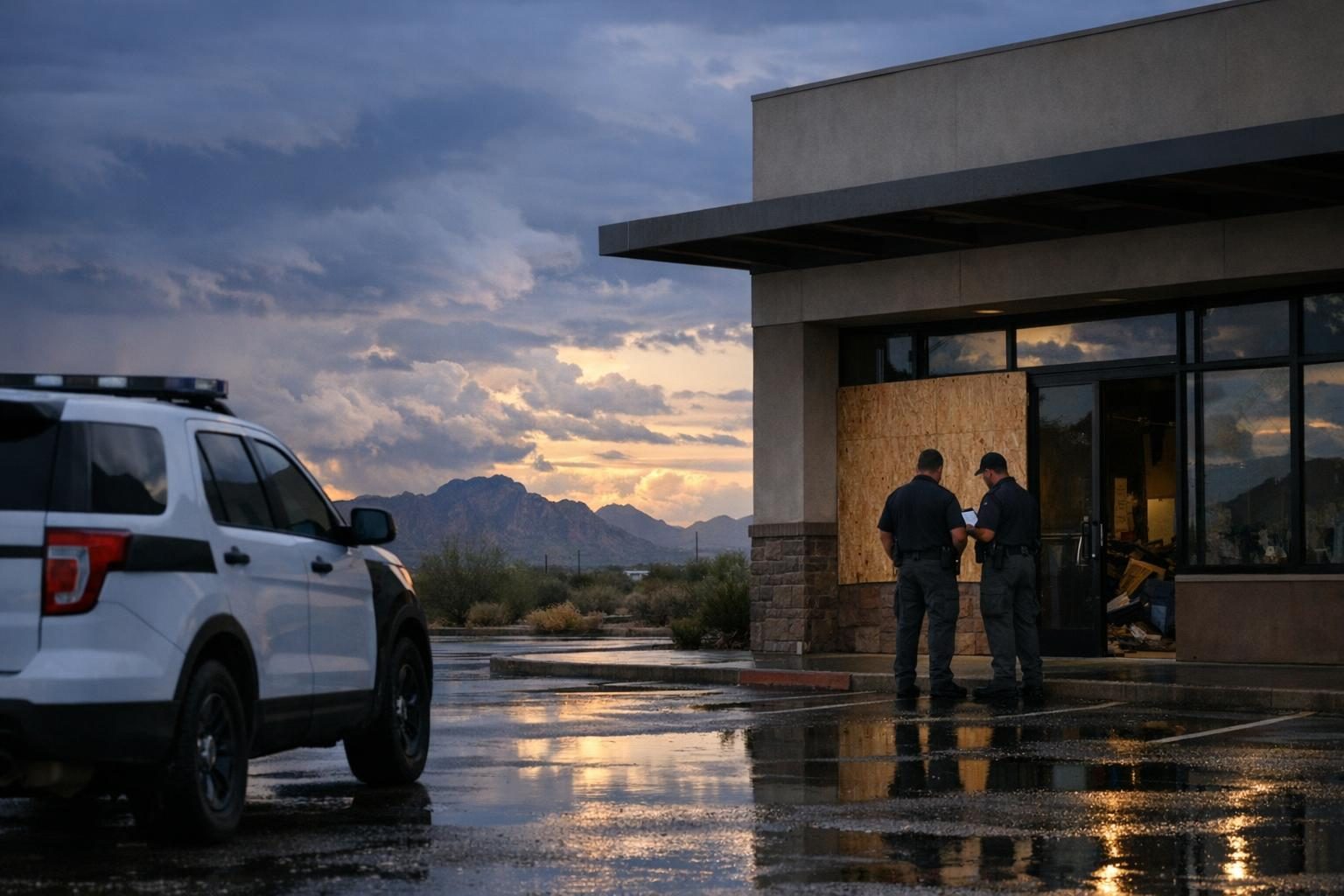
Emergency security staffing is what a business needs when something has already gone wrong: a break-in that left a door that will not lock, a fire that knocked out the sprinklers, a strike notice, a tense termination, or a monsoon storm that tore open a roof. The hard part is not deciding you need officers. It is getting the right officers on post tonight with clear instructions.
This guide covers the situations that trigger short-notice coverage in Arizona, what a rapid deployment looks like, how fire watch and labor-dispute posts differ from ordinary guarding, and how to build a surge plan in advance. Honeybadger Solutions provides emergency and surge security staffing in Arizona from its Casa Grande base, covering the Phoenix metro, Pinal County and the Tucson area.
If anyone is in immediate danger, call 911. Security officers support emergency services; they do not replace them.
Key takeaways
- Speed should never mean skipping vetting. In Arizona, a security guard must be registered and work for a licensed agency (ARS 32-2621).
- Most delays come from missing information: addresses, hours, access details and contacts.
- A fire watch is its own job. Arizona fire departments generally expect the fire watch to have no other duties.
- Strike posts must stay neutral. The NLRB lists filming peaceful protected activity as unlawful interference.
- Heat and the June 15 to September 30 monsoon season shape how Arizona posts are staffed.
Where this guidance comes from. We used NLRB guidance on employee rights, OSHA rules and guidance (29 CFR 1910.38 and 1910.252, workplace violence and heat), Arizona Revised Statutes Title 32, fire watch guidance from the Tucson Fire Department and the City of Chandler, Joint Commission and ASHE material on fire system impairments, and the National Weather Service in Phoenix. It also reflects our team’s field experience standing up short-notice posts at damaged, closed and high-tension sites across Arizona. Details are current as of October 2026.
When do businesses need emergency security staffing?
Short-notice coverage usually comes from a handful of situations, and each one changes what officers do and document.
- After a break-in or fire: broken doors or burned sections leave the site open to trespass and theft.
- Failed alarms, cameras or access control: a person covers what the technology no longer sees until repairs are done.
- Impaired fire protection: a sprinkler or alarm outage usually triggers a fire watch under fire code.
- Labor disputes and strikes: officers protect people and property while staying neutral.
- Terminations and layoffs with threat concerns: presence before, during and after a risky separation.
- Monsoon damage and disasters: buildings without power, locks or lighting for days.
- Protests and unexpected events: a nearby demonstration or attendance spike outgrows the original plan.
- A provider gap: the current guard company no-shows or gives notice.
Emergency security staffing scenarios and typical responses
The table shows how the response usually differs by scenario. It is a starting point; headcount and officer type should follow a quick look at the actual site and risk.
| Scenario | Typical staffing response | Key records | Watch-outs |
|---|---|---|---|
| Break-in or fire damage | Unarmed access control post, often overnight, plus perimeter patrol | Access log, condition photos, incident reports | Unsafe areas, no lighting, compromised keys |
| Failed alarm, cameras or access control | Standing post or patrol covering blind spots until repair | Shift logs, failure and restoration times | Set an end condition so it does not drift |
| Sprinkler or fire alarm impairment | Dedicated fire watch on the interval the fire authority sets | Time-stamped round log, fire department notices | No other duties; staff security separately |
| Labor dispute or strike | Unarmed officers at entrances and parking, supervisor on site | Neutral reports on safety and property only | No surveillance of protected activity |
| High-risk termination or layoff | Planned presence; armed only if an assessment supports it | Briefing notes, incident reports | Coordinate with HR and legal |
| Monsoon or storm damage | Access control and patrol at damaged or evacuated sites | Access log and condition reports for insurers | Heat, flooding, downed lines |
| Protest or sudden crowd | Extra officers folded into existing security under one supervisor | Timeline and incident reports | Police handle enforcement |
| Provider no-show or exit | Bridge coverage of existing posts | Shift logs and handoff notes | Review old post orders first |
What a rapid deployment looks like, step by step
Good short-notice coverage is a sequence, not a single show-up event. A well-run deployment usually moves like this:
- Intake. You describe the situation, sites, hours and reason for coverage. After hours, our urgent intake form reaches the 24/7 intake team.
- Quick site survey. A supervisor reviews the site in person or from photos and a walkthrough with your contact, looking at entrances, hazards, and where officers can shelter and get water.
- Interim post orders. Officers start with written instructions on access control, who may enter, reporting and emergency contacts, refined after the first shifts.
- Officer briefing. Officers learn the site, why they are there, the limits of their role and how to escalate.
- Reporting. Every shift produces a log and every incident a written report. Daily reports show where coverage earns its cost.
After that, coverage typically moves through four phases: stand up, stabilize, right-size, and transition or stand down. Posts are added as a situation grows and pulled back as it settles. Coverage then ends on an agreed date, hands off to a long-term provider, or becomes a standing arrangement, with final reports delivered.
The biggest delays come from missing information, not staffing. Have each site address, the entrances to control, start time and duration, site conditions (power, water, restrooms, shade, hazards), keys or codes, and an on-call contact for each shift.
Need coverage stood up? If you know the site and dates, request emergency security staffing online and our team will review posts, hours and timing. To plan surge coverage before the next storm season, strike deadline or major event, book a consultation online.
Fire watch when sprinklers or alarms are impaired
A fire watch is not a security post with a new name. It is a life-safety assignment that exists because the systems that would detect or control a fire are not working. Our fire watch service page explains how we run it, and our guide to fire watch security services in Arizona goes deeper.
The trigger usually comes from the International Fire Code section on systems out of service. The Tucson Fire Department’s 2023 guidelines cite IFC 901.7 and call for a fire watch, approved by the fire code official, when a required fire protection system is out of service. That makes the fire department your first call after an impairment.
Arizona cities publish their own expectations. As of October 2026:
- Chandler (September 2024) requires a check of the entire building at least every half hour or as the Fire Marshal directs, a written log with date, time, alarm status and signature, and a watch who is continuously awake with no other duties.
- Tucson (2023) says the fire watch shall do fire watch only, with no security or maintenance work, and needs a stand-in during breaks.
So staff fire watch as its own post. If a fire-damaged building also needs access control, plan two roles: one officer on rounds and another on security.
NFPA 25, NFPA 72 and healthcare thresholds
NFPA 25 governs inspection, testing and maintenance of water-based fire protection systems, including impairments, and NFPA 72 is the fire alarm code. Which editions apply depends on local adoption. In healthcare, a Joint Commission FAQ (updated October 2021) describes fire watch thresholds of 4 hours for fire alarms and 10 hours for sprinklers, cumulative over 24 hours, pointing to NFPA 101 (2012). ASHE’s 2020 tool notes sprinkler impairments must follow NFPA 25 (2011).
Hot work has its own rule. Under OSHA 29 CFR 1910.252, fire watchers are required where welding or cutting could start more than a minor fire, and must stay at least a half hour after the work ends. Post-fire and storm repairs often involve both.
Labor disputes and strikes: staying neutral
Strike coverage is sensitive because officers represent the employer while workers exercise federal rights. Section 7 of the National Labor Relations Act protects employees’ right to organize, bargain collectively and engage in other concerted activities for mutual aid or protection.
The NLRB lists spying on union activity, creating the impression of surveillance, and photographing or videotaping employees engaged in peaceful protected activity as unlawful interference. It also says all employees, union or not, may join a protected strike, picket or protest, and that violence or serious misconduct, such as property destruction, is not protected.
- Officers protect people, property and site access, not a bargaining position.
- No commentary on the dispute and no routine filming of picket lines.
- Factual reports limited to safety events, blocked entrances, damage or violence.
- Police handle arrests and enforcement.
This is general information, not legal advice. Have labor counsel review post orders before officers deploy.
Terminations, layoffs and threat concerns
OSHA defines workplace violence as any act or threat of physical violence, harassment, intimidation or other threatening behavior at the work site. OSHA reports that in 2023, violent acts caused 740 of the 5,283 fatal workplace injuries in the United States.
Coverage for a risky separation works best when it follows an assessment, not a gut reaction. Our guide to threat assessment for terminated employees covers warning signs and planning, and our workplace violence prevention team provides high-risk termination coverage coordinated with HR and legal. Typical elements include a pre-meeting briefing, an officer nearby but out of the room, a planned exit route, updated credentials, and a few days of follow-on presence if warranted.
Monsoon damage, heat and disaster sites in Arizona
The National Weather Service in Phoenix says monsoon season officially runs June 15 through September 30, bringing damaging winds, torrential rain, frequent lightning and dust storms, with flash flooding the leading thunderstorm-related killer. Storm damage often leaves buildings without power, lighting or working locks.
Heat matters too. OSHA encourages water, rest and shade and notes that workers new to hot conditions need time to build tolerance. A summer post without power or shade needs rotations, water, cooling and relief officers, which can raise headcount.
Armed or unarmed officers for a surge?
Most emergency posts are unarmed: access control, patrol, documentation and calling for help. Armed coverage should follow documented risk, not urgency alone. Under ARS 32-2621, only registered guards working for a licensed agency may act as security guards. Under ARS 32-2632, guards need eight hours of preassignment training, and armed guards need sixteen hours of initial firearms instruction plus eight hours yearly. These are minimums as of October 2026.
What drives the cost of emergency security staffing?
Price depends on the shape of the request: notice time, number of posts, shift length, armed versus unarmed officers, overnight and holiday hours, site conditions and supervision needs. A 24/7 post takes several officers per week. A clear end condition, such as alarm restored and accepted, keeps costs predictable.
How to prepare a surge plan in advance
The fastest deployments happen for clients who did the paperwork in calm weather.
- List likely scenarios per site: storm damage, alarm failure, labor action, risky separations, nearby protests.
- Build a one-page site packet: entrances, gate codes, key holders, utility shutoffs, fire system contractor, restrooms and shade.
- Name decision-makers: who approves emergency spending and who is on call each shift.
- Match your emergency action plan: OSHA 29 CFR 1910.38 requires one, written unless you have 10 or fewer employees, covering reporting, evacuation and accounting for everyone.
- Pre-clear sensitive scenarios with counsel, especially labor-dispute post orders.
- Agree on intake with a licensed provider and review the plan yearly, before monsoon season.
How Honeybadger handles emergency security staffing in Arizona
Honeybadger Solutions is a veteran-owned, service-disabled veteran-owned small business and licensed Arizona security guard agency in Casa Grande. We keep intake open 24/7, stand up coverage quickly and scale posts as situations change. Every officer is licensed and background-checked before a shift, works from written post orders, and records every shift and incident.
We staff posts with unarmed security officers for access control and patrol, or armed security officers where documented risk justifies it. We run dedicated fire watch posts, neutral labor-dispute coverage with counsel-reviewed post orders, and high-risk termination support. Larger crises can bring in our QRF and special response or event security teams under one command.
Tell us the situation, sites and timeline through our online service request, or book a consultation online to build a surge plan before you need it.
Why the online intake is faster than a phone call: it takes about two minutes, and your answers are routed straight to the specialist team that handles your kind of matter, whether that is cyber and forensics, investigations or field security. That team sees the full picture before it replies, so you skip phone tag and get a real answer and next steps sooner. If it cannot wait for business hours, use the urgent intake form, which is read seven days a week.
Frequently asked questions
How fast can emergency security staffing be in place?
It depends on the posts, the location and the scope. Honeybadger keeps intake open 24/7 and can often stand up coverage on short notice, sometimes the same day. Having addresses, hours, access details and contacts ready speeds it up the most.
Can a security officer also do our fire watch?
Usually not at the same time. Tucson Fire’s 2023 guidelines say the fire watch shall do fire watch only, with no security work, and Chandler expects no other duties. Plan a dedicated fire watch post and a separate security post if you need both.
How long does a fire watch last when a sprinkler or alarm system is down?
Until the system is restored and accepted, or until the fire code official says otherwise. Thresholds and patrol intervals vary by occupancy and jurisdiction, so confirm them with your local fire marshal before coverage starts.
Can security officers film picketing workers during a strike?
The NLRB lists photographing or videotaping employees engaged in peaceful union or other protected activities as unlawful employer interference. Keep officers neutral and focused on safety and property, and have labor counsel review post orders first.
Do we need armed officers for a high-risk termination?
Not automatically. The decision should follow a threat assessment. Many terminations are handled well with unarmed officers and good planning. Armed coverage is a deliberate choice for documented higher risk, and Arizona requires added firearms training under ARS 32-2632.
What should we prepare before an emergency happens?
A one-page site packet per location with entrances, keys and codes, fire system contractor details, utility shutoffs and contacts, plus who can approve spending and an agreed intake path with a licensed security provider.
Sources and further reading
- NLRB: Interfering with employee rights — Section 7 rights; no spying on or filming protected activity.
- NLRB: Strikes, pickets and protest — violence and property damage not protected.
- Tucson Fire Department: Fire Watch Guidelines (2023) — IFC 901.7; fire watch only.
- City of Chandler: Fire Watch Requirements (2024) — half-hour rounds and logs.
- The Joint Commission: Fire Watch – Unplanned Outage — 4- and 10-hour thresholds.
- ASHE: Fire Watch Procedure (2020) — NFPA 101 and NFPA 25 references.
- eCFR: 29 CFR 1910.252 — hot-work fire watchers.
- eCFR: 29 CFR 1910.38 — emergency action plans.
- OSHA: Workplace Violence — definition and 2023 figures.
- OSHA: Heat Exposure — water, rest, shade.
- NWS Phoenix: Monsoon Awareness — season dates and hazards.
- ARS 32-2621 — guard registration.
- ARS 32-2632 — training hours.
Written and reviewed by the Honeybadger Solutions security and investigations team, a veteran-led Arizona firm (Arizona DPS private investigation agency license No. 1759795). Facts checked against the cited sources on October 2, 2026. This article is general information, not legal advice.
Browse by topic
Security guard services · Private investigations · Cybersecurity · Digital forensics · Financial fraud investigation · Executive protection · All articles