
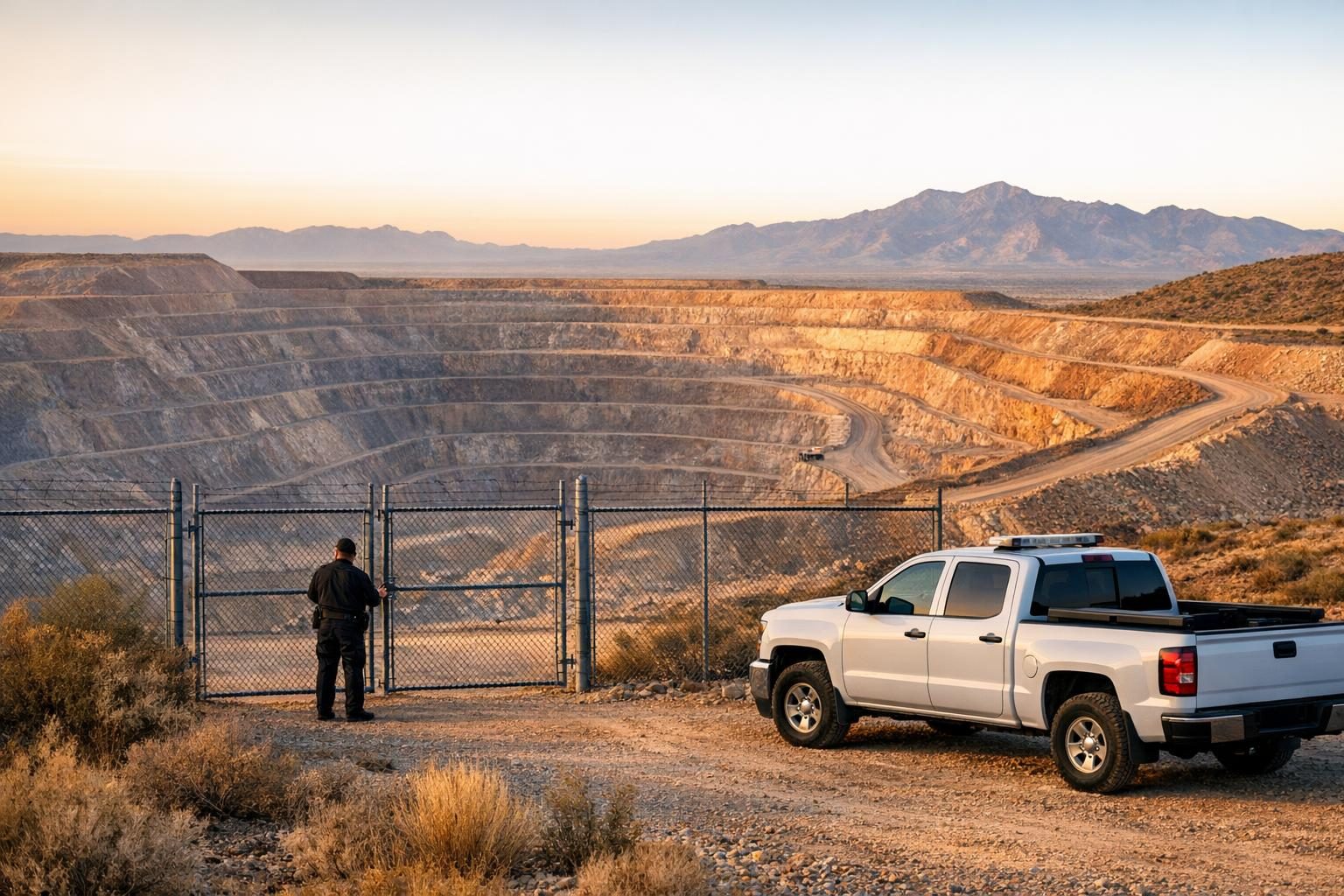
Mining security in Arizona is a problem of distance and value. A copper operation can cover thousands of acres, run haul roads miles from town, and store copper, cable, diesel, tires and explosives that are all worth stealing. One guard at the front gate does not cover that ground.
This guide covers the threats Arizona mine and quarry operators face, the controls that work against each one, and the federal rules that shape how a security contractor works on a mine site. If you already know you need help, our mining security services page describes the gate, scale and patrol coverage we provide in Arizona.
Parts of this guide are regulatory. Treat it as general information, not legal advice, and confirm specifics with your compliance team, counsel or MSHA district office.
Key takeaways
- Arizona produced about 70% of U.S. copper in 2025 (USGS, February 2026), which makes metal and equipment theft a real risk here.
- Most mine loss passes a choke point. Staffed gates and scale houses that check loads against paperwork close the easiest routes.
- Explosives magazines must be inspected at least every seven days, and theft must be reported to ATF within 24 hours (27 CFR Part 555).
- Security firms are independent contractors under MSHA. Copper mines train under 30 CFR Part 48.
- Heat, distance and spotty radio coverage belong in the post orders.
Where this guidance comes from. We used the USGS Mineral Commodity Summaries 2026, the Arizona Geological Survey, ATF rules in 27 CFR Part 555, MSHA rules in 30 CFR Parts 45, 46, 48 and 56 and the MSHA Program Policy Manual, Arizona statutes on scrap metal and trespass, CISA guidance on operational technology, and MSHA heat stress guidance, plus our team’s field experience running gate, patrol and remote-site security in Arizona.
Why mining security matters in Arizona
Copper is the reason. The USGS Mineral Commodity Summaries released in February 2026 report that Arizona was the leading copper-producing state, with about 70% of domestic output. U.S. mine production was an estimated 1.0 million tons in 2025 from 26 mines. The Arizona Geological Survey calls copper the state’s most valuable metallic mineral product, with districts from Ajo and Silver Bell in Pima County to San Manuel-Kalamazoo in Pinal County and Morenci in the east.
That value creates predictable problems: long fence lines in open desert, few people on site at night, material leaving by the truckload, steady contractor traffic, explosives stored for blasting, and plants that run on networked controls. Good mining security does not try to watch every acre. It controls the choke points, patrols the ground in between on a varied schedule, and makes loss show up in records quickly.
The main threats on Arizona mine and quarry sites
Copper and metal theft
Copper shows up across a mine as cathode, power cable, grounding wire, bus bar and maintenance scrap. Cable and scrap are easiest to cut, load and sell. Arizona’s scrap metal law defines scrap metals to include insulated and uninsulated metallic cables (A.R.S. 44-1641).
Under A.R.S. 44-1642, dealers must record a photo, description and weight of the metal, the seller’s ID, the delivery vehicle’s plate and a fingerprint, and keep records for two years. They cannot pay on site for copper and aluminum wire of at least three-eighths of an inch in diameter or for transactions of $300 or more. That paper trail helps you. Photograph and mark cable and scrap so investigators have something specific to match.
Fuel, parts and equipment theft
Diesel, tires, cutting edges, batteries and tools walk off a site long before anyone tries to steal ore. The signs show up in records first: fuel delivered that does not match fuel dispensed and equipment hours, consumables that run short, or fresh tracks along a remote fence. Fuel islands and laydown yards need lighting, locks and patrol checks of their own.
Explosives magazine security
Explosives are the highest-consequence theft risk on many sites. ATF storage rules in 27 CFR Part 555, Subpart K cover magazine types, location, construction, locks and housekeeping. For example, outdoor type 2 magazines need padlocks with at least five tumblers and a case-hardened shackle of at least three-eighths of an inch, protected by steel hoods at least one-quarter inch thick (555.208).
Magazines must be inspected at least every seven days (555.204), and a theft or loss must be reported to ATF and local authorities within 24 hours of discovery (555.30). MSHA’s 30 CFR 56.6130 also requires packaged blasting agents to be locked or attended. Patrols do not replace the licensee’s inspections, but documented checks of locks, hoods and fencing between them shorten the time to discovery.
Trespass on remote ground
Scrappers, off-road riders, hunters and claim jumpers all end up on mine property, and haul roads, highwalls and ponds can kill someone who does not know the site. Under A.R.S. 13-1504, entering unlawfully on land subject to a valid mineral claim or lease with intent to work or take minerals is first-degree criminal trespass, a class 1 misdemeanor. Posted signs, maintained fences and documented warnings make enforcement easier.
Protests and blockades
Mining projects in Arizona can draw organized opposition, so a protest at a gate is a foreseeable event. The security goal is narrow: keep the gate controlled, keep people out of active mining areas, keep haul traffic safe, and document what happens. Plan ahead with law enforcement and set alternate access routes.
Insider theft and collusion
A lot of mine loss involves someone who belongs on site. Manual scale overrides, off-hours weighing, drifting tare weights and badges used at odd times deserve a closer look. Our guide to employee theft investigations explains how a discreet inquiry is typically run.
Cyber risk to operational technology
Mills, conveyors and dewatering pumps often run on controllers tied to the business network. CISA’s 2025 fact sheet on operational technology recommends removing OT internet exposure, changing default passwords, securing remote access with phishing-resistant MFA, segmenting IT and OT, and keeping manual operation available. Control rooms and network cabinets also need locks, access logs and patrol checks.
Mining security threats mapped to controls
| Threat | Where it shows up | Primary controls |
|---|---|---|
| Copper and cable theft | Substations, cable runs, scrap yards | Lighting, locked scrap bins, marked stock, randomized patrol, live camera monitoring |
| Fuel and parts theft | Fuel islands, laydown yards, shops | Fuel reconciliation, locked storage, patrol checks, outbound vehicle inspection |
| Explosives theft | Magazines, blasting agent storage | ATF-compliant locks and hoods, key control, seven-day inspections, patrol checks in between |
| Load and scale fraud | Scale houses, outbound gates | Staffed scale, loads checked against paperwork, cameras on the scale deck |
| Trespass | Remote fence lines, haul roads, pits | Posted signs, fence repair, perimeter patrol, remote video |
| Protest or blockade | Main gate, access roads | Law enforcement contact plan, alternate routes, observe-and-report post orders |
| OT cyber intrusion | Control rooms, remote panels | Physical access control, IT/OT segmentation, MFA on remote access, manual fallback |
Access control at gates and scale houses
Every truckload of ore, every contractor and every pallet of parts crosses a gate or a scale, which makes them the cheapest place to stop loss.
- One authorized list of contractor companies and approved drivers, kept current by site management.
- Outbound inspection gets the closer look, since that is where material leaves.
- Scale discipline: manual overrides and after-hours weighing need a second person and a written reason.
- Records that reconcile: gate logs, scale tickets and camera timestamps should agree.
This is the same discipline our critical infrastructure security teams apply at utility and industrial sites.
Ready to scope coverage? If you are weighing gate, scale or patrol coverage for an Arizona mine or quarry, request mining security online with your site location and concerns, or book a consultation online to plan a site walk.
Remote perimeter monitoring and large-footprint patrol
A fixed post cannot watch a fence line measured in miles. Most sites need posts at the choke points, mobile patrol across the property, and cameras where patrols cannot reach often enough.
How to design patrol routes
- Map magazines, fuel, substations, cable runs, scrap yards, remote gates and control buildings.
- Set check frequency by risk, not convenience.
- Vary timing and order so nobody can learn a gap.
- Record each check with time, location and condition.
- Review records weekly and move patrols to where loss is showing up.
Patrol vehicles must handle rough haul roads and follow site right-of-way rules around heavy equipment. Our mobile vehicle patrol service is built around documented routes like these.
Where remote video fits
Cameras matter most when someone watches live. Live monitoring with voice talk-down, virtual guard tours and remote alarm verification can cover idle pits and sites in care and maintenance between patrols. See our remote virtual guarding page. Plan power and communications before choosing camera locations. For sites tied to power or water, our energy and utilities security work follows the same layered approach, and our post on critical infrastructure physical security planning covers building the plan.
MSHA site access and training for security contractors
A security company working at a mine is an independent contractor under 30 CFR 45.2, which covers any organization that contracts to perform services at a mine. Under 45.4, the contractor must give the operator, in writing, its name and address, the work and where it will be done, its MSHA ID number if any, and an address of record. As of October 2026, 30 CFR Part 46 covers sand, gravel, surface stone, surface clay, colloidal phosphate, surface limestone and shell dredging operations. Copper and other metal mines fall under Part 48.
| Question | Part 46 | Part 48 |
|---|---|---|
| Typical Arizona sites | Sand and gravel pits, stone and limestone quarries | Open-pit and underground copper and metal mines |
| Who trains contractor employees | Contractor is primarily responsible for new miner and refresher training; operator for site-specific hazard awareness (46.12) | Independent contractors are responsible for their employees’ Part 48 training, using their own plan or the operator’s (MSHA guidance) |
| Regular exposure | At least 24 hours new miner training and 8 hours annual refresher (46.5, 46.8) | Comprehensive training; MSHA guidance treats more than 5 consecutive workdays, or a recurring pattern, as regular exposure |
| Occasional presence | Site-specific hazard awareness training before exposure (46.11) | Hazard training before work, refreshed every 12 months (48.31) |
Part 48 hazard training covers hazard recognition and avoidance, emergency and evacuation procedures, safety rules and safe work procedures, and self-rescue and respiratory devices. The MSHA Program Policy Manual (Volume III, Release III-23, July 2003) does not single out security guards, so a gate officer and a patrol officer who drives haul roads nightly may land in different categories. Settle it with the operator’s training department before the first shift, and budget for the training time.
Heat and remote-area officer safety
MSHA’s heat stress alert stresses frequent water intake, regular cool-down breaks, gradual acclimatization and knowing warning signs such as a body temperature over 103 degrees Fahrenheit and confusion. An officer alone on a perimeter run in July needs a plan.
- Water, shade and cooled vehicles on every patrol.
- Scheduled check-ins with a supervisor, and a set response to a missed one.
- Communications mapping so officers know where radios and phones drop out.
- Emergency coordination: muster points and how to guide responders to remote gates.
If anyone is in immediate danger, call 911, then follow the site’s emergency procedures.
Mining security cost drivers and how to choose a provider
Pricing follows the ground and the hours: footprint, gates and scale houses to staff, hours of coverage, armed or unarmed officers, patrol vehicles, distance from town, MSHA training time and existing lighting and cameras. Ask any provider:
- Are your officers licensed by the Arizona Department of Public Safety?
- How will officers meet the site’s MSHA training requirements?
- How do you document patrols, gate entries and incidents?
- What is your plan for heat, communications and a missed check-in?
An independent review is often the right first step. Our security assessments end in a written, prioritized plan. Consider a hypothetical: a Pinal County quarry notices fuel variances and cut fence near an unlit laydown yard. A sensible response is a site walk, a fuel reconciliation review, lighting and lock fixes, and randomized night patrol checks before committing to a permanent post.
How Honeybadger supports mining security in Arizona
Honeybadger Solutions is a veteran-owned, service-disabled veteran-owned small business based in Casa Grande, in Arizona’s copper country. Our officers are licensed under Arizona’s private security guard law. Mine-site coverage includes:
- Remote-site protection and after-hours presence for isolated mines and quarries.
- Access control at gates and scale houses, with contractor verification, traffic logs and load-to-paperwork checks.
- Documented large-footprint patrol of perimeters, laydown yards, fuel and magazine areas.
- Protection of heavy equipment, fuel, copper and ore, with remote video paired with patrol at idle sites.
- Loss follow-up: documenting losses, reviewing access records and supporting law enforcement and insurers.
We brief officers on haul traffic, blasting schedules and restricted areas, work inside your safety protocols, and align with your safety department on training before officers start. We quote after a site walk.
To get started, submit the online service request form with your site location and what you are losing or worried about, or book a consultation online to schedule a site walk.
Why the online intake is faster than a phone call: it takes about two minutes, and your answers are routed straight to the specialist team that handles your kind of matter, whether that is cyber and forensics, investigations or field security. That team sees the full picture before it replies, so you skip phone tag and get a real answer and next steps sooner. If it cannot wait for business hours, use the urgent intake form, which is read seven days a week.
Frequently asked questions
Do security guards at a mine need MSHA training?
Usually some level of it. A security company is an independent contractor under MSHA. At a copper mine, officers regularly exposed to mine hazards may need comprehensive Part 48 training, and those with occasional presence may need hazard training. Settle each role with the operator before the first shift.
Is Part 46 or Part 48 the right training rule for an Arizona copper mine?
Part 48. As of October 2026, Part 46 covers shell dredging, sand, gravel, surface stone, surface clay, colloidal phosphate and surface limestone mines. Metal mines such as open-pit copper operations train under Part 48.
How often must explosives magazines be inspected?
At least every seven days under 27 CFR 555.204. The inspection need not be a full inventory, but it must show whether anyone got in or removed anything without authorization. Security patrols can add checks in between.
What should we do if copper or explosives go missing?
If anyone is in immediate danger, call 911. Preserve the scene, pull gate and scale logs, and report to law enforcement. For explosives, 27 CFR 555.30 requires licensees and permittees to report theft or loss to ATF and local authorities within 24 hours of discovery.
Can a security officer stop a protest or blockade at the mine gate?
Private officers should observe, document and report. Their job is to keep the gate controlled, keep people out of active mining areas and give law enforcement accurate information. Removing people is a law enforcement decision.
What drives the cost of mining security?
Footprint, number of gates and scale houses, hours of coverage, armed or unarmed officers, patrol vehicles for haul roads, distance from town, MSHA training time and existing cameras and lighting. A site walk is the honest way to price it.
Sources and further reading
- USGS Mineral Commodity Summaries 2026: Copper — Arizona share of U.S. output and 2025 production.
- Arizona Geological Survey: King Copper — Arizona copper districts.
- eCFR: 27 CFR Part 555, Subpart K — Magazine inspections and locks.
- eCFR: 27 CFR 555.30 — Explosives theft reporting within 24 hours.
- eCFR: 30 CFR 56.6130 — MSHA explosives storage at surface mines.
- 30 CFR 45.4 (Cornell LII) — Independent contractor information.
- eCFR: 30 CFR Part 46 — Part 46 scope, training hours and duties.
- eCFR: 30 CFR 48.31 — Part 48 hazard training.
- MSHA Program Policy Manual, Volume III — Regular exposure and contractor training.
- A.R.S. 44-1642 — Scrap metal dealer records and payment rules.
- A.R.S. 13-1504 — Trespass on mineral claims.
- CISA: Primary Mitigations to Reduce Cyber Threats to OT — Baseline OT security steps.
- MSHA: Heat Stress Health Alert — Heat illness prevention and warning signs.
Written and reviewed by the Honeybadger Solutions security and investigations team, a veteran-led Arizona firm (Arizona DPS private investigation agency license No. 1759795). Facts checked against the cited sources on October 2, 2026. This article is general information, not legal advice.
Browse by topic
Security guard services · Private investigations · Cybersecurity · Digital forensics · Financial fraud investigation · Executive protection · All articles