
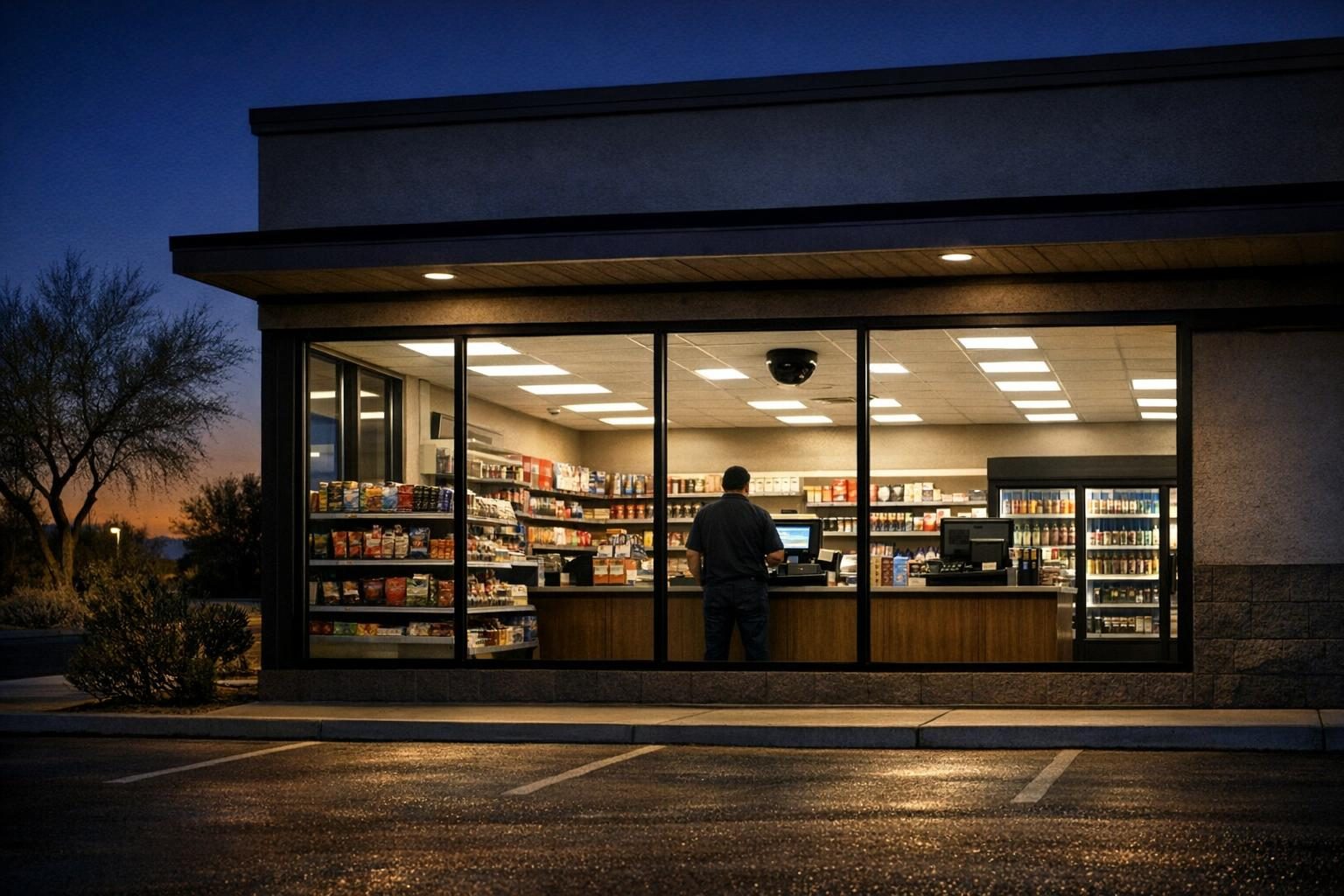
Type 1 workplace violence is violence by an outsider who comes to commit a crime, most often a robbery. The attacker has no legitimate connection to the business or its staff. For convenience stores, gas stations and other cash businesses, it is the form most likely to turn deadly. This guide covers the data, who is most at risk, the controls OSHA and the U.S. Department of Justice point to, and what employees should do during and after a robbery.
If anyone is in immediate danger, call 911.
Key takeaways
- Type 1 means the attacker has no legitimate relationship with the business and is usually committing a crime such as robbery.
- In 2024, 470 U.S. workers were killed in workplace homicides, and shootings caused 379 of those deaths (about 81 percent).
- In the latest BLS assailant breakdown (2013 to 2017), robbers were the largest group of workplace homicide assailants every year.
- OSHA’s late-night retail guidance stresses low cash, good lighting, clear sightlines, cameras and handing over money without resistance.
- Security officers add visible deterrence, but they work best as one layer in a written prevention plan.
Where this guidance comes from. This article draws on BLS, NIOSH, OSHA, FBI, BJS and DOJ COPS Office data and guidance, plus Arizona statutes. It also reflects our team’s field experience running security posts and investigations across Arizona. Each figure carries its data year, because some of the most useful numbers are several years old.
What is Type 1 workplace violence?
The four-type model comes from the University of Iowa Injury Prevention Research Center (UIIPRC), whose February 2001 report to the nation defines Type I this way: “The perpetrator has no legitimate relationship to the business or its employees, and is usually committing a crime in conjunction with the violence.”
The FBI uses the same model and describes Type 1 as “violent acts by criminals who have no other connection with the workplace, but enter to commit robbery or another crime.” For example, that includes an armed robbery at a convenience store counter, a holdup at a gas station at 2 a.m., or a carjacking of a delivery driver.
Our workplace violence prevention and response services cover all four types. This guide focuses on the first.
How Type 1 fits the four types
In the FBI’s version, Type 2 is violence by customers, clients, patients or others the organization serves. Type 3 is violence by a current or former employee. Type 4 is violence by someone with a personal relationship to an employee, such as an abusive partner.
Type 1 stands apart because the offender is usually a stranger and the motive is usually money or goods. The violence is a means to the crime. So prevention focuses on the target: how much cash is on hand, who can see into the store, how late it is open and how staff respond.
The 2001 UIIPRC report, based on 1990s data, said “Eighty-five percent of all workplace homicides fall into this category.” Treat that as historical context, not a current figure.
Related: the four types of workplace violence. Read our guides to Type 2 customer and client violence and Type 3 coworker violence.
Type 1 by the numbers
- 2024 homicides: 470 workers were killed in workplace homicides, up from 458 in 2023, according to the BLS Census of Fatal Occupational Injuries.
- 2024 shootings: shootings by another person caused 379 deaths, about 81 percent of workplace homicides.
- Robbers, 2013 to 2017: robbers were the largest group of workplace homicide assailants each year: 147 (2013), 130 (2014), 128 (2015), 152 (2016) and 128 (2017).
- 2011 to 2015 totals: robbers 721; coworkers or work associates 312; customers, clients, patients or students 247; relatives or domestic partners 160.
BLS stopped publishing homicides by assailant type in its CFOI releases after the 2017 data. The 2013 to 2017 robber counts are the latest BLS breakdown available, not current figures.
Occupation data points the same way. In 2016, cashiers (54 homicides), retail supervisors (50) and police officers (50) had the most workplace homicides, and robbers were the most common assailant in homicides of men (33 percent).
BJS figures for 2015 to 2019 add context. Workers in sales and related jobs were 21 percent of workplace homicide victims, and protective services were 19 percent. Strangers committed 47 percent of nonfatal incidents, and only about 39 percent of nonfatal incidents were reported to police.
Who is most at risk
OSHA’s higher-risk groups include “workers who exchange money with the public, delivery and taxi/ride share drivers,” and others “who may work alone or in small groups.” It also flags late-night shifts, isolated work areas and high-crime locations.
- Late-night retail. OSHA’s enforcement directive names convenience stores, liquor stores and gas stations.
- Cash handlers. Cashiers, retail supervisors and anyone who counts, carries or deposits cash.
- Other cash- or product-heavy businesses. The studies here focus on convenience stores. We include cannabis dispensaries and pharmacies as reasoned examples, because they share the same risk factors: cash or high-value product and a public counter.
- Delivery and ride share drivers. They often work alone and carry cash or goods.
- Security officers. Protective service occupations had 281 work deaths in 2024, and 97 (34.5 percent) were homicides.
OSHA’s late-night retail recommendations (OSHA 3153)
OSHA publication 3153 (2009) is the most practical federal checklist for Type 1 risk. Its engineering controls include low shelving and window signs so staff can see out and police can see in, good lighting inside and out, cameras, curved mirrors, drop safes, bullet-resistant enclosures, buzzer entry, panic buttons and height markers on exit doors.
Its administrative controls include keeping minimal cash in each register, adding staff at stores with a history of robbery or assault, locking doors before and after business hours, working with local police and training staff in “Early recognition of escalating behavior.”
What the robbery research says
The DOJ COPS Office guide Robbery of Convenience Stores (2007) drew three clear lessons from the research:
- Cash limits work. “80 percent of potential robbers can be deterred if a convenience store limits the amount of money kept in its cash register.”
- Hours matter most. “Operation hours are by far the strongest factor contributing to convenience store robbery, particularly for stores open 24 hours a day.”
- Visibility deters. “Robbers are deterred by brightly lit stores in which employees and the store’s cash registers are clearly visible from the street.”
The guide also notes that Florida’s 1992 Convenience Business Security Act required multiple clerks during high-risk hours, but it calls the research on clerk staffing mixed.
A NIOSH-funded case-control study (Amandus and colleagues, 1999) of 400 robberies in three Virginia metro areas found that “cash handling policy, bullet-resistant shielding, and numerous characteristics of the surrounding area and population” were significantly linked to robbery risk.
Robbery prevention controls at a glance
| Control | What it does | Source |
|---|---|---|
| Drop safe and limited-cash signs | Keeps little cash at the counter and tells robbers there is little to take | OSHA 3153 |
| Minimal cash in each register | Lowers the payoff that draws robbers | OSHA 3153; DOJ COPS |
| Low shelving and clear windows | Lets staff see who is coming and lets police see in | OSHA 3153; DOJ COPS |
| Bright interior and exterior lighting | Removes cover and keeps the register visible from the street | OSHA 3153; DOJ COPS |
| Video surveillance and curved mirrors | Adds watchfulness and records evidence | OSHA 3153 |
| Bullet-resistant enclosure | Puts a barrier between the clerk and the public | OSHA 3153; NIOSH study |
| Panic buttons and alarms | Summons help when it is safe to do so | OSHA 3153 |
| Height markers on exit doors | Helps witnesses estimate a suspect’s height | OSHA 3153 |
| Locked doors before and after hours | Protects the riskiest times of day | OSHA 3153 |
| Review of late-night hours | Addresses the strongest single robbery risk factor | DOJ COPS |
| Robbery-response training | Teaches staff to hand over money without resistance | OSHA 3153 |
Crime prevention through environmental design (CPTED)
The Phoenix Police Department describes CPTED principles as “a design tool that combines physical design with the land use to influence personal behavior while reducing crime opportunities.” In practice, that means clear sightlines to the register, a lot with no dark corners and landscaping trimmed so no one can hide near the door.
Phoenix businesses can request a property evaluation from the Phoenix PD Business Crime Prevention program at 602-256-4303. For a review that also covers procedures, staffing and guard coverage, see our on-site security assessments.
Cash handling and opening and closing procedures
Most Type 1 risk centers on cash and on the moments when a store is least protected. Move extra cash to a drop safe throughout the shift, and make sure limited-cash signs are true. A closing routine might run in this order:
- Check the lot and entrance from inside before the last customer leaves.
- Lock the doors at closing time and keep exterior lights on.
- Count and drop cash out of public view.
- Confirm the cameras are recording and set the alarm.
- Leave together when more than one person is on shift, and look around before stepping outside.
Our retail loss prevention security guide covers theft and cash controls in more depth.
What employees should do during a robbery
OSHA 3153 says training should include “Specific instructions on how to respond to a robbery such as turning over money or valuables without resistance.” Make that the core of every briefing.
- Comply. Give the robber what they ask for, calmly and without argument.
- Do not resist. Do not fight, block the door or chase the robber.
- Keep hands visible. Move slowly and say what you are about to do, for example, “I’m opening the drawer now.”
- Use alarms only if safe. Skip the panic button if the robber could see it as a threat.
- Observe. Note height, clothing, voice, any weapon and direction of travel.
- Call 911 after the robber leaves, then lock the door.
After the robbery
- Get medical care. Give first aid and call 911 for anyone hurt.
- Secure the scene. Lock the doors and leave untouched anything the robber handled.
- Keep witnesses. Ask them to stay and write down what they saw, separately.
- Preserve the video. Export a copy of the footage before the system records over it.
- File a police report and keep the report number.
- Support your people. OSHA 3153 lists medical care, trauma counseling, critical incident stress debriefing and employee assistance programs.
- Review and adjust cash levels, lighting, hours and staffing.
OSHA, the General Duty Clause and workplace violence in late-night retail
No federal OSHA standard is written only for workplace violence. OSHA relies on the General Duty Clause, Section 5(a)(1) of the OSH Act, which requires a workplace “free from recognized hazards that are causing or are likely to cause death or serious physical harm” to employees.
OSHA Directive CPL 02-01-058, effective January 10, 2017, names four focus sectors, including late-night retail (convenience stores, liquor stores and gas stations). A citation requires showing that employees were exposed to a hazard, the hazard was recognized, it caused or was likely to cause death or serious harm, and a feasible way to reduce it existed.
In Arizona, ADOSH runs the OSHA-approved state plan, and A.R.S. 23-403(A) uses the same general-duty language. A written program shows you recognized the hazard and acted. Our guide to building an OSHA-aligned prevention program walks through the steps. This section is general information, not legal advice; talk to an Arizona attorney about your situation.
When to add a security officer
The studies above do not test guards directly, but a uniformed officer adds what they point to: someone visible who is watching. Consider coverage when the store is open late, has had robberies or threats, has staff working alone or carrying deposits, or holds a lot of cash or product.
Unarmed officers provide visible deterrence, watch the lot, escort staff at closing and report to police. For many retail posts, unarmed security officers are the right start.
Armed officers may fit sites with a history of armed robbery or large amounts of cash or product. Arizona requires armed guards to register with DPS, complete firearms training and not be a prohibited possessor under A.R.S. 32-2622. Post orders should make clear the job is protecting people, not merchandise. Learn about our armed security officers.
Frequently asked questions
What is Type 1 workplace violence?
Type 1 is criminal-intent violence. The attacker has no legitimate relationship with the business or its employees and is usually committing another crime, most often robbery.
Should employees resist a robber?
No. OSHA’s late-night retail guidance says staff should be trained to turn over money or valuables without resistance. Comply, keep your hands visible, avoid sudden moves and call 911 once the robber has left.
Do security guards reduce robbery risk?
The federal robbery studies cited here measure cash limits, lighting, visibility and hours, not guards directly. A visible, well-trained officer adds the watchfulness those studies point to, especially at opening, closing and late at night. A guard works best as one layer in a written plan and cannot guarantee a robbery will not happen.
What does OSHA require for late-night retail?
No federal OSHA standard is written only for this hazard. OSHA enforces it through the General Duty Clause, and its 2017 directive (CPL 02-01-058) names late-night retail as a focus sector. OSHA publication 3153 lists recommended controls such as drop safes, lighting, clear sightlines, cameras and robbery-response training.
What should a business do after a robbery?
Get medical care for anyone hurt, call 911, lock the doors and protect the scene. Save a copy of the camera footage, file a police report and offer staff trauma support, such as counseling, stress debriefing and an employee assistance program. Then update your prevention plan.
Is Arizona different?
Arizona runs its own OSHA-approved state plan through ADOSH, and its general duty clause, A.R.S. 23-403(A), uses the same language as the federal one. Security guards must also meet Arizona DPS registration rules. Talk to an Arizona attorney about your specific situation.
How Honeybadger helps prevent Type 1 workplace violence
Honeybadger Solutions is a veteran-owned, veteran-led security and investigations firm based in Casa Grande, serving the Phoenix metro, Pinal County and the Tucson area. For robbery risk, we provide security assessments, armed and unarmed officers for late-night and closing coverage, workplace violence prevention programs and robbery-response training, plus investigations, surveillance and background checks for cash-handling roles.
To talk through your site, submit a confidential service request online or book a consultation. For something that cannot wait for business hours, use the urgent intake form. If anyone is in immediate danger, call 911.
Why the online intake is faster than a phone call: it takes about two minutes, and your answers are routed straight to the specialist team that handles your kind of matter, whether that is cyber and forensics, investigations or field security. That team sees the full picture before it replies, so you skip phone tag and get a real answer and next steps sooner. If it cannot wait for business hours, use the urgent intake form, which is read seven days a week.
Sources and further reading
- OSHA, Workplace Violence — OSHA definition and higher-risk worker groups.
- UIIPRC, A Report to the Nation (2001) — Type I definition and the historical 85 percent homicide share.
- FBI, Issues in Response — FBI wording of the four types.
- BLS, National Census of Fatal Occupational Injuries in 2024 — 470 homicides in 2024 and protective service deaths.
- BLS, CFOI Table 2 — 379 shooting deaths by another person in 2024.
- BLS, Workplace homicides by selected assailant, 2013-2017 — Robber assailant counts by year.
- BLS, The Economics Daily: workplace homicides in 2016 — Cashier and retail supervisor homicides in 2016.
- BJS, Indicators of Workplace Violence, 2019 — Occupation shares, stranger offenders and reporting rates, 2015-2019.
- OSHA 3153, Late-Night Retail Recommendations — Engineering, administrative and robbery-response controls.
- DOJ COPS Office, Robbery of Convenience Stores — Cash limits, hours and visibility findings.
- NIOSH-funded case-control study (Amandus et al., 1999) — Cash handling and shielding linked to robbery risk.
- OSHA Directive CPL 02-01-058 — General Duty Clause enforcement and late-night retail focus.
- Phoenix PD, Property Design for Crime Prevention — CPTED definition and business property evaluations.
- A.R.S. 23-403, Employer duties — Arizona general duty clause.
Written and reviewed by the Honeybadger Solutions security and investigations team, a veteran-led Arizona firm (Arizona DPS private investigation agency license No. 1759795). Statistics checked against the cited sources on October 2, 2026. This article is general information, not legal advice.
Browse by topic
Security guard services · Private investigations · Cybersecurity · Digital forensics · Financial fraud investigation · Executive protection · All articles