
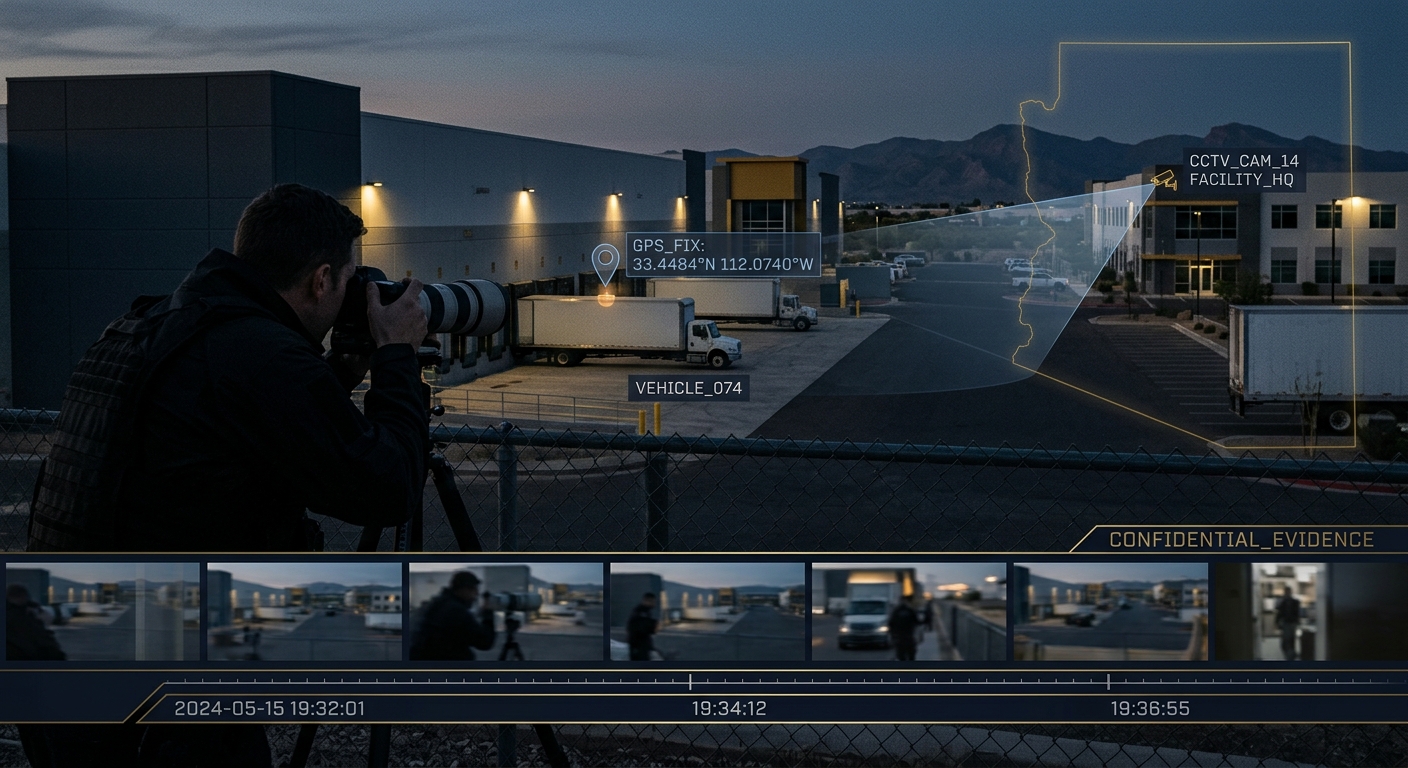
Corporate and employee surveillance is legal in Arizona when an employer investigates a genuine concern using lawful methods—public-vantage observation, monitoring of company-owned systems and premises under clear policy, and no unlawful recording or harassment. Honeybadger’s own AZ-licensed, in-house investigators document misconduct, workers’ compensation fraud, and moonlighting discreetly, then corroborate it with digital forensics and OSINT so it holds up with counsel, insurers, and the courts.
When an Arizona business suspects that an employee is stealing, moonlighting for a competitor, gaming a disability claim, or leaking confidential information, the instinct to \”just watch them\” is understandable—and dangerous if executed without discipline. Corporate surveillance done to an elite standard converts suspicion into a corroborated, court-ready record that supports discipline, termination, insurance defense, or civil recovery. Done carelessly, it produces inadmissible material, wrongful-termination and invasion-of-privacy exposure, and a claim that grows more expensive because the investigation collapsed. This guide explains how corporate surveillance is lawfully conducted in Arizona, where the legal boundaries sit, and how employers and their counsel should scope the work. It is general information for executives, GCs, and HR leaders, not legal advice—confirm specifics with employment counsel.
What is corporate surveillance, and when is it justified?
Corporate surveillance is the lawful observation and documentation of employee or third-party conduct in service of a legitimate business concern. It is a targeted response to articulable red flags—not a default applied to an entire workforce. The strongest, most defensible engagements begin with a specific concern that a reasonable manager could articulate: inventory shrinkage that tracks to one shift, a worker on total-disability leave rumored to be running a side business, a departing engineer suspected of taking trade secrets, or a sales representative believed to be diverting deals to a competitor.
Common categories of justified corporate surveillance include:
- Time theft and productivity fraud—employees claiming hours not worked, or using company vehicles and time for personal ventures.
- Workers’ compensation and disability fraud—claimed restrictions contradicted by observed physical activity or undisclosed work.
- Moonlighting and conflicts of interest—working for a competitor or running a side business in violation of policy or agreement.
- Theft, diversion, and asset misuse—removing inventory, equipment, or funds, or misusing company property.
- Non-compete and non-solicitation violations—soliciting clients or employees in breach of a lawful restrictive covenant.
- Unauthorized access—after-hours entry, badge misuse, or access to restricted areas or systems.
Is employee surveillance legal in Arizona?
Yes—Arizona employers have broad, but not unlimited, authority to investigate their workforce. The legality of any given method turns on three questions: whether the subject had a reasonable expectation of privacy, whether the method complied with Arizona’s recording law, and whether the conduct stayed clear of harassment. As an employer, your rights are strongest over your own property—company-owned computers, phones, vehicles, email systems, and premises—particularly where a written, acknowledged policy has put employees on notice that those assets may be monitored.
Your authority narrows where employees retain a reasonable expectation of privacy. Arizona law does not permit recording in restrooms, locker rooms, or changing areas, and it does not permit intercepting private conversations you are not a party to—Arizona’s one-party-consent rule (A.R.S. § 13-3005 and § 13-3012) allows recording a conversation you participate in, not covert bugging of others. Field surveillance of conduct occurring in public—an employee loading a competitor’s truck, or performing strenuous labor while on total-disability leave—is generally permissible when conducted from public vantage points without trespass. And all surveillance must avoid conduct that would violate the state’s stalking and harassment statute (A.R.S. § 13-2923), which prohibits conduct directed at a specific person that would cause a reasonable person to fear for their safety.
Finally, whoever conducts field surveillance in Arizona must be licensed. Private investigators are regulated by the Arizona Department of Public Safety under A.R.S. Title 32, Chapter 24. Using an unlicensed operator undermines admissibility and invites its own liability.
What methods are used, and what are the Arizona limits?
Corporate surveillance is a toolkit, and each tool carries its own constraints. The table below summarizes what each method establishes and the principal Arizona limit a disciplined investigator observes.
| Method | What it establishes | Principal Arizona limit |
|---|---|---|
| Field video (public vantage) | Moonlighting, disability fraud, off-site activity | Public vantage only; no trespass; no filming into private areas |
| Company-device / system monitoring | Data exfiltration, misuse, communications on company systems | Best with written, acknowledged monitoring policy |
| Premises CCTV | Theft, unauthorized access, safety incidents | No cameras where privacy is expected (restrooms, changing areas) |
| Undercover placement | Internal theft rings, hostile-environment conduct | No entrapment; disciplined scope; often counsel-directed |
| OSINT / public records | Side businesses, competitor ties, contradictions | Public content only; no account access or deception |
| Company-owned vehicle GPS | Time theft, route/asset misuse | Lawful on owned vehicles; pair with policy and notice |

How do digital forensics and OSINT strengthen a corporate case?
Field surveillance rarely stands alone in a corporate matter. The most persuasive investigations fuse observation with evidence drawn from the company’s own systems and from lawful open sources. When an employee is suspected of stealing trade secrets or diverting business, our in-house digital forensics team can examine company-owned devices for exfiltration artifacts—mass file copying to USB, uploads to personal cloud accounts, or communications with a competitor—while access logs and badge data establish who was where and when. Because this work is performed on company-owned assets under policy, it sits on solid legal footing.
Open-source intelligence extends the picture. Public business registrations may reveal a competing side business; public social-media content may show a \”totally disabled\” employee performing strenuous work or advertising services; public court and licensing records may surface undisclosed conflicts. The discipline is the same as in every lawful investigation: access only public content, avoid deception and account intrusion, and preserve everything forensically with timestamps, source URLs, and hash verification so it cannot later be dismissed as fabricated. For a broader treatment of intelligence gathering, see our cyber and intelligence services.
How do we run a defensible corporate surveillance program?
Process is what separates surveillance that supports a clean termination or a successful insurance defense from surveillance that becomes the plaintiff’s best exhibit. This framework reflects how Honeybadger’s own Arizona-licensed investigators structure a corporate engagement.
- Define the articulable concern with counsel and HR. Document the specific suspicion and the business justification before any surveillance begins, so the work targets facts, not a person.
- Confirm policy footing. Verify that relevant monitoring policies for devices, vehicles, and premises are in place and acknowledged; where they are not, coordinate with counsel on lawful methods.
- Deploy licensed investigators. Use AZ-licensed personnel and map recording, trespass, and privacy limits before fieldwork.
- Scout before committing hours. Use OSINT and activity checks to establish patterns and target productive windows.
- Observe lawfully and continuously. Record unbroken, timestamped video from public vantage points—no trespass, no filming into private areas, no unlawful audio.
- Corroborate digitally. Pair field observation with forensic examination of company-owned systems and public-records research.
- Preserve forensically. Retain native files, hash-verify integrity, keep contemporaneous logs, and maintain an unbroken chain of custody.
- Route through counsel and, if applicable, the SIU. Deliver objective findings for legal review and coordinated use in discipline, litigation, or insurance defense.
What separates a defensible investigation from a liability?
Two Arizona employers can run what looks like the same surveillance and end up in opposite places—one with a clean termination that survives a wrongful-discharge challenge, the other defending an invasion-of-privacy or bad-faith claim. The distance between them is not luck; it is discipline. Elite corporate investigations are marked by several features that mediocre ones lack.
- Documented predicate. The file opens with a written, articulable business concern—not a manager’s grudge—so the investigation is demonstrably purpose-driven rather than retaliatory.
- Proportional scope. The methods match the concern. A time-theft suspicion does not justify covert cameras in private spaces; a trade-secret concern justifies forensic review of company devices, not surveillance of an employee’s home.
- Policy alignment. Monitoring of devices, vehicles, and premises rests on written, acknowledged policies, and field surveillance stays on public vantage points.
- Legal-privilege posture. The most sensitive investigations are directed by counsel, which can protect work product and ensure the record is built with litigation in mind.
- Objective reporting. Investigators report what was observed—not legal conclusions or editorializing—because overreaching narration hands the other side a credibility target.
Cost drivers follow the same logic. The price of a corporate investigation is driven less by hours of raw surveillance than by the number of subjects, the complexity of the digital environment, the geographic spread of the conduct, and whether the matter is heading to litigation—where forensic preservation and testimony readiness become essential rather than optional. A carrier or employer that scopes the work precisely, and insists on lawful method and forensic documentation from the outset, spends less and recovers more than one that orders open-ended monitoring and hopes something useful appears.
Representative scenario: the moonlighting field tech
Consider a representative matter. An Arizona services company suspected a field technician on total-disability leave was performing the same skilled labor for cash on the side. The concern was specific and mapped to a genuine business and insurance issue. Working with counsel, AZ-licensed investigators first reviewed public social-media content advertising the side work, then observed several days from public vantage points, documenting on continuous timestamped video the employee performing strenuous tasks squarely inconsistent with the claimed restrictions. Public-records research confirmed an unregistered side business. The footage and captures were preserved with a contemporaneous log and clean chain of custody, then delivered to counsel and the carrier’s Special Investigation Unit. This is an illustrative scenario, not a named client or claimed outcome, but it captures the lesson: a specific concern, lawful method, and forensic documentation are what turn observed conduct into a defensible record.
Honeybadger Solutions supports Arizona employers, general counsel, and defense firms across every venue—coordinated from our Casa Grande, Phoenix, and Oro Valley offices—building corporate investigations that stay lawful and admissible. For related reading, see our guides on undercover workplace investigations and workers’ comp fraud surveillance.
Frequently asked questions
Is it legal for an Arizona employer to conduct surveillance on employees?
Yes, within limits. Arizona employers may investigate suspected misconduct, monitor company-owned systems and premises, and use a licensed investigator to document conduct that occurs in public or in areas without a reasonable expectation of privacy. Employers may not record where privacy is expected (restrooms, changing areas), intercept private conversations they are not party to, or use methods that violate the anti-stalking statute. Clear written policies covering monitoring of company devices, vehicles, and premises strengthen both the legality and the evidentiary value of any findings.
Can an employer track an employee who is on workers’ compensation or FMLA leave?
An employer may commission lawful surveillance of an employee suspected of misrepresenting a disability claim or working elsewhere during protected leave, but the observation must stay within public vantage points and the state’s recording and anti-harassment limits. The purpose must be a genuine, articulable concern—such as evidence of a second job during claimed total disability—not retaliation. Findings should be routed through counsel and, for insurance matters, the carrier’s Special Investigation Unit. Overbroad or retaliatory monitoring invites bad-faith and privacy exposure.
Do we need to tell employees they are being monitored in Arizona?
For monitoring of company-owned devices, systems, vehicles, and premises, best practice—and often the safest legal posture—is a clear, acknowledged written policy stating that such assets may be monitored. This reduces employees’ reasonable expectation of privacy and makes resulting evidence more defensible. Covert field surveillance of conduct occurring in public generally does not require advance notice, but audio recording of conversations you are not part of is restricted regardless of policy. Coordinate the specifics with employment counsel.
What corporate misconduct can surveillance actually prove?
Lawful corporate surveillance is well suited to documenting time theft, moonlighting for a competitor, workers’ compensation and disability fraud, theft and diversion of inventory or assets, unauthorized after-hours access, and violations of non-compete or non-solicitation obligations. It is most powerful when paired with digital forensics on company-owned systems, access-log analysis, and public-records or OSINT research—building a corroborated, court-ready record rather than a single ambiguous observation.
About Honeybadger Solutions
Honeybadger Solutions is an Arizona-licensed security and investigations firm delivering full-spectrum corporate investigations, digital forensics, and cyber intelligence to employers, general counsel, and defense firms across Arizona and nationwide. In Arizona, our corporate and employee surveillance is performed by our own in-house, AZ-licensed investigators—not subcontractors—so the professionals who gather the evidence can also authenticate it. We operate three Arizona offices—Casa Grande (headquarters), Phoenix, and Oro Valley—and support engagements across every Arizona venue.
Facing suspected employee misconduct or fraud and need a defensible investigation? Call 602-725-2818 to brief an investigations lead and scope a lawful approach with your counsel and HR. Confidential. Defensible. Court-ready.
This article is general information, not legal advice; Arizona law changes over time—confirm specifics with qualified employment counsel. Authoritative references: Arizona Revised Statutes Title 23 (Labor) and the U.S. Equal Employment Opportunity Commission.