
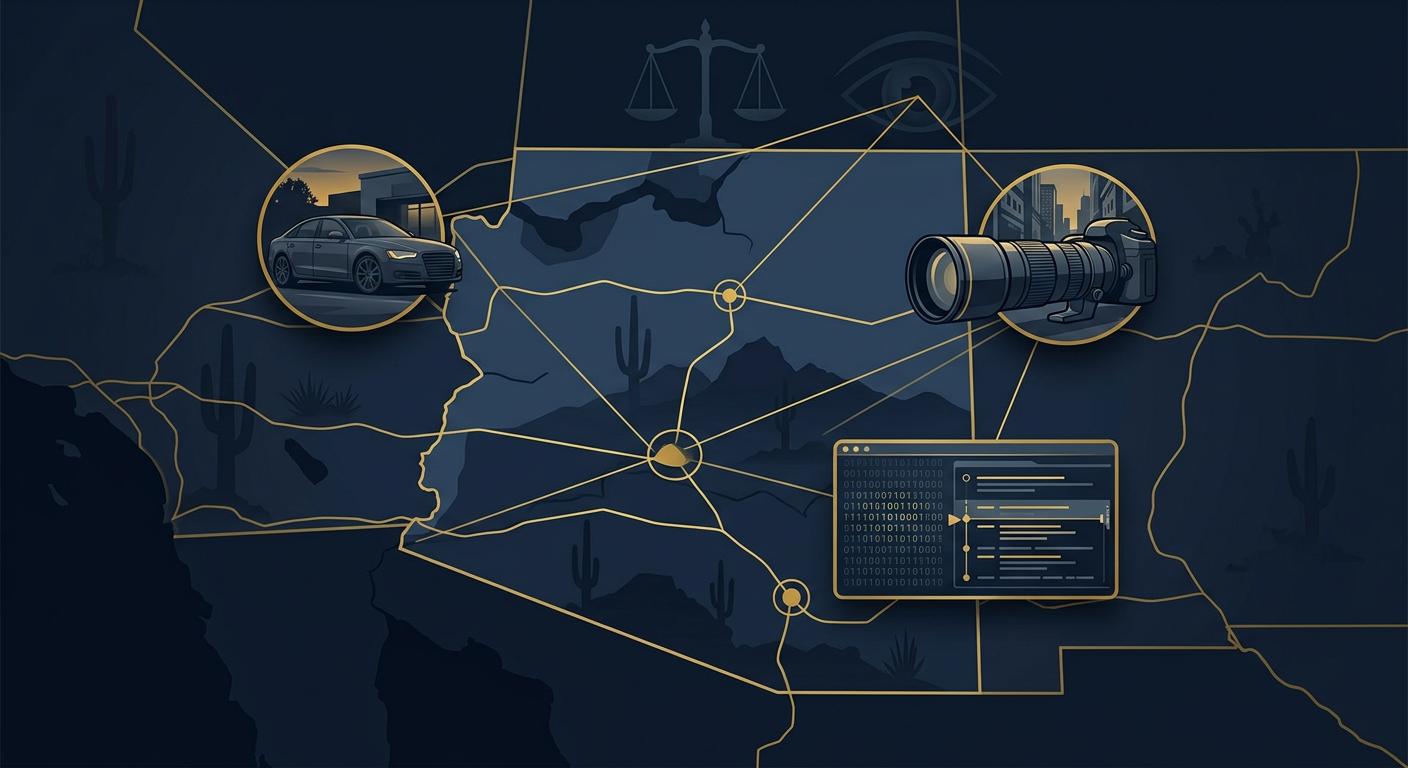
Covert surveillance is the discreet, lawful observation and documentation of a subject’s activity from vantage points where the investigator has a legal right to be, capturing only what any person could observe—without trespass, without intruding on private spaces, and without unlawful audio recording. In Arizona it is legal when performed this way; Honeybadger Solutions conducts it with our own in-house, Arizona-licensed investigators, producing court-ready, chain-of-custody-controlled evidence.
Covert surveillance is one of the most misunderstood tools in the investigative field—romanticized in fiction and, in unskilled hands, a fast route to a burned case or legal liability. Done at an elite level, it is a rigorous discipline of patience, positioning, legal precision, and documentation. For Arizona attorneys, insurers, employers, and private principals, this guide explains what covert surveillance actually is, exactly where Arizona law draws the lines, and how professional investigators operate for days without ever being detected. It is general information, not legal advice; confirm specifics with counsel before acting.
What exactly is covert surveillance?
Covert surveillance means observing a subject without their knowledge, to document behavior, movements, associations, or activity that is relevant to a legal, insurance, corporate, or personal matter. “Covert” refers to the fact that the subject is unaware—not to any unlawful method. The entire objective is a truthful record of what the subject actually does when they believe no one is watching, because that record is often the difference between a claim and proof.
It is useful to separate covert surveillance from adjacent concepts. It is not electronic eavesdropping or wiretapping—intercepting private communications is a distinct activity governed by separate law. It is not hacking or accessing someone’s accounts or devices. And it is not the “overt” monitoring an employer runs on its own premises with posted notice. Covert surveillance is, at its core, disciplined watching and documenting from lawful ground: sitting on a residence, following a vehicle at a distance, photographing activity in a public place, and recording all of it to an evidentiary standard.
Covert surveillance also takes several operational forms depending on the objective. Stationary surveillance holds a fixed observation post to confirm presence, routines, and visitors at a location. Mobile surveillance follows a subject to document destinations and activity away from a fixed site. Foot surveillance blends an investigator into pedestrian environments such as downtowns, malls, and event venues. Most real engagements combine these—beginning stationary, transitioning to a mobile follow, and finishing on foot when the subject reaches a destination. The common thread is that every form documents only what is lawfully observable, and every form succeeds or fails on the investigator’s ability to stay undetected while doing so.
Is covert surveillance legal in Arizona?
Yes—within defined limits. Arizona law permits observing and recording what is plainly visible from public or lawful vantage points, but it draws firm boundaries around privacy, recording, and property. The following limits govern every lawful operation in the state.
- One-party consent for recording communications. Arizona is a one-party-consent state for the interception of oral and electronic communications. A party to a conversation may record it; secretly recording a private conversation you are not part of, without any participant’s consent, is unlawful. Professional surveillance therefore defaults to visual documentation and avoids capturing private audio.
- Reasonable expectation of privacy is protected. Arizona law prohibits the surreptitious viewing, photographing, or recording of a person in a location where they have a reasonable expectation of privacy—restrooms, bedrooms, changing areas, and similar spaces. Investigators do not photograph through windows into private interiors or into fenced, screened yards.
- No trespass. Lawful surveillance is conducted from public streets, rights-of-way, commercial areas open to the public, or locations where the investigator has the owner’s consent. Entering private property or defeating barriers to observe or record is not permitted.
- Vehicle tracking is a separate legal question. Placing a GPS device on a subject’s personal vehicle without authority is not part of standard covert surveillance and raises distinct legal issues; location intelligence, where appropriate, is handled separately and lawfully.
- Licensing is mandatory. Private investigators in Arizona are licensed and regulated by the Arizona Department of Public Safety. Surveillance for hire is professional, regulated work—not something to entrust to an unlicensed operator.
The organizing principle is that lawful covert surveillance documents only what a reasonable person, lawfully positioned, could see—and captures it with methods a court will accept. Everything about professional tradecraft flows from staying inside that line, because evidence gathered outside it is not just useless but potentially damaging.
Lawful vs. unlawful surveillance: where’s the line?
The distinction is concrete. The table below contrasts disciplined, lawful practice with the moves that convert surveillance into liability.
| Activity | Lawful, professional practice | Unlawful / high-risk |
|---|---|---|
| Vantage point | Public street, right-of-way, or consented location | Entering private property; trespassing to get an angle |
| Video | Recording what is visible from lawful vantage | Shooting into a bedroom, bathroom, or screened yard |
| Audio | Avoiding private conversation capture (one-party rule) | Secretly recording a conversation you are not part of |
| Location | Documenting movements observed in public | Attaching a GPS tracker to a personal vehicle without authority |
| Access | Observing behavior in the open | Pretexting into a home or accessing private accounts/devices |
| Operator | Arizona-licensed investigator | Unlicensed operator with no accountability or standing to testify |
The consequences of crossing that line are severe: evidence can be excluded, the investigator and the client can face civil or criminal exposure, and the subject gains leverage. A single unlawful step can sink an otherwise winning case. This is precisely why method and legal discipline matter more than any single dramatic capture.
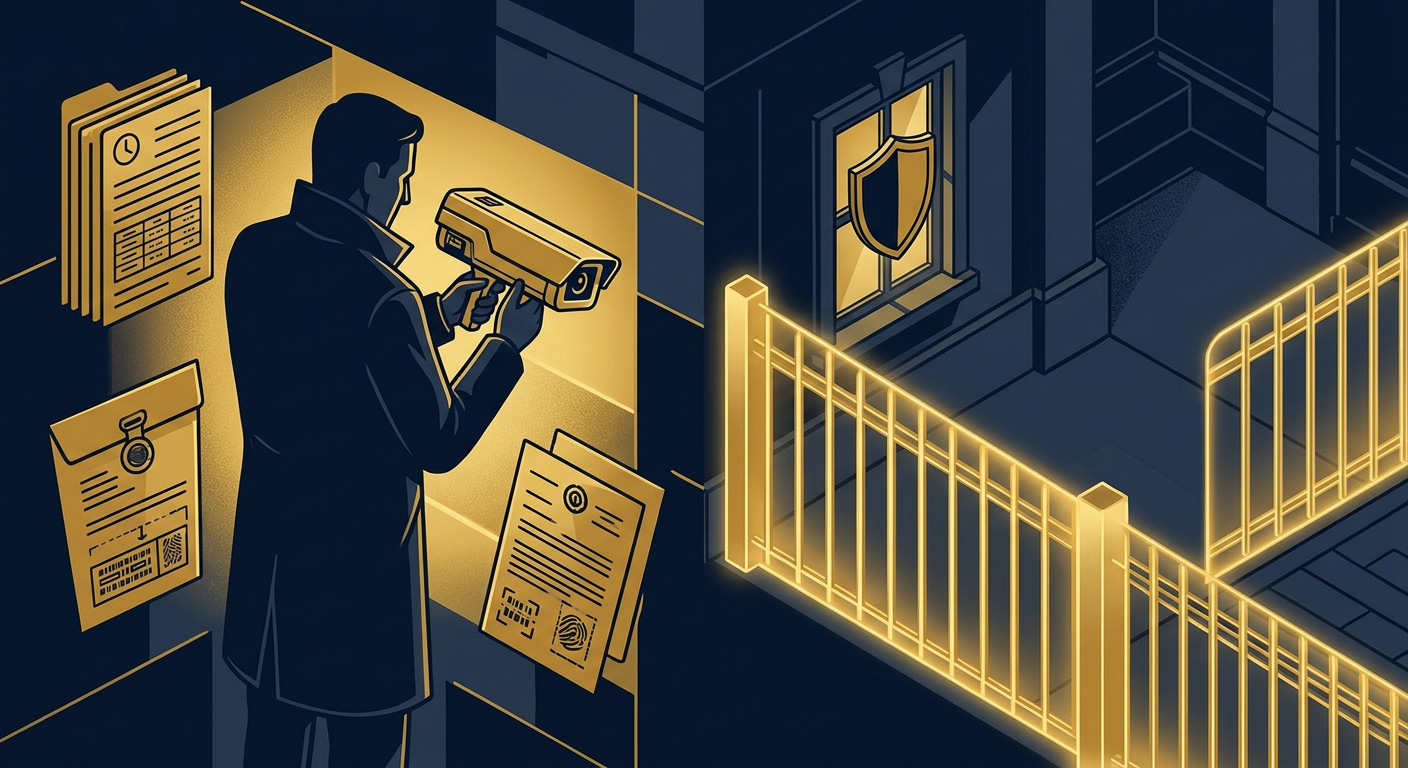
How do professional investigators avoid getting “burned”?
Getting “burned” means the subject detects the surveillance. It is the single greatest failure mode in the field, because a subject who knows they are watched alters behavior, and the truthful record the client is paying for disappears. Avoiding it is a craft. Honeybadger’s Arizona investigators follow a disciplined operating framework:
- Pre-operation reconnaissance. Before a subject is ever observed, the investigator studies the area—road layout, parking, sightlines, traffic patterns, and plausible cover—so the position looks natural from the first minute.
- Area-appropriate vehicles and appearance. The vehicle and operator blend into the specific neighborhood. A vehicle a subject has already seen is not reused; nothing about the setup draws a second look.
- Distance and patience over pursuit. Professionals predict the subject rather than chase them, holding maximum workable distance. The amateur instinct to close in is what gets operators spotted.
- Disciplined breaks. If a follow risks exposure, the investigator breaks off and re-acquires later rather than burn the entire operation for one uncertain frame. Preserving the operation always outranks any single shot.
- Team coverage and hand-offs. On complex routes or difficult subjects, multiple investigators rotate the “eye,” so no single vehicle stays behind the subject long enough to be noticed.
- Environmental awareness. Operators account for heat limiting sit-time, light and shadow affecting camera work, and neighborhood dynamics such as HOAs, curious residents, and gated access.
- Contemporaneous documentation. Observations are logged in real time and footage is time-stamped, so the record is built as the operation unfolds—not reconstructed afterward.
The through-line is restraint. World-class surveillance is defined less by aggressive pursuit than by the discipline to remain invisible, wait for the subject to reveal the truth, and document it cleanly. That patience is exactly what an unlicensed or brokered operator, paid by the frame, tends to lack.
Why does using in-house Arizona investigators matter?
In Arizona, Honeybadger conducts surveillance with our own in-house, Arizona-licensed investigators—not subcontractors. That ownership is not a marketing point; it is what makes the evidence defensible. The investigator who gathered the footage may have to authenticate it and testify to the method. When that person is our trained, licensed employee who followed a documented procedure and maintained chain of custody, the evidence is credible and hard to attack.
Outside Arizona, we extend the same standard through in-house teams combined with vetted field partners. But inside the state—where most of our surveillance runs—the work is entirely our own, supervised end to end. When a matter also involves electronic evidence, our digital forensics capability preserves recovered data to the same evidentiary standard, and complex cases draw on our broader investigations and intelligence resources.
When is covert surveillance the right investment?
Surveillance is resource-intensive, so it should be used where direct observation is the strongest available proof. Across Arizona, the common engagements include insurance and workers’ compensation defense, family-law and domestic matters, employment and corporate inquiries, fraud and financial matters, and due-diligence or threat-assessment work. In each, the deliverable is the same: a chronological activity log, time-stamped video and photographs, an investigator declaration, an objective summary, and continuous chain-of-custody documentation—an evidence package built to hold up.
Honeybadger Solutions provides covert surveillance statewide, coordinated from three Arizona offices and delivered by our own licensed investigators. You can review our Arizona coverage for the full service footprint.
Representative scenario: the patient watch
Consider a representative matter. A client needed to know whether a subject’s stated limitations matched reality, but early attempts by a prior operator had likely burned the subject, who had grown cautious. Re-scoped professionally, the operation began with reconnaissance and a natural, area-appropriate post well back from the residence. For the first day, the investigator gathered almost nothing dramatic—only routine—precisely because the objective was to re-establish invisibility. On the following days, from lawful public vantage, the subject was documented performing activity plainly inconsistent with their claims, each sequence time-stamped and tied to a contemporaneous log. No trespass, no audio, no contact. The clean record spoke for itself. This is an illustrative scenario, not a named client or claimed outcome, but it captures the central truth of the craft: patience and legal discipline, not aggression, produce evidence that survives challenge.
Frequently asked questions
Is covert surveillance legal in Arizona?
Yes, within limits. Arizona permits observing and recording what is plainly visible from public or lawful vantage points, with no trespass and no intrusion into places where a person has a reasonable expectation of privacy. Arizona is a one-party-consent state for recording conversations, so professional surveillance defaults to visual documentation and avoids unlawful audio capture. The work must be performed by a licensed investigator to be professional and defensible.
What does it mean for an investigator to get “burned”?
Being “burned” means the subject detects the surveillance. It is the primary failure mode in the field, because a subject who realizes they are watched changes behavior and the truthful record collapses. Professionals avoid it through reconnaissance, area-appropriate vehicles, distance and patience, disciplined breaks, and team hand-offs on complex follows—prioritizing staying invisible over capturing any single frame.
Can I record a subject’s private conversations during surveillance?
Not lawfully if you are not a party to the conversation and no participant consents. Arizona is a one-party-consent state, meaning at least one party to a conversation must consent to its recording. Because covert surveillance typically involves observing subjects the investigator is not conversing with, professional practice avoids capturing private audio altogether and relies on lawful visual documentation.
Why not just hire the cheapest surveillance provider?
Because surveillance evidence is only worth what it can prove, and cheap, brokered, or unlicensed operators routinely burn subjects, cross legal lines, or produce records that cannot withstand challenge. In Arizona, using an agency’s own licensed investigators—who follow documented method, maintain chain of custody, and can testify to their work—protects both the admissibility of the evidence and the client from liability. The cost of a failed operation almost always exceeds the savings.
About Honeybadger Solutions
Honeybadger Solutions is an Arizona-licensed security and investigations firm delivering full-spectrum investigations, covert surveillance, digital forensics, and security services. In Arizona, our surveillance is performed by our own in-house, AZ-licensed investigators supervised under documented methodology with chain-of-custody controls and court-ready reporting. We operate three Arizona offices—Casa Grande (headquarters), Phoenix, and Oro Valley—serving every Arizona venue and, through in-house teams and vetted partners, engagements nationwide and internationally.
Considering covert surveillance for a legal, insurance, or personal matter in Arizona? Book a consultation online to brief an investigations lead and scope a lawful, defensible approach. Confidential. Defensible. Arizona-owned.
This article is general information, not legal advice; laws vary and change—confirm specifics with qualified counsel. Authoritative references: A.R.S. § 13-3005, interception of communications (Arizona State Legislature) and Arizona Department of Public Safety — Licensing (private investigators).
Where we run surveillance
Surveillance is run in-house across Arizona by our own licensed investigators. If a subject travels out of state, coverage at the destination is arranged through a vetted, locally licensed partner. Laws on recording, tracking and trespass vary by state, so each assignment is planned around the rules where it takes place.
Browse by topic
Security guard services · Private investigations · Cybersecurity · Digital forensics · Financial fraud investigation · Executive protection · All articles