

A corporate email investigation forensically preserves, collects, and analyzes mailbox and audit data across platforms like Microsoft 365 and Google Workspace to answer a legal, regulatory, or internal question, whether fraud, misconduct, data theft, or account compromise. Done correctly it begins with a preservation hold and defensible collection, not a keyword search, because email is the single richest and most contested evidence source in modern disputes, and default retention quietly destroys it on a fixed schedule.
Email remains the connective tissue of every organization, and consequently the first place counsel, regulators, and investigators look when something goes wrong. A departing executive who took client lists, a controller who approved fraudulent invoices, a harassment complaint that hinges on what was actually said, a regulator demanding to see who knew what and when, a mailbox quietly taken over to redirect a wire, all of these are answered, or lost, in corporate email. This guide is written for the general counsel, compliance officer, or executive who needs to understand what a rigorous corporate email investigation involves: how the data is governed and preserved, how it is collected without breaking admissibility, what platform differences matter, and where organizations forfeit cases before an examiner ever reads a message.
When does corporate email become a forensic and legal matter?
Most email lives its life as routine business record. It becomes a forensic and legal matter the moment a dispute, investigation, or obligation attaches to it, and that transition changes the rules governing how it may be handled. The recurring triggers are consistent across industries: internal investigations into misconduct, fraud, or policy violations; intellectual-property and trade-secret disputes where a mailbox holds the proof of exfiltration; employment matters such as harassment, discrimination, or whistleblower complaints; regulatory inquiries and subpoenas; contract and commercial litigation; and account compromise, where the mailbox is both crime scene and evidence. If a mailbox or payment has already been hit, our business email compromise investigation service traces what happened, and you can request it online.
What unites these is a duty. Once litigation or an investigation is reasonably anticipated, an organization’s duty to preserve relevant evidence attaches, and casual handling of email, deletion under routine retention policy, or clumsy self-collection can become spoliation. Under Federal Rule of Civil Procedure 37(e), the failure to preserve electronically stored information that should have been preserved can expose a party to sanctions, including, where there was intent to deprive, an adverse-inference instruction that can decide a case. The forensic discipline exists precisely to prevent that outcome, and it is why sophisticated organizations do not let IT quietly handle a legal-hold email like an ordinary support ticket.
What is email journaling, and how does it differ from archiving and backup?
Three concepts are routinely confused, and the confusion costs cases. Journaling, archiving, and backup solve different problems, and only some of them produce reliable investigative evidence. Understanding the distinction determines what an investigator can actually recover.
Journaling captures a complete, unalterable copy of every message as it is sent or received, recording the true recipients including blind copies, and writing it to a separate journal store the moment the mail flows. Because it captures messages in transit, journaling produces a tamper-evident record that survives even if a user later deletes the message from their mailbox. Archiving, by contrast, moves or copies messages into long-term storage for retention and search, typically after the fact. Backup is a disaster-recovery snapshot, designed to restore a system to a point in time, not to prove who sent what to whom. The table below clarifies why the distinction matters to an investigation.
| Mechanism | Primary purpose | Captures deleted mail? | Forensic value |
|---|---|---|---|
| Journaling | Compliance capture of mail in transit | Yes, captured before deletion is possible | High, tamper-evident, includes true recipients |
| Archiving | Long-term retention and search | Depends on policy and timing | Moderate, strong if immutable and complete |
| Backup | Disaster recovery and restoration | Only if captured in a snapshot | Low to moderate, not built for evidence |
| In-place / litigation hold | Preserve specific data for legal duty | Preserves against deletion once set | High, purpose-built for defensibility |
The investigative lesson is blunt: an organization that relies on backups alone to answer an email question is often reconstructing from an incomplete, hard-to-authenticate source, while one with proper journaling or immutable archiving hands the investigator a clean, complete record. The design decision is made long before the dispute, which is why counsel should ask about it during risk planning, not during a crisis.
Why does the preservation and legal-hold step decide the outcome?
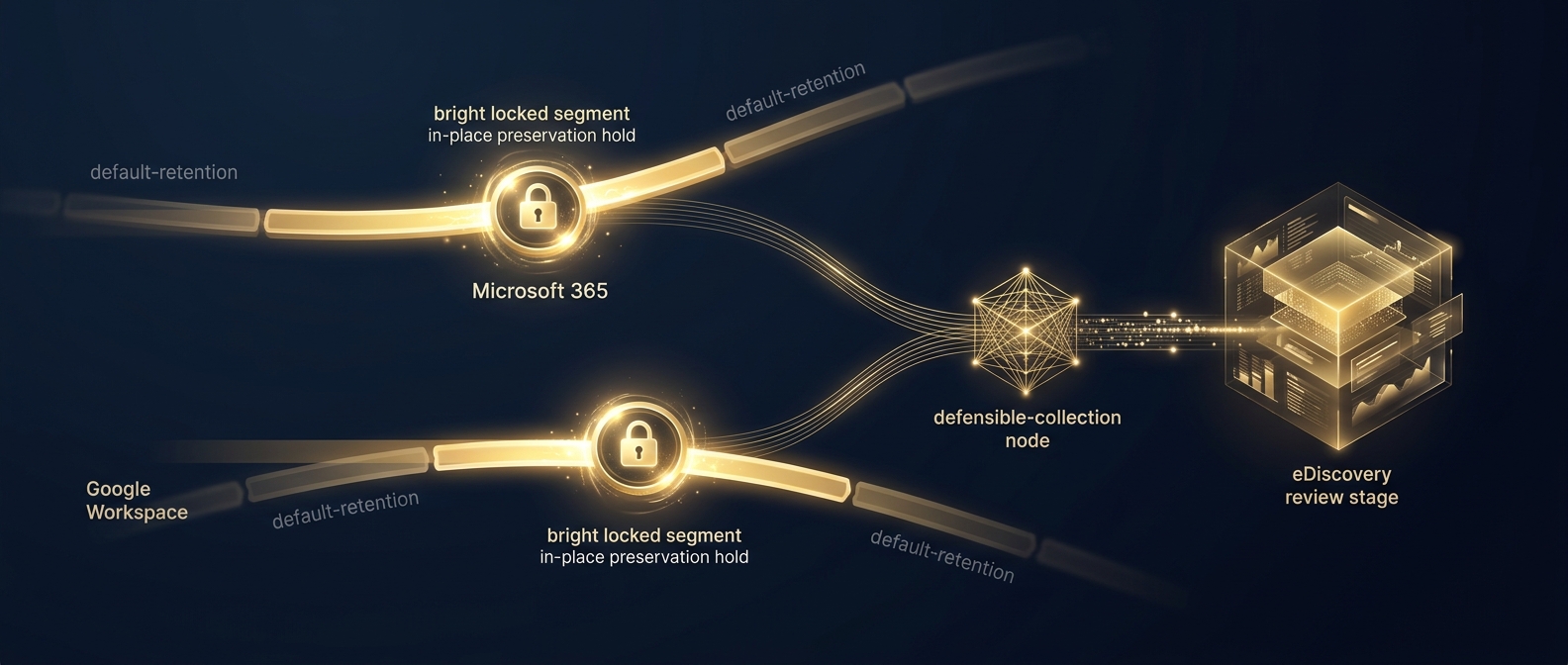
Preservation is the hinge of every email investigation. Cloud mailboxes are not inert; deleted items, sign-in logs, and audit records age out on the provider’s schedule whether or not anyone is looking, and users continue deleting, moving, and editing mail every day. The first professional act is therefore not to search but to freeze, placing the relevant custodians and data under a hold that survives ordinary retention and user deletion.
A defensible preservation sequence does several things in order, before anyone begins substantive review:
- Identify custodians and scope. Determine whose mailboxes, and what date ranges and data types, fall within the duty to preserve, and document the reasoning.
- Place an in-place or litigation hold. Invoke the platform’s preservation hold so that even deleted or edited messages are retained in an immutable location, independent of user behavior.
- Preserve the audit and log layer. Export mailbox audit logs, the unified or admin audit log, and sign-in records into an independent, hashed, chain-of-custody-controlled store, because these age out fastest and prove who did what.
- Snapshot configuration state. Capture inbox rules, forwarding settings, delegate permissions, and connected applications as they exist now, since remediation or normal use will change them.
- Document every responder action. Log each step so attacker or custodian activity can later be distinguished from the investigation’s own footprint.
Only after the evidence is frozen does collection and analysis proceed. This order is not bureaucratic caution; it is the difference between a case you can prove and a story you can only assert. It also mirrors the discipline that governs all of digital forensics: preserve before you analyze, analyze before you change the environment.
How do M365 and Google Workspace investigations actually differ?
The two dominant platforms expose evidence through different tools, retention defaults, and hold mechanisms, and an investigator has to be fluent in both because most enterprises run one or the other, and holding companies often run both. In Microsoft 365, the investigative surface centers on the unified audit log, per-mailbox audit logs, message trace, Entra ID sign-in logs, and preservation through litigation or in-place holds and eDiscovery. In Google Workspace, the equivalent picture comes from the login and admin audit logs, Gmail log search and message routing, and preservation through Vault holds and matters.
The differences that matter operationally are retention windows and hold behavior. Default log-retention periods vary by license tier and configuration, and several of the most probative sources, granular sign-in detail and message-level routing among them, retain for only weeks unless premium licensing or export is in place. That reality makes early engagement decisive: an investigation that begins six weeks after the event is frequently reconstructing from data the provider has already purged on schedule. A competent examiner knows, per platform, which clocks are running and moves against the fastest ones first.
Where the matter is a mailbox takeover rather than an internal-conduct question, the investigation narrows to intrusion reconstruction, hidden inbox rules, OAuth token abuse, and the retention race described in our dedicated guide to business email compromise. The corporate email program and the incident response draw on the same evidence sources; they simply ask different questions of them.
How is email collected defensibly for eDiscovery and investigation?
Collection is where good intentions most often break admissibility. The temptation, forwarding messages, dragging items into a PST, exporting a folder to a personal drive, feels efficient and destroys metadata, breaks chain of custody, and invites an authentication challenge. Defensible collection preserves the message and its metadata intact, records how and when each item was gathered, and produces a verifiable, reproducible set.
A sound collection follows the recognized discovery lifecycle, aligning with the scope and proportionality principles of Federal Rule of Civil Procedure 26 and the standards articulated by the Electronic Discovery Reference Model. The professional sequence is disciplined:
- Collect through native tools or forensic export. Use the platform’s eDiscovery export or a validated forensic method that preserves full headers, metadata, and attachments, never manual forwarding.
- Hash and verify. Compute cryptographic hashes at collection so the produced set can be proven identical to the source.
- Maintain chain of custody. Record who collected what, when, from where, and every subsequent transfer.
- Cull with defensible criteria. Narrow by custodian, date range, and search terms transparently, documenting the methodology so the culling itself is reproducible.
- Review for privilege and relevance. Segregate privileged material and produce only what is responsive, preserving the privilege log.
- Authenticate for use. Preserve the metadata and hash records that let the evidence be authenticated, including under the self-authentication provisions for electronic records.
The through-line is reproducibility. A collection another qualified examiner could repeat and verify is a collection that survives a motion to exclude. One assembled by ad hoc forwarding is a collection an opponent will attack, often successfully, regardless of what the messages actually say. This is where an internal investigation either builds a foundation or forfeits one.
What does analysis reveal that a keyword search misses?
Once evidence is preserved and collected, analysis is far more than reading messages for keywords. The probative story usually lives in the relationships between messages and in the metadata around them. A forensic examiner reconstructs communication timelines, maps who really received a message including blind copies revealed by journaling, identifies backdating or manipulation through header and metadata analysis, surfaces deleted or edited items recovered from holds and recoverable-item stores, and detects the quiet signatures of exfiltration such as auto-forwarding rules and bulk external sends.
In misconduct and fraud matters, the analysis frequently exposes what a custodian tried to hide: messages deleted before a device was returned but preserved by journaling, forwarding rules that quietly routed sensitive mail to a personal account, or a timeline that contradicts a sworn account of events. In account-compromise matters, it distinguishes legitimate activity from an intruder’s by correlating sign-ins, rule creation, and message flow. In every matter, the value is correlation, aligning independent sources so a specific action is tied to a specific actor at a specific time, which is exactly the standard adversarial scrutiny demands and casual review cannot meet.
How does Honeybadger investigate corporate email?
Honeybadger Solutions investigates corporate email the way it must be done to hold up, preservation first, defensible collection second, analysis and reporting built to survive challenge. Because our digital forensics, cyber services, financial-investigation, and background-intelligence capabilities are handled in-house by certified examiners and delivered nationwide and internationally, a matter never fragments across disconnected vendors: the same command that places the hold and preserves the audit logs also reconstructs the timeline, traces exfiltration, and builds the record that counsel, regulators, and courts will scrutinize. We move against the retention clock across Microsoft 365 and Google Workspace, collect without breaking metadata or custody, and document methodology so an opposing expert can reproduce it.
That discipline supports internal and regulatory investigations, employment and misconduct matters, trade-secret and departing-employee cases, eDiscovery, and email-account compromise, structured to operate at the direction of counsel and to preserve privilege where it applies. From Arizona home command, with offices in Casa Grande, Phoenix, and Oro Valley, we serve general counsel, compliance leaders, executives, and organizations across the United States and abroad, closing the gap between what an inbox holds and what can be proven with it.
Frequently asked questions
Is a backup enough to investigate corporate email?
Usually not. Backups are built to restore a system to a point in time, not to prove who sent what to whom. They may miss messages deleted between snapshots, lack the audit and sign-in layer that establishes actor and timing, and be difficult to authenticate. Journaling or immutable archiving, combined with an in-place preservation hold and defensible collection, produces a far stronger evidentiary record. Relying on backups alone often means reconstructing from an incomplete, contestable source.
What is a legal hold and when must it be placed?
A legal or litigation hold suspends routine deletion and preserves potentially relevant data. The duty to preserve attaches once litigation or an investigation is reasonably anticipated, not when a complaint is served. Under Federal Rule of Civil Procedure 37(e), failing to preserve electronically stored information that should have been kept can expose a party to sanctions, up to an adverse-inference instruction where there was intent to deprive. Placing an in-place hold early, before any review, is the defensible practice.
Can deleted corporate emails be recovered?
Often, depending on how the environment was configured and how quickly a hold was placed. Journaling captures messages in transit, so they survive later deletion; preservation holds retain deleted and edited items in immutable stores; and recoverable-item folders hold recently deleted mail for a period. The key variable is time and configuration: once default retention windows lapse and no hold or journal exists, recovery may be impossible. Early preservation is what keeps deleted mail recoverable.
Why not just have IT export the mailbox and search it?
Ad hoc export and keyword search frequently break admissibility. Manual forwarding or dragging items into a PST strips metadata and breaks chain of custody, and keyword review misses the relationships, deleted items, and manipulation that a forensic analysis surfaces. Defensible investigation uses native eDiscovery export or validated forensic collection, hashes and documents every step, and analyzes metadata and timelines. The goal is a reproducible record another examiner could verify, which is what survives a motion to exclude.
About Honeybadger Solutions
Honeybadger Solutions is an Arizona-licensed security and investigations firm delivering intelligence-led forensics, investigations, and cyber services to general counsel, executives, compliance leaders, and organizations nationwide and internationally. Digital forensics, cybersecurity, financial investigations, and background intelligence are handled in-house by certified examiners, so a corporate email matter is preserved, collected, analyzed, and reported under a single accountable chain of custody and command, to a defensible standard.
Offices: Casa Grande (HQ), Phoenix, and Oro Valley, Arizona.
Phone: Book a consultation online
Confidential consultation: discuss a corporate email investigation or legal-hold matter with our command team.
Browse by topic
Security guard services · Private investigations · Cybersecurity · Digital forensics · Financial fraud investigation · Executive protection · All articles