
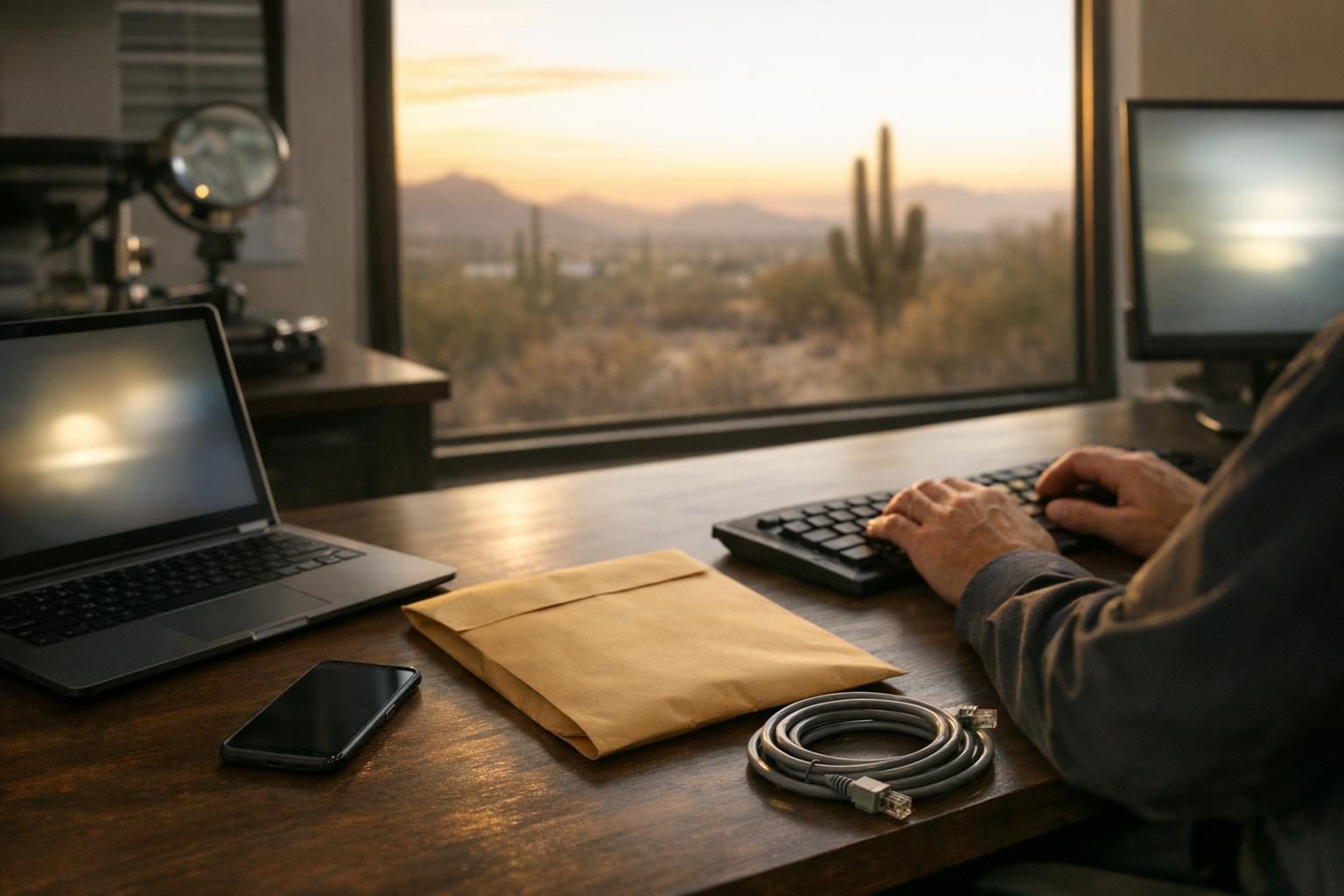
Remote forensic collection lets an examiner acquire evidence from a laptop, phone or cloud account without the device leaving its custodian. For a witness in another state, an employee who still needs a working laptop, or a matter with dozens of custodians, it is often the fastest practical way to preserve evidence. Done properly, it produces a hash-verified, documented collection that holds up in litigation or an internal investigation.
This guide explains how remote collection works, how chain of custody and hashing carry over to a network collection, who can authorize it, and when on-site imaging is still better. Our remote forensic extraction service page describes how Honeybadger runs these engagements nationwide. This article is general information, not legal advice; confirm authorization and discovery questions with counsel.
Key takeaways
- Remote forensic collection is usually a live collection, so the collection tool’s footprint must be documented.
- Most remote work is targeted (user profile, mailbox, date range), and that scope should be a written decision.
- Hash data at the source, verify it at the destination, and log who collected what, when and under whose authority.
- Company devices fall under company policy; personal devices and accounts need informed consent or legal process.
- FRCP 26(b)(1) makes proportionality part of discovery scope, and Rule 37(e) addresses ESI lost without reasonable preservation steps.
Where this guidance comes from. NIST SP 800-86 (2006), NIST SP 800-101 Rev. 1 (2014), NIST IR 8387 (2022), SWGDE’s Best Practices for Remote Collection of Digital Evidence from an Endpoint (v2.0, November 2024), ISO/IEC 27037:2012, Federal Rules of Civil Procedure 26 and 37 and Federal Rule of Evidence 902, and Microsoft Purview and Google Vault export documentation, combined with our team’s field experience as a veteran-led forensics firm.
What remote forensic collection is, and what it is not
Remote forensic collection is the acquisition of digital evidence over a network from a device or account that stays where it is. Data travels over an encrypted connection to a controlled destination, and every step is logged and hash-verified.
NIST SP 800-86 says acquisition “can be performed either locally or over a network.” Local collection is generally preferable because there is greater control, but it is not always feasible when a system is in another location. Over a network, the guide says, decide what type of data to collect and how much effort to use.
Remote collection is not a custodian forwarding emails, taking screenshots or copying a folder to a USB stick. Those steps change metadata and are hard to authenticate. It is also never covert access to someone else’s device or account.
How remote collection works: four common methods
SWGDE’s 2024 guidance groups remote endpoint methods into server-based, endpoint-based, network-based, removable media-based and bring-your-own approaches. Most civil and corporate matters use one of these four patterns.
Agent-based collection on managed computers
For company-owned laptops and servers, IT pushes a collection agent through device management tooling. The agent sends the agreed data to a controlled destination for hashing and verification. It is low-touch, scales across many machines and suits discreet internal investigations.
Custodian-assisted collection
When a device is not centrally managed, the custodian runs a collection tool while an examiner guides each step live. The examiner confirms the device identity and records what happened and when. This is common for personal computers used for work and for outside witnesses.
Mobile remote collection
Phone collection is usually custodian-assisted. NIST SP 800-101 Rev. 1 ranks mobile extraction from manual and logical methods up to more invasive physical techniques, and remote work generally sits at the logical end: messages, contacts, call logs, media and app data. What is reachable depends on model, operating system and security settings. Deeper extractions and locked devices are lab work through mobile and tablet forensics.
Cloud and SaaS exports
Much custodian data lives in Microsoft 365, Google Workspace and chat platforms, best collected through each platform’s compliance tools after holds are applied. Microsoft says Purview search export packages expire 14 days after creation; Google Vault exports are available for 15 days and include a file of MD5 hash values. Download, hash and store exports promptly. See our cloud account extraction service and cloud forensics investigation guide.
Targeted collection vs full image
A full physical image copies every sector of a drive, including deleted and unallocated space. A targeted, or logical, collection copies specific files, mailboxes, artifacts or date ranges. Both are legitimate; the question is which answers the matter at a proportionate cost.
Remote work leans targeted. SWGDE warns that “inadequate network throughput may severely impact remote collections.” NIST SP 800-86 cautions that a bit-stream image of an entire physical device from a live system cannot be validated, while “a bit-by-bit copy of the logical areas of a live system can be completed and validated.”
Make scope a written decision: what was collected, what was excluded and why. If deleted files, wiping or a full disk timeline is central, a write-blocked image through computer and hard drive forensics is usually the better instrument.
Need a collection scoped now? If a custodian is leaving or a hold is coming, request a remote forensic collection online with custodian locations, device types and your deadline, or book a consultation online to talk through scope and authorization first.
Chain of custody and hashing in a remote forensic collection
Chain of custody does not disappear because the device stayed with its owner. NIST SP 800-86 describes logging every person with custody and what they did and when, storing evidence securely, examining only copies and verifying the integrity of original and copy. The network transfer and destination storage are simply links in that chain.
Hashing makes the chain checkable. NIST IR 8387 (2022) notes that changing one bit produces a completely different hash and calls it best practice to use a NIST-approved algorithm and store hashes separately from the evidence. SWGDE likewise calls for a cryptographic hash and verification of collected data. A sound record includes:
- Written authority and the scope agreed with counsel.
- Unique identifiers for the source device or account, such as serial number, hostname or account ID.
- Tool and version, start and end times, and the person who collected.
- Hash values at source and destination, plus any errors.
- Changes the collection made to the live system, documented well enough to account for them later.
Federal Rule of Evidence 902(14), added in 2017, lets data copied from a device or file be self-authenticated by “a process of digital identification” with a qualified person’s certification; the committee note says such data are “ordinarily authenticated by ‘hash value’.” ISO/IEC 27037:2012 sets international guidelines for identifying, collecting, acquiring and preserving digital evidence. For messaging content, see authenticating social media evidence for litigation.
Consent and authorization: who can approve the collection
Remote tools make a machine easy to reach, which makes authority more important. SWGDE says examiners “must have the legal authority to collect data and forensically examine the collected data” and should consult counsel when unsure.
- Company-owned, managed devices: usually collected under the organization’s authority and written policies, with privacy considerations for the individual.
- Personal devices used for work: the custodian’s informed, written consent stating what will be collected, such as a work profile or date range.
- Personal cloud accounts: the account holder’s authorization or legal process to the provider. A spouse, employer or device holder cannot authorize it.
- Attorney direction: keeps scope tied to claims and defenses and supports privilege, but does not replace the owner’s authority.
- Custodians abroad: local privacy and data-transfer laws may limit collection or storage. Check with counsel there first.
Defensibility and proportionality under the Federal Rules
FRCP 26(b)(1) limits discovery to nonprivileged matter relevant to a claim or defense and “proportional to the needs of the case,” weighing the issues, amount in controversy, access to information, resources, importance of the discovery and burden versus benefit. A targeted remote forensic collection of named custodians, date ranges and data types fits that framework, and the written scope shows the reasoning.
Rule 37(e) covers ESI lost because a party failed to take reasonable preservation steps. Prejudice allows measures no greater than necessary to cure it; only intent to deprive supports an adverse presumption, adverse-inference instruction, dismissal or default. The 2015 committee note says “perfection in preserving all relevant electronically stored information is often impossible” and a party “may act reasonably by choosing a less costly form of information preservation.” Our eDiscovery and litigation support team carries collections through processing and production. Confirm current rules and local practice with counsel as of October 2026.
Remote vs on-site forensic collection: side-by-side
| Factor | Remote forensic collection | On-site or in-lab imaging |
|---|---|---|
| Device location | Stays with the custodian | Examiner travels or device is shipped |
| Speed to start | Once authority is confirmed and access is set up | Depends on travel or shipping |
| Typical output | Targeted logical collection; full image on fast links | Full write-blocked physical image |
| Live-system footprint | Must be documented | None when media is imaged powered off |
| Deleted and unallocated data | Limited in targeted collections | Fully available |
| Custodian disruption | Low | Device out of service |
| Many custodians | Parallel collections | Sequential and travel-heavy |
| Best fit | Distributed staff, urgent preservation, live servers, cloud accounts | Physical custody, wiping questions, compromised devices, deep mobile extraction |
When on-site imaging is still the better choice
- The device is part of a criminal matter or otherwise belongs in physical custody.
- The case turns on deleted files, wiping or unallocated space and the connection cannot support a full image.
- The machine may be actively compromised; the network path is part of the problem.
- A phone needs isolation and a file-system extraction that cannot be done remotely.
- The custodian cannot reliably follow guided steps, so the process could not be documented properly.
Many matters use both: a remote targeted pass identifies the few devices that matter, which are then imaged in hand.
Step-by-step remote forensic collection process
- Confirm authority for each device and account: policy, written consent or legal process.
- Preserve first: apply legal holds, suspend auto-deletion and stop reimaging returned laptops.
- Scope custodians, devices, accounts, data types and date ranges with counsel.
- Plan and test operating systems, management enrollment, connection speed and time windows.
- Collect by agent, guided session or platform export, logging each action.
- Hash and verify at source and destination; store hash records separately.
- Document scope and footprint: what was collected, excluded and changed.
- Secure and hand off to analysis or review, logging every transfer.
What clients should prepare before collection day
- Custodian list with locations, time zones and a scheduling contact.
- Device and account inventory: owner, operating system and management enrollment for each item.
- Written authorization for each device or account.
- The questions and date range the collection must answer.
- An IT contact who can push agents and approve temporary exceptions.
- Preservation steps taken, such as holds issued and devices set aside.
Meanwhile, avoid self-help: do not reimage a returned laptop, forward emails as a substitute for collection, rely on screenshots alone, or power down a live server.
How Honeybadger handles remote forensic collection
Honeybadger Solutions is a veteran-owned SDVOSB based in Casa Grande, Arizona, licensed by Arizona DPS as a private investigation agency (License No. 1759795). Our digital forensics practice works nationwide and acquires evidence on-site, in the lab or remotely, whichever the matter needs.
A remote engagement includes authorization review, scoping, agent deployment or guided collection, hashing at source and destination, a collection log, chain of custody, a written scope statement naming what was excluded, and secure storage for the agreed period. It is quoted per custodian and per device, and we will tell you when remote is the wrong instrument.
Send us where the custodians and devices are, what authority exists and your deadline through the online service request, or book a consultation online to talk through scope and consent.
Why the online intake is faster than a phone call: it takes about two minutes, and your answers are routed straight to the specialist team that handles your kind of matter, whether that is cyber and forensics, investigations or field security. That team sees the full picture before it replies, so you skip phone tag and get a real answer and next steps sooner. If it cannot wait for business hours, use the urgent intake form, which is read seven days a week.
Frequently asked questions
Is remote forensic collection as defensible as an on-site image?
It can be, when it is planned, hashed, logged and honestly described. The report should disclose the footprint of a live collection and state whether the result is a full image or a targeted set. SWGDE’s 2024 guidance accepts deviations from best practice when they are documented.
Can an employer collect from an employee’s personal phone remotely?
Not on the employer’s say-so alone. A personally owned device generally needs the custodian’s informed, written consent describing what will be collected, or proper legal process. Company-owned, managed devices are usually collected under company policy. Confirm specifics with counsel.
How long does a remote forensic collection take?
A targeted collection of a user profile, mailbox or date range often takes hours. A full image of a large drive over a home connection can take far longer, so the examiner should test the connection and give a realistic estimate first.
Does the custodian have to be involved?
It depends on the method. On company devices enrolled in management tooling, IT can deploy the collection agent. Phones and personal devices usually need the custodian to follow guided steps during the session.
What hash algorithm should a remote collection use?
NIST IR 8387 (2022) and SWGDE (2024) call for a NIST-approved cryptographic hash, recorded at the source and verified at the destination. Some platform exports, such as Google Vault, include their own MD5 checksum file, which should be kept with the record.
When should we choose on-site imaging instead?
When the device belongs in physical custody, when a full image or deleted-space recovery is required and the connection cannot support it, when the device may be actively compromised, or when a phone needs an extraction that cannot be done remotely.
Sources and further reading
- NIST SP 800-86 (2006) — Network acquisition, live systems, hashing and chain of custody.
- SWGDE 22-F-003 v2.0 (2024): Remote Collection from an Endpoint — Methods, authority, throughput and documentation.
- NIST IR 8387 (2022): Digital Evidence Preservation — Hashing and storing hash values.
- NIST SP 800-101 Rev. 1 (2014) — Mobile extraction levels.
- ISO/IEC 27037:2012 — Digital evidence handling guidelines.
- FRCP Rule 26 (Cornell LII) — Proportionality in 26(b)(1).
- FRCP Rule 37 (Cornell LII) — Rule 37(e) and its 2015 committee note.
- FRE Rule 902 (Cornell LII) — 902(14) authentication by hash value.
- Microsoft Learn: Export search results in eDiscovery — 14-day export expiration.
- Google Vault Help: Export data from Vault — 15-day export availability.
- Google Vault Help: Vault export contents — MD5 hash file in exports.
Written and reviewed by the Honeybadger Solutions security and investigations team, a veteran-led Arizona firm (Arizona DPS private investigation agency license No. 1759795). Facts checked against the cited sources on October 2, 2026. This article is general information, not legal advice.
Browse by topic
Security guard services · Private investigations · Cybersecurity · Digital forensics · Financial fraud investigation · Executive protection · All articles