
Honeybadger Solutions is a security guard company serving Peoria, Arizona with our own in-house, Arizona-licensed officers — staffing HOA and master-planned community patrol, spring-training and event-day security, retail and entertainment-district coverage, and construction-site protection. Every officer is our own personnel, supervised from our Arizona command structure, with our Phoenix office anchoring West Valley response roughly 25 minutes south.
Peoria is one of the fastest-growing cities in Maricopa County, and its security needs reflect that growth curve directly: sprawling new-build HOA communities pushing north toward Lake Pleasant, a seasonal Major League Baseball spring-training economy that packs tens of thousands of visitors into a few weeks each spring, a retail and dining district built for evening foot traffic, and a continuous pipeline of construction sites turning desert land into rooftops. A guard program built for a dense downtown core does not fit this footprint; Peoria demands a patrol model built for distance, seasonality, and rapid growth.
What makes Peoria a distinct security environment?
Peoria stretches from established neighborhoods near the Arrowhead area in the south to the still-developing Vistancia and Trilogy at Vistancia communities near the base of the Sonoran Preserve in the north, with Lake Pleasant Regional Park anchoring the city’s northern edge as both a recreational draw and a source of seasonal vacation-property and lake-access security questions. That geographic spread means a single Peoria client portfolio can include a 55-and-over gated community, a young-family master-planned neighborhood still under active construction, and a lakeside recreational property, each with a different risk profile and a different expectation of what “security” means.
Layered on top of that residential sprawl is a genuinely unusual seasonal driver: the Peoria Sports Complex hosts spring training for two Major League Baseball franchises, drawing large, temporary crowds every February and March to a facility that otherwise runs at a fraction of that traffic the rest of the year. The P83 Entertainment District nearby adds a year-round retail, dining, and nightlife environment with its own parking-lot and after-hours risk profile. Few Arizona suburbs combine large-scale seasonal event security with rapid-growth residential patrol in the same service area, and a guard company that treats Peoria as generic “Phoenix suburb” coverage misses both.
How does patrol work for Peoria’s master-planned and HOA communities?
Vistancia, Trilogy at Vistancia, Westwing Mountain, and the many smaller HOA communities spread across Peoria share a common structural challenge: they are large, low-density footprints with multiple entrances, extensive common area, and residents who expect a visible, consistent presence without feeling over-policed. The dominant risks are package and vehicle theft, unauthorized access through unmanned gates, amenity misuse at pools and clubhouses, and after-hours disturbances — not the high-value cargo or industrial risk profile you would find in a warehouse district.
For most of these communities, randomized, GPS-verified mobile patrol is the most effective and cost-efficient posture: our officers run varied routes across gates, common areas, pools, and clubhouses, logging every pass so the HOA board or property manager has a defensible record for liability and budget purposes. Where a single community’s scale or resident expectation warrants it, we staff a fixed gatehouse or courtesy-officer post instead. Because our officers are our own in-house, Arizona-licensed personnel, a Peoria HOA gets a supervised, accountable guard force rather than a rotating cast of subcontracted, unknown officers.
How is spring training and event-day security different?
The Peoria Sports Complex spring-training season compresses a year’s worth of crowd-management demand into roughly six weeks, drawing thousands of out-of-town visitors daily to parking lots, gates, and surrounding retail that otherwise see ordinary weekday traffic. That surge creates a distinct set of temporary risks: parking-lot theft and vehicle break-ins, ticket and merchandise fraud, overcrowding at gates and concessions, and a spike in opportunistic property crime at nearby retail and hospitality businesses riding the overflow traffic.
Our approach scales staffing to the calendar rather than running a flat year-round posture: additional uniformed officers and vehicle patrol are surged into affected properties for the spring-training window and other high-attendance events at the P83 Entertainment District, then scaled back down once the season ends. Nearby retail, restaurant, and parking-facility clients benefit from the same event-cycle planning, since a single unmanaged event weekend can generate more loss than a normal month of operations. Businesses that experience event-driven fraud or theft can escalate directly into our investigations practice without switching vendors.
What does construction-site security require in a fast-growth city like Peoria?
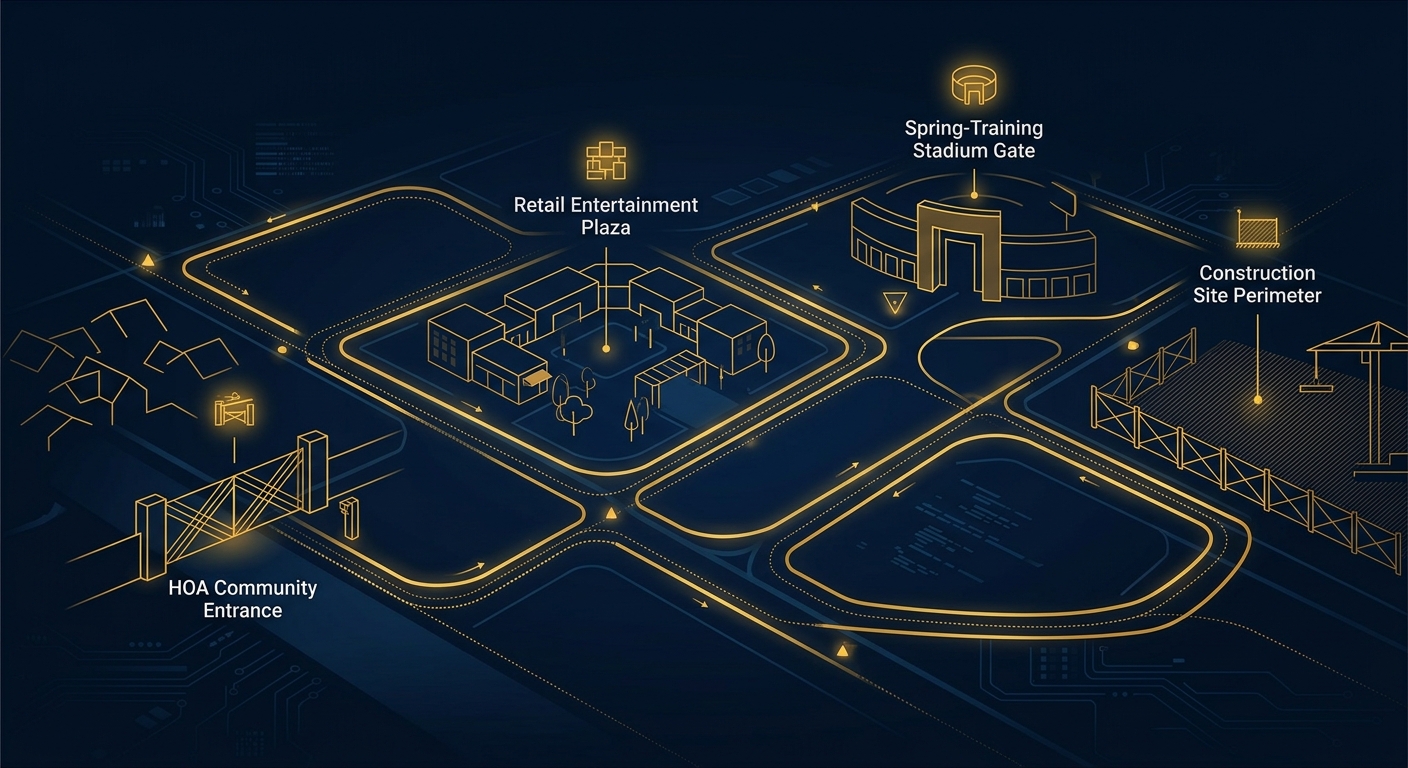
Peoria’s continued northward expansion toward Vistancia and the surrounding foothills means active construction sites — new subdivisions, retail pads, and infrastructure builds — are a constant feature of the city, not a temporary phase. Vacant lots, staged materials, heavy equipment, and partially built structures are persistent targets for material theft, copper and metal stripping, equipment vandalism, and trespassing, particularly overnight and on weekends when a site sits unattended.
Our construction-site programs combine overnight fixed posts at high-value equipment and material staging areas with perimeter patrol and access logging for contractors, subcontractors, and deliveries. Documented sign-in and vehicle logs give developers a defensible record for insurance claims and subcontractor accountability, and our officers are trained to recognize the specific theft patterns — copper wiring, HVAC units, appliances staged for install — that recur on active residential builds.
How do retail and entertainment-district posts reduce loss at P83?
The P83 Entertainment District and Peoria’s broader retail corridor run on evening and weekend foot traffic across restaurants, bars, and shops sharing common parking areas — an environment where visible deterrence does more work than after-the-fact response. The recurring risk profile includes parking-lot theft and vehicle break-ins, intoxicated-patron incidents outside bars and restaurants, shoplifting, and after-hours vandalism once foot traffic thins out.
A fixed, visible uniformed presence at key entrances and parking areas, combined with proactive patrol of the broader lot and service corridors, changes offender behavior before an incident occurs. Officers are trained to document incidents thoroughly enough to support prosecution or insurance claims while coordinating with property management and local law enforcement, protecting both the property’s liability position and public safety.
How do heat and seasonal operations affect Peoria guard programs?
Peoria’s extended summer heat season is a genuine operational factor for any outdoor post or patrol route, particularly across the large, low-density HOA footprints and open construction sites that define much of the city. The U.S. Occupational Safety and Health Administration recognizes heat as a workplace hazard requiring hydration, rest, shade, and acclimatization planning, and a guard program that ignores it exposes both officers and clients to real risk.
Our heat operations build these controls in as standard practice: hydration and rest cycles, vehicle-based patrol for large HOA and construction footprints, heat-adapted scheduling that shifts intensive outdoor work to cooler hours, and officer training on early heat-illness recognition. Combined with the seasonal surge planning required for spring training, this makes Peoria one of the more operationally complex West Valley markets to staff correctly — and one where a local, in-house team consistently outperforms an out-of-state or improvised crew.
What are the Arizona licensing and liability requirements?
Private security in Arizona is regulated under A.R.S. Title 32, Chapter 26 and administered by the Arizona Department of Public Safety (AZ DPS). Guard agencies must hold an agency license, and individual officers must be registered and hold a valid guard card, with background screening and training requirements set by the state. Hiring an unlicensed provider transfers direct legal and insurance exposure to the property owner or HOA board.
Honeybadger Solutions is an Arizona-licensed firm, and in Arizona our officers are our own in-house, licensed, supervised personnel — not subcontracted through a broker. That structure means one accountable firm owns the licensing, insurance, training, and supervision behind every officer we place in Peoria, rather than layering an unknown subcontractor between the client and the person on their property.
Which posture fits which Peoria property type?
| Peoria property type | Dominant risk | Recommended guard posture |
|---|---|---|
| HOA / master-planned community (Vistancia, Trilogy) | Package/vehicle theft, unauthorized gate access | Randomized GPS-verified mobile patrol + optional gatehouse |
| 55+ / active-adult community | Amenity misuse, unfamiliar-vehicle reporting | Fixed courtesy-officer post + scheduled patrol rounds |
| Spring-training / stadium-adjacent | Seasonal crowd surge, parking-lot theft, ticket fraud | Event-scaled uniformed staffing + vehicle patrol |
| Retail / entertainment district (P83) | Parking-lot theft, intoxicated-patron incidents | Visible fixed post + proactive lot patrol |
| Active construction site | Material and copper theft, equipment vandalism | Overnight fixed post + perimeter patrol + access logging |
| Lake Pleasant-adjacent property | Seasonal vacancy, vandalism, trespassing | Scheduled patrol checks + vacancy monitoring |
How does a Peoria security guard company scope your guard program?
Every program starts from a documented risk assessment rather than a generic staffing template. Use this framework to scope a guard or patrol program for a Peoria property or portfolio.
- Define the assets and threats. Identify what is being protected — residents, inventory, equipment, event crowds — and the specific threats each faces.
- Map the footprint and seasonality. Measure gates, common areas, and perimeters, and flag any seasonal surge, such as spring training or event weekends.
- Set coverage objectives. Decide required hours, response-time targets, and which points demand a fixed post versus mobile patrol.
- Choose the posture. Select fixed posts, mobile patrol, or a hybrid, and define patrol frequency and randomization.
- Plan for event scaling. Build a surge staffing plan for spring training and other high-attendance periods, then scale back afterward.
- Build heat and safety controls. Schedule hydration, rest, shaded rotations, and heat-adapted patrol timing for Arizona conditions.
- Confirm licensing and liability. Verify Arizona licensing, insurance, and that officers are in-house supervised personnel, not subcontractors.
- Establish reporting. Define incident documentation, GPS patrol logs, and escalation paths, including investigative escalation.
- Set supervision and audits. Schedule post audits and officer accountability checks on a defined cadence.
- Review and adjust. Reassess as the property, season, and threat picture change.
Where does Honeybadger operate around Peoria?
Honeybadger Solutions serves Peoria and the surrounding West Valley, including Glendale, Surprise, and El Mirage, as well as the greater Phoenix metro and all of Arizona. In Maricopa County, our security guard programs are staffed with our own in-house, Arizona-licensed officers. We operate three Arizona offices — our Casa Grande headquarters, our Phoenix office, and our Oro Valley office near Tucson — and support clients nationwide and internationally through our in-house digital forensics and investigative capabilities. Our Phoenix office anchors Peoria and West Valley coverage; see our full Arizona security guard services or our broader security services, and for the neighboring market see our Glendale digital forensics services.
Frequently asked questions
Does Honeybadger use its own guards in Peoria, Arizona?
Yes. In Arizona, every uniformed officer, mobile patrol unit, and protective agent we place in Peoria is our own in-house, Arizona-licensed, supervised personnel. We do not broker your post to a subcontractor or third-party network; you contract with one accountable firm that owns the licensing, training, insurance, and supervision behind the officer on your property.
Can you staff extra security for spring training and P83 event weekends?
Yes. We scale uniformed staffing and vehicle patrol to the calendar for the Peoria Sports Complex spring-training season and other high-attendance events at the P83 Entertainment District, then reduce staffing back to normal levels once the event window ends, so clients pay for surge coverage only when the risk is actually elevated.
Do you cover master-planned communities like Vistancia and Trilogy?
Yes. We provide randomized, GPS-verified mobile patrol across gates, common areas, pools, and clubhouses for Peoria’s master-planned and HOA communities, including Vistancia, Trilogy at Vistancia, and Westwing Mountain, with fixed gatehouse or courtesy-officer staffing available where a community’s scale warrants it.
Are Honeybadger officers licensed in Arizona?
Yes. Arizona regulates private security under A.R.S. Title 32, Chapter 26, administered by the Arizona Department of Public Safety. Honeybadger holds Arizona agency licensing, and our individual officers are registered and screened as required by the state, which protects clients from the legal and insurance exposure of hiring an unlicensed provider.
About Honeybadger Solutions
Honeybadger Solutions is an Arizona-licensed security and investigations firm serving Peoria and the West Valley. In Arizona, our uniformed security officers, mobile patrol, and protective agents are our own in-house, Arizona-licensed, supervised personnel — not subcontractors. Digital forensics, cybersecurity, financial investigations, and background intelligence are run in-house and delivered worldwide. We serve all of Arizona and support clients nationwide and internationally.
Offices: Casa Grande (HQ), Phoenix, and Oro Valley, Arizona.
Phone: 602-725-2818
Confidential consultation: speak with our command team about a Peoria guard, patrol, or event-security program.