
Security Guard Services Arizona – Professional Armed & Unarmed Guards
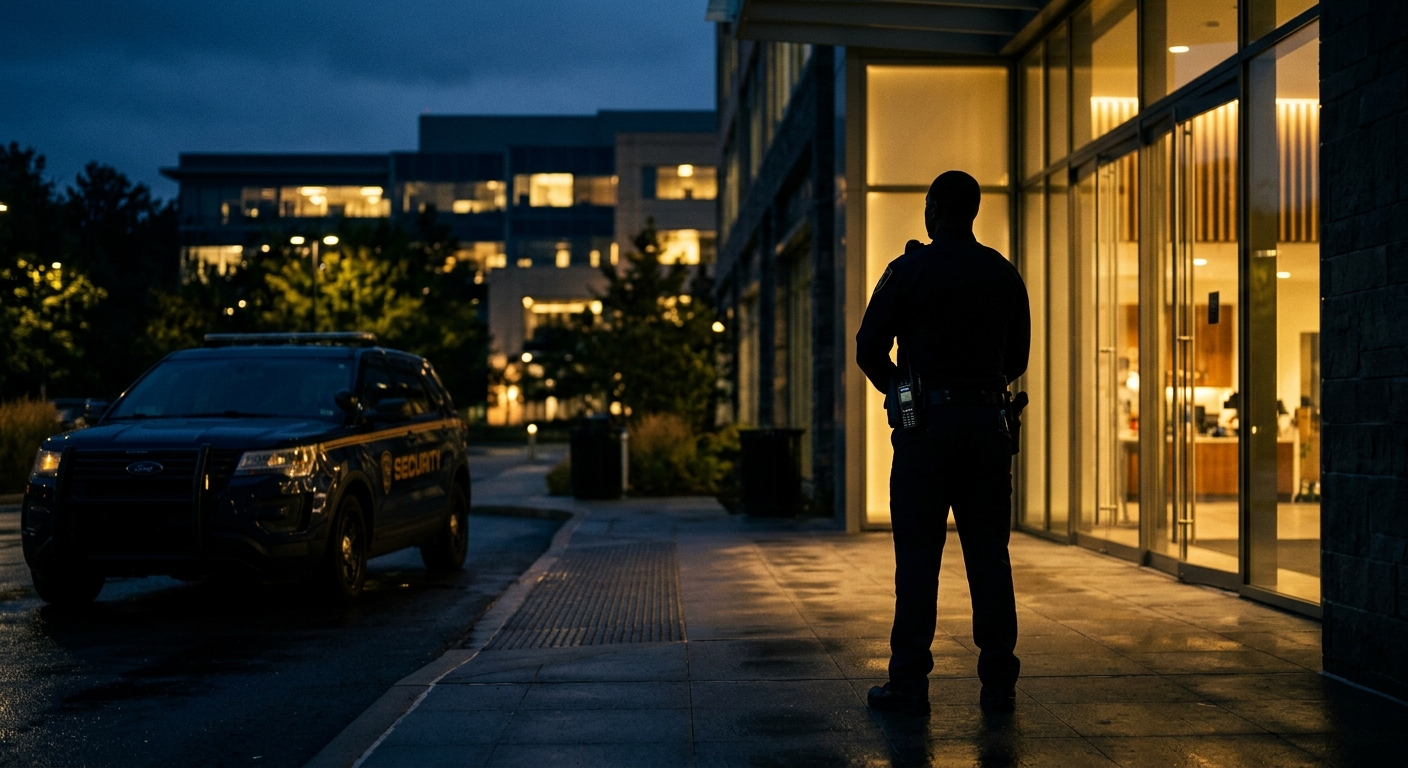
Arizona businesses hire armed guards when a site carries a documented threat of violence, high-value cash or assets, or a legal/insurance mandate for a weapons-capable response — retail loss prevention, most commercial properties, construction sites, and residential patrol are typically well served by unarmed, AZDPS-registered officers. Honeybadger Solutions staffs both tiers with our own in-house, Arizona-licensed guards — never subcontracted labor.
Every year, Arizona retailers, office landlords, general contractors, HOA boards, and event producers need a uniformed presence on-site and struggle to evaluate the guard company standing in front of them. The industry has a well-earned reputation problem: a national brokerage answers the phone, a subcontracted officer with minimal vetting shows up, and the client discovers the gap in training or licensing only after an incident. Arizona’s Department of Public Safety (AZDPS) regulates the private security industry precisely because that gap is common enough to require oversight. This guide covers how armed and unarmed guard services actually work in Arizona, what AZDPS requires of both the agency and the individual officer, which use case calls for which tier of coverage, and what separates a licensed, in-house guarding operation from a broker reselling someone else’s labor.
What’s the real difference between armed and unarmed security guards?
The distinction isn’t “better” versus “worse” — it’s a deliberate match between an officer’s authority and response capability and the actual risk profile of the site. An unarmed guard is trained in observation, access control, de-escalation, patrol, and incident documentation, with reasonable physical intervention consistent with private-citizen use-of-force limits where authorized. An armed guard carries all of that plus a firearm, meets a higher AZDPS registration standard, and is deployed specifically where the threat assessment or the client’s risk profile justifies a weapons-capable response.
- Asset value and cash exposure. Cash-intensive retail, high-value construction material yards, and other high-shrink environments.
- Documented threat history. A prior armed robbery, a workplace-violence incident, or an active protective order against a known individual.
- Site volatility. Hostile-termination support, labor disputes, or crowd events with elevated risk factors.
- Contractual or insurance requirement. Some lenders, insurers, and property managers specify armed coverage for particular occupancy classes.
In the large majority of Arizona engagements — office buildings, retail loss prevention, construction sites, residential and HOA patrol, and most public and private events — a well-trained unarmed officer is the correct, proportionate, and most cost-effective choice. Escalating to armed coverage without a documented risk basis raises liability and insurance cost without adding real protective value. That assessment is the first thing a competent provider should walk a client through — not an upsell.
What AZDPS licensing does an Arizona security guard actually need?
Arizona’s private security industry is regulated by the Arizona Department of Public Safety (AZDPS), which administers licensing for guard agencies and registration for the individual officers those agencies employ. At a structural level, the framework requires three things to align before an officer can lawfully stand a post in Arizona:
- Agency licensure. The company providing the guards must hold a current AZDPS security guard agency license — entity-level authorization to operate a guarding business in the state.
- Individual registration. Each officer working under that agency must carry a current, valid AZDPS registration in the category deployed — unarmed or armed — which requires a background check, fingerprint clearance, and completion of the required training curriculum before assignment.
- Armed-specific qualification. Officers registered to carry a firearm on duty must additionally satisfy AZDPS’s firearms qualification standard and maintain it on the state’s renewal cycle — it is not a one-time credential.
The practical risk for a client is that this system is easy to misrepresent and hard to verify from the outside. A company can hold current agency licensure while individual officers on a rotating roster lapse on registration, or a “1099 contractor” staffing model can put an unregistered body on post because verifying every subcontracted individual’s AZDPS status was never built into the pipeline. Ask any prospective provider — including us — to produce current agency licensure and to explain how individual officer registration is tracked and audited, not just asserted.
Which use case calls for which type of guard coverage?
Guarding is not one product. The right posture, staffing level, and armed/unarmed mix depend heavily on the environment:
- Commercial and office properties. Lobby and access control, after-hours patrol, tenant and visitor management, and incident and maintenance-issue reporting to property management — almost always unarmed, uniformed, and visible as a deterrent.
- Retail and loss prevention. Uniformed deterrence at entrances, plainclothes loss-prevention support for high-shrink locations, and de-escalation-trained response to shoplifting and disorderly-customer incidents — unarmed by default; armed only where cash handling or a prior armed-robbery history justifies it.
- Special events. Access control, bag checks, crowd flow, and ID/age verification for licensed venues, with rapid coordination with off-duty law enforcement or EMS on larger events — staffing level and the armed/unarmed mix scale with expected attendance and alcohol service.
- Construction sites. Overnight and weekend patrol against material and equipment theft — one of the highest-shrink categories in the trade — perimeter checks, access-log enforcement for subcontractors, and mobile patrol across multiple active sites.
- Residential and HOA communities. Gate and access control, vehicle and visitor patrol, courtesy enforcement of community rules, and rapid-response coordination with local law enforcement for actual incidents — unarmed, with as much emphasis on tone and customer service as on security posture.
A competent provider scopes the site before quoting a rate card — walking the property, reviewing incident history, and asking what’s actually driving the request (an insurer requirement, a recent incident, a new tenant mix) rather than defaulting every client to the same guard count and the same armed/unarmed answer.
| Dimension | Unarmed Guard | Armed Guard |
|---|---|---|
| AZDPS registration | Standard unarmed guard registration, background check, fingerprint clearance | Standard registration plus firearms qualification and periodic re-qualification |
| Best-fit use cases | Office/commercial, retail, construction, HOA/residential, most events | Cash-intensive retail, documented threat history, hostile-termination support, high-risk events |
| Primary function | Deterrence, access control, patrol, observe-and-report, de-escalation | All of the above, plus a weapons-capable response where the risk assessment justifies it |
| Relative billing rate | Lower — the appropriate baseline for most sites | Higher — reflects qualification, insurance, and liability exposure |
| Insurance/liability profile | Standard general-liability coverage for the engagement | Elevated coverage requirements; confirm carrier terms before deployment |
| Client fit signal | No documented threat history; moderate asset value | Documented risk, insurer/lender mandate, or client-specific threat |
How does Honeybadger select, train, and supervise its Arizona guards?
The officer standing at your door is the actual product — everything else is scheduling and paperwork. Our selection and supervision model is built around three commitments a broker reselling subcontracted labor structurally cannot make the same way:
Selection. Every officer goes through a background investigation that goes beyond the AZDPS minimum — verified employment history, reference checks, and a disqualifying-conduct review — before an offer is extended. We are a licensed investigations firm first; vetting the people we put on post is never outsourced.
Training. Beyond the AZDPS-mandated curriculum, officers train on site-specific post orders, de-escalation and use-of-force boundaries, emergency and evacuation procedures, and incident-report writing that holds up if a matter ever becomes a police report or a civil claim. We align our internal curriculum with the broader industry standards published by ASIS International, the leading professional association for security practitioners. Armed officers requalify on the state’s cycle, not on a “when we get to it” basis.
Supervision. Field supervisors conduct unannounced post checks, officers log checkpoints and incident activity in real time, and every site has a documented post order that’s reviewed and updated as conditions change — not a laminated sheet from the day the contract started. Clients receive activity reporting, not just an invoice.
A 7-point framework for vetting any Arizona security guard provider
Before signing a guard services contract — with us or anyone else — run the provider through this checklist:
- Confirm current AZDPS agency licensure and ask them to produce it, not just claim it verbally.
- Ask how individual officer registration is tracked — is there an internal audit process, or is compliance simply assumed?
- Determine whether officers are direct employees or subcontracted 1099 labor — direct employment gives the provider actual control over training and conduct; a subcontracted pool often doesn’t.
- Ask for the site-specific post-order process — a generic guard is a liability; a briefed guard with written post orders is a deterrent.
- Confirm the supervision cadence — how often are posts checked, and by whom?
- Request the insurance certificate and confirm coverage limits match the site’s actual risk — armed coverage requires higher limits than unarmed.
- Ask what happens after an incident — is there a documented reporting chain, and does it hold up if the matter escalates to law enforcement or litigation?
What does a uniformed guard actually do during a shift?
Post orders vary by site, but the core discipline is consistent: a documented patrol schedule, a logged checkpoint system, an access-control protocol for who enters and exits, and a written incident report for anything outside the routine — no matter how minor it seems at the time. A construction-site overnight patrol looks different from a retail-entrance post, but both run on the same principle: activity that isn’t documented didn’t happen, and a guard who can’t produce a coherent incident report when something does happen has cost the client more than an empty post would have.
For commercial and retail clients, this typically includes lobby or entrance coverage, periodic interior and perimeter patrol, visitor and vendor sign-in enforcement, and direct coordination with property management or store leadership on anything that needs escalation. For construction sites, it shifts toward perimeter checks, equipment and material security, subcontractor access-log enforcement, and mobile patrol across multiple active sites during off-hours, when theft risk is highest. For events, it’s entry screening, bag checks, crowd-flow management, and — for licensed venues — age and ID verification, coordinated with venue management and, on larger events, off-duty law enforcement.

What drives the cost of security guard services in Arizona?
Rate cards vary by market, but the drivers are consistent. Armed coverage costs more than unarmed because of qualification, insurance, and liability exposure. Overnight and weekend shifts typically carry a premium over standard daytime coverage. Single-officer, single-site contracts run a different rate structure than multi-site mobile patrol, where one officer covers several properties on a rotating schedule at a lower per-site cost. Short-notice or event-specific staffing carries a premium over a standing contract with a predictable schedule. And officer tenure and training investment show up in the rate too — a provider staffing every post at the state minimum is, by definition, offering less than one that trains, supervises, and retains its officers.
The lowest quote is rarely the lowest total cost. An under-trained or unregistered officer creates exposure — a theft that goes undetected, an incident that’s mishandled, or a claim the provider can’t defend because the paperwork doesn’t exist. Scope the actual risk first, then price the coverage that matches it.
Why does in-house, Arizona-licensed guarding matter more than a guard company’s size?
Guard services are one part of Honeybadger’s broader Arizona security services practice, and the industry has a well-known structural problem: a handful of national brokerages sell contracts nationwide, then subcontract the actual staffing to whichever local labor pool is cheapest and available that week. The client sees one logo on the invoice; the officer standing post may have been onboarded days earlier by a company the client has never heard of, with training and vetting the broker can’t fully verify because it wasn’t the broker who did it.
Honeybadger Solutions staffs its Arizona guard contracts with our own in-house, AZDPS-registered officers — not subcontracted labor. As a licensed investigations and security firm, the same standard we apply to a background investigation or a digital forensics chain of custody applies to who we put in uniform on a client’s property: verified, trained, supervised, and accountable to us directly. From our Casa Grande headquarters and offices in Phoenix and Oro Valley, coverage extends across the Phoenix metro, the Tucson corridor, and Pinal County. When a client’s needs extend beyond routine guarding — executive protection for a principal facing a specific threat, or a broader security consulting engagement to assess a facility’s overall risk posture — that work is handled by the same in-house team, not handed off to a different vendor.
Frequently asked questions
Does Arizona require security guards to be licensed?
Yes. Arizona regulates the private security industry through the Department of Public Safety (AZDPS), which requires guard companies to hold a security guard agency license and requires each individual officer to carry current AZDPS registration in the category — unarmed or armed — they’re deployed in, including a background check and, for armed officers, firearms qualification.
When does a business actually need armed guards instead of unarmed guards?
Armed coverage is justified when a site has documented risk that unarmed deterrence can’t adequately address — significant cash or high-value asset exposure, a prior armed-robbery or violent-incident history, hostile-termination support, or an insurer or lender requirement. Most commercial, retail, construction, and residential sites in Arizona are appropriately and cost-effectively covered by trained unarmed officers.
What’s the difference between a licensed guard agency and subcontracted guard labor?
A licensed agency directly employs, trains, vets, and supervises its own officers and carries direct accountability for their conduct. Subcontracted or brokered labor means the company you’re contracting with doesn’t control — and often can’t fully verify — who is actually standing post, how they were trained, or whether their AZDPS registration is current.
How quickly can a security guard contract be staffed in Arizona?
Standing contracts with a predictable schedule can typically be staffed within days once the site walk and post orders are finalized. Short-notice or event-specific coverage is possible but carries a premium and depends on officer availability — the earlier a provider is engaged, the more control a client has over which officers are assigned rather than who happens to be free.
About Honeybadger Solutions
Honeybadger Solutions is an Arizona-licensed security and investigations firm. Our uniformed guard division staffs commercial, retail, construction, event, and residential sites across Arizona with our own in-house, AZDPS-registered armed and unarmed officers — never subcontracted labor. The same firm also delivers executive protection, security consulting, licensed private investigations, and in-house digital forensics and background intelligence nationwide.
Three offices: Casa Grande HQ, Phoenix, and Oro Valley.
Call: 602-725-2818
This article is educational and general in nature; appropriate staffing levels, the armed/unarmed mix, and post orders vary by site and risk profile. Contact us for a site-specific assessment.