

A security guard company in Glendale, Arizona needs to run three very different postures well: stadium and arena event coverage around State Farm Stadium and Desert Diamond Arena, warehouse and distribution-center patrol along the Loop 101 logistics corridor, and retail and residential guarding at Westgate, Arrowhead, and surrounding neighborhoods. Honeybadger Solutions staffs Glendale with our own in-house, Arizona-licensed guards — not a subcontracted network — so the officer on your site is trained, supervised, and accountable to one command team.
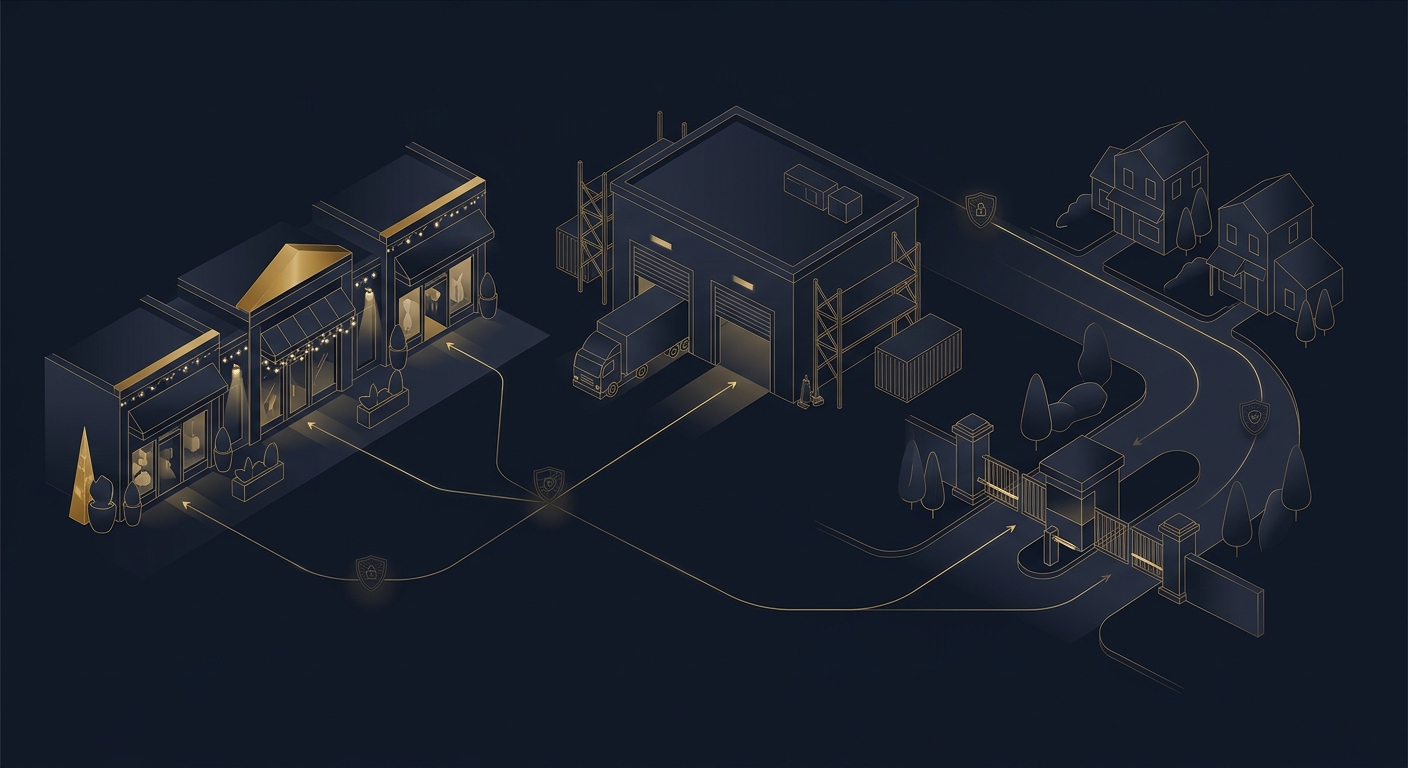
Glendale is not a single security environment; it is at least three overlapping ones inside a compact 60-square-mile footprint in Maricopa County. On any given fall weekend, 60,000-plus people converge on the Sports and Entertainment District for an Arizona Cardinals game, a Fiesta Bowl, or a stadium concert. On the same day, dozens of distribution and fulfillment operations along the Loop 101 Agua Fria corridor are running receiving docks, yard trailers, and overnight shifts with no crowd at all — just high-value freight and a different threat profile entirely. And in between, Arrowhead Towne Center, the Tanger Outlets at Westgate, HOA-governed communities like Arrowhead Ranch, and the historic Catlin Court district downtown each need a guard program calibrated to their own risk, not a copy-pasted post order. This guide covers how those three environments differ, what licensing Arizona requires, what a properly built program looks like, and how Honeybadger deploys into Glendale from our nearest offices.
What does event-day security require around State Farm Stadium and Desert Diamond Arena?
Glendale’s Sports and Entertainment District is the West Valley’s largest recurring crowd-management challenge. State Farm Stadium hosts NFL games, the annual Fiesta Bowl, and has staged a Super Bowl and a Final Four; Desert Diamond Arena runs concerts, family shows, and conventions on non-NFL dates; and the Westgate Entertainment District around both venues fills with restaurant and bar traffic before and after every event. That combination creates a security demand that spikes hard on event days and drops to near-zero the next morning — a staffing pattern most guard vendors cannot flex to without either overstaffing quiet weeks or scrambling for bodies on game day. Venue-adjacent work typically means perimeter and access-point support, parking and traffic-flow assistance, hospitality and restaurant-row patrol, and coordination with venue security, Glendale Police, and event promoters rather than direct stadium-bowl security (which the NFL and the venue’s own security contractor control). We staff this as scheduled, scalable event coverage — officers who show up for the surge and stand down for the lull — rather than a flat year-round headcount that does not match Glendale’s actual demand curve.
How is warehouse and distribution-center security different along the Loop 101 corridor?
West of the stadium district, Glendale is one of metro Phoenix’s densest logistics and light-industrial corridors, with fulfillment, cold-storage, and distribution facilities clustered along Loop 101 and the surrounding business parks near Luke Air Force Base. This is a fundamentally different security problem than a stadium crowd: the risk is cargo theft, trailer and yard intrusion, internal shrinkage, and after-hours perimeter breaches at facilities that can run 24 hours with skeleton overnight crews. Effective coverage here means gate and dock-door access control, driver and trailer check-in verification, mobile patrol across large yards that a single fixed post cannot see, and documentation disciplined enough to support a claim or prosecution if freight goes missing. Guards assigned to a Glendale distribution center need different training and a different rhythm than guards working a Saturday concert crowd two miles away — which is exactly why we build the post order around the site’s actual risk instead of a generic guard-standing-a-door template.
What does retail and community security look like at Westgate, Arrowhead, and Catlin Court?
Glendale’s commercial core outside the stadium district splits into a few distinct pockets. The Tanger Outlets and dining row at Westgate face organized retail crime, parking-lot vehicle break-ins tied to the entertainment-district crowd, and after-hours loitering once restaurants close. Arrowhead Towne Center and the surrounding Arrowhead retail and medical corridor — anchored by Abrazo Arrowhead Campus and a dense band of professional offices — need loss-prevention-minded uniformed presence blended with parking and access-control coverage. Downtown, the Catlin Court Historic District’s antique shops and the annual Glendale Glitters holiday event bring seasonal foot-traffic surges through a compact, older commercial grid with different sightlines and access patterns than the newer suburban centers. Each pocket gets a posture matched to its actual customer base and risk, not a single template stretched across all three.
| Glendale setting | Recommended posture | Primary priority |
|---|---|---|
| State Farm Stadium / Desert Diamond Arena event days | Scalable uniformed event staffing, perimeter + access support | Crowd flow, coordination with venue security |
| Loop 101 warehouse / distribution centers | Gate/dock access control + mobile patrol | Cargo protection, after-hours intrusion deterrence |
| Westgate retail / Tanger Outlets | Uniformed entrance + loss-prevention-aware patrol | Theft deterrence, parking-lot safety |
| Arrowhead retail / medical corridor | Uniformed patrol + access control | Patient/visitor safety, parking security |
| Higher-education campuses (Midwestern, GCC) | Uniformed patrol + campus access coordination | Student/staff safety, after-hours building security |
| HOA communities (Arrowhead Ranch and similar) | Vehicle patrol + gate/access verification | Deterrence, resident privacy |
What does campus security look like near Midwestern University and Glendale Community College?
Glendale hosts a meaningful education and healthcare footprint alongside its retail and logistics base: Midwestern University’s Glendale health-sciences campus, Glendale Community College, and the Abrazo Arrowhead Campus hospital each carry a distinct security profile built around student and patient safety rather than cargo or crowd control. Campus programs typically combine uniformed foot and vehicle patrol of parking structures and building perimeters, after-hours lock-down verification, and coordinated response with campus safety offices — work that rewards officers who are trained to de-escalate a stressed student or visitor, not just stand at a door. Healthcare-adjacent posts add visitor-management discipline: verifying access to restricted areas, supporting front-desk and emergency-department staff during disruptive incidents, and documenting every escalation to a standard hospital risk-management teams can rely on. It is a quieter environment than a stadium event, but the consequences of a poorly trained officer — a mishandled mental-health crisis, a missed access-control gap — are just as serious.
What separates a real Glendale security guard company from a warm-body staffing vendor?
Metro Phoenix has no shortage of firms that will send a uniformed body to a Glendale address for a low hourly rate. What most of them will not do is train that officer to Glendale’s specific environments, supervise the post with a named regional lead, or produce documentation that survives a liability claim, an insurance dispute, or a prosecution. A warm-body vendor treats a stadium parking lot, a distribution-center dock, and an HOA gate identically — one post order, one generic officer, minimal oversight. A properly built guard company writes a site-specific post order, assigns officers who have actually worked that environment before, runs supervisory check-ins on a defined schedule, and keeps an auditable incident log from day one. The difference rarely shows up on a quiet Tuesday; it shows up the day a cargo theft, a shoplifting apprehension, or a crowd-control incident ends up in a claims file or a courtroom, and only one of those two approaches produces a record anyone can rely on.
How do HOA and gated communities in Glendale handle guard coverage?
Northwest Glendale’s master-planned communities — Arrowhead Ranch and the gated neighborhoods around it chief among them — typically want vehicle patrol and gate-access verification rather than a static guard shack, because the goal is visible deterrence and consistent documentation, not a checkpoint feel in a residential neighborhood. A well-run HOA patrol contract logs patrol times and observations, verifies visitor and vendor access at controlled entries, and flags maintenance or safety issues (broken gate arms, non-functioning cameras, lighting outages) back to the HOA board — the same operational discipline we apply to a commercial post, scaled to a residential setting.
Are Honeybadger’s Glendale security guards licensed under Arizona law?
Yes. Security guard agencies and officers in Arizona are regulated by the Arizona Department of Public Safety under A.R.S. Title 32, Chapter 26. Honeybadger holds the required agency licensure, registers every guard individually, and maintains the background screening, training, and insurance the statute requires. In Arizona, that guard is our own employee — not a subcontractor pulled from a labor pool — which keeps supervision, use-of-force policy, and incident documentation under one accountable command structure. Clients can verify agency and individual licensing directly through the Arizona DPS licensing portal.
How do you build a security guard program for a Glendale site?
- Identify which of Glendale’s risk environments your site actually sits in — event-adjacent, logistics/industrial, retail, medical, or residential — since each demands a different post design.
- Conduct a site assessment: access points, parking layout, camera and alarm coverage, lighting, and any event-day or seasonal traffic spikes nearby.
- Define the real threat — cargo theft, retail shrinkage, parking-lot crime, trespass, or crowd-driven disorder — rather than defaulting to a generic guard order.
- Choose posture per zone: fixed uniformed post, mobile patrol, access-control/gate verification, or a scaled event-day surge, matched to the table above.
- Set headcount, shift structure, and a named on-site or regional supervisor with a clear reporting and incident-escalation line.
- Coordinate with property management, venue security (if event-adjacent), and Glendale Police non-emergency channels for any recurring issue.
- Review incident logs and coverage monthly and adjust staffing to actual activity, not a static contract that never changes.
What drives the cost of a Glendale security guard contract?
Cost tracks risk and complexity, not just hours. A flat-rate, low-traffic warehouse overnight post costs less per hour than a scalable event-day contract that has to surge from zero to a dozen officers and back down inside a single weekend. Armed versus unarmed posture, response-time requirements, supervisory oversight, and whether the site needs incident documentation detailed enough to support an insurance claim or prosecution all move the number. Vendors that quote a single flat rate for every Glendale site — stadium parking lot, Loop 101 warehouse, or HOA gate — are typically not pricing the actual risk, and it shows the first time something goes wrong and the paperwork does not hold up.
Arizona’s climate is also an operational cost driver Glendale clients often overlook. Officers assigned to outdoor posts — a warehouse yard, a stadium parking lot, a construction perimeter — work through summer stretches that regularly exceed 110°F and through monsoon season’s dust storms, sudden downpours, and lightning risk. A properly run program builds in hydration and heat-illness monitoring protocols, rotates officers off exposed posts on a schedule rather than waiting for someone to feel unwell, and has documented procedures for suspending outdoor patrol during a haboob or lightning warning. Vendors that skip this add-on cost usually cut it from officer welfare, not from the invoice — a false economy that shows up as turnover, incident gaps, or worse.
How quickly can Honeybadger deploy guards in Glendale?
Our Phoenix office is the closest to Glendale — roughly a 20–25-minute drive via I-10 and Loop 101 depending on the specific site and traffic — and functions as the primary command point for West Valley deployments, including event-day surge staffing at the Sports and Entertainment District. Casa Grande, our headquarters, is about an hour south and coordinates statewide scheduling and supervision; Oro Valley, near Tucson, supports southern Arizona and backs up Phoenix on larger multi-site or multi-day engagements. For a recurring post — warehouse, retail, or HOA — that structure means consistent supervision and a fast response if a shift needs backup. For a stadium event, it means we can scale staffing up for a game day and back down the next morning without carrying a bloated year-round contract.
About Honeybadger Solutions
Honeybadger Solutions is an Arizona-licensed security and investigations firm serving Glendale and the entire West Valley. In Arizona, our uniformed security officers, mobile patrol, and protective agents are our own in-house, Arizona-licensed, supervised personnel — not subcontractors. Digital forensics, cybersecurity, financial investigations, and background intelligence are run in-house and delivered worldwide. We serve all of Arizona and support clients nationwide and internationally.
Offices: Casa Grande (HQ), Phoenix, and Oro Valley, Arizona.
Phone: 602-725-2818
Confidential consultation: request a free Glendale site assessment or event-day staffing quote, or ask about booking a consultation with our AI scheduling agent.