

Honeybadger Solutions is a Mesa, Arizona security guard company staffing Mesa properties exclusively with our own in-house, Arizona-licensed officers, never subcontracted labor. We provide armed and unarmed guards, mobile patrol, and access control for Mesa’s aerospace and manufacturing sites, hospitals, downtown arts and event venues, and retail and residential communities, dispatched from our nearby Phoenix office and backed by our Casa Grande headquarters, with a free security assessment and quote for every prospective post.
Mesa is Arizona’s third-largest city, spanning more than 130 square miles of Maricopa County east of Phoenix and Tempe, and its security needs look nothing like a single downtown core. A guard program built for a compact office tower does not translate to a city that runs from an aerospace manufacturing plant to a hospital campus to a spring-training ballpark district within a few miles of one another.
What makes Mesa a distinct security market?
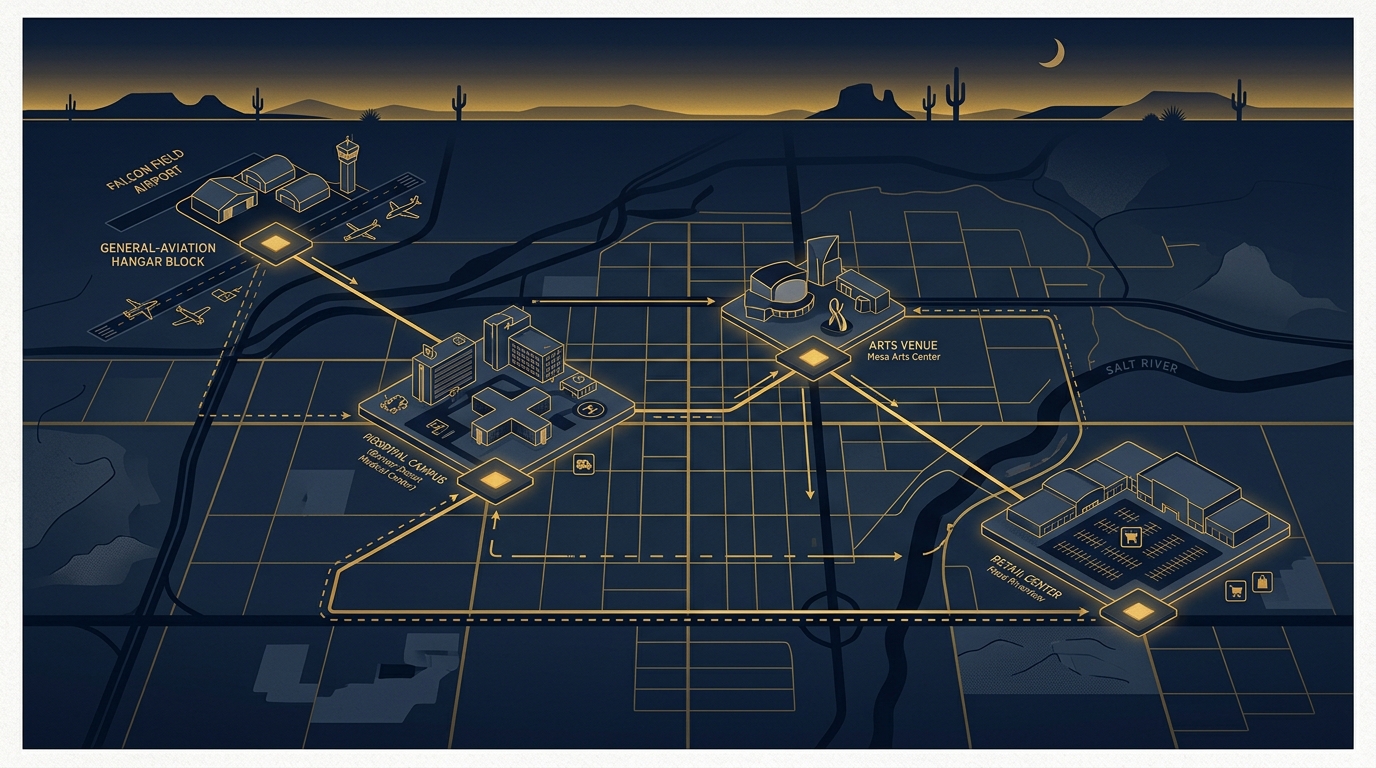
Mesa’s roughly half a million residents and sprawling footprint sit across genuinely different risk environments: an aerospace-manufacturing corridor near Falcon Field, a major hospital campus, a walkable downtown arts district, large retail power centers, and dense residential and HOA communities stretching toward Queen Creek and Apache Junction. Each of those environments carries a different threat profile and demands a different guard posture, which is why a templated “one post, one post order” approach tends to underperform here. Our nearest office is in Phoenix, roughly a 20 to 25 minute drive west via US-60, which keeps supervision, dispatch, and rapid response close to every Mesa post.
Which Mesa industries and landmarks shape guard staffing decisions?
Boeing’s Mesa facility, adjacent to Falcon Field Airport, manufactures the AH-64 Apache helicopter and anchors a defense-adjacent manufacturing corridor where access control, badge verification, and insider-threat awareness matter as much as a visible guard presence. Falcon Field itself hosts general-aviation hangars and maintenance operations where aircraft parts and avionics equipment are a recognized theft target. Banner Health’s Banner Desert Medical Center and Cardon Children’s Medical Center bring hospital-specific security needs, from emergency-department disturbance response to lobby and visitor screening. Downtown Mesa’s Arts District and the Mesa Arts Center, along with the Cactus League crowds that Sloan Park draws each spring, create seasonal event-security demand. Mesa Riverview and the Fiesta District carry the retail-loss-prevention profile of any major shopping corridor, while the city’s residential growth toward the ASU Polytechnic and Phoenix-Mesa Gateway area in the southeast keeps demand growing for HOA and multifamily patrol.
How does guard posture change by Mesa property type?
| Mesa property type | Primary risk | Recommended guard posture |
|---|---|---|
| Aerospace / advanced manufacturing (Falcon Field corridor) | Insider threat, unauthorized access, material or IP loss | Badge-verified access control + escort protocol + investigative escalation |
| Hospital / medical campus (Banner Desert, Cardon Children’s) | Workplace violence, ED disturbances, infant and visitor security | De-escalation-trained officer at ED/lobby + visitor screening + rapid response |
| Downtown arts & event venues (Mesa Arts Center, Sloan Park area) | Crowd management, pedestrian and parking conflicts during events | Event-staffed patrol + traffic and pedestrian control |
| Retail corridor (Mesa Riverview, Fiesta District) | Organized retail crime, parking-lot incidents | Visible fixed post + proactive lot and corridor patrol |
| General aviation (Falcon Field hangars) | Aircraft, tool, and avionics theft | Perimeter and hangar patrol + access logging |
| HOA / residential community | Trespassing, vehicle and package theft | Randomized GPS-verified mobile patrol |
How should a Mesa business choose a security guard company?
Use this framework before signing with any provider:
- Verify Arizona licensing. Confirm the firm and its individual officers are registered under A.R.S. Title 32, Chapter 26, through the Arizona Department of Public Safety.
- Confirm employment status. Ask directly whether guards on your property are the company’s own employees or subcontracted through a labor broker.
- Require a documented risk assessment. A serious provider scopes your property’s specific threats before proposing a post count or patrol frequency.
- Match posture to threat. Decide, post by post, whether a fixed guard, mobile patrol, or hybrid coverage fits the risk.
- Check armed versus unarmed certification. Confirm the officer assigned to an armed post holds the additional Arizona armed-guard certification the post requires.
- Review insurance and supervision. Ask how officers are supervised, audited, and how incidents are escalated after hours.
- Confirm technology and reporting. GPS-verified patrol checkpoints and digital incident reporting should be standard, not an upcharge.
- Get a transparent, itemized quote. Pricing should break out hourly rate, armed premium if applicable, and any setup or equipment costs.
Are Honeybadger’s Mesa guards our own employees or subcontracted?
They are our own. In Arizona, every uniformed officer, mobile patrol unit, and armed protective agent assigned to a Mesa post is Honeybadger’s in-house, Arizona-licensed, supervised personnel. We do not broker Mesa posts to a subcontractor or a third-party staffing network. That matters practically: when a single firm owns the licensing, training, insurance, and day-to-day supervision behind the officer standing on your property, you have one accountable point of contact rather than a chain of vendors to sort through when something goes wrong.
Subcontracted guard staffing is common in the Phoenix metro because it is cheaper to run for the vendor: a broker wins the contract, then fills the post through whichever third-party staffing agency has an available body that week. Turnover on that model tends to be high, supervision is thin, and the officer on your property often has little accountability to the firm whose name is on your contract. Because Mesa is served directly from our nearby Phoenix office rather than through a subcontracted layer, the officer patrolling your property, the supervisor who audits that patrol, and the firm that carries the licensing and insurance are the same organization from top to bottom.
How is aerospace and healthcare-adjacent security handled differently in Mesa?
The Falcon Field aerospace corridor and Mesa’s hospital campuses demand training beyond a standard uniformed post. At a manufacturing or hangar facility, officers focus on controlling movement: verifying badges at every access point, escorting visitors and contractors, logging tool and material movement, and escalating any anomaly, such as an unfamiliar device on a workstation or an unusual after-hours entry, to an investigative team rather than treating it as routine. At a hospital campus, officers are trained in de-escalation for emergency-department disturbances, lobby and visitor screening protocols, and coordination with clinical staff during a code response, recognizing that a healthcare environment calls for restraint and communication as much as a visible presence.
What drives the cost of a Mesa guard program, and what separates elite providers from mediocre ones?
Cost is driven by whether a post is armed or unarmed, the hours and days of required coverage, whether the property needs a fixed post, mobile patrol, or a hybrid, and how much technology integration (cameras, access control, GPS-verified patrol reporting) is layered in. A single overnight patrol route across an HOA community is a fundamentally different scope than a 24/7 armed post at a manufacturing gatehouse.
What separates elite security providers from mediocre ones in Mesa is rarely the uniform; it is what stands behind it. Elite providers staff with their own licensed employees, run a documented risk assessment before quoting, verify patrol activity with GPS-timestamped checkpoints, and escalate incidents to real investigative capability rather than a call center. Mediocre providers rotate subcontracted labor with high turnover, propose a generic post count without assessing the property, and hand you a paper log with no way to verify a patrol actually occurred.
How fast can Mesa security coverage start?
Because our nearest office sits a short drive away in Phoenix, most Mesa properties can move from an initial risk assessment to an active guard post within days rather than weeks. Request a free assessment and quote by calling 602-725-2818, or book a consultation through our AI scheduling assistant to get a site walk on the calendar and a proposal scoped to your specific Mesa property.
What does a Mesa risk assessment actually look for?
A site walk is not a formality; it is where the guard plan actually gets built. For an aerospace or manufacturing site near Falcon Field, the assessment maps every vehicle and pedestrian access point, badge-reader coverage, and blind spot along a fence line that may run for a mile or more. For a hospital campus, it maps emergency-department entry and exit flow, visitor-check-in chokepoints, and after-hours lobby exposure. For a retail center or downtown event venue, it maps parking-lot lighting, sightlines, and pedestrian flow during peak hours and events. That documented assessment, not a generic post-count template, is what determines whether a property needs a single fixed post, a mobile patrol route, or a hybrid of both, and it is the same document we revisit if an incident occurs so the posture can be adjusted rather than guessed at.
How does Mesa’s sprawling footprint change patrol strategy compared to a compact urban core?
A downtown Phoenix office tower can often be covered by a single well-placed lobby post because the entire risk surface sits within one building envelope. Mesa rarely offers that luxury. A single commercial client might operate a manufacturing building near Falcon Field, a retail location near Mesa Riverview, and a multifamily property near the Gateway corridor, three sites separated by ten or more miles of surface streets. Rather than staffing each site identically, we typically build a coverage plan around randomized, GPS-verified mobile patrol that rotates across a defined territory, layered with fixed posts only where a specific chokepoint, entrance, or asset genuinely requires a constant physical presence. This keeps coverage responsive across Mesa’s geography without paying for redundant fixed staffing at every location.
What happens if a Mesa incident requires more than a guard on the scene?
A guard program is only as strong as what stands behind it once something actually happens. If a Mesa post uncovers internal theft at a manufacturing site, a false workers’ compensation claim, or a pattern of after-hours access that looks like more than a one-off trespass, that incident does not have to be handed off to an outside investigator who starts from zero. Because our investigations division sits inside the same firm, a Mesa guard incident can escalate directly into a documented internal investigation, complete with interview support, surveillance if warranted, and, where digital evidence is involved, coordination with our in-house forensic examiners. Fewer handoffs mean a faster, more defensible response and a single point of accountability from the moment a guard reports something unusual to the moment the matter is resolved.
Frequently asked questions
Is Honeybadger’s Mesa security guard company using its own officers or a subcontractor?
Our own officers. Every guard, patrol unit, and armed protective agent assigned to a Mesa post is Honeybadger’s in-house, Arizona-licensed, supervised personnel. We do not subcontract Mesa posts to a third-party staffing network.
How quickly can guard coverage start at a Mesa property?
Most Mesa properties can move from an initial site assessment to an active post within days. Our nearest office is in Phoenix, roughly 20 to 25 minutes from most Mesa locations, which keeps supervision and rapid response close.
Do you provide security for Mesa healthcare facilities like Banner Desert or Cardon Children’s?
We provide officers trained for hospital-adjacent environments, including emergency-department de-escalation and lobby and visitor screening, and we scope every healthcare engagement around the specific campus and its clinical operations rather than a generic post order.
Are Honeybadger officers licensed under Arizona law?
Yes. Arizona regulates private security under A.R.S. Title 32, Chapter 26, administered by the Arizona Department of Public Safety. Honeybadger holds Arizona agency licensing, and our individual officers are registered and screened as state law requires, which protects clients from the legal and insurance exposure that comes with an unlicensed provider.
About Honeybadger Solutions
Honeybadger Solutions is an Arizona-licensed security and investigations firm serving Mesa from our nearby Phoenix office. In Arizona, our uniformed security officers, mobile patrol, and protective agents are our own in-house, Arizona-licensed, supervised personnel, not subcontractors. Digital forensics, cybersecurity, financial investigations, and background intelligence are run in-house and delivered nationwide and internationally.
Offices: Casa Grande (HQ), Phoenix, and Oro Valley, Arizona.
Phone: 602-725-2818
Confidential consultation: request a free security assessment and quote for your Mesa property, by phone or through our AI scheduling assistant.
Sources and further reading
- Arizona Department of Public Safety — Licensing Unit — The state authority that licenses security guard agencies, private investigators and individual registrations in Arizona, including current requirements and fee schedules.
- U.S. Bureau of Labor Statistics — Security Guards — Federal occupational data on employment levels, wages, training requirements and projected demand for security officers.
- ASIS International — Standards and Guidelines — ANSI-accredited standards covering physical asset protection, security risk assessment, investigations, executive protection and workplace violence prevention.
Honeybadger Solutions staffs Residential Security Services, Commercial & Corporate Security and Event Security directly across Maricopa, Pinal and Pima counties in Arizona, and coordinates the same standard nationwide through vetted partner agencies licensed in their own states — managed from Arizona under a single point of accountability.