
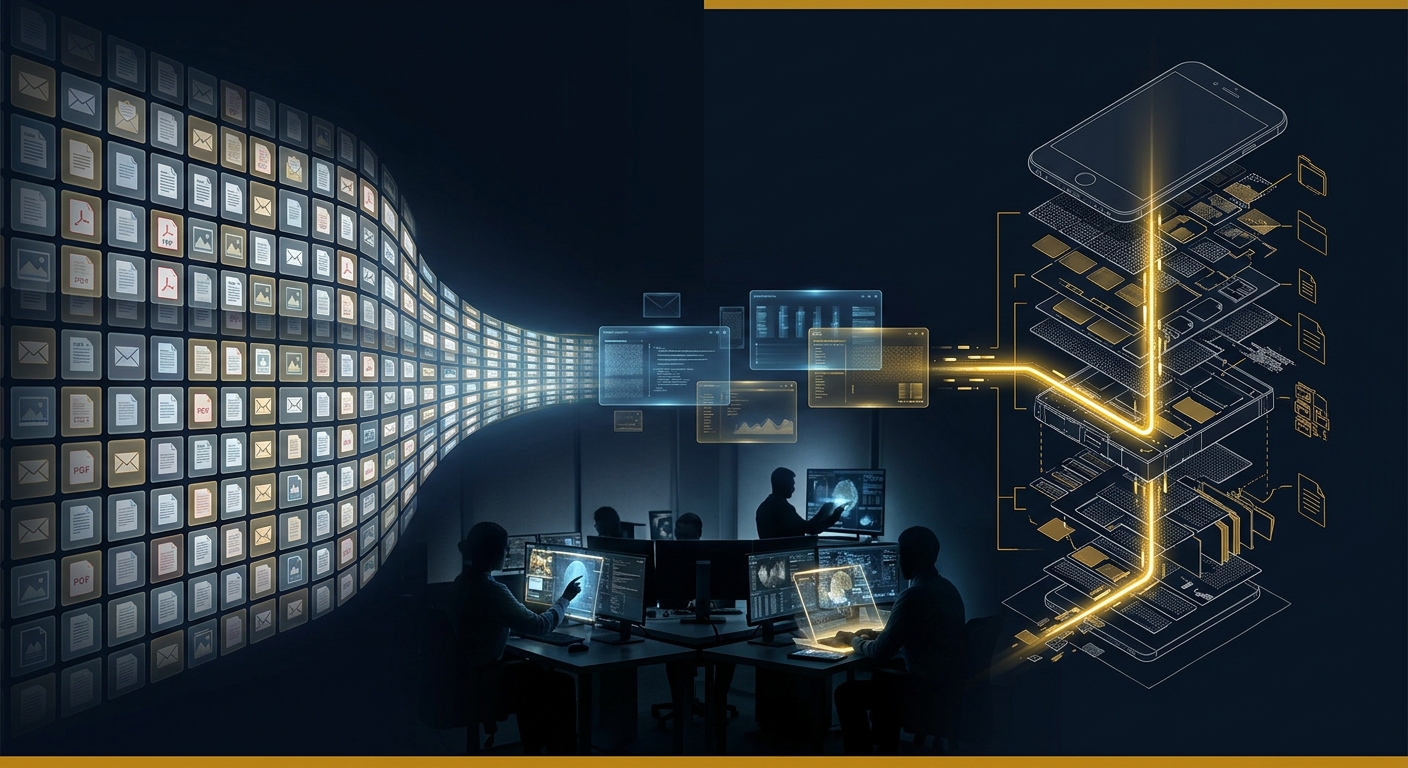
E-discovery is the large-scale identification, preservation, collection, and review of electronically stored information for litigation or regulatory response; digital forensics is the deep technical examination of a specific device or data source to recover, authenticate, and interpret artifacts. Put simply, e-discovery answers “what relevant documents exist across the enterprise?” while forensics answers “what actually happened on this machine, and can we prove it?” Sophisticated matters use both.
General counsel, litigation partners, and corporate risk officers routinely conflate the two disciplines—and vendors are happy to let the ambiguity ride, because a per-gigabyte review platform and a forensic laboratory carry very different price tags and very different burdens of proof. The confusion is expensive. Scoping a matter as routine e-discovery when it demands forensic rigor can forfeit the ability to authenticate a key file, prove deletion, or reconstruct a timeline; over-forensicating a straightforward document production wastes budget and slows the case. Knowing which tool the matter requires—and where the two converge—is a strategic decision that belongs to counsel, not to whichever vendor answered the phone first.
What is e-discovery, and what problem does it solve?
Electronic discovery—e-discovery—is the process of identifying, preserving, collecting, processing, reviewing, and producing electronically stored information (ESI) in response to litigation, arbitration, or a regulatory or government inquiry. It is the modern engine of the discovery phase governed by the Federal Rules of Civil Procedure and their state analogues, and it operates at scale: email accounts, chat platforms, shared drives, cloud repositories, collaboration tools, and structured databases, often spanning dozens of custodians and terabytes of data.
The discipline follows a well-established workflow—widely mapped to the Electronic Discovery Reference Model (EDRM)—that moves from information governance through identification, preservation, collection, processing, review, analysis, and production. The defining challenge is volume and relevance: reducing an ocean of ESI to the responsive, non-privileged subset a matter actually requires. Modern e-discovery leans heavily on technology-assisted review (predictive coding), advanced search, deduplication, threading, and analytics to make that reduction defensible and affordable. The output is a produced set of documents—with metadata, privilege logs, and a documented, repeatable process that will withstand a challenge to its completeness.
Crucially, e-discovery generally works with data that is already visible and accessible—the live and archived files a custodian created or received. It is breadth-first: cast a wide, defensible net across many sources, then cull. It is not, by design, an exercise in recovering what someone tried to hide.
What is digital forensics, and how is it different?
Digital forensics is the scientific examination of digital devices and data to identify, preserve, recover, analyze, and present facts about their use—conducted to a standard that will survive courtroom scrutiny. Where e-discovery casts wide, forensics goes deep: a forensic examiner takes a bit-for-bit image of a single hard drive, phone, or cloud account and interrogates it at the artifact level—deleted files, unallocated space, file-system metadata, registry keys, link files, browser history, system logs, timestamps, and traces the ordinary user never sees.
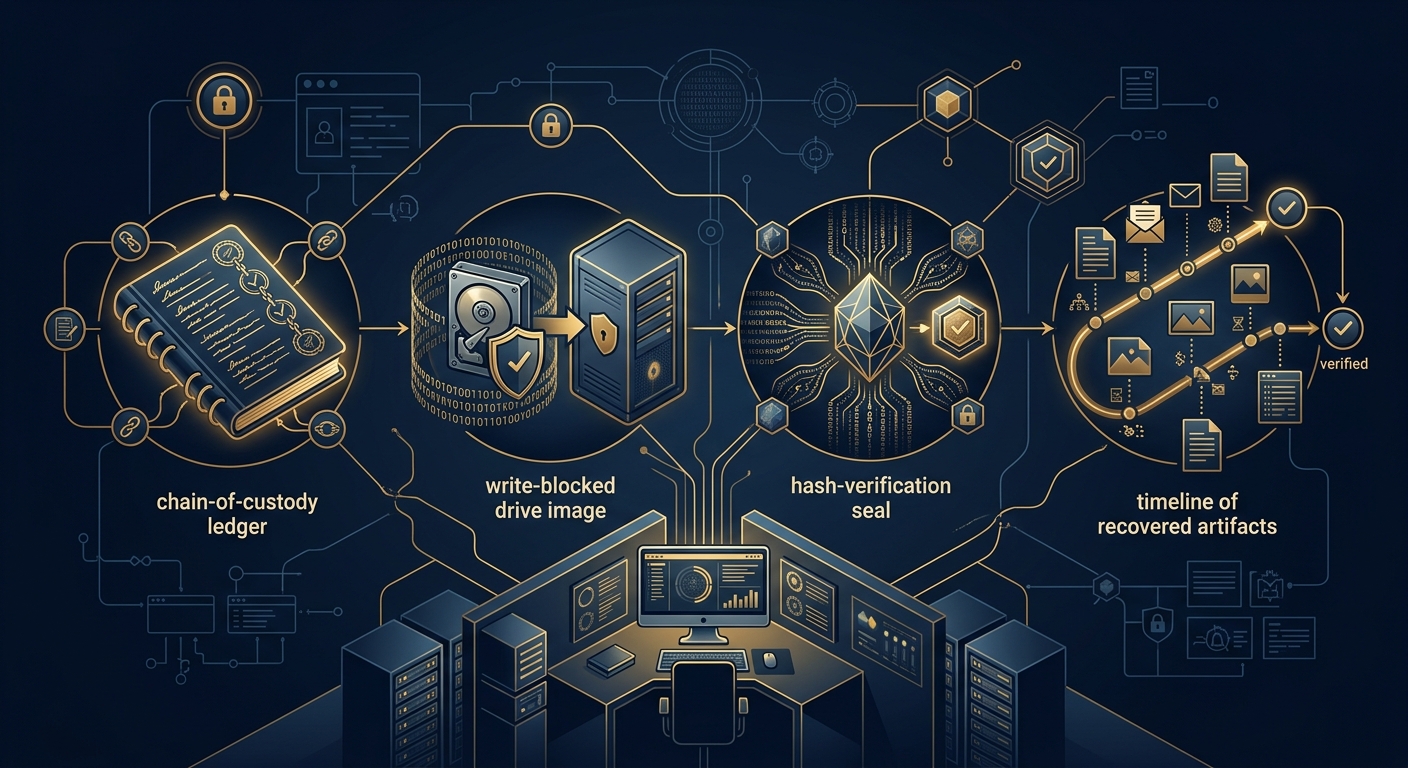
The purpose is not to summarize what a document says but to establish provenance and behavior: Who created this file, and when? Was it altered, backdated, or exfiltrated? Was data deleted or wiped, and can it be recovered? Did a departing employee plug in a USB drive and copy a client list the night before resigning? Answering these questions demands write-blocking, cryptographic hash verification, forensically sound imaging, validated tools, and—above all—an unbroken chain of custody. The deliverable is an expert analysis, often accompanied by expert testimony, that can authenticate evidence under the rules of evidence and withstand a Daubert challenge.
The distinction is one of depth and burden. E-discovery must be defensible as a process; forensics must be defensible as science. A document reviewer reads the letter; a forensic examiner proves who wrote it, when, on which machine, and whether it was tampered with afterward.
E-discovery vs digital forensics: a side-by-side comparison
| Dimension | E-Discovery | Digital Forensics |
|---|---|---|
| Core question | What relevant documents exist? | What happened on this device, and can we prove it? |
| Approach | Breadth-first, across many sources | Depth-first, into a specific source |
| Data type | Live and archived, accessible ESI | Active, deleted, hidden, and system-level artifacts |
| Scale | Terabytes; dozens to hundreds of custodians | One to a handful of devices, examined exhaustively |
| Primary standard | Defensible, repeatable process (FRCP, EDRM) | Scientific rigor; admissibility (Daubert, Rule 902) |
| Key techniques | Culling, dedup, TAR/predictive coding, review | Imaging, hashing, artifact recovery, timeline analysis |
| Chain of custody | Tracked at the collection level | Forensically strict, evidence-grade throughout |
| Typical output | Produced document set, privilege log, metadata | Expert report, authenticated artifacts, testimony |
| Cost driver | Data volume and review hours | Examiner expertise and analytical depth |
| Answers | “What is discoverable?” | “What is the truth about this data?” |
The two are complementary, not competing. E-discovery manages the volume problem; forensics resolves the truth problem. A mature litigation strategy knows which one each fact in dispute requires—and when a matter that began as ordinary document review must escalate to forensic examination.
Where do e-discovery and digital forensics overlap?
The disciplines share a common spine—the obligation to preserve evidence and to handle it defensibly—and they meet at several practical junctions:
- Preservation and the litigation hold. Both begin the moment a duty to preserve attaches. Failure here triggers spoliation exposure under Federal Rule of Civil Procedure 37(e)—sanctions, adverse-inference instructions, and worse. Whether the matter is a document production or a forensic inquiry, evidence must be locked down first.
- Forensic collection feeding e-discovery. The most defensible e-discovery collections are performed with forensic methods—targeted, hash-verified acquisitions that preserve metadata rather than drag-and-drop copies that silently alter timestamps. Forensics often supplies the front end of an e-discovery workflow.
- Metadata as shared currency. Both care intensely about metadata, but for different ends—e-discovery for relevance, threading, and production format; forensics for authentication, timeline, and tampering analysis.
- Escalation triggers. A routine review can surface an anomaly—a gap in an email thread, a suspiciously round file-modification time, a custodian who claims a device is “wiped”—that converts the matter into a forensic investigation.
Because the handoff between them is where cases are won or lost, the strongest outcomes come from a single, integrated team that can pivot from breadth to depth without a custody-breaking transfer between vendors.
When does counsel need e-discovery, and when does it need forensics?
The choice turns on what is actually in dispute. Use the following decision framework at the outset of any matter involving electronic evidence:
- Is the dispute about the content of documents, at scale? Contract interpretation, knowledge, notice, communications among many people—this is e-discovery. You need to find, review, and produce responsive ESI defensibly.
- Is the dispute about the authenticity, integrity, or history of specific data? Was a document forged or backdated? Was a photo or recording manipulated? Here you need forensics to authenticate the artifact.
- Does the matter turn on conduct on a device? Data theft, IP exfiltration, unauthorized access, deletion or wiping, spyware, employee misconduct—forensics recovers the artifacts and reconstructs the timeline.
- Is deleted or hidden data likely material? If what someone removed matters as much as what remains, you need forensic recovery from unallocated space and system artifacts—e-discovery review of live files will not reach it.
- Is there a real risk of spoliation or a hostile custodian? When you cannot trust the other side to preserve honestly, forensic imaging captures an evidence-grade snapshot before anything can change.
- Will the evidence face an admissibility fight? If a fact must survive a Daubert or authentication challenge, the forensic standard—validated tools, hash verification, expert testimony—is what holds up.
Answer “yes” to questions 2 through 6 and the matter needs forensics, alongside or ahead of e-discovery. Most significant cases are hybrids: forensics establishes the critical facts and authenticates the key exhibits, while e-discovery manages the broader documentary record around them.
How do cost and scope differ?
The economics are fundamentally different because the cost drivers are different. E-discovery cost scales with data volume and human review: collection and processing are typically priced per gigabyte, hosting is a recurring monthly charge per gigabyte on a review platform, and review—historically the single largest line item—scales with the number of documents that human attorneys or reviewers must examine. The strategic goal of the entire discipline is to shrink that review population through culling, deduplication, date and custodian filtering, and technology-assisted review, because every document eliminated early is a document nobody pays to review later.
Digital forensics cost scales with examiner expertise and analytical depth, not volume. A forensic engagement is priced on skilled labor: the hours a qualified examiner spends imaging a device, recovering and interpreting artifacts, building a timeline, writing a defensible report, and—if required—testifying. A single phone or laptop examined exhaustively can cost more than collecting many custodians for review, because the value is in the depth of analysis and the credibility of the expert, not the quantity of data. Rush timelines, encryption, anti-forensic countermeasures, and the need for courtroom-ready testimony all push cost upward.
Scope diverges accordingly. E-discovery scope is defined horizontally—which custodians, which date ranges, which data sources, which search terms. Forensic scope is defined vertically—which devices, examined to what depth, to answer which precise questions. The most common budgeting error is treating a forensic question as an e-discovery line item, or paying to review at scale when a targeted forensic examination of two devices would have resolved the case.
What are the most costly mistakes counsel make?
Several recurring errors separate matters that hold up from those that unravel:
- Self-collection that destroys metadata. Having a custodian or IT staffer “just copy the files” overwrites timestamps and can spoliate the very evidence needed to authenticate them. Collection method is itself a forensic decision.
- Treating a forensic question as document review. Loading a device’s live files into a review platform will never recover deleted data, expose wiping, or authenticate a suspect file. The truth may sit in exactly the places review does not reach.
- Waiting too long to image. Devices get reassigned, reimaged, and recycled; cloud logs age out; auto-delete policies run. Forensic preservation is perishable—delay can permanently erase the answer.
- Breaking chain of custody across vendors. Every uncontrolled transfer between a collection vendor, a review vendor, and an examiner is an authentication argument handed to opposing counsel. Integrated handling closes that gap.
- Under-scoping preservation. Litigation holds that miss chat apps, personal devices used for work, ephemeral messaging, or cloud collaboration tools invite spoliation motions and sanctions.
Representative scenario: the review that should have been a forensic exam
Consider a representative trade-secrets matter in which a departing executive was suspected of taking a proprietary pricing model to a competitor. Counsel initially scoped it as standard e-discovery: collect the executive’s email and files, load them for review, and search for the model. The live review turned up nothing incriminating—the relevant files simply were not there. Only when the matter escalated to a forensic examination of the returned laptop did the picture change: file-system artifacts and USB connection history showed an external drive attached in the final week of employment, link files and shellbags referenced the pricing model by name, and recovery from unallocated space surfaced fragments of the deleted files along with timestamps establishing the copy occurred after the litigation duty to preserve had attached. This is an illustrative scenario, not a named client or claimed outcome—but it captures the core lesson: e-discovery searched what remained; forensics proved what was taken and hidden. The answer lived precisely where document review could not go.
Frequently asked questions
Is digital forensics part of e-discovery, or separate?
They are distinct disciplines that frequently work together. E-discovery is the defensible, large-scale process of finding and producing relevant electronic documents; digital forensics is the deep scientific examination of specific devices to recover and authenticate data. Forensics often provides the collection front end for e-discovery and is escalated when a matter requires proving authenticity, deletion, or conduct on a device—something document review alone cannot establish.
When does a case need forensics rather than just e-discovery?
When the dispute turns on the authenticity, integrity, or history of data—forged or backdated documents, manipulated media, data theft or exfiltration, deletion or wiping, unauthorized access, or a hostile custodian—or when key evidence must survive an admissibility challenge. If deleted or hidden data is likely material, forensics is required, because e-discovery review of live files cannot reach unallocated space or system-level artifacts.
Why is forensic collection better than self-collection for e-discovery?
Because how you collect determines whether the evidence survives challenge. Drag-and-drop copying by a custodian or IT staffer alters timestamps and metadata and can spoliate evidence. Forensically sound, hash-verified collection preserves metadata, documents chain of custody, and captures the data in a defensible state—protecting both the production and any later authentication argument. Collection method is a forensic decision, not a clerical one.
Do you provide e-discovery support and digital forensics nationwide?
Yes. Our digital forensics, cybersecurity, financial-investigations, and background-intelligence capabilities are in-house and remote-by-design, delivered across all U.S. jurisdictions and internationally from our Arizona home command. We perform forensically sound collection and analysis and coordinate with e-discovery review workflows, with defensible chain of custody maintained end to end.
About Honeybadger Solutions
Honeybadger Solutions is an Arizona-licensed security and investigations firm providing digital forensics, cybersecurity, and full-spectrum investigations to law firms, corporations, and counsel nationwide and internationally. Our digital forensics, cybersecurity, financial-investigations, and background-intelligence capabilities are in-house and remote-by-design, delivered under recognized forensic standards with evidence-grade chain of custody and board- and court-ready reporting. We operate three Arizona offices—Casa Grande (headquarters), Phoenix, and Oro Valley—and support engagements across every Arizona venue, all U.S. jurisdictions, and abroad.
Facing litigation, an investigation, or a preservation duty and unsure whether you need e-discovery, forensics, or both? Call 602-725-2818 to brief a forensic lead and scope the right approach before evidence changes. Confidential. Defensible. Nationwide.
Authoritative references: Federal Rule of Civil Procedure 37(e) (Failure to Preserve ESI) and the Electronic Discovery Reference Model (EDRM).