
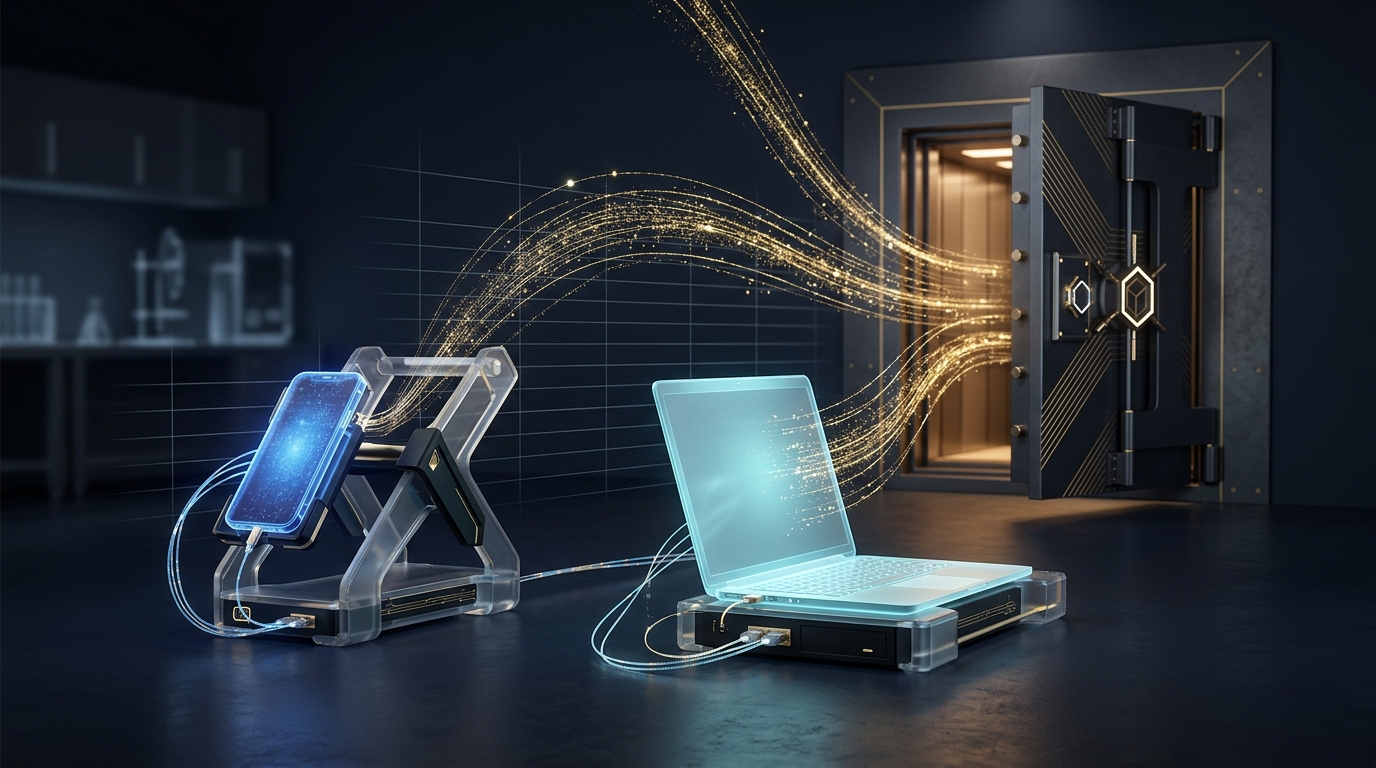
Cell phone forensics and computer forensics share the same evidentiary goal but demand different disciplines. Computers use open, standardized storage that examiners can remove, write-block, and image bit-for-bit. Phones are sealed, heavily encrypted ecosystems where acquisition depends on the exact model, OS version, and lock state. The result: computers often yield fuller disk-level recovery, while phones surface richer behavioral and location intelligence—when they can be accessed at all.
To an executive, general counsel, or investigator, both may look like “pulling data off a device.” In practice they are separate specialties with different hardware, software, legal exposure, and success rates. Treating them as interchangeable is how evidence gets spoliated, how a rushed extraction bricks a key device, and how a case that looked airtight collapses under a chain-of-custody challenge. Understanding where the two diverge is what lets counsel scope the right engagement, set realistic expectations, and preserve the evidence that actually decides the matter.
Why do mobile and computer forensics require different disciplines?
The divergence starts with the hardware itself. A traditional computer stores data on a discrete drive—an SSD or hard disk—that an examiner can physically remove, attach to a hardware write blocker, and copy in full without altering the original. Storage formats are standardized and well documented, file systems such as NTFS, APFS, and ext4 are broadly understood, and decades of tooling exist to parse them. The computer is, in forensic terms, an open book with a stable spine.
A smartphone is the opposite: a sealed, integrated system built to resist exactly the access a forensic examiner needs. Storage is soldered to the board, encryption is on by default and tied to hardware-backed keys, and the operating system changes materially with every release. There are thousands of device-and-OS permutations across Apple and Android, and a technique that works on one build may fail—or destroy data—on the next. As the U.S. National Institute of Standards and Technology notes in its mobile forensics guidance, the pace of change and the diversity of devices make mobile acquisition uniquely challenging compared with the relative stability of computer forensics. Mobile work is therefore a moving target that rewards specialists who track firmware and exploit availability week to week; computer forensics rewards methodical mastery of a mature, slower-moving field.
How does data acquisition differ between phones and computers?
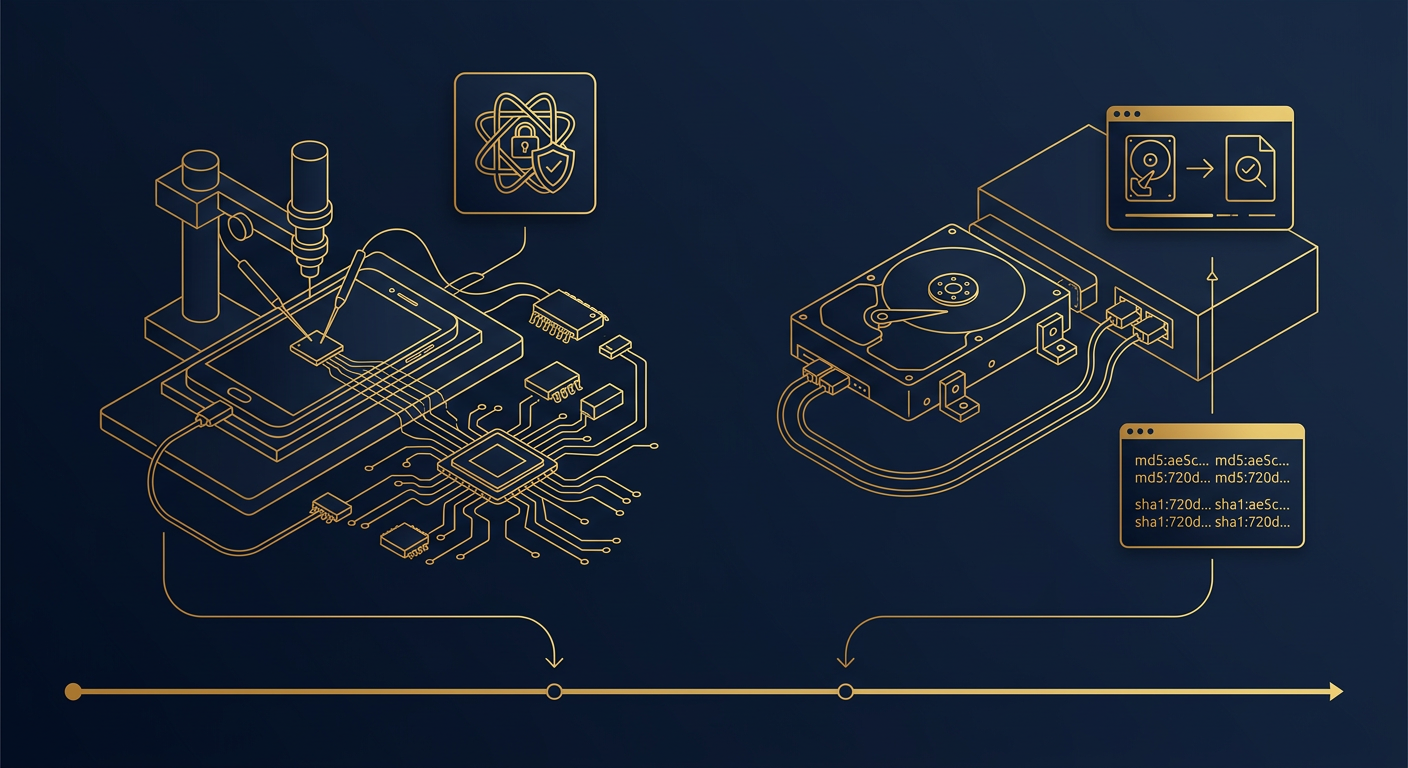
Acquisition—the forensically sound copying of data—is where the two disciplines look least alike. On a computer, the gold standard is a physical image: power down the machine, remove the drive (or use a trusted boot environment), connect through a write blocker that guarantees no data is written back to the source, and create a bit-for-bit copy verified with a cryptographic hash. The same hash, recomputed later, proves the image is identical to the original. It is repeatable, defensible, and largely device-agnostic.
Phones rarely permit that clean separation of storage from system. Examiners instead work through a tiered set of methods, choosing the most complete one the device and its lock state will allow:
- Logical acquisition pulls active, user-accessible data through the device’s own interfaces—contacts, messages, call logs, app data the OS is willing to hand over. Fast and widely supported, but it misses deleted and protected content.
- File-system acquisition reaches deeper into the file structure, recovering databases, caches, and application artifacts that logical methods skip—often the richest practical yield on a modern locked phone.
- Physical acquisition attempts a full bit-level copy of the flash storage, the mobile equivalent of a disk image. On older or exploitable devices it recovers the most, including unallocated space; on current, fully encrypted hardware it is frequently impossible.
- Advanced hardware methods—JTAG and chip-off—connect to test ports or physically remove the memory chip. They can recover data from damaged or locked devices but are destructive, slow, and, against strong encryption, may yield only ciphertext.
The practical consequence: on a computer, an examiner can almost always obtain a complete, verifiable image. On a phone, the achievable depth depends on make, model, OS version, patch level, and whether the device is locked, and it may change the moment a new exploit or a new security patch ships. Scoping a mobile engagement without first identifying the exact device and firmware is guesswork.
Cell phone forensics vs computer forensics at a glance
| Dimension | Computer Forensics | Cell Phone / Mobile Forensics |
|---|---|---|
| Storage | Removable, standardized drives (SSD/HDD) | Soldered flash, integrated with the system-on-chip |
| Primary acquisition | Write-blocked physical image, hash-verified | Tiered: logical, file-system, physical, JTAG/chip-off |
| Encryption | Often optional or configurable; keys may be recoverable | On by default, hardware-backed, tied to passcode |
| OS diversity | Few, stable operating systems | Thousands of device/OS/firmware permutations |
| Deleted-data recovery | Frequently strong (unallocated space, carving) | Limited and device-dependent |
| Signature evidence | Documents, email, browsing, system/event logs | Location history, chat/app data, sensors, usage patterns |
| Time sensitivity | Lower once imaged | High—remote wipe, lock timeouts, battery loss |
| Repeatability | High and largely device-agnostic | Variable; method must match exact device state |
How does encryption change what is recoverable?
Encryption is the single factor that most sharply separates the two fields today. Modern smartphones encrypt storage by default, binding the decryption keys to a dedicated security chip and to the user’s passcode or biometric. If the device is locked and the passcode is unknown, even a perfect physical copy of the flash yields only unintelligible ciphertext. This is why lock state, not raw storage size, dictates a mobile examiner’s success—and why the moment a phone comes into custody, preserving its power and network state matters enormously.
Computers face encryption too—full-disk products such as BitLocker and FileVault are common in enterprises—but the calculus differs. Keys may be escrowed with corporate IT or a directory service, recoverable from a running system’s memory, or available through a cooperating custodian, and a machine seized while powered on and unlocked can often be imaged before its protections re-engage. The forensic lesson is symmetrical but opposite in emphasis: for a computer, capture it live if you safely can; for a phone, isolate it from networks immediately (a Faraday bag or airplane mode) to block a remote wipe, and never let it lock or power down before an examiner has planned the acquisition.
What can each examination actually recover?
Because the devices are used differently, they hold different evidence—and a sophisticated investigation frequently needs both to reconstruct a complete picture. A computer is where deliberate, document-centric activity lives. A phone is where a person’s movements, communications, and habits are recorded almost continuously.
Computer forensics typically surfaces: documents and their metadata, email archives and drafts, web-browsing history, downloaded files, operating-system and application logs, USB and external-device connection records, deleted files recoverable from unallocated space, and artifacts that reveal user intent and timelines. In fraud, intellectual-property theft, and e-discovery matters, the workstation or server is often the decisive source.
Cell phone forensics typically surfaces: SMS, MMS, and encrypted-app messages, call logs, contacts, photos and videos with embedded metadata, GPS and location history, Wi-Fi and cell-tower associations, app usage and account data, health and sensor data, and cloud-sync artifacts. Because a phone travels everywhere with its owner, it is unmatched for establishing where someone was, who they contacted, and when. The trade-off is depth of recovery: deleted-data carving that is routine on a computer is far less reliable on an encrypted, wear-leveled phone.
Neither device exists in isolation. Both increasingly offload data to the cloud—email, backups, chat history, location timelines—so a complete examination often extends to lawfully obtained cloud sources, which can even fill gaps left when the physical device is locked or destroyed.
Which tools do examiners use, and why does that matter?
Toolchains reflect the underlying differences. Computer forensics relies on mature imaging and analysis suites and hardware write blockers, backed by well-established validation. Because the field moves slowly, a competent examiner can carry a stable methodology across most matters. Mobile forensics depends on specialized extraction platforms whose value lies in how current they are—support for the latest handsets and OS builds appears in updates, and a lab running last quarter’s version may simply be unable to access this quarter’s phone.
What matters more than any brand name is validation and defensibility. Elite practice, consistent with NIST and SWGDE guidance, means using tested tools, documenting the exact method and version, verifying results with cryptographic hashes, and preserving a continuous chain of custody. A tool that produces data no one can explain or reproduce is a liability in a deposition, not an asset. When you evaluate a provider, ask how they validate their tools, how they document acquisitions, and how they handle a device or OS their primary platform does not support—because the answer separates a forensic laboratory from a data-recovery shop.
When do you need mobile forensics, computer forensics, or both?
The right scope follows the evidence, not the device that happens to be in hand. Use this framework to decide:
- Define the questions first. “Where was this person and who did they contact?” points to mobile. “What documents were taken and when?” points to computer. “What actually happened across the whole incident?” almost always points to both.
- Inventory every relevant device and account. Phones, laptops, desktops, tablets, external drives, and the cloud accounts they sync to. Missing a device or a backup is how the decisive evidence never enters the case.
- Preserve before you analyze. Isolate phones from networks immediately, capture running computers live where safe, and avoid powering devices on or off ad hoc. Preservation is where cases are won or lost, and it cannot be redone.
- Match method to device state. Identify exact models, OS versions, and lock status so the examiner can select the deepest defensible acquisition rather than the first one that runs.
- Maintain chain of custody throughout. Document who handled each item, when, and why—continuously, from seizure to reporting.
- Correlate across sources. The strongest findings emerge when a computer’s document trail and a phone’s timeline and communications are analyzed together, then cross-checked against cloud records.
- Engage counsel and forensics early. Legal authority, privilege, and scope should be settled before acquisition—especially where employee-owned devices, privacy law, or cross-border data are involved.
In corporate investigations, litigation, and incident response, the answer is rarely “one or the other.” It is a coordinated examination in which each discipline covers the other’s blind spots.
Representative scenario: the laptop said one thing, the phone said another
Consider a representative departing-executive matter. Computer forensics on the returned laptop showed large volumes of proprietary files copied to an external drive in the days before resignation—clear evidence of exfiltration, with timestamps and USB connection records to match. The custodian’s account was that the transfers were routine backups authorized by a manager. Mobile forensics on the same individual’s phone told the rest of the story: location history placed the person at a competitor’s office during the alleged “backup” window, and messaging-app data captured discussions about the very files in question. Neither device alone was conclusive; together they reconstructed intent and timeline. This is an illustrative scenario, not a named client or claimed outcome—but it captures why elite investigations treat computer and mobile forensics as complementary halves of one examination, not competing services.
Frequently asked questions
Is cell phone forensics harder than computer forensics?
In many respects, yes. Phones use sealed storage, default hardware-backed encryption, and thousands of device-and-OS variations, so a technique that works on one model may fail on the next. Computers use removable, standardized drives that can be write-blocked and imaged completely and repeatably. Mobile work demands specialists who track firmware and exploit availability continuously; computer forensics rewards mastery of a more stable, mature field.
Can deleted data be recovered from a phone the way it can from a computer?
Less reliably. On computers, deleted files often persist in unallocated space and can be carved back. On modern phones, default encryption and flash wear-leveling mean deleted content is frequently unrecoverable, and success depends heavily on the exact model, OS version, and lock state. File-system acquisition and lawfully obtained cloud backups often recover more than an attempt to carve the device itself.
What should we do the moment we seize a device to preserve evidence?
For phones, isolate them from all networks immediately—airplane mode or a Faraday bag—to prevent a remote wipe, and do not let them lock or power down before an examiner plans acquisition. For computers, capture them live where it is safe, because a powered-on, unlocked machine can often be imaged before encryption re-engages. Document every action and preserve chain of custody from the first moment.
Do you handle both mobile and computer forensics nationwide?
Yes. Our digital forensics, cybersecurity, financial-investigations, and background-intelligence capabilities are in-house and remote-by-design, delivered across all U.S. jurisdictions and internationally from our Arizona home command. We coordinate phone, computer, and cloud examinations as a single, defensible engagement with continuous chain of custody and court-ready reporting.
About Honeybadger Solutions
Honeybadger Solutions is an Arizona-licensed security and investigations firm providing digital forensics, cybersecurity, and full-spectrum investigations to organizations, counsel, and principals nationwide and internationally. Our forensics, cybersecurity, financial-investigations, and background-intelligence capabilities are in-house and remote-by-design, conducted under recognized methodologies with hash-verified acquisitions, continuous chain of custody, and board- and court-ready reporting. We operate three Arizona offices—Casa Grande (headquarters), Phoenix, and Oro Valley—and support engagements across every Arizona venue, all U.S. jurisdictions, and abroad.
Need a phone, computer, or cloud examination handled correctly the first time? Book a consultation online to brief a digital-forensics lead and scope the acquisition before evidence is lost. Confidential. Defensible. Nationwide.
Authoritative references: NIST SP 800-101 Rev. 1, Guidelines on Mobile Device Forensics and NIST SP 800-86, Guide to Integrating Forensic Techniques into Incident Response.
Browse by topic
Security guard services · Private investigations · Cybersecurity · Digital forensics · Financial fraud investigation · Executive protection · All articles