
Arizona Executive Protection Services: What Elite Clients Should Expect in 2026
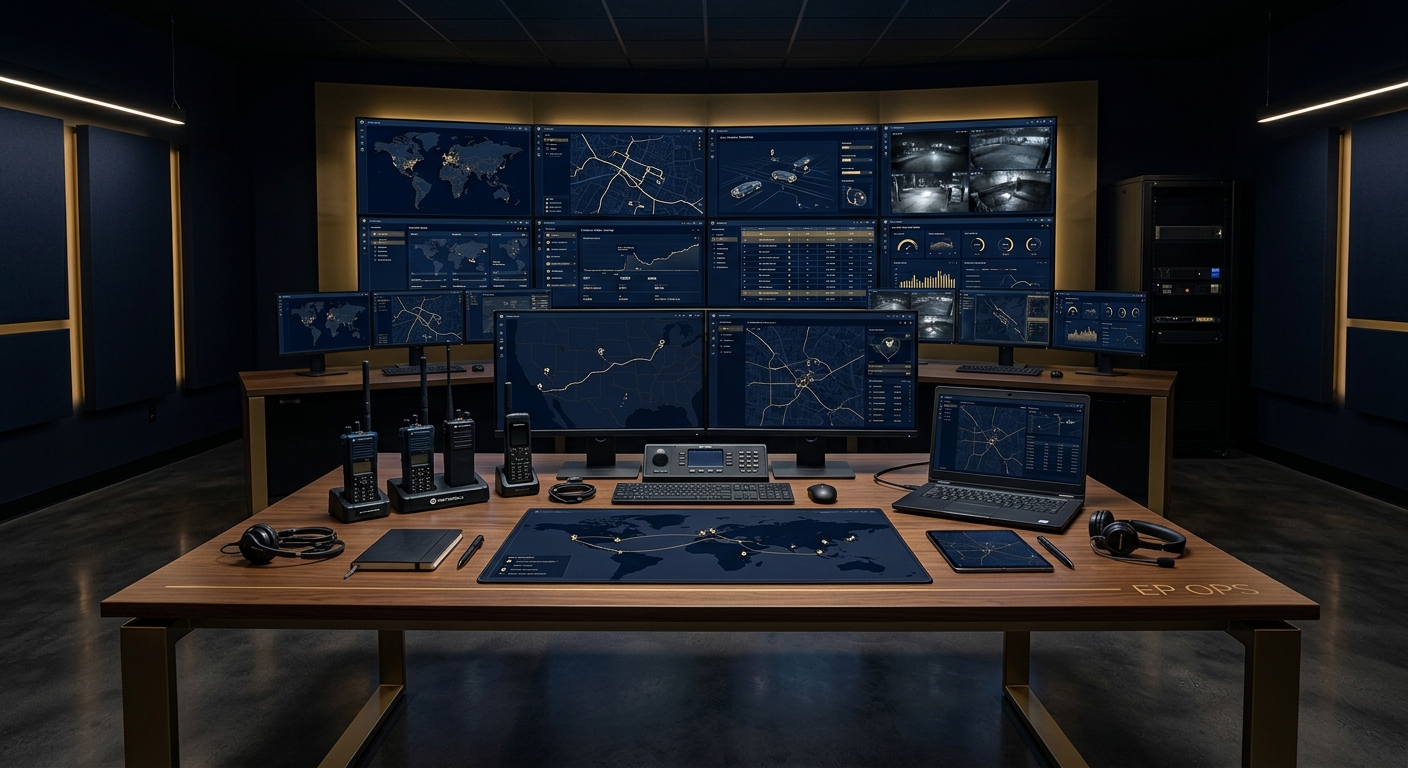
Every security firm in the Southwest now advertises “executive protection.” Very few actually run one. The gap between the two is not muscle, uniforms, or a fleet of black SUVs — it is program discipline: the intelligence work done before a principal ever leaves the residence, the medical plan built into the movement plan, and the command structure that makes a detail predictable under pressure instead of improvised. For a Fortune-500 general counsel evaluating protection for a traveling executive, or a UHNW family assessing coverage for a principal and household, the 2026 standard has moved well past “hire a bodyguard.” It has become a managed operational program.
In 2026, elite executive protection in Arizona means an intelligence-led, advance-driven program — not a bodyguard on a payroll. Expect continuous threat assessment, documented advance work before every movement, embedded medical readiness, layered (not novelty) technology, and a named command structure. In Arizona, that capability should be owned and in-house; outside Arizona, it should run through a vetted, licensed partner network that a single command element holds accountable.
What “Elite” Actually Means in Executive Protection
“Elite” is one of the most abused words in the protective services industry, usually attached to a large man in a dark suit standing near a principal for a photo opportunity. That is theater, not protection. The actual discipline — the one taught in close-protection doctrine derived from U.S. Diplomatic Security, UK close protection training, and the standards bodies that codify the field, including ASIS International — treats protection as a risk-management program, not a physical posture.
A genuinely elite program is measured by a ratio: the hours invested before a principal moves versus the hours spent moving with them. In a mature program, that ratio favors preparation heavily — advance work, intelligence review, medical pre-planning, and contingency design consume far more effort than the visible act of walking a principal from a vehicle to a building. Clients who evaluate providers on headcount and vehicle inventory alone are pricing the wrong variable. Clients who ask “show me your advance-work process” are asking the right question.
The Six Standards of a Modern EP Program in 2026
Regardless of firm size, a program built to a 2026 standard is architected around six components. A provider unable to speak fluently to all six is not running a program — it is renting labor.
1. Intelligence-Led Protection
Reactive protection waits for a threat to appear and then responds. Intelligence-led protection assumes the threat picture changes continuously and builds a standing process to track it: open-source monitoring of the principal’s public exposure, review of prior threat history and any restraining or protective orders on file, social-media exposure audits for the principal and immediate family, travel-risk intelligence for any city or venue on the itinerary, and insider-risk screening of household or executive-assistant staff who have proximity access. The output is not a static risk score — it is a living brief that updates the advance team and the detail leader before every movement, not once a quarter.
2. Advance Work: The Part No One Sees
Advance work is the single most predictive indicator of program quality, and it is almost invisible to the client. Before a principal arrives anywhere, a competent advance element has already walked the site, timed the routes, identified primary and secondary egress, mapped the nearest trauma-capable hospital, coordinated with venue or building security, scouted vehicle load points, and built a contingency for the two or three most plausible disruptions — a medical event, a credible threat escalation, or a logistics failure. Elite programs run this process on every movement, not just “high-risk” ones, because most disruptions occur during routine, low-attention movement, not the marquee event everyone is already watching closely.
3. Discretion by Design
A protective detail that draws attention has already failed one of its core objectives. Elite programs default to a low-profile posture: plainclothes agents, unmarked vehicles, staffing sized to the actual threat tier rather than to impress, and strict information compartmentalization — itineraries, routes, and residence details are shared on a need-to-know basis, under signed non-disclosure agreements, with no case data ever used publicly. A firm that markets client names, photographs, or “war stories” in its portfolio has already told you how it treats confidentiality.
4. Medical Readiness Embedded in the Detail
The most common life-safety event on a protective detail is not an attack — it is a medical emergency: cardiac events, heat-related illness (a materially higher risk in Arizona’s summer operating environment), diabetic emergencies, and falls. A 2026-standard program embeds medical readiness into the movement plan itself, not as an afterthought: agents trained to at least Tactical Combat Casualty Care or EMT-equivalent standards, trauma kits staged in every vehicle, and pre-identified trauma-capable hospitals along every route, confirmed during the advance rather than looked up during the emergency. The life-safety plan is built before the movement plan, not bolted onto it.
5. Technology as a Force Multiplier, Not a Gimmick
Technology should extend trained judgment, not replace it. That means vehicle telematics and GPS tracking tied to the operations desk, encrypted communications between agents and command, duress and panic-alert protocols for the principal and household staff, access-control discipline at residences, and situational awareness of low-cost drone surveillance as a genuine and growing exposure at events and residences. What it should never mean is a firm substituting an app for trained personnel, or presenting a dashboard as a replacement for advance work. Technology is layered onto the six standards; it does not stand in for any of them.
6. Command Structure and Home-Base Capability
Every engagement should have a named detail leader, a 24/7 operations desk that can be reached without delay, a defined escalation chain, and a documented after-action report following any incident or notable deviation from plan. Just as important — and the single question clients skip most often — is where the provider’s capability is actually owned. A firm should be direct about which jurisdictions it staffs with its own licensed personnel and which it commands through a partner network. Vague answers to that question are the most reliable warning sign in the entire evaluation.
Arizona: Home Command, Owned Capability
Within Arizona, Honeybadger Solutions delivers executive protection through our own in-house, state-licensed agents — not subcontracted labor. That distinction matters more than most clients realize: an owned team trains together, drills together, and is accountable to a single chain of command, which is precisely what a mature protective program depends on. Arizona is our home command — the base from which intelligence, advance planning, and detail leadership originate for engagements that run through Phoenix, Scottsdale, and the broader Sun Corridor, supported by our three-office footprint across Casa Grande, Phoenix, and Oro Valley.
Arizona also carries operational specifics that a locally rooted provider plans for and an out-of-state provider often misses: extreme summer heat as a genuine medical-risk multiplier during outdoor movements and events, the density of UHNW residential corridors in Paradise Valley and North Scottsdale, high-volume executive travel through Phoenix Sky Harbor, and a state licensing regime — administered by the Arizona Department of Public Safety — that governs who may lawfully provide protective and investigative services in the state. Verifying that licensure is not a formality; it is the baseline that separates a legitimate protective program from unlicensed exposure for the client who hired it.
Outside Arizona: The Vetted-Partner Command Model
No responsible firm claims owned, licensed protective agents in every state — that claim is itself a red flag. Outside Arizona, Honeybadger commands protective engagements through an established, vetted-partner network with mature theaters in California, Texas, and Florida. The distinction that matters to the client is where command sits: Honeybadger’s intelligence function, advance-work oversight, and quality-control standards govern the engagement end-to-end, even where the physical detail on the ground is staffed by a partner agency. Every partner is vetted against the same six standards outlined above — licensing, insurance, medical training level, and reporting discipline — before being cleared to run a Honeybadger-commanded detail.
For engagements outside the CA/TX/FL theaters, we scope capability individually rather than overstate it; an honest “let us assess and confirm partner coverage for that market” is a stronger signal of program integrity than a blanket “yes, everywhere” that no legitimately licensed firm can actually back up.
Baseline Bodyguard Services vs. a 2026-Standard EP Program
| Program Element | Baseline “Bodyguard” Model | 2026 Elite EP Standard |
|---|---|---|
| Advance work | Little to none; agent arrives with the principal | Site, route, and hospital reconnaissance completed before every movement |
| Intelligence | One-time background check, rarely updated | Continuous OSINT and threat-history monitoring feeding live briefs |
| Medical readiness | Basic first aid, if any | TCCC/EMT-trained agents, staged trauma kits, pre-identified trauma centers |
| Staffing model | Sized for visual deterrence | Sized to documented threat tier; discreet, plainclothes-first |
| Technology | Personal cell phone | Encrypted comms, vehicle telematics, duress protocols |
| Command & reporting | Informal, no after-action record | Named detail leader, 24/7 ops desk, documented after-action reports |
| Geographic honesty | Claims coverage everywhere | Discloses owned vs. vetted-partner coverage by state |
How to Evaluate a Provider Against These Standards
Whether the engagement is a single executive’s travel itinerary or standing coverage for a principal and household, the same evaluation framework applies. Work through it in order — each item narrows the field faster than the last.
- Verify licensing directly. In Arizona, confirm the firm’s PI/guard licensing with AZDPS rather than accepting a claim at face value.
- Ask for the advance-work process in writing. A real program can describe its site-survey and route-reconnaissance checklist without hesitation; a labor-only provider cannot.
- Confirm medical training level. TCCC or EMT-equivalent certification for agents, and ask whether trauma kits are standard-issue per vehicle.
- Request the command structure. A named detail leader and a 24/7 operations desk should exist before day one, not be assembled after the contract is signed.
- Ask how discretion is enforced. NDA practice, staffing footprint philosophy, and whether the firm has ever referenced client work publicly.
- Get geographic coverage in writing — owned vs. partner. Any firm claiming owned, licensed agents in every U.S. state should be disqualified on that claim alone.
- Ask about after-action reporting. Does every engagement close with a documented report, and will you receive it?
- Check insurance and liability coverage. Protective services carry real liability exposure; confirm coverage limits match the engagement’s risk tier.
Cost Drivers — and What They Actually Signal
Pricing in executive protection varies widely, and the variance itself is informative. The primary cost drivers are detail size relative to documented threat tier, advance-work lead time (a same-day request costs materially more than a program with a standing retainer and pre-built advance templates), medical asset level (EMT-trained agents cost more than untrained staff, and for the highest-risk engagements a paramedic or on-call physician arrangement costs more still), geographic scope (in-house Arizona coverage versus commanded multi-state or partner-network coverage), and engagement duration (a single event versus standing protective coverage for a principal and family).
A quote that arrives suspiciously low relative to the scope described almost always signals one of the same failures: no real advance work, untrained or under-trained personnel, or informal subcontracting with no accountable command structure behind it. In protective services, the cheapest bid is rarely the cheapest outcome.
Representative Scenario
Consider a representative — not an actual client — scenario: a Scottsdale-based principal with a multi-city investor roadshow spanning Phoenix, Los Angeles, and Houston. Honeybadger’s Arizona team runs intelligence and advance work for the Phoenix legs directly with owned personnel, builds the full itinerary-level threat brief before departure, and hands command of the Los Angeles and Houston legs to vetted CA and TX partners — briefed against the same standards, reporting into the same operations desk, with the same after-action process on the back end. The principal experiences one continuous program; the client’s general counsel receives one consolidated after-action report, regardless of which jurisdiction’s personnel were physically on the ground.

The 2026 Outlook: What’s Changing for Elite Clients
Several trends are reshaping what “elite” protection has to account for heading into 2026. AI-assisted open-source monitoring now makes continuous threat-intelligence coverage achievable for programs that would once have needed a much larger analyst bench — and clients should expect their provider to be using it. Deepfake-enabled impersonation and extortion attempts against executives and family members are a documented and growing threat category, distinct from physical stalking but requiring the same intelligence-led response. Corporate boards are increasingly treating documented executive protection programs as a governance and duty-of-care matter tied to director and officer exposure, not a discretionary perk — meaning the after-action reporting and program documentation discussed above is becoming something general counsel is expected to produce on request, not merely nice to have. And the proliferation of low-cost consumer drones has made unauthorized aerial surveillance of residences and events a real, planned-for variable in advance work, not a theoretical one.
None of these shifts change the underlying architecture of a sound program. They raise the floor on what “intelligence-led” and “advance work” have to include. A provider still operating on a 2015 bodyguard model — visible muscle, no advance work, no documented medical plan — is not simply old-fashioned; it is now measurably behind the threat environment its clients actually face.
Frequently Asked Questions
What makes executive protection “elite” versus a standard bodyguard service?
Elite protection is defined by program architecture, not headcount: continuous intelligence monitoring, documented advance work before every movement, embedded medical readiness, layered technology, and a named command structure with after-action reporting. A standard bodyguard service typically offers visible presence with little to none of the preparation behind it.
Does Honeybadger provide its own protection agents in Arizona, or does it subcontract?
In Arizona, Honeybadger Solutions runs executive protection with our own in-house, state-licensed agents. Arizona is our home command base, and we do not subcontract protective coverage within the state.
How does Honeybadger handle executive protection outside Arizona?
Outside Arizona, Honeybadger commands the engagement through an established, vetted-partner network, with mature theaters in California, Texas, and Florida. Honeybadger’s intelligence, advance-work oversight, and reporting standards govern the engagement even where a partner agency staffs the physical detail. Coverage in other states is assessed and scoped case by case.
How far in advance should a principal engage an EP team before travel or an event?
For standard domestic travel or a single event, two to four weeks allows a full intelligence review and proper advance work. Standing protective coverage for a principal or household should be established as an ongoing program with a live threat brief, rather than assembled reactively after a specific concern arises.
About Honeybadger Solutions. Honeybadger Solutions is an Arizona-licensed security and investigations firm operating from three offices — Casa Grande (HQ), Phoenix, and Oro Valley — delivering in-house executive protection, security consulting, and intelligence-led risk programs across Arizona, with vetted-partner-commanded coverage in California, Texas, and Florida. For a confidential program assessment, call 602-725-2818.