
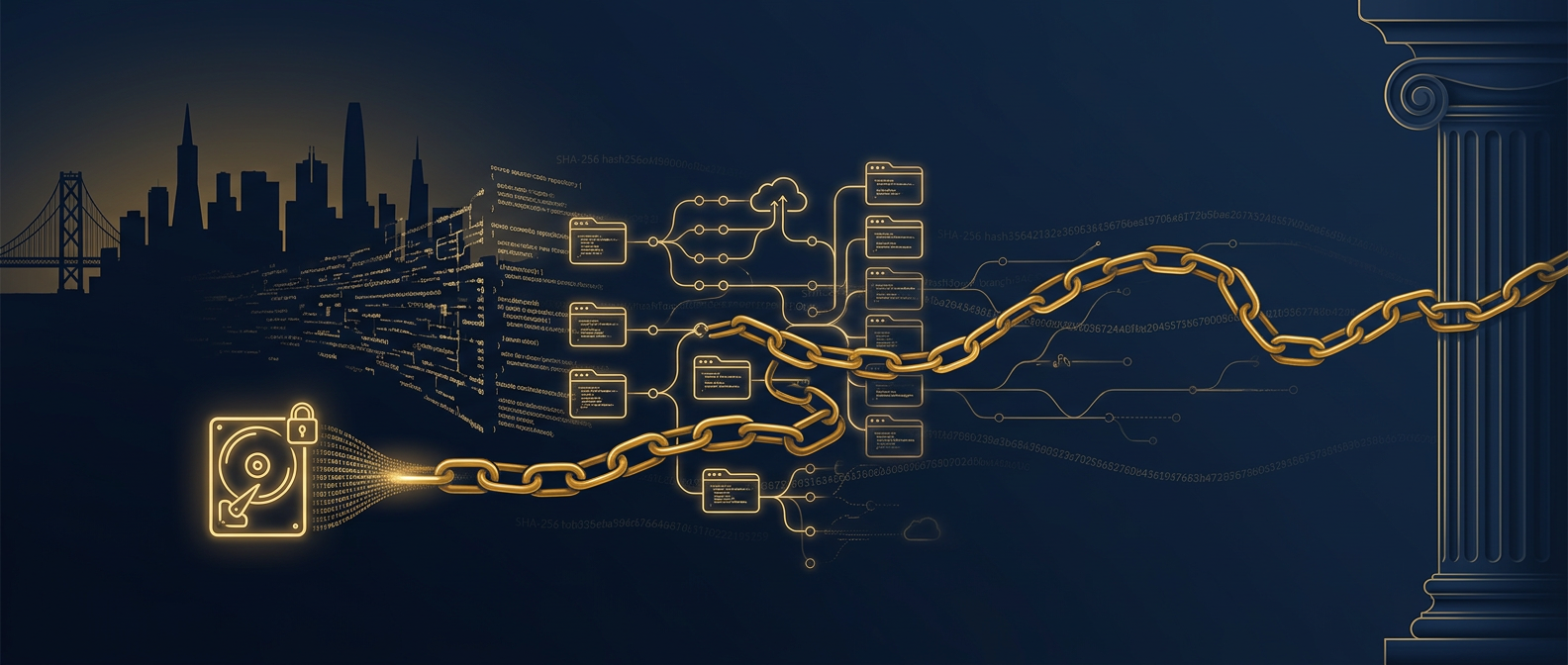
Digital forensics in San Francisco is the court-defensible recovery and analysis of electronic evidence in technology disputes — most often source-code theft, trade-secret misappropriation, and departing-engineer exfiltration. In the Bay Area, cases are won or lost on repository logs, USB and cloud-sync artifacts, and device images, all captured through a write-blocked chain of custody and hash verification an examiner can defend under California’s Kelly and Sargon standards.
No region on earth concentrates more valuable intellectual property inside more portable containers than the San Francisco Bay Area. A company’s crown jewels — a machine-learning model, a proprietary codebase, a customer graph, a chip design — fit on a thumb drive or sync to a personal cloud account in minutes. When a senior engineer resigns for a competitor or a founder spins out a rival, the dispute that follows is decided almost entirely by digital evidence: what left, when, how, and on whose authority. This guide is written for the general counsel, litigation partner, founder, and board member who need to understand how source-code and trade-secret theft is actually proven in San Francisco, why California law makes the forensic timeline the whole ballgame, and what separates an elite forensic partner from a commodity imaging vendor.
Why is source-code theft the defining forensic problem in the Bay Area?
The Bay Area’s economy runs on intangible assets that never appear on a loading dock. The value of a Series-C startup or a public technology company lives in code, models, architecture, and the relationships and know-how of the people who build them. That value is also uniquely fluid. Unlike a physical prototype, a codebase can be cloned in seconds, compressed, encrypted, and moved through a dozen egress paths that look identical to ordinary work. The result is a threat surface where the difference between a legitimate late-night commit and the theft of a company’s future is visible only in the metadata.
Three realities make San Francisco matters distinct. First, the talent market is hyper-mobile: engineers routinely move between direct competitors, and the highest-risk window is the two to four weeks around a resignation. Second, the tooling is adversary-friendly to investigators only if evidence is preserved early — Git repositories, CI/CD systems, cloud storage, and messaging apps all record rich history, but that history is also easy to overwrite or age out. Third, the stakes and sophistication are extreme; opponents are well-funded and technically fluent, so every step of collection will be scrutinized. A provider that treats a Bay Area IP matter like a routine drive copy is a liability. The work must be built for adversarial cross-examination from the first hour.
How does California non-compete law change the forensic playbook?
California is the one jurisdiction where the usual restrictive-covenant playbook does not apply, and that single fact reshapes every technology dispute here. Under California Business and Professions Code § 16600, contracts that restrain a person from engaging in a lawful profession are void, and recent amendments (§§ 16600.1–16600.5) make even attempting to enforce most non-competes against California workers unlawful. Employers therefore cannot lean on a non-compete to stop a departing engineer. What they can protect is their trade secrets — and that is where forensics becomes decisive.
Because the legal lever is misappropriation rather than a covenant, the case rises or falls on proof that specific, protectable information was actually taken and used. That proof is forensic. Claims proceed under the California Uniform Trade Secrets Act (Civil Code § 3426) and, where interstate commerce is involved, the federal Defend Trade Secrets Act, which opens the door to the U.S. District Court for the Northern District of California in San Jose and San Francisco. In both venues the plaintiff must identify the trade secret with particularity and demonstrate acquisition or use by improper means. A forensically established timeline — the moment a repository was cloned to a personal machine, a folder was copied to a USB device, or a project was uploaded to a private cloud account days before resignation — is frequently the evidence that carries the burden. Without it, a complaint is an allegation; with it, it is a case.
Where does the evidence of source-code theft actually live?
Exfiltration leaves fingerprints across systems most custodians never think to preserve. The table below maps the common egress paths in Bay Area matters to the artifacts a forensic examiner targets and what each establishes. These are representative patterns, not case files, but they are familiar to any litigator practicing technology disputes here.
| Egress path | Forensic artifacts | What it establishes |
|---|---|---|
| Source repository (Git/GitHub/GitLab) | Clone and fetch logs, access records, commit and branch history, reflog | Whether and when a codebase was copied, and to which account or machine |
| Removable media (USB) | Windows/macOS device connection history, file-copy timestamps, link/jump-list artifacts | That a device was attached and specific files were transferred to it |
| Personal cloud storage | Sync-client logs, upload timestamps, OAuth grants, browser history | Bulk uploads or syncs of proprietary material to non-company accounts |
| Email & messaging | Sent items, attachments, auto-forward rules, Slack/Signal/WhatsApp records | Transmission of files or coordination with a competitor |
| Endpoint devices | Disk images, unallocated space, shellbags, prefetch, deleted-file remnants | What was accessed, staged, copied, or wiped, and the surrounding timeline |
| Cloud infrastructure & CI/CD | Access logs, API keys, build artifacts, download records | Whether models, data, or build outputs were exfiltrated at scale |
Two Bay Area wrinkles run through all of it. Personal-device and personal-account data raise privacy limits: self-help access to a former employee’s private account can violate California Penal Code § 502 and privacy law, tainting the evidence. And the richest artifacts — sync logs, volatile system data, cloud records with short retention — are perishable, which is why preservation in the first hours often matters more than analysis in the following weeks.
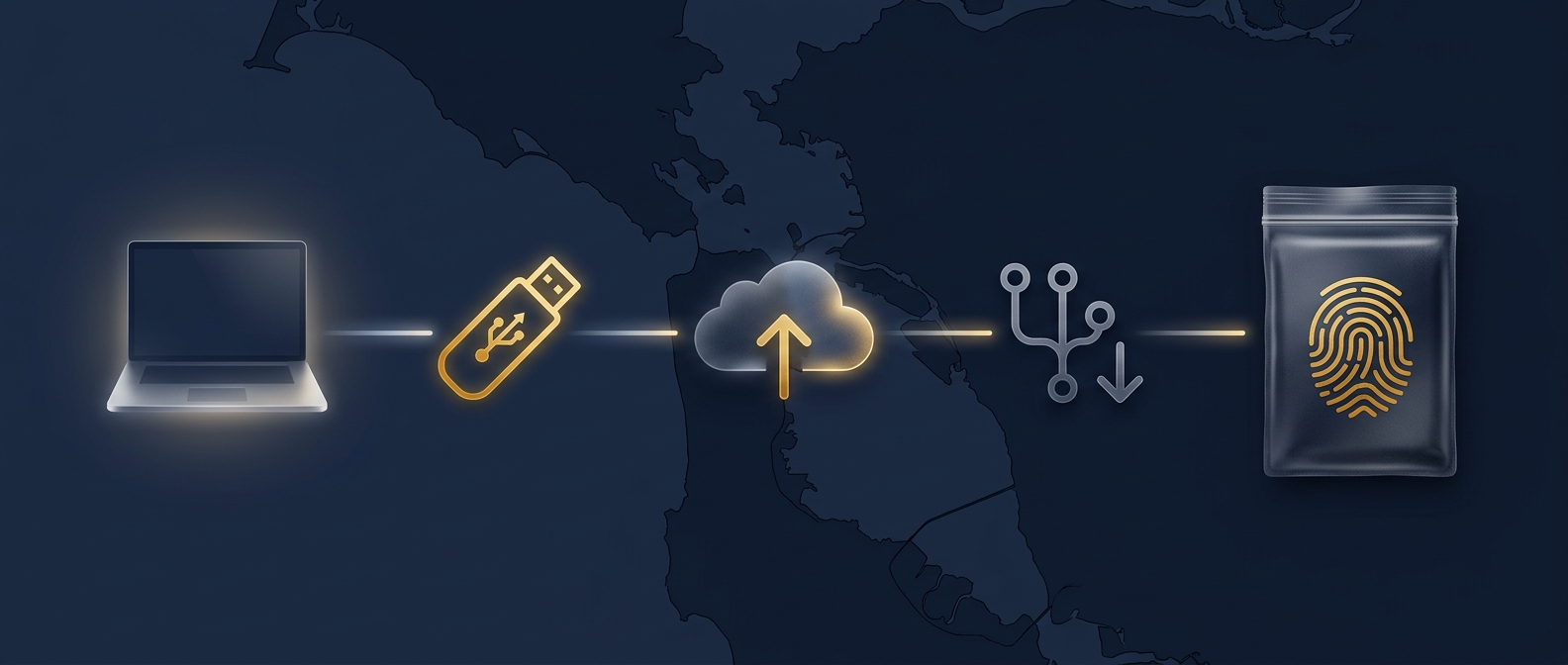
How do examiners reconstruct a departing-engineer exfiltration timeline?
Elite forensic work in a departing-engineer matter follows a repeatable sequence, documented as it is performed rather than reconstructed afterward. The steps below are the operational discipline that produces a timeline able to withstand a San Francisco cross-examination. They align with internationally recognized handling standards and with the tool-validation reference maintained by the NIST Computer Forensics Tool Testing program.
- Trigger preservation immediately. On notice of a high-risk departure, place a litigation hold and preserve the returned laptop, corporate accounts, repository access logs, and cloud records before anything ages out or is reissued.
- Confirm legal authority and scope with counsel. Define custodians, systems, and the trade secret at issue, and confirm the right to collect each source, so nothing is gathered unlawfully under Penal Code § 502 or privacy law.
- Isolate and image the endpoint. Capture a bit-for-bit, write-blocked image of the company device; never boot, browse, or analyze the original.
- Hash and verify. Calculate a cryptographic hash such as SHA-256 at acquisition and re-verify it at every step, so any single-bit change is detectable.
- Pull server-side records. Collect repository clone/fetch and access logs, cloud sync and upload logs, email egress, and VPN or endpoint-DLP data through proper channels.
- Reconstruct USB and file-movement activity. Correlate device-connection history, file-copy timestamps, and link-file artifacts to show what was moved to removable media and when.
- Build a unified timeline. Fuse endpoint, server, and cloud artifacts into a single chronology tied to the resignation date, exposing staging, copying, and any attempted deletion.
- Analyze on working copies only. Conduct all examination on verified copies, keeping the original image pristine, and log every transfer with no gaps.
- Re-verify and document for testimony. Confirm the hash still matches before production and maintain contemporaneous notes so the methodology can be defended on the record.
None of this is glamorous, and that is the point. A defensible exfiltration timeline looks methodical because every step is engineered to be explained, reproduced, and survived months later in front of a hostile examiner.
Which standards govern admissibility in San Francisco and Northern California?
Technology disputes here are litigated in two forums with different reliability tests, and elite work is built to satisfy both. In California state court, admissibility of scientific technique follows the Kelly test from People v. Kelly (1976): the method must be generally accepted in the relevant scientific community and correctly applied. Established forensic methods — write-blocked imaging, hash verification, validated extraction tools — clear that bar precisely because they are the accepted standard, which is why improvised handling is so dangerous. Authentication is governed by the California Evidence Code, which treats electronically stored information as a “writing” and requires evidence sufficient to sustain a finding that an item is what it purports to be (Evid. Code §§ 250, 1400–1401). In civil matters, courts also screen expert opinion for reliable methodology under Sargon Enterprises v. USC (2012).
Many Bay Area trade-secret cases proceed federally under the Defend Trade Secrets Act in the Northern District of California, where the Federal Rules of Evidence and the Daubert reliability standard apply instead. The practical consequence is that a forensic examiner working a San Francisco IP matter must produce a record that satisfies whichever gate the case walks through — acceptance and correct application under Kelly, or testable, peer-reviewed, error-rate-aware reliability under Daubert. A clean, hashed image with a continuous chain and a methodology tied to recognized standards authenticates almost routinely in either forum; a self-collected folder of files invites a fight over whether it is real.
Why does self-collection destroy so many strong cases?
The most common way a winnable Bay Area IP case dies is well-intentioned self-collection. A manager images the returned laptop with everyday tools, an IT administrator exports a mailbox, or a founder forwards screenshots of a competitor’s repository to counsel. Each of those steps alters metadata, breaks the chain, and hands a sophisticated opponent an authenticity challenge. The contrast with forensically sound acquisition is stark.
| Dimension | Self-collection / IT copy | Forensic acquisition |
|---|---|---|
| Source handling | Device booted, browsed, or copied live | Write-blocked; original untouched |
| Metadata & timestamps | Altered or overwritten | Preserved intact |
| Integrity proof | No hash to verify | Hash captured and re-verified at each step |
| Deleted & staged data | Missed entirely | Recoverable from unallocated space |
| USB & cloud artifacts | Often ignored or lost | Correlated into a defensible timeline |
| Legal exposure | Risk of § 502 / privacy violations | Authority confirmed before collection |
| Courtroom posture | Vulnerable to exclusion | Withstands Kelly, Sargon, and Daubert scrutiny |
The lesson for San Francisco counsel is to bring forensic expertise in before anyone touches the data. Once a device has been booted or a mailbox exported by untrained hands, some damage cannot be undone, and the argument shifts from the merits to the reliability of the evidence — exactly where a well-funded opponent wants it.
What separates a world-class forensic partner in the Bay Area?
Providers are not equal, and the gap becomes visible under pressure. When selecting a digital forensics partner for a San Francisco IP matter, sophisticated buyers weigh a specific set of criteria rather than price alone.
- In-house, single-chain command. When acquisition, analysis, and testimony run under one accountable team rather than a string of subcontractors, the chain of custody does not fragment and privilege is easier to protect.
- Native fluency in developer tooling. Reconstructing source-code theft demands examiners who understand Git internals, CI/CD systems, cloud infrastructure, and OAuth grants — not just consumer file recovery.
- Speed to preserve perishable data. Sync logs, volatile artifacts, and short-retention cloud records disappear fast; the right partner mobilizes in hours, before a laptop is reimaged or logs roll off.
- Dual-standard testimony experience. An examiner who has withstood cross-examination writes reports and keeps records to satisfy both Kelly in state court and Daubert in the Northern District.
- Discretion and privilege awareness. Elite work is structured to operate at the direction of counsel, protect confidentiality, and preserve privilege — critical for venture-backed companies and public filers.
- Full-spectrum capability. IP matters rarely stay in one lane; a partner that also brings investigations, cybersecurity, and financial-intelligence capability can follow the evidence wherever it leads without a handoff to a stranger.
The common thread is defensibility. A world-class partner produces work engineered from the first hour to be explained and survived on the record — not merely to find the answer.
How does Honeybadger deliver forensics to San Francisco IP cases?
Honeybadger Solutions delivers digital forensics to San Francisco and the wider Bay Area through in-house, remote-by-design laboratories, so the same accountable team that scopes a matter carries it through acquisition, analysis, and production under a single chain of custody and command. Our forensic work is handled internally rather than farmed out, which keeps source-code and device evidence from fragmenting across vendors and lets us protect privilege and confidentiality end to end — an advantage that matters as much in a trade-secret action as in a founder dispute or a board-level investigation.
Because our forensic, cybersecurity, financial-investigation, and background-intelligence capabilities are global and remote-by-design, we serve San Francisco, Silicon Valley, and the broader California market without a handoff, mobilizing in hours to preserve perishable repository, cloud, and endpoint data before it is overwritten. California is an established operational theater for the firm, and our examiners build methodology and documentation intended to be defended on the record — by written certification or live testimony — under both California’s Kelly and Sargon standards and the Daubert standard in the Northern District. That same discipline supports the full arc of a dispute through our investigations practice, from source-code exfiltration and departing-engineer matters to executive misconduct and competitive-intelligence threats. Operating from Arizona home command, with offices in Casa Grande, Phoenix, and Oro Valley, we close the gap between what the evidence shows and what a San Francisco or Northern California court will actually admit.
Frequently asked questions
If California voids non-competes, how do we stop a departing engineer from using our code?
You protect the trade secret, not the person’s mobility. Business and Professions Code § 16600 makes most non-competes void in California, so enforcement runs through the California Uniform Trade Secrets Act and the federal Defend Trade Secrets Act instead. Those claims require proof that specific, protectable information was actually taken or used — which is a forensic question. A defensible timeline showing when a repository was cloned or files were copied to a personal device or cloud account is often the evidence that carries the case.
Can we just have IT image the returned laptop to save time and money?
It is rarely worth the risk. Booting the device, copying files, or exporting a mailbox with ordinary tools alters metadata, misses deleted and staged data, and creates no chain of custody, inviting an authenticity challenge from a sophisticated opponent. The safest path is to preserve the device without powering it on, place a litigation hold on repositories and cloud accounts, and have a trained examiner acquire everything forensically. Preserving evidence properly the first time is far cheaper than defending a broken collection later.
Do you need to be physically in San Francisco to handle the matter?
For most digital forensic work, no. Our laboratories are in-house and remote-by-design, so acquisition, analysis, and reporting run under the same accountable team regardless of where the data sits, and we mobilize quickly to preserve perishable repository, cloud, and endpoint evidence. California is an established theater for the firm, and we coordinate any needed on-the-ground steps while keeping the chain of custody and command intact.
Will forensic evidence hold up in both state court and the Northern District of California?
That is exactly how it should be built. California state courts apply the Kelly acceptance test and screen expert opinion under Sargon, while trade-secret cases in the U.S. District Court for the Northern District of California apply the Federal Rules and the Daubert reliability standard. Evidence acquired with write-blocked imaging, hash verification, validated tools, and a continuous chain of custody is designed to satisfy whichever gate the case walks through, which is why methodology and documentation matter as much as the findings themselves.
About Honeybadger Solutions
Honeybadger Solutions is an Arizona-licensed security and investigations firm delivering intelligence-led forensics, investigations, and cyber services to founders, general counsel, boards, and technology companies across San Francisco, the Bay Area, California, and worldwide. Digital forensics, cybersecurity, financial investigations, and background intelligence are handled in-house and remote-by-design, so every step from evidence preservation through production runs under a single accountable chain of custody and command.
Offices: Casa Grande (HQ), Phoenix, and Oro Valley, Arizona.
Phone: 602-725-2818
Confidential consultation: discuss a San Francisco source-code, trade-secret, or evidence-preservation matter with our command team.