
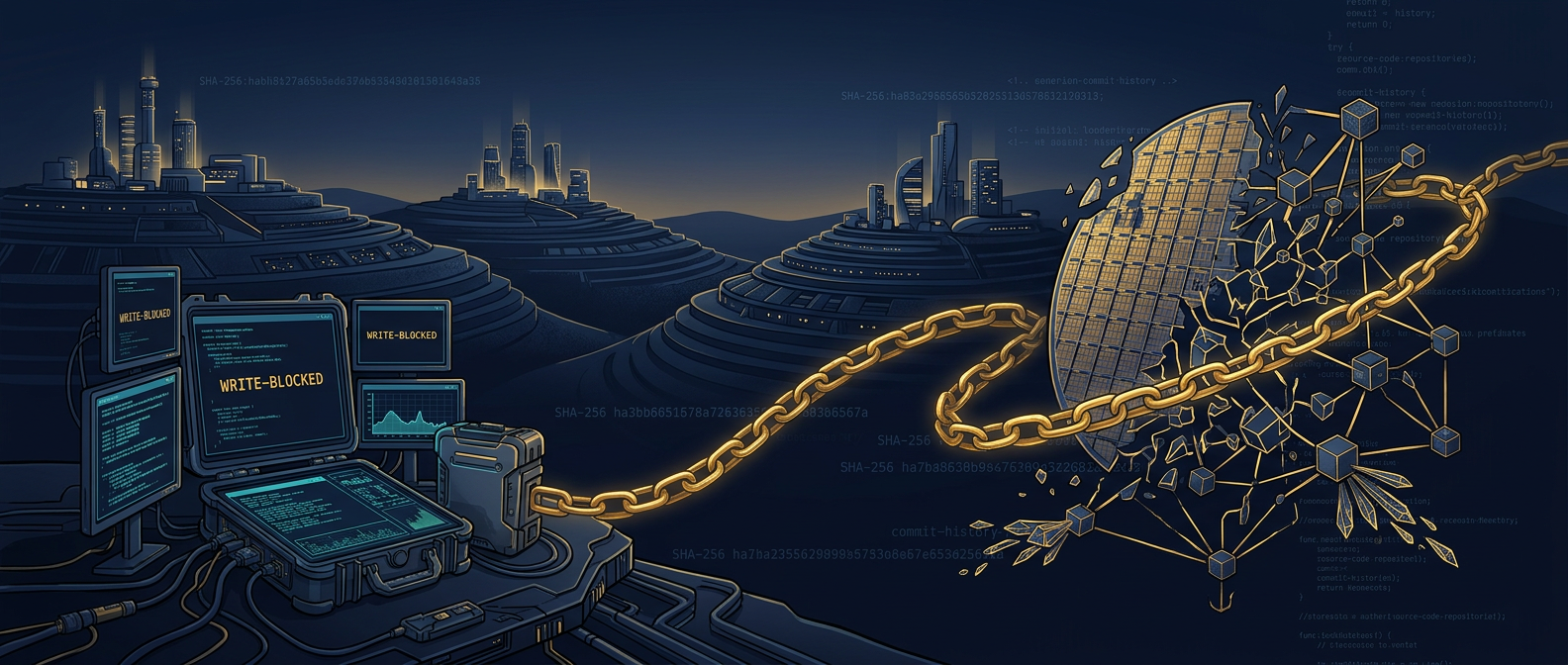
Digital forensics in Austin trade-secret and departing-employee cases is the forensically sound preservation and analysis of source code, devices, and cloud accounts so the proof survives challenge in Texas courts. When an engineer leaves a semiconductor or software firm for a competitor, the evidence lives in git history, USB artifacts, personal cloud syncs, and email. Write-blocked acquisition, hash verification, and an unbroken chain of custody are what make that evidence admissible under Texas Rule of Evidence 702.
Austin has become one of the most concentrated technology and semiconductor economies in the country, and that concentration produces a distinctive litigation profile. “Silicon Hills” now hosts advanced-node fabrication, chip design, electric-vehicle engineering, cloud platforms, and a dense startup ecosystem, and talent moves constantly between them. When a design engineer, firmware developer, or product architect departs for a rival, the company’s most valuable assets, its source code, register-transfer-level designs, process recipes, and customer and pricing intelligence, exist only as electronically stored information. The dispute that follows is decided almost entirely by what forensic analysis can prove about how that data moved. This guide is written for the general counsel, litigation partner, technology executive, and founder who need to understand what makes source-code and device evidence court-ready in Texas, how departing-employee exfiltration is reconstructed, and what separates an elite forensic partner from a commodity vendor.
Why does Austin’s tech and semiconductor economy generate so many trade-secret disputes?
The mechanics of Austin’s growth are the same mechanics that create trade-secret risk. A regional economy built on chip design, advanced fabrication, embedded systems, and software depends on proprietary technical knowledge that is expensive to develop and portable in a way that physical assets never were. A departing engineer cannot carry a cleanroom out the door, but a repository clone, a design database, or a folder of process specifications fits on a device smaller than a thumb. The velocity of hiring between competing firms compounds the exposure: the same specialized talent pool circulates among a handful of employers, and every move carries the risk that confidential material moves with it, sometimes deliberately, sometimes through careless habit.
Three characteristics make these matters unusually demanding. The technical stakes are high, because a single leaked dataset, a reservoir of source code or a semiconductor design file, can represent years of research and enormous commercial value. The data is fragmented across corporate laptops, version-control systems, cloud repositories, personal devices, and messaging apps. And the opponents are sophisticated and well-funded, so every step of collection will be scrutinized for a reason to exclude the evidence. A provider that treats an Austin trade-secret matter like a routine drive copy is a liability; the work has to be engineered for adversarial scrutiny from the first hour.
What makes source-code and device evidence court-ready in Texas?
Court-ready is a concrete evidentiary threshold, not a marketing phrase. Before a Texas judge lets a jury weigh what a commit log, a USB artifact, or a drive image says, the proponent must establish that the evidence is authentic and unaltered. Texas Rule of Evidence 901 requires evidence sufficient to support a finding that an item is what its proponent claims. For electronically stored information that means far more than a printout of a repository or a screenshot of a file listing; it means a demonstrable path from the original source to the exhibit, mathematical proof the copy is identical to the source, and a witness who can explain how the data was obtained without changing it.
Four pillars carry that burden. First, forensically sound acquisition: capturing a bit-for-bit image through a hardware or software write-blocker so the original is never modified. Second, integrity proof: calculating a cryptographic hash such as SHA-256 at acquisition and re-verifying it at each subsequent step, so any change of even a single bit is detectable. Third, an unbroken chain of custody documenting who handled the evidence, when, and why. Fourth, a qualified examiner whose methodology is standardized, tested, and repeatable. In civil litigation Texas measures the reliability of that methodology under Rule 702 and the factors set out in E.I. du Pont de Nemours & Co. v. Robinson, the state’s Daubert analog, with the trial court acting as gatekeeper; criminal matters apply the parallel Kelly v. State framework. Established techniques clear these bars comfortably because they are validated and testable. Lawful collection is equally non-negotiable: accessing a former employee’s personal device or account without authorization can violate the Texas Penal Code Chapter 33 Breach of Computer Security provisions and taint the very evidence you were trying to preserve.
What kinds of Austin matters turn on this forensic work?
The recurring engagements in the Austin market cluster into a handful of patterns, each with a distinct evidentiary center of gravity. The table below maps common matter types to the digital evidence that usually decides them and what forensics is asked to establish. These are representative scenarios, not case files, but the fact patterns are familiar to any litigator practicing in the region.
| Matter type | Where the evidence lives | What forensics establishes |
|---|---|---|
| Semiconductor design-IP theft | EDA workstations, design databases, version control, USB history | Whether RTL, layout, or mask/process data was copied, and the exfiltration timeline |
| Software source-code misappropriation | Git repositories, cloud repos, build servers, local clones | What code left, via which commits or clones, and by whom |
| Departing-team & non-compete disputes | Company laptops, personal cloud accounts, messaging apps, email | What data left, how, and whether restrictive covenants were breached |
| Customer & pricing-book theft | CRM exports, spreadsheets, email, mobile devices | Whether confidential commercial data was taken to a competitor |
| Founder & investor disputes | Corporate mail, chat, source repos, financial systems | Authorship, timelines, and authenticity of records |
| Internal investigations & misconduct | Corporate mail, chat, mobile devices, endpoint logs | Conduct, communications, and concealment, preserved for litigation or regulators |
Two Texas-specific wrinkles run through most of these. Trade-secret claims are governed by the Texas Uniform Trade Secrets Act (Civil Practice and Remedies Code Chapter 134A) alongside the federal Defend Trade Secrets Act, so the forensic timeline of exfiltration, exactly when and how data moved, is often dispositive. And in the technology context the “secret” is frequently a living dataset rather than a static document: a source-code repository with years of commit history, a chip-design database, a proprietary firmware image, or a customer and pricing book whose value evaporates the moment it reaches a competitor.
Where does a departing employee’s data actually go?
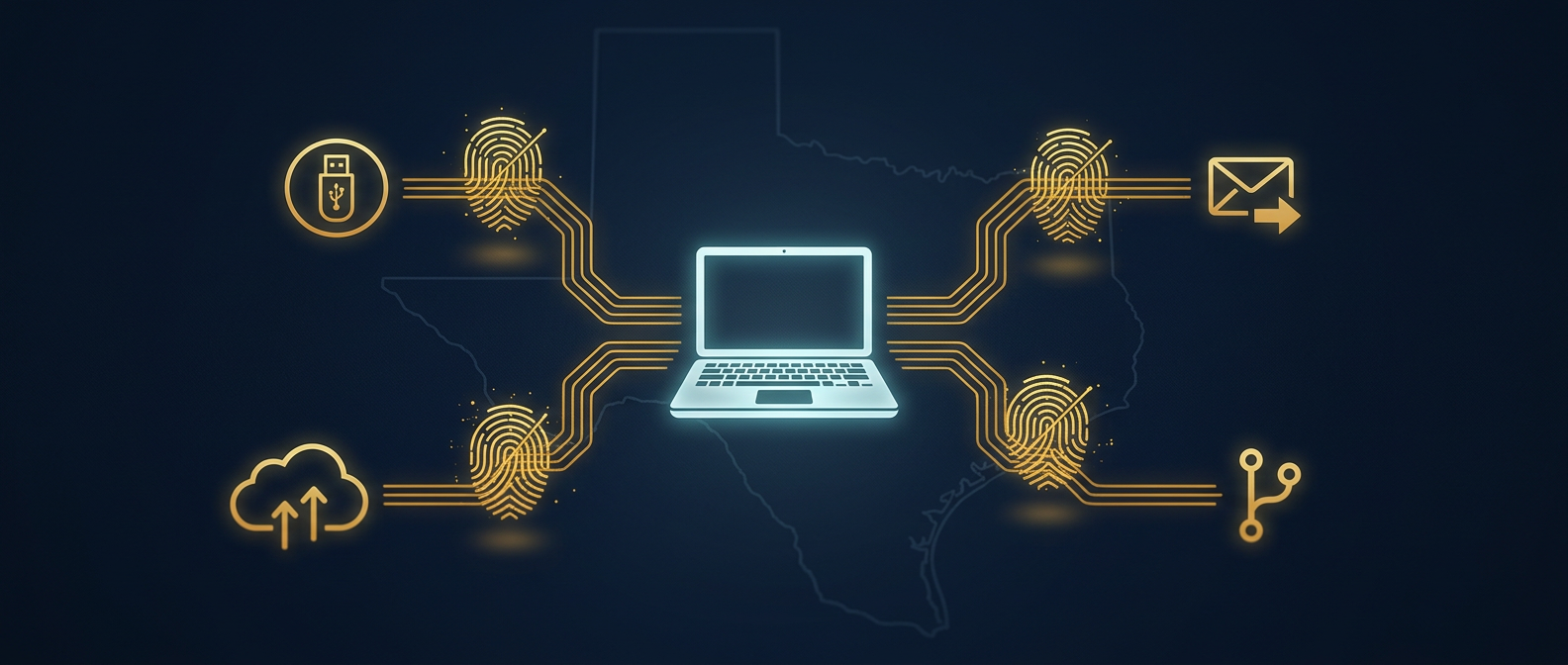
Reconstructing a departure means knowing the channels through which data leaves and the artifacts each one leaves behind. Elite forensic analysis does not rely on a single smoking gun; it correlates evidence across sources to build a defensible timeline that no innocent explanation fits. The most common exfiltration channels, and the traces they create, include the following.
- Removable media. USB drives and external disks leave device-connection records, registry and system-log artifacts, and file-access timestamps that reveal what was copied and when.
- Personal cloud sync. Consumer Dropbox, Google Drive, iCloud, or OneDrive clients installed on a work machine leave sync databases and logs showing which files were uploaded out of the company’s control.
- Source-control clones and pushes. Git and other version-control systems record commit history, clone events, and remote pushes; unauthorized repository copies or pushes to personal accounts are recoverable and time-stamped.
- Email and webmail. Forwarding to personal addresses, mass self-sending before departure, and large attachments appear in mail logs and mailbox metadata.
- Cloud collaboration and printing. Bulk downloads from SharePoint or a code platform, and large or unusual print jobs before a resignation, are visible in access and spooler logs.
- Messaging and AirDrop-style transfers. Signal, WhatsApp, and local wireless transfers can move files with fewer traces, which is precisely why deleted-data recovery and cross-source correlation matter.
The evidentiary power comes from convergence. A USB insertion at 11:47 p.m., a spike in file-access activity across a design directory, a resignation email the next morning, and a repository clone to an unrecognized machine tell a story together that any one artifact alone could not. Building that story requires disciplined acquisition of every relevant source before any of it is overwritten.
How is source-code and device evidence forensically preserved?
Elite forensic collection follows a repeatable sequence, documented as the work is performed rather than reconstructed afterward. The steps below are the operational discipline that produces evidence able to withstand an Austin cross-examination, and they align with the tool-validation reference maintained by the NIST Computer Forensics Tool Testing program.
- Scope with counsel and confirm legal authority. Define the custodians, devices, repositories, and accounts at issue and confirm the right to collect, so nothing is gathered unlawfully under Penal Code Chapter 33 or Texas privacy law.
- Preserve before you probe. Issue and honor litigation-hold obligations, and secure company-controlled cloud repositories and mail before access can be revoked or logs age out.
- Identify and isolate sources. Locate every relevant laptop, phone, server, and account, and prevent further change, including disconnecting from networks that could trigger a remote wipe or cloud sync.
- Document the original state. Photograph and record the condition, connections, and running status of each device before anything is touched.
- Acquire forensically. Use a write-blocker to capture a bit-for-bit image; for cloud repositories and mail, capture with logging that preserves commit history and metadata. Never analyze, boot, or browse the original.
- Hash and verify. Calculate the cryptographic hash of both source and image, confirm they match, and record both values.
- Log every transfer. Record who received the evidence, when, why, and in what condition, leaving no gap in the timeline.
- Store under seal. Keep evidence access-controlled, encrypted, and logged, and preserve the access record itself.
- Analyze on working copies. Conduct all examination on verified copies, keeping the original image pristine.
- Re-verify and document for testimony. Confirm the hash still matches before analysis and again before production, and maintain contemporaneous notes so the methodology can be defended under Robinson and Rule 702.
None of this is glamorous, and that is the point. Court-ready work looks methodical and even tedious because every step is engineered to be explained, reproduced, and defended months or years later in front of a hostile examiner.
Why does self-collection destroy so many strong cases?
The most common way strong evidence dies is well-intentioned self-collection. A manager opens the departing engineer’s laptop to “see what’s there,” an IT administrator exports a mailbox or clones a repository with ordinary tools, or a founder forwards screenshots to counsel. Each of these alters metadata, breaks the chain, and hands the opponent an authenticity challenge. In a trade-secret dispute where a single repository can carry enormous value, that is a catastrophic way to lose. The contrast with forensically sound acquisition is stark.
| Dimension | Self-collection / IT copy | Forensic acquisition |
|---|---|---|
| Source handling | Original opened, copied, or booted | Write-blocked; original untouched |
| Metadata & timestamps | Altered or destroyed | Preserved intact |
| Integrity proof | No hash to verify | Hash captured and re-verified at each step |
| Deleted & USB artifacts | Missed or overwritten | Recovered from unallocated space and logs |
| Repository history | Clones lose provenance | Commit history and clone events preserved |
| Chain of custody | Gaps; unaccounted access | Continuous, documented log |
| Courtroom posture | Vulnerable to exclusion | Withstands adversarial scrutiny |
The practical lesson for Austin counsel is to involve forensic expertise before anyone touches the data. Once a device has been booted or a repository cloned by untrained hands, some damage cannot be undone, and the argument shifts from the merits of the case to the reliability of the evidence, exactly where a sophisticated opponent wants it.
How do Texas non-compete and trade-secret laws shape the forensic mandate?
Texas law does not treat every departure the same way, and the legal theory drives what the forensics must prove. Unlike jurisdictions that broadly refuse to enforce them, Texas will enforce a reasonable covenant not to compete under the Texas Business and Commerce Code, provided it is ancillary to an otherwise enforceable agreement and reasonable in time, geographic area, and scope. That means a departing-employee matter often runs on two parallel tracks: a contract claim asking whether restrictive covenants were breached, and a trade-secret claim under Chapter 134A and the federal Defend Trade Secrets Act asking whether protected information was actually misappropriated. Forensics serves both. It establishes whether confidential data moved and when, and it can corroborate or refute claims about what an employee accessed, retained, or used after resignation.
Timing is frequently decisive. Courts and opponents scrutinize the window around a resignation, and a forensic timeline that places mass file access, a USB insertion, or a repository push in the days before departure is far more persuasive than testimony alone. Equally important is the defensive posture: a well-run forensic examination can also exonerate an incoming employer, showing that a new hire did not import a former employer’s code or data, which is often exactly what a company needs to prove to defeat an injunction or an inevitable-disclosure argument. In both directions, the evidence only carries weight if it was preserved lawfully and defensibly from the outset.
What separates a world-class forensic partner for Austin tech matters?
Not all providers are equal, and the gap becomes visible under pressure. When evaluating a digital forensics partner for an Austin trade-secret or departing-employee matter, sophisticated buyers weigh a specific set of criteria rather than price alone.
- In-house, single-chain command. When acquisition, analysis, and testimony run under one accountable team rather than a chain of subcontractors, the chain of custody does not fragment and privilege is easier to protect.
- Source-code and cloud fluency. The examiner should understand version-control internals, build systems, EDA and design-file formats, and cloud-repository logging, not just laptop imaging, because that is where technology IP actually lives.
- Validated tools and methodology. The provider should use industry-standard, independently tested tools and be able to cite their validation, which is what satisfies the Robinson reliability inquiry.
- Testimony experience. An examiner who has withstood cross-examination writes reports and keeps records with the courtroom in mind from the first hour.
- Speed without shortcuts. Evidence is perishable; the right partner mobilizes immediately to preserve devices, mail, and repositories before logs age out or data is overwritten, without cutting a single procedural corner.
- Full-spectrum capability. Forensics rarely stands alone. A partner that also brings investigations, cyber, and financial-intelligence capability can follow the evidence wherever it leads without handing off to a stranger.
The distinguishing trait across all of these is defensibility. A world-class partner produces work designed, from the first hour, to be explained and survived on the record, not merely to find the answer.
How does Honeybadger deliver court-ready forensics to Austin?
Honeybadger Solutions delivers digital forensics to Austin through in-house, remote-by-design laboratories, so the same accountable team that scopes a matter carries it through acquisition, analysis, and production under a single chain of custody and command. Our forensic work is handled internally rather than farmed out, which keeps evidence from fragmenting across vendors and lets us protect privilege and confidentiality end to end, an advantage that matters as much in a semiconductor design-IP dispute as it does in a software source-code or departing-team matter.
Because our forensic, cyber, financial-investigation, and background-intelligence capabilities are global and remote-by-design, we serve Austin and the broader Texas market without a handoff, mobilizing quickly to preserve perishable data before it is overwritten. Texas is an established operational theater for the firm, and our examiners build methodology and documentation intended to be defended on the record, by written certification or live testimony, under Rule 702 and the Robinson factors. That same discipline supports the full arc of a dispute through our investigations practice, from source-code and semiconductor-IP exfiltration to departing-team and internal-misconduct inquiries. Operating from Arizona home command, with offices in Casa Grande, Phoenix, and Oro Valley, we close the gap between what the evidence shows and what a Texas court will actually admit.
Frequently asked questions
Can you prove a departing engineer took our source code?
Often, yes, when the evidence is preserved before it is overwritten. Forensic analysis correlates version-control commit and clone history, USB device-connection artifacts, personal-cloud sync logs, email and file-access records, and deleted-data recovery to build a defensible timeline of what moved and when. No single artifact wins a case; the strength comes from convergence across sources. Preserving devices, mail, and repositories early is essential, because relevant logs age out and local traces are overwritten with continued use.
Does Texas enforce non-compete agreements in tech departures?
Texas will enforce a reasonable covenant not to compete under the Texas Business and Commerce Code when it is ancillary to an otherwise enforceable agreement and reasonable in time, geographic area, and scope. Departing-employee matters frequently run on two tracks: a contract claim about whether covenants were breached and a trade-secret claim under Chapter 134A and the federal Defend Trade Secrets Act about whether protected information was misappropriated. Forensics supports both by establishing what data moved and precisely when.
Can our IT team just clone the laptop or repository to save time?
It is rarely worth the risk. Booting a device, copying files, or cloning a repository with ordinary tools alters metadata and timestamps, can strip commit provenance, misses deleted data, and creates no chain of custody, inviting an authenticity challenge under Rule 901 and a reliability attack under Robinson. The safest path is to isolate the device, avoid powering it on or browsing it, preserve company-controlled cloud and mail, note who has had access, and have a trained examiner acquire everything forensically.
Do you need to be physically in Austin to handle the matter?
For most digital forensic work, no. Our labs are remote-by-design and in-house, so acquisition, analysis, and reporting are handled by the same accountable team regardless of where the data sits, and we mobilize quickly to preserve perishable evidence. Texas is an established theater for the firm, and we coordinate any needed on-the-ground steps while keeping the chain of custody and command intact.
About Honeybadger Solutions
Honeybadger Solutions is an Arizona-licensed security and investigations firm delivering intelligence-led forensics, investigations, and cyber services to executives, general counsel, technology and semiconductor companies, founders, and organizations across Austin, Texas, and worldwide. Digital forensics, cybersecurity, financial investigations, and background intelligence are handled in-house and remote-by-design, so every step from evidence preservation through production runs under a single accountable chain of custody and command.
Offices: Casa Grande (HQ), Phoenix, and Oro Valley, Arizona.
Phone: Book a consultation online
Confidential consultation: discuss an Austin trade-secret, source-code, or departing-employee forensic matter with our command team.
Browse by topic
Security guard services · Private investigations · Cybersecurity · Digital forensics · Financial fraud investigation · Executive protection · All articles