
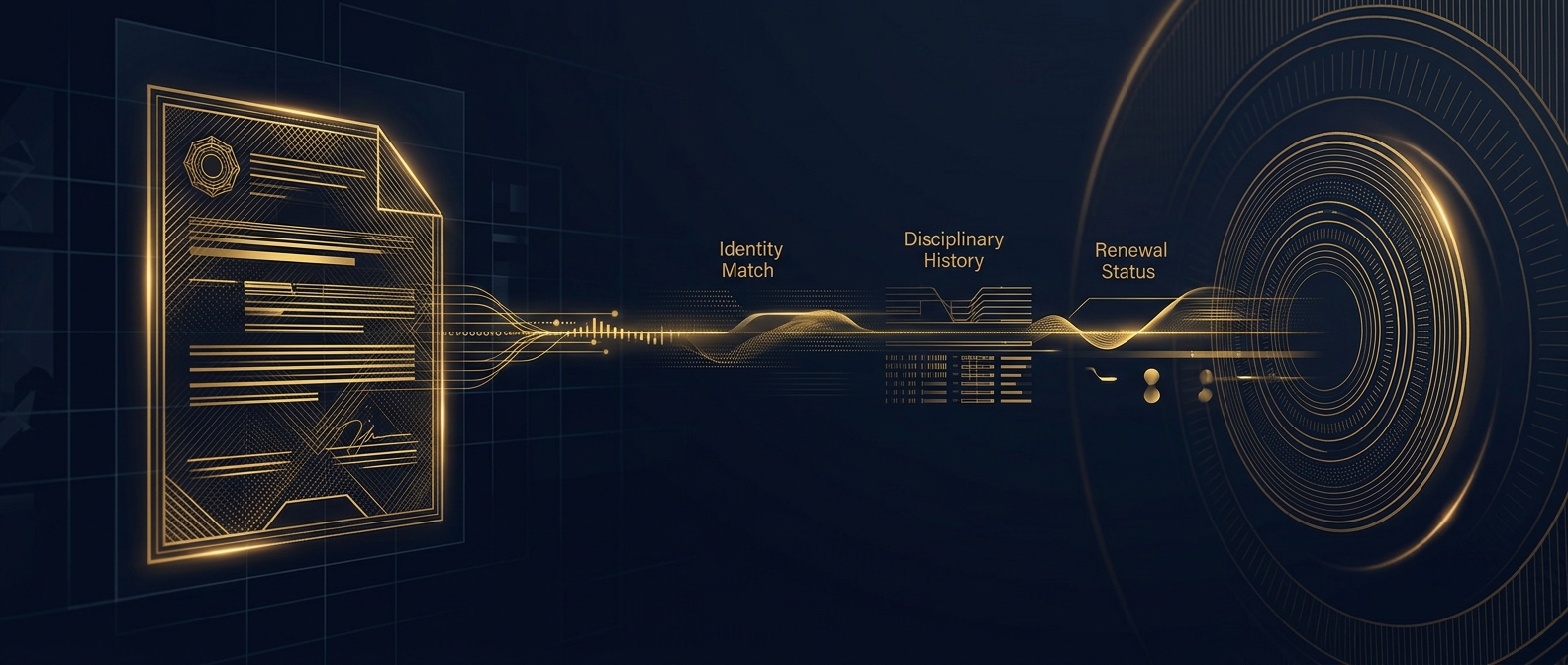
Professional license verification in employment screening means confirming, directly with the issuing state board or a primary-source database rather than trusting the candidate’s own paperwork, that a license is genuine, currently active, unrestricted, and matched to the person holding it. Self-reported credentials fail silently — a lapsed nursing license, a suspended contractor registration, or a disciplinary action never shows up unless someone checks the source directly, and by then the unqualified or sanctioned individual is already on payroll.
A resume line, a photocopied certificate, or even a plausible-looking license number is not evidence of anything by itself. Licenses lapse, get suspended, get surrendered in lieu of discipline, or belong to someone else entirely. For roles where the license is the legal basis for the work — a registered nurse administering medication, a licensed contractor pulling permits, a financial advisor handling client funds, a commercial driver holding a CDL — verifying it wrong is not a paperwork gap, it is a negligent-hiring exposure and, in regulated industries, a compliance violation in its own right. This guide covers how verification should actually be done, industry by industry, and what a defensible program looks like.
Why does self-reported license information fail so often?
Candidates rarely set out to deceive an employer, but self-reported license data fails for reasons that have nothing to do with intent. A license can lapse between the candidate’s last renewal check and the interview date. A candidate can genuinely believe a license transferred across state lines when scope-of-practice rules mean it did not. A disciplinary action can be pending or recently entered and simply unknown to the candidate’s own understanding of their standing. And, less commonly but consequentially, a license number can be copied from someone else’s public registration entirely.
None of these require malice to create liability. An employer that places an unlicensed or improperly licensed individual into a role that legally requires that credential — patient care, financial advisory, structural construction — can face negligent-hiring claims, regulatory penalties, and, in healthcare and finance particularly, exposure that follows every transaction or patient interaction the individual handled while unqualified. Verification exists to catch the gap before it becomes an incident, not to interrogate the candidate’s honesty.
Which industries carry the highest license-verification exposure?
License verification matters everywhere a credential gates legal authority to perform the work, but exposure concentrates in a handful of sectors. Healthcare carries the highest stakes: nursing, physician, pharmacy, and allied-health licenses govern direct patient care, and a lapsed or sanctioned license connects directly to patient-safety liability, which is why our healthcare employee background checks practice treats license status as a standing, not a one-time, check. Financial services is close behind — broker-dealer registrations, insurance producer licenses, and fiduciary credentials govern who may legally handle client funds and give advice, and our financial industry background screening work verifies these directly against regulatory databases rather than firm-supplied attestations.
Construction and skilled trades carry a different but equally real exposure: an unlicensed contractor or electrician on a job site creates permitting, insurance, and liability problems the moment an inspection or an incident occurs. Transportation depends on commercial driver’s license class and endorsement accuracy, where a mismatch between vehicle class and license endorsement is both a safety and a regulatory issue. Childcare and eldercare licensing, real estate licensure, and legal bar admission round out the sectors where a lapsed or fabricated credential creates immediate downstream liability for the employer, not just the individual.
What is primary-source verification, and why isn’t a database check enough?
Primary-source verification means confirming credential status directly with the entity that issued it — the state licensing board, the certifying organization, or an authoritative federal registry — rather than relying on an aggregated third-party database that may be stale, incomplete, or scoped to a different jurisdiction than the one that actually governs the role. Aggregated databases are useful for a first pass across a large applicant pool, but they lag real-world changes: a suspension entered last week may not appear in a database refreshed monthly, and a candidate licensed in one state working under a different state’s reciprocity rules may not resolve correctly in a nationwide search built around a single jurisdiction’s data.
| Verification method | What it actually confirms | Where it fails |
|---|---|---|
| Self-attestation | What the candidate believes or reports | No independent confirmation; fails silently on lapses and errors |
| Aggregated third-party database | Status as of the last data refresh | Lag between real-world change and database update; jurisdictional gaps |
| Primary-source, direct-to-board | Current status, disciplinary history, and scope as of the verification date | Slower per-record; requires knowing the correct issuing authority |
| Federal registry cross-check (where applicable) | Sanctions, exclusions, or adverse actions reported nationally | Covers specific programs only; not a substitute for state-board verification |
The defensible standard for high-exposure roles is primary-source verification supplemented by a federal exclusion or sanctions check where one exists for the profession, not a database pull treated as sufficient on its own.
What should verification confirm beyond “is the license active”?
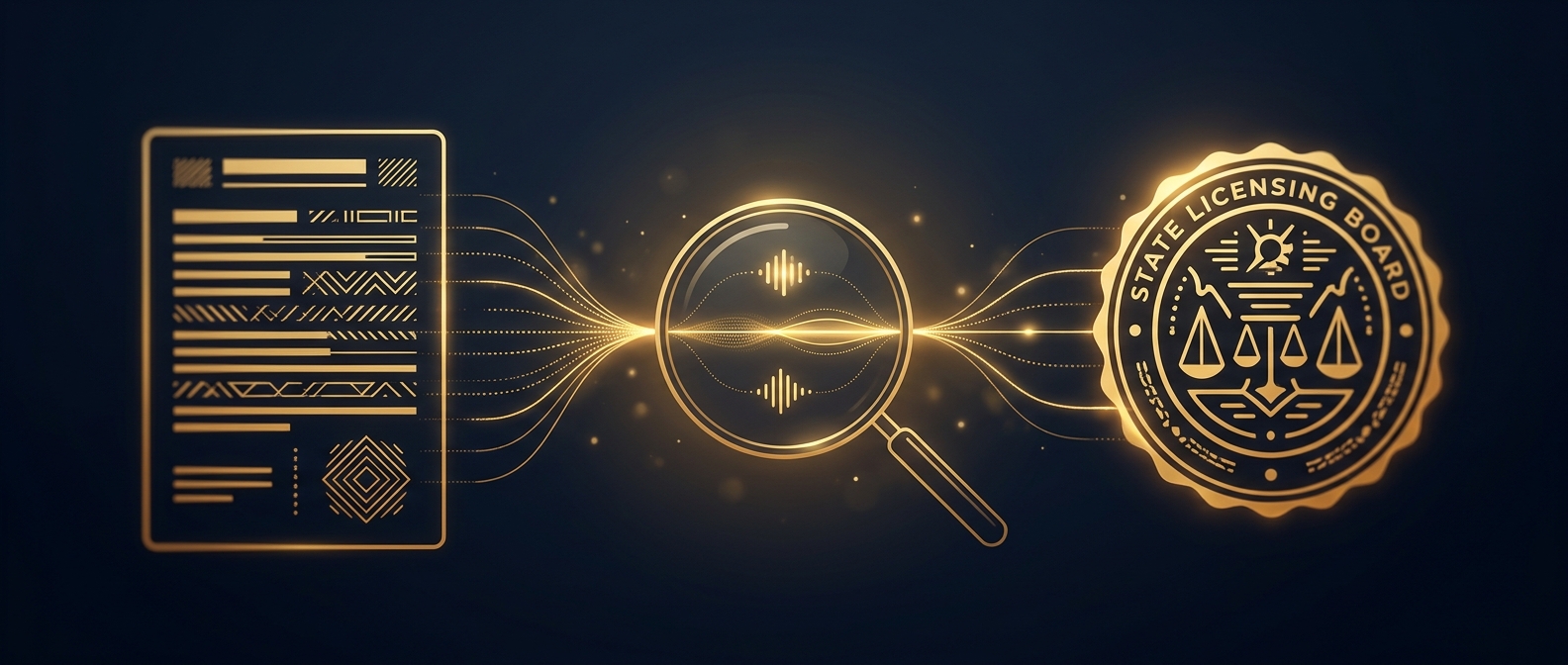
A verification that stops at “active or not” misses most of what actually matters. A complete check confirms five distinct facts, not one: that the name and identifying details on the license match the candidate being screened; that the license is currently active and not merely unexpired on paper while administratively lapsed; that no disciplinary action, consent order, or public complaint is on file with the issuing board; that continuing-education or renewal requirements are current, since some jurisdictions technically list a license as active during a grace period despite lapsed CE; and that the license’s scope matches the actual duties of the role — a license valid in one state does not automatically authorize the same scope of practice in another, and a license valid for one level of practice does not authorize a higher one.
Scope mismatch is the failure mode employers most often overlook. A nurse licensed as an LPN in one state is not authorized for RN-level duties regardless of experience; a contractor licensed for residential work is not automatically authorized for commercial structural work. Verification has to confirm scope against the actual job, not just confirm that a license exists.
What is the framework for a defensible license-verification program?
The following sequence reflects how we structure license verification for employers in regulated industries:
- Identify the correct issuing authority for the specific license and jurisdiction — not a generic nationwide search that may miss a state-specific board.
- Verify identity match first. Confirm the license record belongs to the candidate, not a similarly named individual, before relying on any status shown.
- Confirm current active status directly with the board, not from a cached database entry.
- Check disciplinary and public-complaint history on file with the issuing authority, not just the active/inactive flag.
- Confirm continuing-education and renewal compliance where the license type requires it.
- Confirm scope-of-practice alignment between the license type and jurisdiction and the actual duties of the role.
- Cross-check applicable federal exclusion or sanctions lists for the profession, where one exists.
- Re-verify on a defined cadence for standing roles, since a license active at hire can lapse or be sanctioned at any point afterward.
That final step is the one most programs skip and the one most likely to create liability. A license verified correctly at the point of hire provides no protection eighteen months later if it has since lapsed or been suspended and no one checked again.
What fraud patterns show up in license verification?
Deliberate fraud is less common than administrative gaps, but it does occur, and it follows recognizable patterns. Altered or fabricated certificates are the most direct, sometimes convincing enough to pass a visual review but never verifiable against the actual board record. Using another individual’s valid license number, occasionally with a name change or a shared surname, is a more serious variant that only surfaces through identity-matched, primary-source verification rather than a bare license-number lookup. Allowing a license to lapse while continuing to represent it as active is common enough that it warrants standing re-verification rather than a one-time check. And out-of-state practice without the correct reciprocity or endorsement — practicing under a license valid elsewhere but not in the jurisdiction of actual employment — is frequent enough in mobile professions like nursing and trucking that scope confirmation should never be assumed from the license type alone.
What is the negligent-hiring exposure when verification is skipped?
Negligent-hiring and negligent-credentialing claims turn on a single question: did the employer know, or should reasonable diligence have revealed, that the individual was not properly qualified for the role before an incident occurred? Skipping primary-source verification does not eliminate this exposure — it guarantees the employer cannot show it exercised reasonable diligence when the question is later asked in litigation or by a regulator. In healthcare, this connects directly to hospital credentialing standards and Joint Commission-style oversight; in financial services, to regulatory suitability and fiduciary obligations; in construction and transportation, to premises-liability and vicarious-liability exposure when an unlicensed or improperly licensed individual causes harm in the course of the work. The cost of primary-source verification is consistently a fraction of the cost of defending a negligent-hiring claim after the fact.
When does license verification escalate into a broader investigation?
Routine verification handles the great majority of candidates cleanly. Escalation is warranted when verification itself surfaces an anomaly it cannot resolve — an identity that will not settle to one clean record, a certificate that appears altered, a disciplinary history that suggests a broader pattern of misconduct, or a candidate for an executive, fiduciary, or high-trust role where the license is only one piece of a larger risk picture. At that point the work moves from a standing verification check into full background checks and, where documents themselves are in question, our investigations and digital-forensics teams can authenticate the credential and trace its actual origin.
How does Honeybadger deliver professional license verification?
Honeybadger Solutions performs professional license verification as primary-source-first work: direct confirmation with the issuing state board or authoritative registry, identity matching before any status is relied upon, disciplinary and continuing-education history, and scope-of-practice confirmation against the actual role — not a database pull treated as the finish line. For healthcare, financial services, construction, and transportation clients, this integrates directly with our broader employment background check program, including standing re-verification for roles where a lapse or sanction between hire and today creates ongoing exposure.
Because digital forensics, financial investigations, and background intelligence are handled in-house and delivered nationwide, a credential anomaly never dead-ends at a database result — it escalates seamlessly into document authentication or full identity investigation without a handoff to a third party. As an Arizona-licensed firm serving employers across the country, we give hiring teams in regulated industries a single accountable partner for the credential risk that a resume line alone can never actually confirm.
Frequently asked questions
Is checking a license number online enough, or does it need to go through the board directly?
A public online lookup is a reasonable first pass, but it is not equivalent to primary-source verification unless it is the board’s own live system and the identity match is confirmed independently. Aggregated third-party databases can lag real-world changes by weeks or months, which is exactly the window in which a suspension or lapse most often goes undetected.
How often should a license be re-verified after hire?
For roles where the license is the legal basis for the work, standing re-verification on a defined cadence, commonly tied to the license’s own renewal cycle, is the defensible standard. A license confirmed valid at the point of hire provides no protection if it has since lapsed, been suspended, or been sanctioned and no one checked again.
What happens if an employee’s license lapses without the employer knowing?
The employer can face negligent-credentialing exposure for any work performed after the lapse, along with potential regulatory penalties in licensed industries. This is the core reason standing re-verification, not just a hiring-stage check, is necessary for roles where the license is legally required to perform the duties.
Can a license valid in one state be used to justify hiring for work in another state?
Not automatically. Scope of practice and reciprocity rules vary by state and by profession, and a license valid in the issuing state does not guarantee equivalent authorization elsewhere. Verification should confirm the license is valid for the specific jurisdiction and scope of the actual role, not merely that a license of the correct type exists somewhere.
About Honeybadger Solutions
Honeybadger Solutions is an Arizona-licensed security and investigations firm delivering primary-source professional license verification, employment background screening, corporate investigations, and cyber services to employers across the country and internationally. Digital forensics, cybersecurity, financial investigations, and background intelligence are handled in-house; physical and executive protection is delivered through a commanded vetted-partner network directed from Arizona home command.
Offices: Casa Grande (HQ), Phoenix, and Oro Valley, Arizona — serving all Arizona, nationwide, and international clients.
Phone: 602-725-2818
Confidential consultation: discuss primary-source license verification for your regulated workforce.
Sources and further reading
- Arizona Department of Public Safety — Licensing Unit — The state authority that licenses security guard agencies, private investigators and individual registrations in Arizona, including current requirements and fee schedules.
- ASIS International — Standards and Guidelines — ANSI-accredited standards covering physical asset protection, security risk assessment, investigations, executive protection and workplace violence prevention.
Honeybadger Solutions delivers Covert Operations, Corporate & Due Diligence and Technical Surveillance Countermeasures (TSCM) from its Arizona office for clients across the United States and internationally. This casework is performed remotely under Arizona licensure, so there is no geographic limit on where a client can be based.