
Process Server Services in Arizona: Fast, Reliable Legal Document Delivery
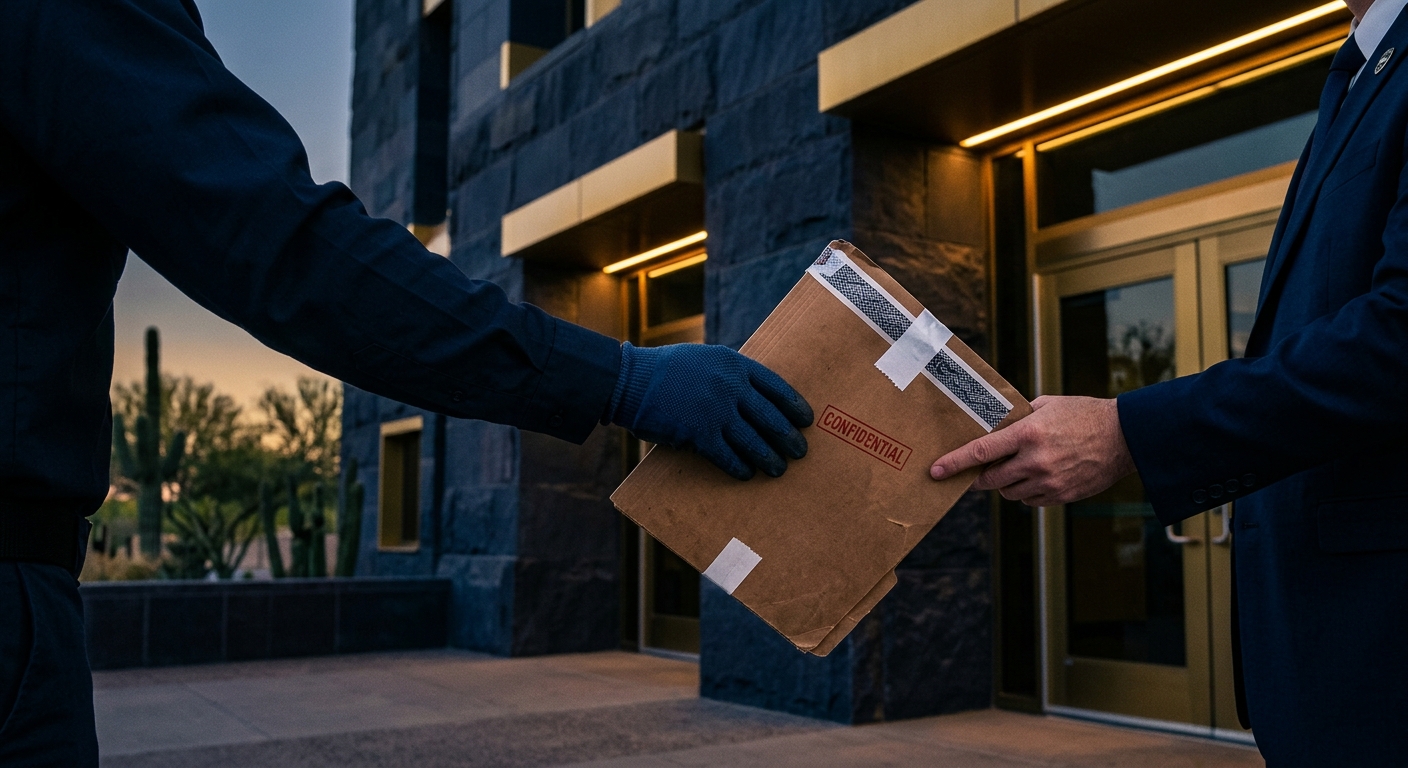
When a lawsuit, subpoena, or court petition has to reach a party by a fixed deadline, the method of delivery is not an administrative afterthought — it is the mechanism that either preserves a case or exposes it to dismissal, a vacated default, or a contested motion to quash. Arizona courts do not accept a text message, a certified-mail receipt signed by someone else, or a process server’s unsupported claim that “it got there.” They require a documented chain: who served whom, where, when, and how, sworn under penalty of perjury. Getting that chain right, on the first attempt, on a Tuesday afternoon in Casa Grande or a Thursday morning in Flagstaff, is what professional process serving actually delivers.
Professional process serving in Arizona means a licensed, statewide-capable server delivers summonses, subpoenas, petitions, and writs in strict compliance with the Arizona Rules of Civil Procedure, then produces a signed, notarized affidavit of service the court will accept without challenge. Routine service typically completes in three to five business days across all fifteen counties, with rush and same-day options available for time-sensitive filings, plus direct e-filing coordination with the clerk of the court.
What Does Professional Process Serving Actually Cover in Arizona?
Process serving is the formal, legally-defined act of delivering court documents to a party in a manner the issuing court recognizes as valid notice. It spans far more than the popular image of a single summons handed across a doorway. In practice, it covers civil summonses and complaints, deposition and trial subpoenas, family court petitions and orders to show cause, small claims summonses, writs of garnishment and execution, and time-sensitive eviction notices — each governed by its own procedural rule, its own deadline pressure, and its own tolerance for error.
Many process-serving engagements begin as, or quietly escalate into, a broader fact-finding effort — confirming a residence is still occupied, verifying a business’s current statutory agent, or cross-checking a corporate filing before a clerk’s deadline closes. That is why Honeybadger runs process serving inside the same in-house practice that handles Arizona investigations more broadly, rather than as a disconnected courier function bolted onto a law firm’s vendor list. A server who understands the underlying matter serves it correctly the first time; a courier who does not, generates a defective affidavit that a defense attorney will happily challenge.
Which Documents Require Formal Service, and What Governs Each One?
Arizona’s procedural rules do not treat all court paper the same way. A summons and complaint carries a strict answer-deadline once served; a trial subpoena carries witness-fee tender requirements; an eviction notice carries a compressed timeline measured in days, not weeks. Matching the document to the correct rule — and to a realistic, defensible turnaround — is the first decision point in any service engagement, summarized below.
| Document Type | Governing Framework | Standard Turnaround | Proof of Service Filed |
|---|---|---|---|
| Civil Summons & Complaint | Arizona Rules of Civil Procedure, Rule 4 & 4.1 | 3–5 business days routine; 24–48 hrs rush | Affidavit of Service filed with the clerk |
| Deposition / Trial Subpoena | Ariz. R. Civ. P. 45 | 3–5 business days; same-day available | Affidavit plus witness-fee tender confirmation |
| Family Court Petition (Dissolution, Custody, OSC) | Arizona Rules of Family Law Procedure | 5–7 business days | Affidavit, or acceptance of service where applicable |
| Forcible Entry & Detainer (Eviction) Notice | A.R.S. Title 12, Landlord-Tenant provisions | 24–72 hours (calendar-driven) | Affidavit filed ahead of the hearing date |
| Small Claims Summons | Arizona Rules of Procedure for Small Claims | 3–5 business days | Affidavit of Service |
| Writ of Garnishment / Execution | A.R.S. Title 12, Enforcement of Judgments | 2–4 business days | Return of service filed with the issuing court |
How Fast Can Statewide Service Actually Move?
Turnaround is a function of geography, urgency tier, and how current the address on file actually is. Routine service — the majority of civil, family, and small claims filings — completes in three to five business days statewide. Priority and rush tiers compress that to twenty-four to forty-eight hours for filings with an imminent hearing or a court-ordered deadline. Same-day and emergency dispatch is available in the core corridors and, county infrastructure permitting, in most of the remaining fourteen counties.
Before a server is ever dispatched, the file gets an address-verification pass — a light intelligence check confirming the residence or business location is current rather than stale from a two-year-old court record or an outdated corporate filing. Skipping this step is the single most common cause of a wasted first attempt, and a wasted first attempt is what turns a three-day routine job into a two-week problem. This verification pass draws on the same intelligence discipline Honeybadger applies across its investigative work, scaled down to what a straightforward service assignment actually needs.
What Has to Be True for an Affidavit of Service to Hold Up in Court?
The affidavit of service is the document that actually matters to the court — the physical act of delivery is only evidence if it is properly attested. Arizona’s rules require anyone serving process for a fee to be either a sheriff, a constable, or a process server registered under the Arizona Code of Judicial Administration’s certification program. An affidavit from an uncertified server, or one missing a required element, is an invitation for opposing counsel to file a motion to quash service — and a granted motion resets the clock on the entire matter.
A defensible affidavit states, at minimum: the certified server’s identity and certification number, the exact date and time of service, the precise address, the manner of service (personal, substitute, or otherwise authorized), a physical description sufficient to identify the person served, and the server’s signature under penalty of perjury, notarized. Every field is there because a defense attorney will look for the one that is missing. A firm that treats the affidavit as paperwork to fill in later, rather than the actual deliverable of the engagement, is the firm whose service gets challenged.
How Does E-Filing Coordination Actually Work?
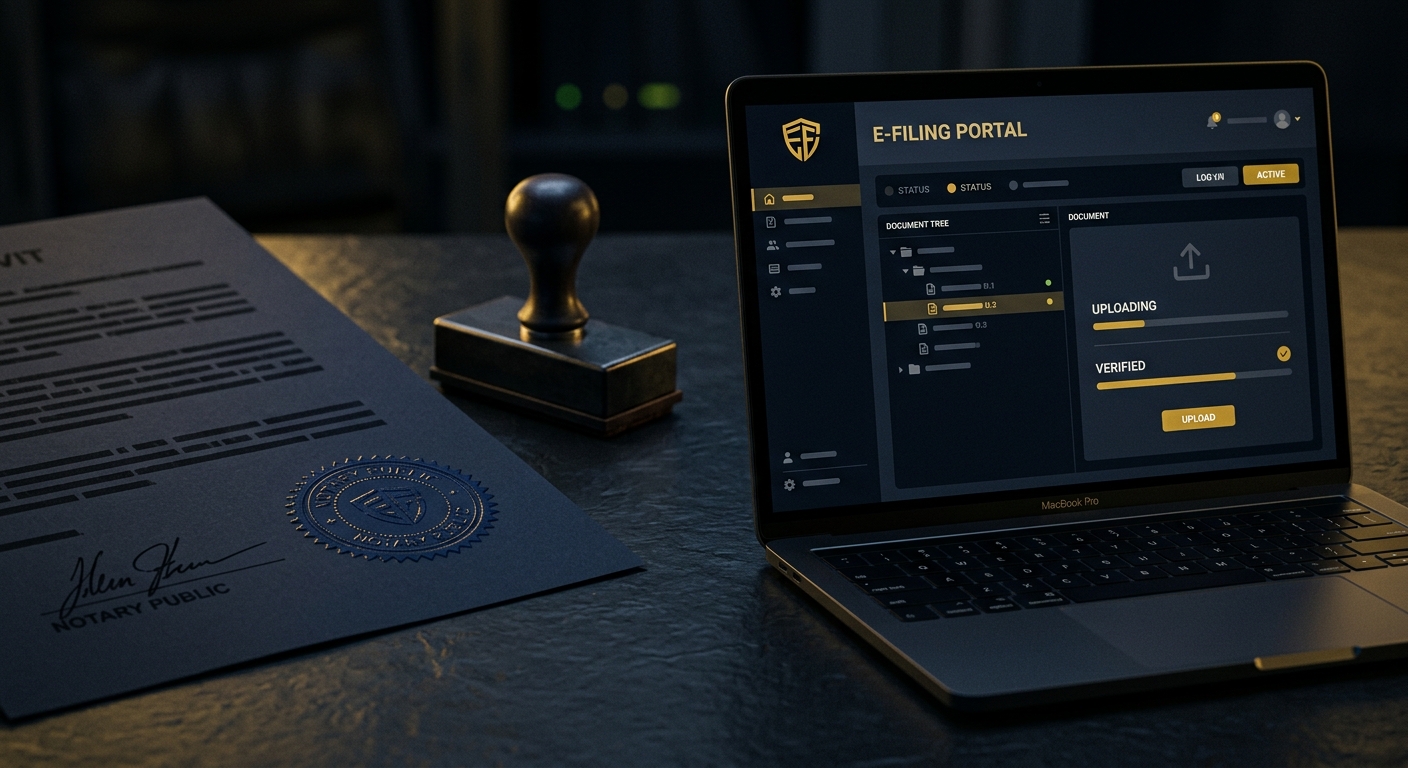
Service and filing run on two connected tracks. Service under the Arizona Rules of Civil Procedure establishes that the court has jurisdiction over the party; the county’s e-filing system is what puts the proof on the docket where a judge, clerk, or opposing counsel can see it. Maricopa, Pima, and Pinal counties, along with most of the remaining counties, run e-filing through AZTurboCourt or an equivalent county portal, and a completed affidavit can be notarized, scanned, and uploaded the same day service is completed — rather than mailed, lost in a firm’s outbox, or filed a week later once someone remembers to do it.
That same-day discipline matters most when a hearing date is close. A rush service completed at 4:00 p.m. is functionally useless to a filing attorney if the affidavit does not reach the court record until three days later. Coordinating notarization and e-filing as part of the same engagement — not as a separate follow-up task — is what turns fast physical service into a fast, provable court record.
What Separates an Elite Process-Serving Operation From a Mediocre One?
Any list of process servers can promise fast and cheap. Very few can produce an affidavit that survives a motion to quash, a same-day e-filed docket entry, and a phone call that gets answered when a hearing is two days out. The gap between adequate and elite comes down to a short, verifiable set of operational disciplines.
- Certification and bonding are verified, not just claimed. The server’s registration under the Arizona Code of Judicial Administration is current and checkable before the engagement starts, not discovered to be lapsed after service is challenged.
- Address verification happens before the first attempt, not after a failed one. A quick records pass against current corporate filings and public records catches a stale address before it wastes a billable dispatch.
- Dispatch logs are time-stamped and defensible. Real GPS and time data back the affidavit’s recitation, not a server’s memory reconstructed at 5:00 p.m.
- Notarization happens in-house, same day. The affidavit is not sitting in a queue waiting for a traveling notary while a filing deadline closes.
- E-filing is a direct relationship with the county clerk’s system, not a third step handed to the client. The proof of service lands on the docket without a separate mailing or manual upload from the law firm.
- Statewide coverage means owned capacity in the core corridors, not blind subcontracting to an unknown server in a county the firm has never worked. Every server carrying the firm’s name is accountable to the same certification and documentation standard.
- Affidavit language is reviewed against current rule amendments. Arizona’s civil and family procedure rules are periodically amended; an affidavit template from five years ago can be missing a field the current rule requires.
What Does Genuine Statewide Coverage Require?
Statewide coverage is easy to claim and hard to actually operate. It requires a firm to either staff or directly supervise process servers across geography that spans dense urban filings in Maricopa County, a large rural footprint in Pinal and Pima, and thinly-populated counties where the nearest certified server may be an hour’s drive from the address on the summons. Honeybadger Solutions runs this from three Arizona offices — Casa Grande (headquarters), Phoenix, and Oro Valley — positioned to reach the Phoenix and Tucson metro corridors quickly while maintaining real dispatch capacity into the state’s outlying counties, rather than routing every rural file through a single overworked contractor.
For corporate defendants, statewide reach also means confirming the current statutory agent of record before dispatch — a registered agent listed with the Arizona Corporation Commission can change without an opposing party’s knowledge, and serving a former agent at a vacated address accomplishes nothing. That confirmation is a quick pull that pairs naturally with the same due-diligence work behind a Honeybadger background check, run by the same in-house team rather than outsourced to a separate vendor with its own turnaround time.
What Actually Drives the Cost of Process Serving in Arizona?
Pricing on a routine service assignment is driven by a small number of concrete variables rather than a flat, one-size-fee. Mileage and county matter — a downtown Phoenix office building costs less to reach than an address forty minutes outside Casa Grande. Urgency tier matters — same-day and rush dispatch command a premium over the standard three-to-five-day window because they pull a server off a planned route. Number of attempts matters, since a first-attempt success at a verified address costs less than a file requiring three trips across a week. Notarization and same-day e-filing are typically bundled into the base fee rather than billed as surprise add-ons, and any additional records or address-verification work beyond the standard pre-dispatch check is scoped and quoted before it is performed, not after.
Frequently Asked Questions
How quickly can a document actually be served in Arizona?
Routine service across Arizona’s fifteen counties typically completes in three to five business days once the address is verified. Priority and rush tiers bring that down to twenty-four to forty-eight hours for filings with an imminent hearing, and same-day dispatch is available in the core Phoenix, Tucson, and Casa Grande corridors when the matter is genuinely time-critical.
What actually counts as valid proof of service in an Arizona court?
A valid affidavit of service names the certified server, states the exact date, time, address, and manner of service, describes the person served, and is signed under penalty of perjury and notarized. Missing any required element gives opposing counsel grounds to challenge service, so the affidavit should be treated as the actual work product — not paperwork completed as an afterthought.
Can the affidavit be e-filed directly with the court the same day?
Yes. Once service is completed and the affidavit is notarized, it can be scanned and uploaded the same day through AZTurboCourt or the relevant county e-filing portal, putting the proof on the docket immediately rather than waiting on mail delivery or a separate filing step handled later by the law firm.
Does coverage really extend beyond Maricopa and Pima counties?
Yes. Statewide coverage from Casa Grande, Phoenix, and Oro Valley reaches all fifteen Arizona counties, including rural service areas where a document must be delivered by a certified process server rather than left to an out-of-area contractor with no accountability to the requesting firm.
About Honeybadger Solutions
Honeybadger Solutions is an Arizona-licensed security and investigations firm operating from three offices — Casa Grande (headquarters), Phoenix, and Oro Valley — with in-house process serving, investigations, background intelligence, and digital forensics capability serving all of Arizona and, for remote investigative work, nationwide. Every process server carrying the Honeybadger name operates under the firm’s own certification and documentation standard, not a subcontracted patchwork with no accountability. For statewide process serving, rush dispatch, or a coordinated affidavit-to-e-filing turnaround, call 602-725-2818.
Arizona’s certification requirements for anyone serving process for compensation are set out under the Arizona Code of Judicial Administration and enforced through the state’s court system; the underlying civil procedure requirements are codified in the Arizona Revised Statutes, Title 12. Verifying that a server is currently certified against those requirements, before an engagement begins, remains the single fastest way to confirm that the affidavit it produces will hold up when a case is contested.