
Private Investigator Services Arizona – Comprehensive Investigation Solutions
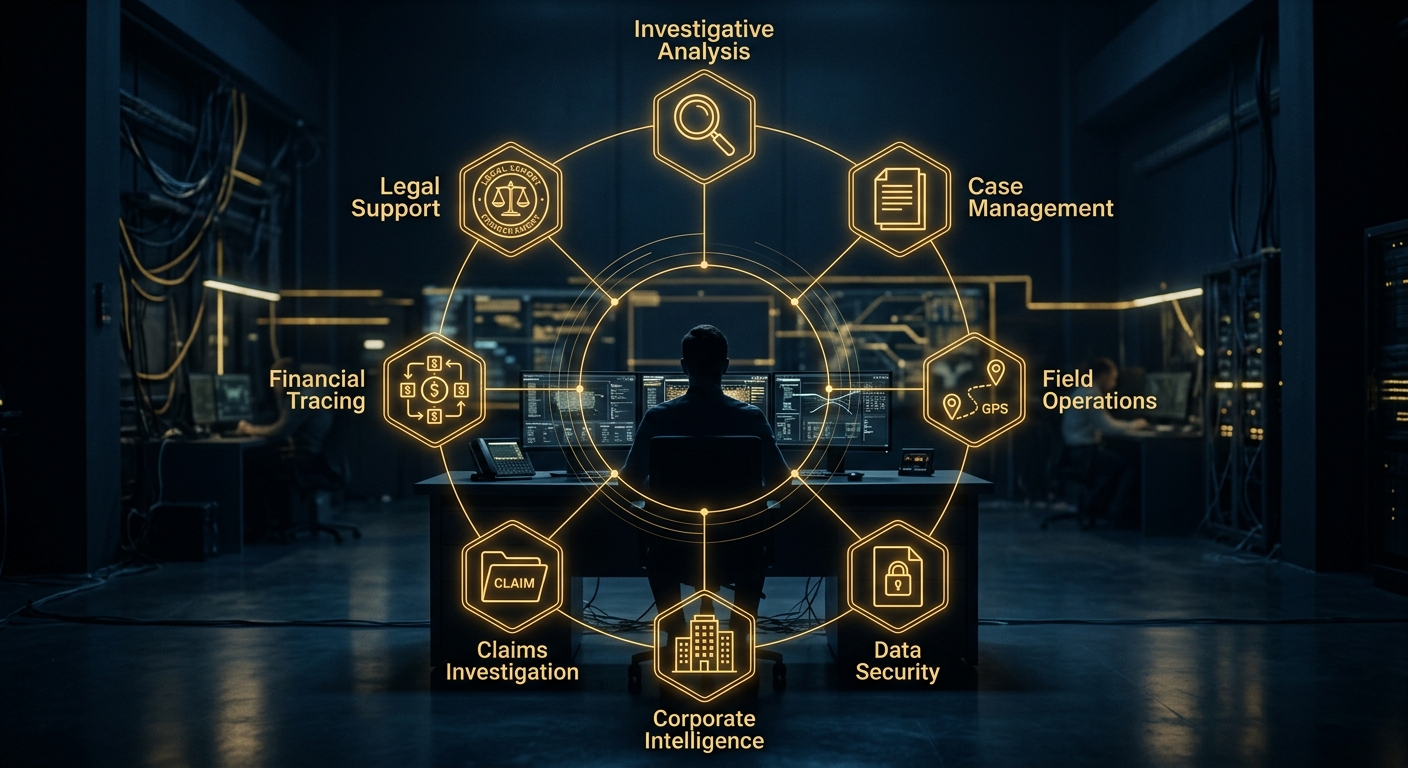
Arizona private investigator services fall into eight core disciplines: surveillance, background investigations, skip tracing and locates, infidelity and domestic cases, corporate investigations, insurance and injury investigations, asset and financial investigations, and process serving. Each discipline demands distinct licensing, tradecraft, and reporting standards. A single AZDPS-licensed agency that houses all eight in-house — rather than farming pieces out to subcontractors — delivers faster turnaround, an unbroken chain of custody, and one accountable point of contact from intake through a courtroom-ready report.
Most people search for “a private investigator” as if the profession were a single service. It is not. The investigator qualified to sit on a discreet three-day surveillance detail is not automatically the analyst equipped to trace a diverted asset through shell entities, and neither is necessarily the process server who understands Arizona Rule of Civil Procedure 4.1 well enough to defeat a motion to quash service. Attorneys, insurers, business owners, and private clients who understand the menu — and who engages a firm that runs the full menu in-house under one Arizona license — make faster, better-informed decisions about who to call and what to expect. This overview maps the eight disciplines, how they differ, when each is used, and what separates a defensible, AZDPS-licensed operation from a hobbyist with a camera.
What does a licensed Arizona private investigator actually cover?
In Arizona, private investigation is a regulated occupation. The Arizona Department of Public Safety (AZDPS) licenses agencies and individual investigators under Arizona Revised Statutes Title 32, Chapter 24, and licensure requires a qualifying background, fingerprinting, and — for agency principals — a demonstrated record of investigative experience or examination. That licensing structure exists because the work touches privacy, evidence integrity, and, at times, courtroom testimony. An unlicensed operator who runs a surveillance job or pulls a background file is not simply cutting corners on paperwork; findings from an unlicensed source can be challenged, excluded, or used as grounds to unwind an otherwise strong case.
Within that licensed framework, the profession organizes into recognizable specialties. Some — surveillance, domestic and infidelity cases, in-person locates, and process serving — are inherently physical, boots-on-the-ground work tied to a jurisdiction. Others — background intelligence, financial and asset tracing, and much of corporate investigation — are increasingly digital, records-driven, and deliverable from anywhere with the right access and methodology. Honeybadger Solutions runs Arizona’s physical investigative work with our own in-house, AZDPS-licensed agents based out of three Arizona offices — Casa Grande (headquarters), Phoenix, and Oro Valley — while our digital forensics, financial investigations, and background-intelligence teams are in-house and remote-by-design, serving clients nationwide. Outside Arizona, physical field work runs through a commanded network of vetted, licensed partners, with established coverage in California, Texas, and Florida today and expansion underway elsewhere.
What is surveillance investigation, and when is it the right tool?
Surveillance is the discipline most people picture: an investigator observing and documenting a subject’s movements, activity, and associations from a lawful vantage point, without trespass or unlawful interception. Done well, it is unglamorous and methodical — hours of patient positioning for minutes of decisive footage. Common applications include workers’-compensation and disability-claim verification, child-custody and parenting-time disputes, infidelity confirmation, employee misconduct or moonlighting investigations, and pre-litigation activity checks.
What separates a defensible surveillance product from a liability is discipline in the field: staying on public property or otherwise lawful vantage points, avoiding any conduct that could be characterized as stalking or harassment, maintaining a contemporaneous, timestamped log alongside the video, and preserving an unbroken chain of custody from camera to report. A surveillance file built to this standard survives cross-examination. One that is not — gaps in the timeline, unexplained footage handling, an investigator who cannot account for their own movements — can be excluded outright, taking the client’s entire theory of the case down with it.
How do background investigations differ from a consumer background check?
A twenty-dollar online “background check” scrapes aggregated public records with no verification and no analyst judgment. A professional background investigation is analyst-driven: criminal and civil litigation history verified at the source, employment and credential confirmation, licensing checks, media and public-record review, and — where lawfully appropriate and FCRA-compliant — credit and financial history for pre-employment or business-partner vetting. The distinction matters most when the result feeds a decision with real exposure: hiring an executive, vetting a business partner, screening a caregiver, or building the factual record ahead of litigation.
Background intelligence — the broader discipline that includes reputational, financial, and open-source research on individuals and entities — is one of the capabilities we deliver in-house and remote-by-design nationwide, because the sourcing (courts, licensing boards, corporate registries, public records) is largely records-based rather than tied to a physical location. Arizona clients get the same rigor as a national corporate client vetting a counterparty in another state.
What is a skip trace or locate service, and how does it actually work?
A skip trace locates a person who has moved, gone silent, or is actively avoiding contact — a missing witness, a defendant evading service, a debtor who has relocated, an absent parent, or a beneficiary who cannot be reached for an estate matter. The methodology layers database research (address history, utility connections, vehicle and property records, employment signals) against field verification, because a database hit is a lead, not a confirmed location. Skilled locate work resolves common-name confusion, stale address data, and deliberate evasion — a subject who has changed jobs, vehicles, and phone numbers specifically to avoid being found.
Locates frequently feed directly into process serving: once a subject is confirmed at a current address, the same engagement can transition seamlessly into service of process, without re-briefing a second vendor or losing time re-explaining the case. That handoff, done under one roof, is one of the clearest efficiency gains of using a full-menu firm rather than stitching together a locate specialist and a separate process server.

How are infidelity and domestic investigations handled discreetly and legally?
Infidelity and domestic matters are among the most emotionally charged engagements a firm takes on, and they demand a correspondingly high bar for discretion and legal restraint. This work typically combines surveillance with digital and financial signal review — unexplained spending, hidden accounts, or communication patterns — always confined to lawful methods. Arizona is a no-fault divorce state, but documented conduct still matters directly in custody determinations, parenting-time disputes, and, at times, the equitable division of assets when concealment is involved.
The legal boundary here is absolute and non-negotiable: no trespass, no unlawful interception of electronic communications under the federal Wiretap Act and Arizona’s own interception statutes, and no access to a spouse’s devices or accounts without clear legal authority to do so. A finding obtained unlawfully is not just inadmissible — it can expose the client who requested it to civil or criminal liability of their own. A licensed investigator’s job is to build a fact record a family-law attorney can actually use, not to hand a client a legal problem disguised as evidence.
What do corporate investigations cover for Arizona businesses?
Corporate investigations serve businesses, boards, and their outside counsel: internal theft and embezzlement, employee misconduct and policy violations, intellectual-property leakage, workplace-harassment investigations conducted with defensible neutrality, vendor and franchisee fraud, and due-diligence vetting ahead of a merger, acquisition, or key hire. This category sits at the intersection of investigative fieldwork, background intelligence, and — increasingly — digital forensics, since most corporate misconduct today leaves a digital trail across email, file access logs, and financial systems long before it surfaces in a hallway conversation.
A well-run corporate investigation is scoped tightly with counsel from the outset, follows a defined evidentiary protocol so the findings can support a termination decision or hold up in subsequent litigation, and preserves privilege wherever counsel directs the work. Arizona businesses with multi-state footprints benefit from a firm whose background-intelligence and digital-forensics capabilities are already national and in-house, because a workplace investigation rarely respects state lines cleanly — a former employee’s misconduct trail often runs through cloud accounts, prior employers, and records in other jurisdictions.
How do insurance and injury investigations support claims and defense?
Insurance carriers, defense counsel, third-party administrators, and self-insured employers commission this work to verify the facts behind a claim: activity-check surveillance on a disability or workers’-compensation claimant, scene investigation and witness canvassing after an incident, recorded statement coordination, and social-media and public-record review consistent with each platform’s terms of service and applicable claims-handling regulations. On the plaintiff side, the same discipline supports building a credible damages narrative, locating witnesses, and preserving scene evidence before it disappears.
Insurance fraud is a real and material cost across the industry — the National Insurance Crime Bureau and state fraud bureaus track it as a recurring driver of premium loss — which is why carriers invest in verification rather than paying every claim at face value. The work has to be even-handed: a surveillance file that happens to support the claimant is exactly as valuable, and exactly as reportable, as one that undermines it. Investigators who chase a predetermined conclusion produce reports that collapse under scrutiny; investigators who document what actually happened produce reports that resolve claims faster, in either direction.
What asset and financial investigation services are available?
Asset investigations trace where money and property actually are — critical in judgment-collection efforts, divorce asset-division disputes, business-partner disputes, and fraud recovery. The work maps real property, vehicles, business ownership interests, and, where a subject has layered funds through entities or accounts to obscure ownership, follows that trail through public filings, corporate registries, and lawfully available financial records. It pairs closely with digital forensics when the concealment involves electronic records, cryptocurrency wallets, or deleted financial data that needs to be recovered and authenticated for use in court.
Because this discipline is fundamentally records- and analysis-driven rather than tied to physical presence in a jurisdiction, it is one of the capabilities we deliver in-house and remote-by-design nationwide — an Arizona family-law client tracing a spouse’s out-of-state holdings gets the same in-house rigor as a corporate client tracing a diverted vendor payment across three states.
What is process serving, and why pair it with investigative services?
Process serving is the formal delivery of legal documents — summonses, subpoenas, family-law filings — in strict compliance with the Arizona Rules of Civil Procedure and the rules of the court issuing the papers. It sounds administrative until service is contested: a defendant who claims never to have been served can delay or derail a case for months. A licensed process server documents every attempt with contemporaneous notes, photographs where appropriate, and a defensible affidavit of service that can withstand a motion to quash.
Difficult-to-serve subjects — someone actively evading service, a corporate registered agent that has gone dark, a subject who has relocated — are exactly where pairing process serving with skip-trace and surveillance capability under one firm pays off. Rather than a process server reporting a failed attempt and stopping there, an integrated team can pivot immediately into locating the subject and completing service, without losing days re-engaging a separate vendor.
How do the eight disciplines compare at a glance?
| Service | Typical client | Primary method | Delivery model |
|---|---|---|---|
| Surveillance | Attorneys, insurers, employers, families | Discreet field observation and documentation | Arizona: our own in-house licensed agents |
| Background investigations | Employers, boards, private clients | Verified records + analyst review | In-house, remote, nationwide |
| Skip trace / locates | Attorneys, process servers, estates | Database research + field verification | Arizona field: in-house agents; research: nationwide |
| Infidelity / domestic | Individuals, family-law attorneys | Surveillance + lawful financial/digital review | Arizona: our own in-house licensed agents |
| Corporate investigations | Businesses, boards, outside counsel | Fieldwork + digital forensics + background intel | In-house, nationwide |
| Insurance / injury | Carriers, TPAs, defense and plaintiff counsel | Surveillance + scene/witness work | Arizona: our own in-house licensed agents |
| Asset / financial | Litigants, judgment creditors, businesses | Records tracing + forensic financial analysis | In-house, remote, nationwide |
| Process serving | Attorneys, courts, litigants | Compliant personal/substitute service | Arizona: our own in-house licensed agents |
How should you choose the right service for your situation?
Most real-world engagements are not a clean fit for exactly one category — a custody dispute may need surveillance and a locate; a corporate fraud matter may need background intelligence, digital forensics, and asset tracing together. Use this framework to scope the engagement before the first call:
- Define the decision the findings must support. A custody filing, a termination, a claim denial, and a collection action each demand a different evidentiary bar — know the destination before scoping the work.
- Identify whether the subject or evidence is physical or digital. A person to be observed or served requires licensed field agents in the subject’s jurisdiction; records, devices, and financial trails can often be worked remotely and nationwide.
- Confirm the legal authority for the method. Surveillance, digital access, and financial record review each carry different legal limits — confirm authority with counsel before the work starts, not after.
- Check for cross-jurisdiction exposure. If the subject, assets, or witnesses span multiple states, confirm the firm has in-house national capability or a vetted, licensed partner in that theater — not an unlicensed generalist.
- Insist on one accountable firm for multi-discipline engagements. When a matter needs two or more of the eight services, a single AZDPS-licensed agency running all of them in-house eliminates the handoff gaps, duplicated intake, and chain-of-custody breaks that come from stitching together separate vendors.
- Confirm reporting will hold up where it needs to. Ask how findings are documented, sourced, and preserved — and whether the investigator or analyst is prepared to support the file in a deposition or hearing if required.
Why does licensing and in-house capability matter more than price?
The investigations market has no shortage of low-cost operators, and the gap between them and a properly licensed, well-run firm rarely shows up until the findings matter most — in a hearing, a claim dispute, or a boardroom. An unlicensed or under-resourced investigator can produce a report that looks plausible and still collapses on cross-examination because the chain of custody is broken, the methodology was unlawful, or no one can credibly testify to how a finding was developed. A firm operating under one AZDPS license across all eight disciplines, with in-house digital forensics and background-intelligence teams supporting the field work rather than a rotating cast of subcontractors, produces a file built to survive that scrutiny the first time.
Representative scenario: a corporate client suspects a departing employee took confidential client lists to a competitor. The engagement starts as a corporate investigation, but the same team pulls in digital forensics to recover deleted file-transfer logs, background intelligence to map the employee’s new employer relationship, and — because the former employee has relocated out of state — a locate to confirm current address before a demand letter and, if necessary, service of a complaint. Run through one firm, that is a single coordinated engagement with a single evidentiary thread. Run through four separate vendors, it is four separate stories that opposing counsel can pick apart at the seams. This is a representative scenario illustrating how the disciplines interact, not a named client or claimed outcome.
Frequently asked questions
Do I need a lawyer to hire a private investigator in Arizona?
No, private clients can engage a licensed investigator directly for matters like infidelity concerns, locates, or background checks. For litigation-adjacent work — corporate investigations, insurance defense, or anything likely to end up in court — coordinating scope with an attorney from the outset preserves privilege where applicable and keeps the methodology aligned with the eventual evidentiary standard.
Is surveillance evidence actually admissible in Arizona courts?
Yes, when it is gathered lawfully — from public vantage points, without trespass or unlawful interception — and documented with a contemporaneous log and unbroken chain of custody. Admissibility turns on how the evidence was obtained and preserved, which is exactly why licensing and disciplined field protocols matter more than the footage itself.
Can one firm really handle surveillance, background checks, and financial tracing together?
Yes, when the disciplines are staffed in-house rather than subcontracted. Honeybadger Solutions runs Arizona field work — surveillance, domestic cases, locates, process serving — through our own in-house AZDPS-licensed agents, while our digital forensics, financial investigations, and background-intelligence teams are in-house and remote-by-design, serving clients nationwide from our Arizona home base.
What if the person or business I need investigated is outside Arizona?
Records-based work — background intelligence, financial and asset tracing, digital forensics — is delivered in-house nationwide regardless of where the subject is located. Physical field work outside Arizona (surveillance, locates, process serving in another state) runs through our commanded network of vetted, licensed partners, with established coverage in California, Texas, and Florida today and additional theaters coming online.
About Honeybadger Solutions
Honeybadger Solutions is an Arizona-licensed (AZDPS) security and investigations firm running the full menu of private investigator services — investigations, surveillance, skip tracing, infidelity and domestic cases, corporate investigations, insurance and injury investigations, asset and financial tracing, and process serving — in-house across three Arizona offices: Casa Grande (headquarters), Phoenix, and Oro Valley. Our Arizona field work is delivered by our own licensed agents; our digital forensics, financial investigations, and background checks and intelligence capabilities are in-house and remote-by-design, serving clients across the United States. Outside Arizona, physical field engagements are commanded through a vetted, licensed partner network, with established coverage in California, Texas, and Florida.
Not sure which service fits your situation? Call 602-725-2818 to speak with a licensed investigator about scoping the right engagement. Confidential. Licensed. Arizona-based, nationwide reach.
Authoritative references: the Arizona Department of Public Safety — Private Investigator Licensing and the Arizona Revised Statutes, Title 32 (Professions and Occupations) governing private investigator regulation in Arizona.