
Personal Security Services Arizona – Private Protection & Bodyguards
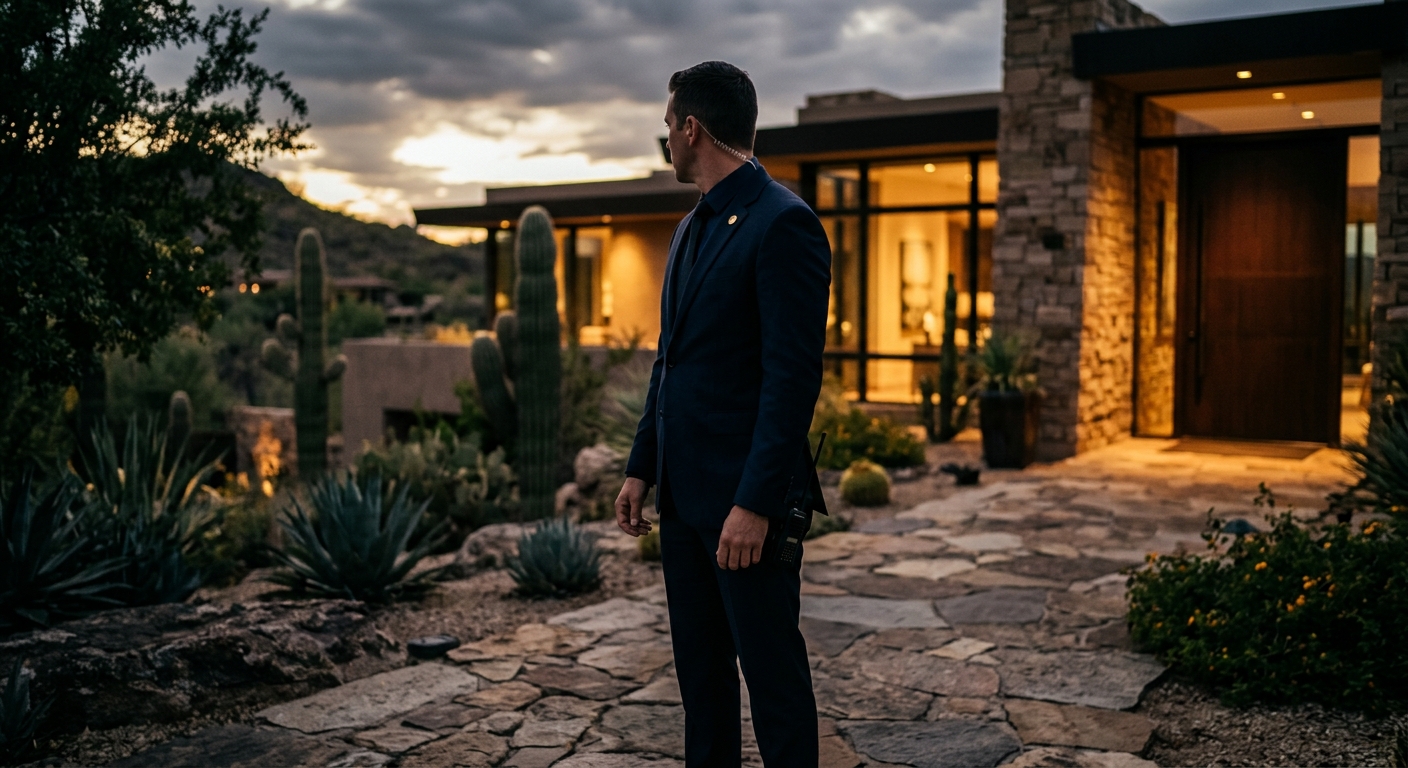
For a family facing a documented stalking pattern, a business owner navigating a hostile buyout, or a principal whose new role has made them a target overnight, personal protection is not a lifestyle accessory. It is a licensed operational discipline governed by Arizona statute, and the gap between a firm that treats it that way and one that simply rents out large men in suits shows up exactly when it matters — during the incident nobody planned for.
Personal security services pair Arizona-licensed protective agents with a documented threat assessment, then build residential coverage, travel security, or full close protection around a client’s specific risk — not a generic guard posted at a door. In Arizona, Honeybadger Solutions staffs every detail with our own in-house, state-licensed personnel; outside Arizona, coverage extends through a vetted, established partner network.
Who Actually Needs a Personal Protection Detail?
Personal protection is not reserved for celebrities and elected officials. The engagements that actually come through our door in Arizona involve a family living with a documented stalking pattern; a spouse or ex-partner who has already violated a protective order; an executive whose litigation, layoffs, or a public dispute has generated direct threats; a business owner in the middle of a contentious buyout, partnership dissolution, or labor dispute; and a principal stepping into a higher-visibility role — a new CEO, a public appointee, a controversial expert witness, a whistleblower — who needs coverage in place before the exposure becomes a target, not after. Parents managing custody disputes with a volatile co-parent, and individuals whose online harassment has crossed the line from digital to physical — a name tied to an address, a workplace, a school pickup line — round out the majority of the requests we field. The common thread across all of them is the same: a specific, identifiable risk profile, not a vague sense of unease. That distinction is exactly why the engagement always starts with an assessment, not a body.
Why Does the Engagement Start With an Assessment, Not a Guard?
The single biggest difference between a professional protective engagement and a rented-muscle arrangement is what happens before anyone is posted anywhere. A competent threat assessment examines who the adversary is (when known), what capability they have demonstrated, what their intent appears to be, and how close they have already gotten — physically, digitally, or through third parties. Analysts review the client’s pattern of life (routine routes, school pickup times, gym schedules, recurring public appearances), the digital footprint that makes that pattern discoverable (social media geotags, property records, court filings, data-broker listings that publish home addresses), and the history of prior incidents, including the ones that seemed minor at the time — a car idling too long outside the house, an unfamiliar account probing social accounts, a message that crossed a line and was dismissed as a one-off.
That assessment produces a risk tier, and the tier — not a client’s preference or a headline budget number — determines whether the correct response is a single low-profile agent conducting periodic residential checks, a static post at the property, a full close-protection team with a dedicated advance element for travel, or a posture that shifts as circumstances evolve. Skipping this step and simply deploying a large, visible presence is how well-intentioned protection becomes a liability: it signals the client’s perceived importance to exactly the wrong audience, disrupts a family’s normal life, and rarely maps to the actual risk sitting behind it.
What Actually Makes an Arizona-Licensed Protective Agent Qualified?
Armed protective work in Arizona is a regulated activity, not a freelance trade you can pick up on a weekend course. Agents providing armed protection or security services are subject to licensing administered by the Arizona Department of Public Safety under state private-investigator and security-guard licensing statutes, which require background screening, agency registration, and firearms certification for any agent carrying a weapon on assignment. That license is the floor, not the qualification — it confirms an agent cleared a background check and a firearms course, and nothing more.
The qualification that actually matters for close protection sits well above that floor. It includes documented training in defensive tactics and use-of-force law, so an agent understands precisely when — and when not — to act; trauma medicine, because a protective agent is frequently the only trained person on scene in the critical first minutes of a real incident; surveillance detection, to recognize hostile reconnaissance before it escalates into an approach; low-profile and evasive protective driving; and the judgment, built through real operational experience rather than a certificate on a wall, to de-escalate the overwhelming majority of situations that never need to become physical at all. Frameworks published by industry bodies such as ASIS International reflect this same standard: licensing is a prerequisite, but protective competence is demonstrated through training, documented procedure, and disciplined judgment under pressure.
Honeybadger Solutions staffs every Arizona detail exclusively with our own in-house, state-licensed protective agents — never subcontracted, never sourced from a labor pool the week of the assignment. Every person assigned to a client has been screened, trained, and personally briefed by our team, and that ownership is what allows us to guarantee a standard rather than simply promise one.
Licensed Detail vs. Unlicensed “Bodyguard”: What Is the Real Difference?
Families evaluating options are often comparing a licensed protective services firm against an off-market referral — a friend of a friend who “used to be in the military” or “worked security once.” The differences are not cosmetic; they determine whether the arrangement holds up during an incident and whether it creates liability exposure for the client who hired it.
| Factor | Unlicensed “Bodyguard” | AZ-Licensed Protective Detail |
|---|---|---|
| Licensing & background | Unverified; no state oversight or agency accountability | State-licensed agent operating under a licensed agency, background-screened |
| Threat assessment | Skipped; deployment is reactive and generic | Formal assessment drives risk tier and posture before deployment |
| Use-of-force training | Unknown or informal; legal exposure for the client | Documented training aligned to Arizona use-of-force law |
| Medical readiness | Rarely trained beyond basic first aid, if that | Trauma-care trained; equipped for the first minutes of a real incident |
| Legal & insurance exposure | Client often bears direct liability for the individual’s actions | Agency-insured, contracted engagement with documented scope |
| Discretion & posture | Frequently overt, drawing attention to the client | Posture calibrated to blend in and minimize signaling |
What Does Residential Protection Actually Look Like Day to Day?
Residential coverage is rarely a single agent standing at a gate. A properly designed plan starts with a walk-through of the property itself: sightlines, points of entry, landscaping that could conceal an approach, delivery and service-vendor access, and how the existing alarm and camera systems integrate with a live human presence rather than operating as a separate, disconnected layer. From there, coverage is built to the risk tier established in the assessment — a roving or periodic check for a lower-tier concern, a static overnight post where the threat has an identified pattern of nighttime activity, or full 24-hour coverage where the risk is acute.
The details that separate a professional plan from an improvised one are the ones a family rarely thinks to ask about until they matter: a documented protocol for vendors, contractors, and deliveries so an agent isn’t guessing who is supposed to be at the door; a safe-room or rally-point plan for the household, including staff and children, with a rehearsed procedure rather than a verbal suggestion; consistent, varied routines for school drop-off and pickup so a static pattern isn’t handed to anyone watching; and a direct communication line between the detail and the client’s broader security program — alarm monitoring, camera footage, and access control — so the protective agent is working with the same information the client’s system is generating, not duplicating it or missing it entirely.
What Does Travel and Mobile Protection Involve?
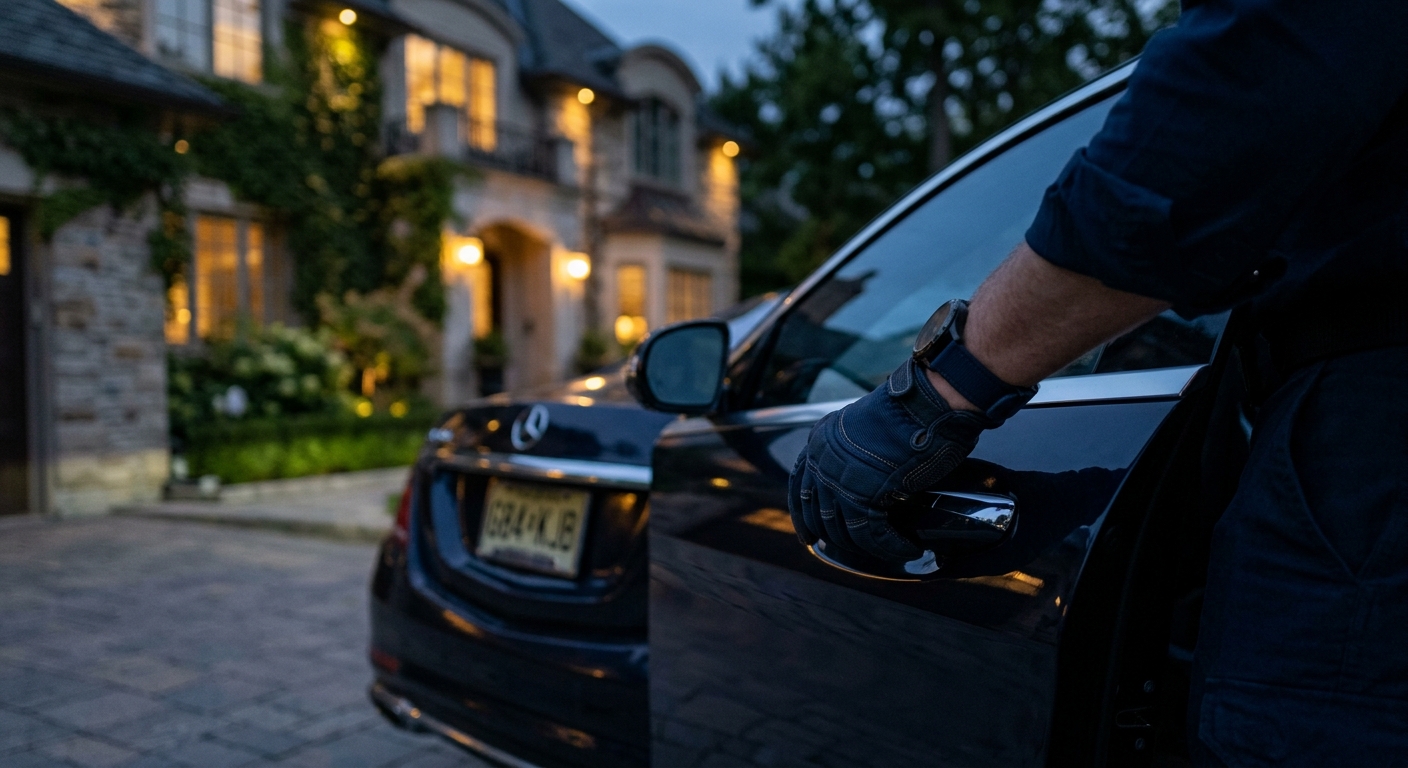
Travel is where inexperienced protection fails first, because the work that matters happens before the client ever leaves home. Advance work means an agent — or, for higher-tier engagements, a dedicated advance team — reaches the destination ahead of the principal to survey routes, identify the nearest trauma-capable hospital, confirm hotel or venue security posture and liaise with their staff, and build primary and alternate routes between every stop on the itinerary. None of that is visible to the client in the moment; it is the reason nothing visible happens.
Ground transportation is planned with the same discipline: vehicles and drivers briefed on routes and contingencies, arrival and departure timing staggered to avoid predictable patterns, and a defined posture — low-profile for a family that wants to move through an airport or a hotel lobby without drawing a second look, or a more overt posture where visible deterrence is itself part of the strategy. Communication protocols, check-in intervals, and a clear emergency and extraction plan are established before departure, not improvised mid-trip. The goal of every travel detail is the same: the client experiences a normal trip, and the work that made it normal stays invisible.
How Does a Protective Engagement Actually Come Together?
Every Honeybadger protective engagement follows the same disciplined sequence, whether the scope is a single event or an open-ended residential detail:
- Confidential intake interview. A direct conversation with the client to understand the adversary (if known), the history of incidents, and the daily patterns that need protecting.
- Formal threat assessment. Capability, intent, and proximity are evaluated and documented, producing a defensible risk tier rather than a guess.
- Protective plan design. Residential, travel, or combined coverage is scoped to the tier — including staffing levels, armed or unarmed posture, and hours of coverage.
- Agent selection and briefing. Agents are matched to the assignment and personally briefed on the client, the threat picture, and the operating protocol — never dispatched cold.
- Advance work. For travel or event engagements, routes, venues, and contingencies are surveyed and locked before the client arrives.
- Detail deployment. Coverage begins on the agreed posture, with a direct line to the client’s household or security team throughout.
- Continuous reassessment. The threat picture is revisited on a set cadence and immediately after any incident, adjusting posture up or down as the facts change.
What Happens Outside Arizona?
Arizona coverage is delivered entirely by our own personnel, and that distinction matters enough to state plainly: outside Arizona, physical protective coverage is commanded through a vetted partner network rather than owned Honeybadger agents. California, Texas, and Florida are established partner theaters where we have long-standing relationships with licensed, vetted local firms; engagements in other states are coordinated case by case through the same vetting standard. In every instance, our team defines the protective plan, verifies the partner firm’s licensing and insurance, and briefs the assigned agents directly — the client is working with Honeybadger’s standard, delivered through a partner’s local footprint, not a name we simply forwarded a phone number for.
What we do not do is claim owned offices, owned guards, or owned agents outside Arizona. A firm that overstates its physical footprint to close a deal is the same firm that will overstate what its coverage can actually deliver when it counts. We would rather tell a client exactly how a multi-state or national engagement is structured than let them discover the structure during an incident.
Why Is Discretion the Actual Product?
A visible security presence can deter a low-commitment threat and can also do real damage: it disrupts a family’s normal life, signals to neighbors and schools that something is wrong, and, in some cases, communicates to a determined adversary exactly how seriously the client is taking the threat — information that can escalate rather than calm a situation. Elite protective work is built around minimizing that footprint without minimizing capability. Agents typically work in plain clothes and unmarked vehicles, coordinate quietly with a child’s school or an employer’s front desk rather than announcing a “security detail,” and compartmentalize information about the client’s schedule and risk profile on a strict need-to-know basis, including within the client’s own household staff.
Confidentiality agreements govern every agent on every engagement, and case details are never discussed outside the operational team assigned to them. For a family, that discretion often matters as much as the protection itself — the goal is for a child’s classmates, a spouse’s colleagues, and a neighbor walking the dog to see nothing unusual at all, while the household is, in fact, thoroughly covered.
What Actually Drives the Cost of a Protection Detail?
Pricing a protective engagement without a threat assessment is a guess, but the variables that move the number are consistent across cases. Staffing level is the largest driver — a single agent versus a rotating team required for genuine 24-hour coverage changes the cost structure entirely, since round-the-clock protection requires enough personnel to cover shifts, rest, and overlap without a gap. Armed versus unarmed posture, the duration of the commitment (a single event versus an open-ended residential detail), and whether travel is involved — with its added costs for advance work, lodging, and transportation for the detail itself — all factor directly into scope.
Less obvious cost drivers separate a serious firm from a cut-rate one: the quality and frequency of ongoing threat reassessment, the training and experience level of the agents actually assigned (a licensed agent with elite training costs more than a licensed agent with the statutory minimum, and the difference is exactly where quality lives), and whether the firm treats advance work and route planning as a billable afterthought or a mandatory phase of every travel engagement. A detailed proposal should itemize all of it — staffing, posture, duration, and reassessment cadence — so a client is pricing a plan, not a guess.
Arizona Statewide, With Nationwide Coordination
Honeybadger Solutions operates from three offices — our headquarters in Casa Grande, plus Phoenix and Oro Valley — giving us direct, in-house coverage across the Phoenix metro, Tucson and Southern Arizona, and Pinal County, with the ability to reach any Arizona community for a residential or travel engagement. For clients whose lives or businesses cross state lines, our team coordinates protective coverage nationally through the vetted partner network described above, always under a Honeybadger-designed protective plan.
Frequently Asked Questions
Do I need a documented threat before I can hire a protective detail?
No. Many clients engage protection proactively — before, during, or after a life change that raises their visibility, such as a contentious divorce, a public role, or a business dispute — rather than only after an incident. That said, whatever documentation exists (police reports, protective orders, threatening messages, prior incidents) meaningfully sharpens the threat assessment and helps calibrate the right level of coverage from day one.
Are your protective agents armed?
Posture is set by the threat assessment, not by default. Some engagements call for an armed, state-licensed agent; others are appropriately covered by an unarmed presence focused on observation, access control, and rapid coordination with law enforcement. Every agent assigned to an armed role holds the required Arizona firearms certification in addition to the underlying security license.
Can you cover protection outside of Arizona?
Yes, through our vetted partner network. Arizona engagements are staffed exclusively by our own in-house, state-licensed agents. Outside Arizona, we design and manage the protective plan and place it with vetted, licensed local firms — California, Texas, and Florida are established partner theaters, with other states coordinated case by case under the same vetting standard.
How quickly can a protective detail be in place?
For an acute, in-progress threat in Arizona, coverage can typically be arranged far faster than a standard engagement timeline, because the intake interview and an abbreviated threat assessment can happen the same day. A fully designed plan, with advance work for travel or a comprehensive residential build-out, is stronger with a short lead time, but we do not make a family wait through a lengthy sales process when the risk is immediate.
About Honeybadger Solutions
Honeybadger Solutions is an Arizona-licensed security and investigations firm providing personal protection, executive protection, and close protective services to individuals and families across the state, with coverage extended nationwide through a vetted partner network. We maintain three offices — our headquarters in Casa Grande, plus Phoenix and Oro Valley — and every Arizona detail is staffed by our own in-house, state-licensed protective agents, never subcontracted.
To discuss a confidential threat assessment or a residential or travel protection plan, call 602-725-2818 or visit our executive protection practice. Every conversation is handled with the same discretion we bring to the field.