
Missing Person Investigation in Arizona: Finding Lost Loved Ones
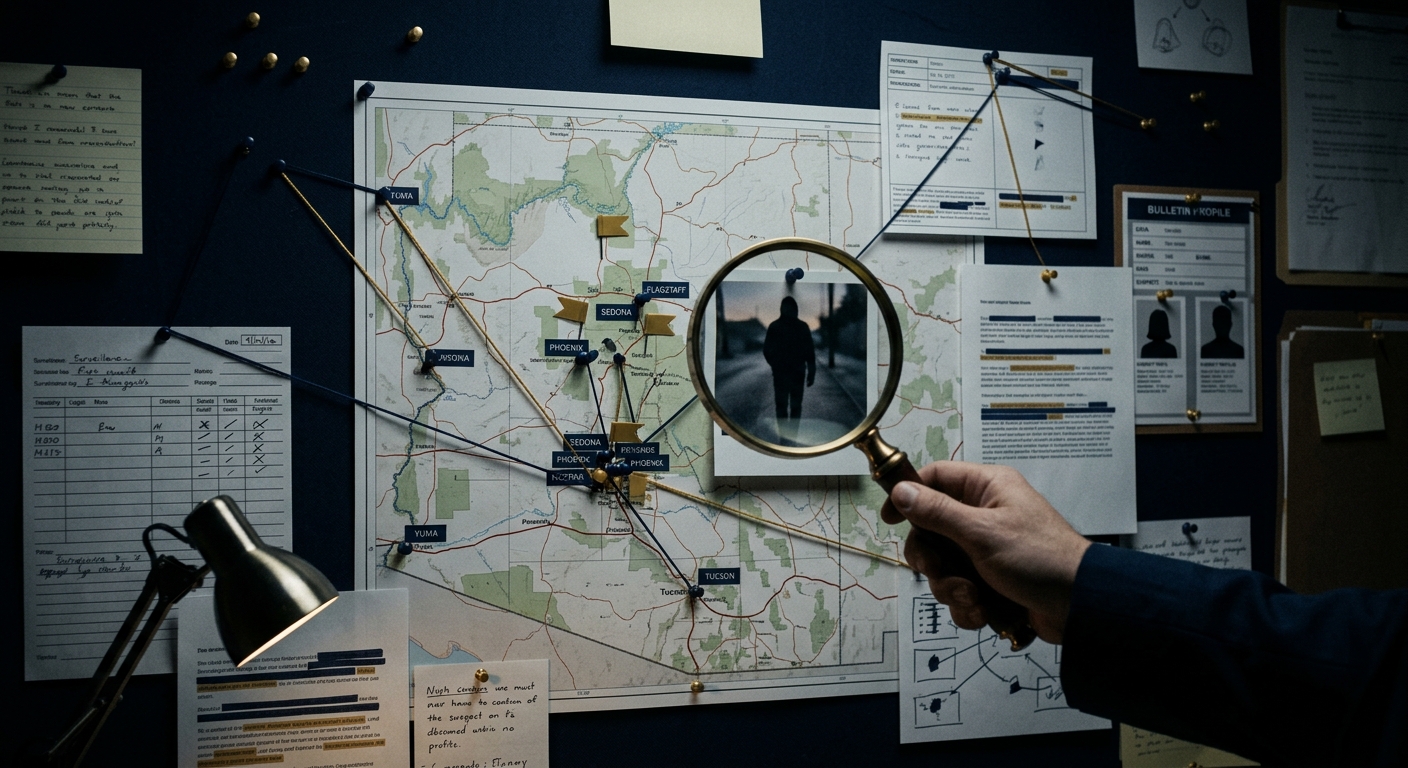
A missing-person investigation locates a runaway, an estranged relative, an at-risk elderly adult, or a skip-trace subject through structured interviews, lawful digital-footprint analysis, permissible-purpose database searches, and financial-trail work — run in coordination with, not instead of, law enforcement and the National Missing and Unidentified Persons System (NamUs). A licensed Arizona investigator’s obligation is to confirm the person’s safety and willingness to reconnect before ever disclosing a location to a family member, because most missing adults are not victims — they are people who chose to leave.
Every family that calls us about a missing loved one is living inside the same unbearable gap: no proof of harm, no proof of safety, and no idea which agency, if any, is actually looking. That gap is where a licensed investigations firm does its most important work. A private investigations firm is not a replacement for the Arizona Department of Public Safety, local police, or the FBI when a case involves abduction, foul play, or a child — those are law-enforcement matters and we route them there immediately. We exist for the enormous space beneath that threshold: the runaway who left of their own will, the sibling who has not answered a phone in six years, the parent with dementia who wandered from a care facility, and the subject of a lawful skip trace who has to be located to serve papers or settle an estate matter. Below is how that work actually happens — the methods, the legal boundaries, the coordination with official channels, and the ethics that separate a competent search from a well-meaning amateur one.
What actually counts as a “missing person” case, and who leads it?
Not every disappearance is the same emergency, and treating them all identically wastes the hours that matter most in the cases that are genuine emergencies. Arizona law enforcement leads immediately, and a private investigator’s role is strictly supportive, when a case involves a minor believed to be abducted, any credible indication of foul play or violence, an adult with a diagnosed cognitive impairment who has wandered into potential danger, or a person whose absence coincides with signs of a crime at their residence. Those are reported to the local law enforcement agency or the Arizona Department of Public Safety without delay, and a family should never substitute a private search for that report.
A private investigation leads, often with law enforcement already aware but resource-constrained, when the case is a competent adult who left voluntarily and cut off contact, a runaway teenager with no indication of abduction, a family member who has been unreachable for years and needs to be located for a legal, medical, or financial reason, or a subject who must be found so that a court document, debt, or estate matter can proceed. law enforcement agencys carry enormous caseloads of confirmed-voluntary adult absences with no criminal nexus; those cases are real, they are painful, and they are frequently the ones that get the least investigative bandwidth — which is exactly the gap a licensed firm is built to close.
The four cases we are asked to help with most often
Each of the following presents a different urgency profile, a different legal posture, and a different definition of a good outcome. Confusing them — treating a voluntary adult disappearance like a criminal abduction, or a wandering dementia patient like a routine skip trace — is the most common mistake families and inexperienced searchers make.
| Case type | Typical urgency | Who should lead | What a good outcome looks like |
|---|---|---|---|
| Runaway or unaccounted-for minor | High, time-sensitive | Police report first, always; investigator supports | Location confirmed, safety verified, family reunited or agency-supported |
| Estranged or lost-contact adult relative | Low urgency, high emotional weight | Private investigation, no police jurisdiction | Location and welfare confirmed; contact only with subject’s consent |
| At-risk elderly adult (dementia, wandering) | Critical, hours matter | Police/Turquoise Alert first; investigator supports and continues after the alert window closes | Rapid recovery; long-term wandering-risk plan for the family |
| Skip case (process service, collections, estate) | Moderate, deadline-driven | Private investigation | Verified current address sufficient for lawful service or notice |
How a licensed investigator actually finds someone
Locating a person who does not want to be found, or simply does not know anyone is looking, is a discipline built on corroboration — no single source is trusted until at least one other independently confirms it. The methods below are used in combination, in roughly the order a case allows.
Structured family and associate interviews
Every case starts with the people who knew the missing person best, interviewed in a structured sequence rather than a single open-ended conversation: immediate family, then the wider circle — employers, landlords, close friends, estranged partners, and anyone mentioned in old correspondence. The goal is a timeline of last-known contacts, habits, financial pressures, relationship conflicts, and any stated intention to leave, because voluntary disappearances almost always have a discoverable motive and a discoverable direction if the right person is asked the right question.
Digital footprint and lawful open-source intelligence
Social media, forums, marketplace listings, and public-facing professional profiles routinely reveal a current city, employer, or social circle long before a formal record catches up. This work stays strictly within lawful open-source collection — publicly visible information — and never involves account intrusion, password guessing, or impersonation to gain access, all of which are both unethical and criminal exposure for the investigator and the client alike.
Permissible-purpose database and skip-tracing tools
Licensed investigators hold access to consumer and public-record databases — address history, utility connects, vehicle registrations, professional licensing, court filings — that are not available to the general public, gated behind a documented permissible purpose under the Fair Credit Reporting Act and related state law. A skip trace built correctly cross-references several of these sources against the interview timeline rather than accepting the newest database hit as automatically correct; stale or duplicate records are one of the most common causes of a wasted lead.
The financial and utility trail
People stop updating their social profiles far more often than they stop needing electricity, a phone plan, or a paycheck. Where lawful process allows — subpoena in an active legal matter, the subject’s own authorization, or a permissible-purpose inquiry — a financial or utility connection is one of the most reliable confirmations of a current address, because it requires the subject to have physically re-established service somewhere.
Lawful surveillance and geolocation
Once a probable location is developed, verification often means a discreet, lawful physical check — confirming a vehicle, an occupancy pattern, or a place of employment from public vantage points, without trespass or pretext calls that misrepresent the investigator’s identity. This is the step that turns a database hit into a confirmed, defensible finding rather than a guess.
Law-enforcement liaison and NamUs
For cases that started with, or escalate to, an official report, an investigator’s role is to feed usable leads to the assigned detective rather than compete with the agency of record. The National Missing and Unidentified Persons System (NamUs), operated by the U.S. Department of Justice, is the national clearinghouse that connects missing-person reports with unidentified-person and unclaimed-person cases nationwide; a case entered there by the reporting agency or, in eligible circumstances, by the family, remains searchable long after local attention has moved on. We treat a NamUs entry as a durable, national backstop that continues working even after our active engagement ends.

When it isn’t optional: at-risk elderly adults and the wandering clock
A missing adult with Alzheimer’s disease, dementia, or another cognitive impairment is not a voluntary-disappearance case, and it should never be treated with the wait-and-see posture appropriate to an estranged family member. Wandering behavior carries a genuinely compressed clock — exposure, dehydration, and disorientation near roadways or water are real risks within hours, not days. The first action is always a call to 911 and a report to the local law enforcement agency; Arizona also operates a statewide alert program, administered through the Department of Public Safety, specifically for missing persons with a cognitive or physical disability, which pushes the case to broader public attention faster than a standard report. An investigator’s value in these cases is threefold: helping the family compile the fast, complete description law enforcement needs immediately, canvassing a wider radius than patrol resources can cover in the first hours, and — once the immediate recovery is resolved, one way or another — building a wandering-risk plan (door alarms, GPS wearables, neighbor and business notification lists) so the family is not facing the same emergency again in a month.
Runaway minors: the legal framework families are rarely told about
A runaway report should always go to police first, and most departments will take it regardless of the circumstances, but families are frequently surprised that a teenager who left voluntarily and is not believed to be abducted often does not meet the strict criteria for an AMBER Alert, which is reserved for confirmed child-abduction cases. That gap is exactly where a private investigation adds capacity a stretched patrol division may not have: chasing the digital and social leads — who they were talking to, where they were last seen online, which friend’s household is a likely landing spot — while the case remains open with the agency of record. Arizona also criminalizes custodial interference under A.R.S. § 13-1302, which matters when a runaway has been taken in, knowingly or not, by an adult who is interfering with a parent’s legal custody; an investigator experienced in these cases knows how to document that distinction cleanly for the detective handling the file, rather than confronting anyone directly.
The adult who doesn’t want to be found: the right-to-privacy line
This is the case type that most separates a professional firm from a well-meaning relative armed with a database subscription, and it is the single most important ethical rule in this work: a competent adult has a legal right to disappear from people they no longer wish to have contact with, and no investigator — regardless of who is paying the bill — has the authority to hand a client an address without first confirming the subject’s safety and, wherever the case allows it, their willingness to be contacted. In practice that means the investigator locates the person, verifies through discreet, lawful means that they are safe, and then offers to relay a message rather than disclosing the location outright. If the located person declines contact, that decision is communicated to the client along with confirmation that their loved one is alive and unharmed — which, for most families, is the outcome they actually needed, even when it is not the reunion they hoped for. A firm that skips this step and simply hands over an address is not protecting its client from liability, and it is not treating the missing person like a human being with rights of their own.
Before you call: the missing-person engagement checklist
Families move faster, and get a more accurate cost estimate, when they arrive with the following assembled. This is the same intake framework we walk clients through on the first call.
- File the police report first if there is any indication of danger, abduction, cognitive impairment, or a minor involved — a private search never substitutes for this.
- Get the report number and assigned officer or detective so the investigation can be coordinated with, not duplicated against, the official file.
- Gather recent photographs, ideally within the last twelve months, from multiple angles.
- Compile last-known contact details: phone numbers, email addresses, social media handles, and usernames.
- List known associates — friends, employers, romantic partners, estranged family — with any contact information available.
- Document the last confirmed sighting or contact: date, location, and circumstances, as precisely as memory allows.
- Identify any legal deadline driving the search, such as a process-service window, probate filing, or court date, since that changes the investigative priority.
- Decide, honestly, what outcome you are seeking — confirmed safety, a relayed message, or direct reunification — because the ethical and legal boundaries differ for each and shape how the case is run from day one.
What separates a competent investigation from a well-meaning amateur search
Grieving, frightened families frequently turn first to online “people finder” tools, unlicensed forum sleuths, or a friend who is “good at the internet.” The results are, at best, unreliable and, at worst, actively harmful: stale or misattributed addresses that send a family to the wrong house, digital contact attempts that alert a subject and cause them to go further to ground, or well-intentioned public appeals that expose sensitive family information for no investigative benefit. A licensed firm brings three things an amateur search structurally cannot: access to permissible-purpose data sources that are not available to the public, documented chain-of-custody on every finding so it can support a legal filing if needed, and — critically — the professional judgment to know when a lead should be handed to law enforcement rather than pursued directly. Every finding we produce is corroborated by at least two independent sources before it is presented to a client, precisely because a single database hit is a lead, not a location.
What this isn’t: adoption tracing and probate heir searches
Missing-person investigation is frequently, and incorrectly, lumped together with two related but legally distinct services. Adoption tracing — reconnecting adoptees with biological parents or siblings — involves sealed-record procedures, state-specific disclosure laws, and consent registries that follow an entirely different legal path than locating a person who is simply unreachable. Probate and asset-related heir searches — locating unknown or unlocated beneficiaries so an estate can be distributed — are driven by fiduciary and court deadlines rather than family welfare, and follow their own documentation standard for the court. If your situation is either of those rather than a welfare-driven search for a living person you have lost contact with, tell us up front; the intake, the records approach, and the legal disclosures involved are different enough that treating them the same would shortchange both.
Arizona reach, national capability
Our field capability — interviews, discreet verification, coordination with local agencies — is delivered by our own in-house, Arizona-licensed investigators across the state, based out of Casa Grande, Phoenix, and Oro Valley. The digital-footprint analysis, database work, and financial-trail research that drive the majority of modern missing-person investigations are performed in-house and are not bound by geography, which means a case that starts with an Arizona family and ends with a subject located in another state does not require a handoff to a different firm. Where a case requires sustained physical presence outside Arizona, we coordinate through a vetted regional partner network rather than claiming capability we do not directly operate.
Frequently asked questions
When should I call police instead of a private investigator?
Always call police first, and immediately, if there is any indication of abduction, foul play, violence, a minor involved, or an adult with a cognitive impairment who has wandered off. A private investigator supports those cases but never replaces the initial report. Private investigation leads when a competent adult has left voluntarily, a case has gone cold with limited police bandwidth, or a subject must be located for a lawful civil matter.
If you find my missing family member, will you tell me exactly where they are?
Not automatically. Competent adults have a legal right to decide who has access to their location. Our standard practice is to confirm the person’s safety, attempt to relay a message on the family’s behalf, and disclose a location only with the located person’s consent or where a specific legal process — such as court-ordered service — requires it. Families are told, at minimum, whether their loved one is safe.
What is NamUs and should my family’s case be entered into it?
NamUs, the National Missing and Unidentified Persons System, is a Department of Justice database that connects missing-person reports to unidentified and unclaimed-person cases nationwide. Cases are generally entered by the law-enforcement agency handling the report; in eligible circumstances family members can submit information directly. It is a durable, national resource that keeps a case searchable long after local investigative attention has necessarily moved to newer cases, and we recommend confirming an entry whenever a case has been open with police for an extended period.
How is a missing-person case different from a standard skip trace?
The techniques overlap heavily — both rely on database work, digital-footprint analysis, and address verification — but the intent and ethical posture differ. A skip trace is typically driven by a legal or financial deadline, such as serving court papers or locating a debtor, and the standard is a verified current address sufficient for that purpose. A missing-person case for a lost loved one is welfare-driven, and the standard includes confirming the person’s safety and respecting their choice about contact, not just producing an address.
About Honeybadger Solutions
Honeybadger Solutions is an Arizona-licensed security and investigations firm. Missing-person and skip-trace fieldwork across Arizona is conducted by our own in-house, Arizona-licensed investigators — not outsourced — supported by in-house digital forensics, financial investigation, and background intelligence capability that serves clients nationwide, remote-by-design, under strict chain-of-custody discipline. We operate from three offices: Casa Grande (HQ), Phoenix, and Oro Valley. To discuss a missing loved one confidentially with a licensed investigator, call 602-725-2818.
Authoritative Resources
For authoritative guidance, see NamUs — National Missing and Unidentified Persons System. Explore related Honeybadger Solutions services: Missing Persons Investigations and Hiring a Private Investigator.