
Cyber Security Investigation Arizona – Digital Threat Protection

A cybersecurity investigation determines what actually happened inside a compromised system, network, or account and builds evidence a court, insurer, or board can rely on. When a wire transfer disappears after a spoofed vendor email, when an executive’s mailbox starts sending messages no one recognizes, or when a departing employee’s laptop shows signs of mass file access, guesswork is not a strategy. Honeybadger Solutions runs cybersecurity investigations and digital threat protection engagements for Arizona organizations and clients nationwide, pairing incident-containment speed with forensic chain-of-custody discipline from the first hour of engagement.
A cybersecurity investigation in Arizona identifies the attack vector, timeline, and scope of a business email compromise, account takeover, insider incident, or network intrusion, then preserves digital evidence under a defensible chain of custody. Honeybadger Solutions delivers this in-house, remote-by-design, for Arizona organizations and clients nationwide, combining incident containment with forensic-grade documentation from first contact.
What makes a cybersecurity investigation different from routine incident response?
The first instinct after discovering a breach is almost always the same: reset the passwords, wipe the affected machine, restore from backup, and get back to work. That instinct is understandable, and in isolation it is exactly the mistake that turns a resolvable incident into a recurring one, because the compromise vector was never identified, the attacker’s remaining access was never confirmed closed, and no record exists proving what data was or was not touched.
Routine IT-driven incident response asks one question: how do we get back online. A cybersecurity investigation asks a harder set of questions: what actually happened, when did it start, what did the intruder or misuse touch, who is responsible, and can the findings be proven under scrutiny. That last requirement is the dividing line. An organization that only remediates has a system that works again. An organization that investigates has a defensible record it can hand to outside counsel, a cyber insurer, a regulator, or opposing counsel in litigation, without gaps that invite doubt. Honeybadger’s cybersecurity services are built around that second standard from the outset, not retrofitted onto it after the fact.
How is a business email compromise (BEC) actually traced?
Business email compromise is not a single technique but a family of attacks that all exploit the same thing: trust in a familiar sender. An attacker may spoof a display name, register a look-alike domain a single character off from the real one, or — increasingly — compromise the real mailbox outright and operate from inside it. That last variant is the most dangerous, because outgoing messages come from a genuinely authenticated account, pass every spam filter, and read exactly like the person who normally writes them.
A defensible BEC investigation works backward from the fraudulent instruction — a redirected wire, a changed vendor bank account, a request for gift cards or a W-2 batch — to the point of compromise. That means pulling and preserving full message headers (not just what the inbox displays) to establish the true originating infrastructure; reviewing authentication sign-in logs for impossible-travel patterns, unfamiliar IP ranges, or logins from hosting-provider ASNs rather than residential or corporate networks; auditing the mailbox for hidden forwarding rules, delegate access grants, or newly created inbox rules that quietly route messages to an attacker while the victim sees nothing unusual; and reconstructing the financial trail alongside the technical one, since BEC almost always has a money movement at its center. Where a fraudulent wire is in motion, speed matters more than completeness — banks and the FBI’s Internet Crime Complaint Center (IC3) can sometimes intercept a transfer within a narrow window, but only if notified within hours, not days.
What does an account-compromise investigation look for?
Account compromise is broader than email and increasingly does not require stealing a password at all. Credential-stuffing attacks reuse passwords leaked in unrelated breaches; infostealer malware harvests saved browser credentials directly off an endpoint; and adversary-in-the-middle phishing kits intercept a session token in real time, defeating multi-factor authentication entirely because the attacker never needed the password — they captured the already-authenticated session.
An investigation reconstructs the authentication timeline in detail: when the account was issued a new session token and from where; whether a new device or unrecognized user agent registered itself as trusted; whether an OAuth application was granted consent to the account’s mail or files without the user’s knowledge (a common and easily overlooked persistence mechanism); and whether the compromised account was then used as a pivot point to reach other systems, mailboxes, or shared drives. That last step — lateral movement — is where a contained nuisance becomes an enterprise-wide exposure, and it is precisely the step that a simple password reset does nothing to detect or stop.
Why does an insider-misuse investigation require a different posture?
Insider matters are the most delicate category, because the person under investigation is an authorized user operating with legitimate credentials. There is no intrusion to detect — the access itself was permitted. What has to be established instead is whether that access was used outside its authorized purpose: a departing employee mass-downloading client files to a personal cloud account in the days before resignation, a staff member browsing records they had no business reason to view, or a contractor exceeding the scope of a limited engagement.
Because the legal exposure runs in both directions — for the organization if it overreaches on an employee’s privacy, and for the employee if the conduct is real — insider investigations are sequenced carefully with employment counsel and HR before any device is touched or any interview is conducted. The technical work looks for the same signal patterns every time: USB device history and cloud-upload artifacts clustered in an unusual window, access to files or systems outside a person’s normal role, and data-loss-prevention or access-log alerts that were generated but never escalated. The goal is a record that speaks for itself, distinguishing ordinary work activity from a deliberate departure from authorized use, without relying on the investigator’s characterization alone.
How do investigators scope and contain a network intrusion?
A true network intrusion — an attacker with a foothold inside infrastructure rather than a single mailbox — demands the widest scope of any cyber matter. The first task is identifying patient zero: the initial point of entry, whether a phished credential, an exposed remote-access service, an unpatched internet-facing application, or a third-party vendor connection. From there, investigators establish dwell time (how long the intruder had access before detection), map lateral movement across the environment, and identify persistence mechanisms — scheduled tasks, new administrative accounts, or backdoored services — that would allow the attacker to return even after the obvious entry point is closed.
Containment has to happen without destroying the evidence needed to answer those questions. Volatile memory, active network connections, and in-progress log data can be lost the moment a system is powered down or an existing IT team “cleans up” ahead of the investigation — the same instinct that damages BEC and account-compromise cases does even more damage here, because intrusion evidence is often the most time-sensitive of all. Coordinating containment and preservation as a single, disciplined sequence — rather than letting well-meaning internal staff race ahead of it — is what separates a scoped, provable incident from an open-ended guess about what an attacker actually reached.
Investigation-grade response vs. IT cleanup: what actually differs?
| Factor | Investigation-Grade Cyber Response | Standard IT Cleanup |
|---|---|---|
| First action | Isolate and preserve logs, memory, and session data before any change | Reset passwords and restore from backup immediately |
| Scope | Full timeline: entry point, dwell time, lateral movement, data touched | Whatever machine or account triggered the alert |
| Evidence handling | Hashed exports, documented chain of custody, defensible reporting | Screenshots or verbal summary; originals often overwritten |
| Cloud/log sources | Preserves provider audit logs before retention windows expire | Logs frequently roll off before anyone reviews them |
| Insider matters | Coordinated with employment counsel before any access or interview | Ad hoc; often escalates legal exposure unintentionally |
| Outcome | Provable findings usable with insurers, regulators, or courts | System works again; root cause and scope remain unknown |
The difference rarely shows up on day one, when both approaches can look identical from the outside — the affected system is back up either way. It shows up weeks or months later, when a cyber insurer asks for proof of scope, a regulator asks what data was exposed, or the same attacker returns through a persistence mechanism no one confirmed was removed. Investigation-grade response is more expensive on day one and dramatically cheaper across the life of the matter.
What does digital evidence and chain of custody require in a cyber matter?
Cyber evidence is unusually perishable compared to a physical device sitting in an evidence locker. Cloud platform audit logs — Microsoft 365, Google Workspace, identity providers, VPN concentrators — retain detailed activity for a fixed window, often 30 to 90 days depending on license tier, and then roll off permanently. Session tokens expire. Memory contents vanish on reboot. An investigation that starts even a week late can find the most decisive evidence already gone, not because anyone destroyed it, but because no one asked the platform to preserve it in time.
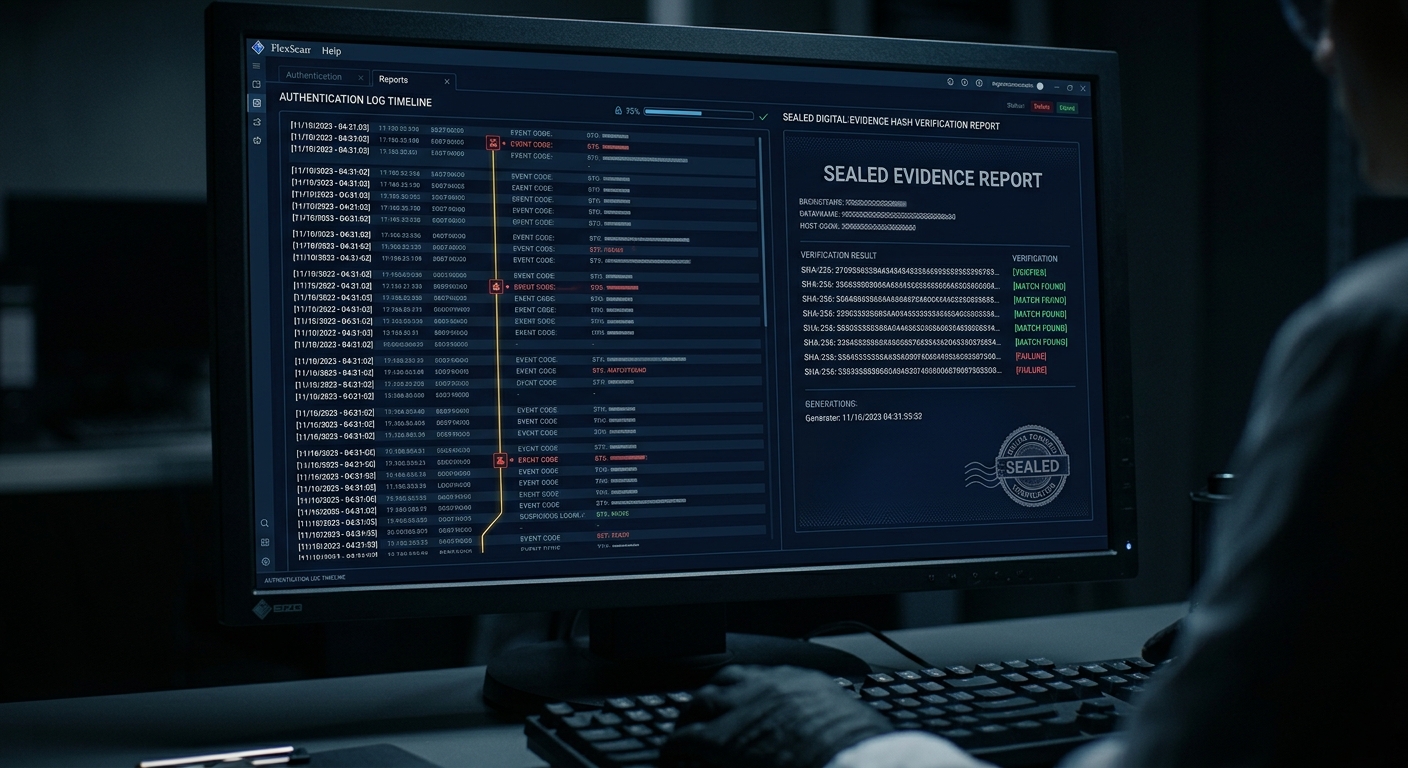
A defensible chain of custody in a cyber matter follows the same underlying discipline used in digital forensics generally: every export is hashed at the point of collection, every transfer of custody is documented, and analysis happens on a preserved copy rather than the live, changing environment. The difference is speed — a legal hold letter to a cloud provider, an export of authentication and audit logs, and a memory capture from a still-running system often have to happen within hours of discovery, not after a leisurely internal review. Organizations that treat evidence preservation as a same-day priority consistently end up with stronger, more complete findings than those that call an investigator only after IT has already “handled it.”
Remediation: a defensible seven-step framework
- Triage and isolate. Contain the affected account, endpoint, or segment without powering down systems that hold volatile evidence worth capturing first.
- Preserve before you touch. Export and hash logs, memory, and session data ahead of any password reset, reimage, or restore.
- Scope the timeline. Establish entry point, dwell time, and every system, account, or file the actor reached.
- Eradicate persistence. Remove backdoors, forwarding rules, rogue OAuth grants, and unauthorized accounts — not just the original entry point.
- Reset credentials and tokens. Rotate passwords, revoke active sessions, and reissue MFA for every account in the confirmed blast radius.
- Harden the environment. Close the specific gap that enabled entry — conditional access rules, endpoint detection, mailbox rule auditing, least-privilege review.
- Report and close the loop. Produce a defensible written record of findings and remediation for leadership, counsel, and any insurer or regulator who may later ask what happened and what was done about it.
Steps four through six are frequently rushed or skipped once the immediate alarm stops ringing, and that is exactly how the same intruder returns through a mechanism the first cleanup never found. A remediation plan is only complete when every item on this list has a documented answer, not just the ones that were urgent enough to force the issue.
When does a cyber incident require outside counsel and regulators?
Not every account compromise triggers a legal notification obligation, but enough of them do that the question should be asked early rather than assumed away. Whether personal information, protected health data, or financial account details were accessed — even briefly — can trigger state and federal breach-notification requirements, and the analysis of what was “accessed” versus merely “reachable” is itself a factual finding the investigation has to support with evidence, not assumption. Organizations that loop in outside counsel at the point of discovery, rather than after remediation is already finished, generally preserve more options: attorney-client privilege over the investigation’s findings, coordinated timing with any required notifications, and a cleaner record if litigation or a regulatory inquiry follows.
Federal guidance from the Cybersecurity and Infrastructure Security Agency (CISA) outlines when and how incidents should be reported, and serves as a useful baseline even for organizations without a formal regulatory reporting obligation. Honeybadger’s investigators work alongside — not in place of — the client’s counsel and, where relevant, cyber insurer, supplying the technical findings each of those parties needs to make their own determinations. This coordination is part of the firm’s broader investigations practice, which routinely operates at the intersection of technical evidence and legal exposure.
What drives the cost and complexity of a cybersecurity investigation?
Serious clients want to understand the variables before scoping an engagement, and cyber matters vary more widely than physical investigations because the environment itself varies so much. The number of accounts, endpoints, and cloud tenants involved; whether logs are still within their retention window or have already rolled off; the presence of anti-forensic activity such as cleared logs or disabled auditing; whether the matter is likely to require expert testimony or formal insurer coordination; and how many separate systems — email, identity provider, file storage, VPN, endpoint — have to be correlated into one timeline all shape both cost and duration. A single compromised mailbox with intact logs is a contained, fast-moving engagement. A multi-tenant intrusion spanning cloud and on-premises systems with gaps in logging is a materially different undertaking, and an honest provider says so before quoting a number rather than after.
What consistently separates a strong outcome from a weak one is not the sophistication of the tooling — most serious investigators use comparable technology — but the discipline to preserve evidence before acting, to sequence insider matters correctly with counsel, and to keep scoping honest rather than declaring victory the moment the visible symptom disappears. That is the standard Honeybadger holds every cyber engagement to, whether the client sits in Arizona or anywhere else in the country.
Frequently asked questions
What is the difference between incident response and a cybersecurity investigation?
Incident response focuses on restoring operations — getting systems back online and stopping active damage. A cybersecurity investigation goes further, establishing the entry point, timeline, scope, and provable facts of what happened, preserved under a defensible chain of custody so the findings hold up with insurers, regulators, or in litigation.
How is a business email compromise investigated?
Investigators preserve full message headers, review authentication logs for unfamiliar locations or devices, audit the mailbox for hidden forwarding rules or delegate access, and reconstruct the financial trail if a fraudulent transfer occurred. Speed matters — banks and the FBI’s IC3 can sometimes intercept a wire, but generally only within hours of the fraud.
Can Honeybadger investigate a cyber incident remotely and nationwide?
Yes. Honeybadger’s cybersecurity and digital forensics practice is delivered in-house and remote-by-design, allowing evidence preservation and investigation to begin for clients across Arizona and throughout the country within hours, without requiring an on-site visit for most cloud and account-based incidents.
What should we do first if we suspect an account compromise or insider misuse?
Preserve before you act. Avoid resetting passwords, wiping devices, or letting internal IT “clean up” before logs, sessions, and access records are exported and preserved. For suspected insider misuse, involve employment counsel before accessing any device or conducting interviews. Contact an investigator immediately to sequence containment and preservation correctly.
About Honeybadger Solutions
Honeybadger Solutions is an Arizona-licensed security and investigations firm delivering cybersecurity investigations, digital forensics, financial investigations, and background intelligence in-house and remote-by-design for clients across all of Arizona, nationwide, and internationally. Our cyber engagements pair rapid containment with the same evidentiary discipline used in our forensic examinations — preserved logs, hashed evidence exports, and documented chain of custody from the first hour.
Offices: Casa Grande (headquarters, central Arizona) · Phoenix · Oro Valley. To discuss a suspected compromise, insider incident, or intrusion in confidence, call 602-725-2818. In a cyber matter, evidence has a shelf life — the sooner preservation begins, the more the investigation can prove.