
Corporate Security Services Arizona – Protect Your Business Assets

Arizona’s fastest-growing employers — logistics hubs along the I-10/I-17 corridor, semiconductor and advanced-manufacturing campuses in Phoenix and Chandler, corporate headquarters in Scottsdale and Tempe, mining and agribusiness operations in Pinal and Pima counties — share a common exposure: the security program that protected a 50-employee office does not scale to a 500-employee campus with contractors, visitors, proprietary IP, and a payroll department. A corporate security services program closes that gap. It is not a single guard post or a one-time audit; it is an integrated, managed system of guarding, access control, executive protection, insider-threat monitoring, and written policy that a licensed provider designs, staffs, and operates on your behalf, day after day.
A corporate security program in Arizona combines four operating layers — a trained, licensed guard force; electronic and procedural access control; executive/VIP protection for leadership and high-risk travel; and insider-threat detection backed by written policy — delivered as one managed system rather than disconnected vendors. Done correctly, it reduces shrinkage, deters workplace-violence and intrusion incidents, satisfies insurance and contractual security requirements, and gives ownership a documented, auditable security posture rather than an assumption of safety.
Why does a growing Arizona business need a formal security program instead of ad hoc guards?
Most companies back into security. A theft incident prompts a camera install. A workplace-violence scare prompts a guard contract. A new enterprise client’s vendor-security questionnaire suddenly demands documentation that doesn’t exist. This reactive pattern leaves gaps precisely where a sophisticated threat — an insider with legitimate credentials, a disgruntled former employee, an organized theft ring targeting a warehouse, a targeted approach against an executive — will find them. Arizona’s Unified Fire, Attorney General, and Department of Public Safety consistently flag organized retail and cargo theft, workplace violence, and internal fraud as growth risks tracking the state’s economic expansion, not incidental to it.
A formal program replaces guesswork with a designed system: a risk-rated site assessment drives staffing levels and post orders; access control is engineered around actual traffic patterns and asset locations, not installed generically; executive protection is scaled to real threat indicators, not budget theater; and every layer produces a paper trail — incident logs, access audit trails, training records — that stands up to a regulator, an insurer, an opposing counsel, or a board asking what the company actually does to protect its people and assets.
What does a licensed guard-force program in Arizona actually include?
Guarding is the most visible layer and the easiest to get wrong through a low-bid vendor. A defensible program includes AZ-licensed, background-screened officers; written, site-specific post orders (not generic templates); documented supervision and spot-check schedules; and measurable performance standards tied to the contract, not left to the officer’s judgment. Deployment options are matched to the risk profile and the client’s operating hours:
- Uniformed static posts at reception, loading docks, and controlled entrances — visible deterrence plus first-line access screening.
- Mobile/roving patrol across multi-building campuses, parking structures, and after-hours facilities where a fixed post can’t cover the footprint.
- Concierge-security hybrid for corporate headquarters and Class-A office towers where the security presence also functions as the front-of-house experience.
- Event and high-traffic coverage for shareholder meetings, product launches, and site visits by VIPs or press.
- Emergency/surge response — rapid stand-up of additional coverage during a labor action, a credible threat, or a facility incident.
Our licensed Arizona guard and patrol division operates as owned, in-house personnel — supervised, W-2 employees under our own AZ license, not a subcontracted labor pool. That distinction matters: when a guard-force vendor is itself a broker of subcontracted officers, accountability, training consistency, and liability all get harder to pin down. Owned personnel means one chain of command, one set of standards, and one point of accountability when something goes wrong.
How should access control be designed for a corporate facility?
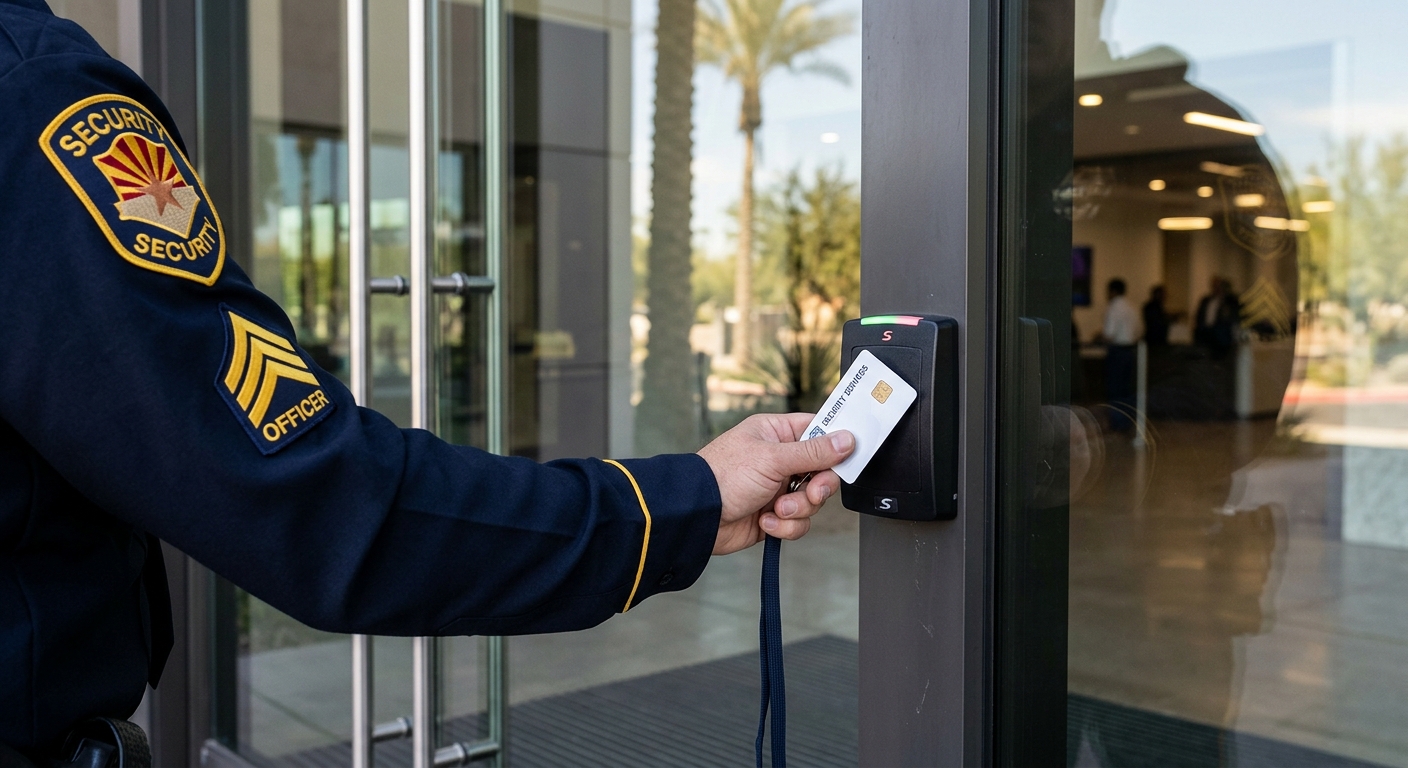
Access control is where most corporate security programs quietly fail, because it is treated as an IT ticket rather than a security discipline. A card reader on a door is not an access-control program; it is one component of one. A properly engineered program addresses four questions for every controlled space: who is authorized, how is that authorization verified, how is every entry/exit event logged, and how quickly is a terminated credential actually deactivated.
Core elements of a corporate access-control build-out include tiered credentialing (visitor, contractor, employee, and privileged-access tiers with different clearance levels), mantrap or turnstile controls at high-value entries, visitor management with photo ID capture and host sign-off, integration between the badge system and HR’s termination workflow so access is revoked the same day employment ends, and CPTED (Crime Prevention Through Environmental Design) principles applied to lighting, sightlines, and landscaping so the physical environment itself discourages unauthorized approach. Server rooms, R&D labs, executive suites, and finance/payroll areas warrant a higher credentialing tier than general office space — treating every door identically is a common and costly design mistake.
Access control model comparison: which tier fits which space?
| Access Tier | Typical Spaces | Verification Method | Audit Requirement |
|---|---|---|---|
| Public/Visitor | Lobby, reception, conference floor | Photo ID capture, host escort or badge | Visitor log reviewed weekly |
| General Employee | Open office, break rooms, general floors | Employee badge, standard credential | Quarterly access-list reconciliation |
| Restricted/Operational | Warehouse, loading dock, server room | Badge + PIN or biometric, logged entry | Monthly audit trail review |
| Privileged/Executive | Executive suite, finance, R&D/IP vault | Multi-factor: badge + biometric, dual control on sensitive rooms | Continuous log review + immediate anomaly alerting |
When does a company need executive protection, and what does it look like day to day?
Executive protection is often assumed to be a Fortune 500 luxury. In practice, the trigger isn’t company size — it’s threat exposure. A regional CEO handling a contentious layoff, a founder with a public dispute, a principal who has received a direct or implied threat, an executive traveling to a higher-risk jurisdiction, or a family office managing a high-net-worth principal’s personal security all warrant a protection posture scaled to the actual risk, assessed rather than assumed.
A properly run program starts with a threat assessment, not a protective detail. That assessment examines the specific indicators — direct threats, online hostility, litigation posture, prior incidents, travel itinerary risk — and scales the response accordingly: it may mean a discreet advance survey of a venue before an event, a single protective agent for a specific engagement, a full detail with route planning and secure transportation for sustained high-risk periods, or ongoing monitoring with no visible footprint at all. Overprotecting wastes budget and draws unwanted attention; underprotecting a genuine threat is the failure mode that ends up in a board minute or a lawsuit. In Arizona, our EP capability is delivered through our own licensed personnel; for protective engagements outside Arizona, we command a vetted-partner network with established coverage in California, Texas, and Florida, coordinated under our own operational planning so the client experiences one point of contact regardless of location.
What is insider-threat risk, and how is it actually monitored without violating employee rights?
Every physical-security conversation eventually runs into the uncomfortable truth: the highest-value threat to most companies isn’t the stranger at the gate, it’s the employee, contractor, or departing hire with legitimate access. Insider-threat programs address this directly, but the discipline lives at the intersection of HR policy, legal exposure, and security operations — and a program built without legal and HR sign-off is a liability, not a safeguard.
A defensible corporate insider-threat framework combines behavioral indicators (documented policy violations, access-pattern anomalies, credible reports from colleagues) with technical controls (access logs, data-transfer monitoring where legally permissible, badge-in/badge-out correlation) and a formal escalation path that routes findings to HR and legal before any confrontation or termination decision. It is never surveillance for its own sake, and it never operates on assumption — every action is grounded in a documented policy the employee has acknowledged, applied consistently, and reviewed by counsel for compliance with Arizona and federal employment, privacy, and labor law.
Building an insider-threat and workplace-violence-prevention framework: an 8-step approach
- Asset and role mapping — identify which roles have access to what data, cash, inventory, or physical assets, and rank by exposure.
- Written acceptable-use and access policy — drafted with legal review, acknowledged in writing by every employee and contractor.
- Baseline access and behavior monitoring — establish what normal badge, data, and system activity looks like for each role tier.
- Anomaly detection and reporting channel — a defined, confidential process for colleagues and supervisors to flag concerning behavior without fear of retaliation claims.
- Termination and offboarding protocol — same-day access revocation across physical badge, network, and third-party systems; documented chain of custody for returned assets.
- Threat-assessment team — a standing cross-functional group (security, HR, legal, and a designated executive) that reviews flagged cases before any action is taken.
- Training and drills — workplace-violence-prevention training for managers and staff, including recognition of escalating behavior.
- Documented review cadence — quarterly policy review and annual program audit, creating the paper trail that protects the company if a decision is later challenged.
How does written policy tie the program together?
Guards, access control, and threat monitoring only function as a program — rather than three disconnected vendor relationships — when written policy governs how they interact. That means a documented security manual covering post orders, escalation authority, incident-reporting standards, visitor and vendor management, credential-issuance and revocation procedures, and the chain of command during an active incident. Policy is also what makes the program defensible after the fact: when an insurer, a regulator, a plaintiff’s attorney, or a board committee asks what the company actually did, a documented, consistently enforced policy is the difference between a company that can answer that question and one that cannot.
This is also where a security program and a security-consulting engagement diverge and complement each other. A security consulting engagement produces the risk assessment, CPTED survey, and system design — the blueprint. A corporate security program is the operational delivery of that blueprint: the licensed guards on post, the access-control system running, the EP detail deployed, the insider-threat framework monitored, day after day. Companies frequently need both — the assessment to know what’s required, the program to actually run it.
What separates a world-class corporate security provider from a commodity guard vendor?
Four differentiators consistently separate elite providers from commodity vendors in Arizona’s market: ownership of personnel (in-house, supervised, AZ-licensed staff versus a brokered subcontractor pool with high turnover), integration across disciplines (a single command structure spanning guarding, access control, EP, and investigations, rather than three separate vendor contracts that don’t talk to each other), documentation discipline (every post, every credential decision, every incident logged and auditable), and escalation capability — the provider that can move from a routine guard post to an executive-protection detail to a formal internal investigation without a hand-off to a different company, because investigations and forensics work often start exactly where a security incident ends.
What does an internal investigation into a security incident actually require?
When the program’s monitoring layer flags a genuine incident — an internal theft pattern, a credible insider-threat escalation, a data-handling violation — the response has to be investigative, not reactive. That means preserving evidence (access logs, camera footage, badge records) before it ages out of retention, conducting interviews with proper documentation and legal coordination, and building a chain of custody that will hold up if the matter proceeds to termination, litigation, or a law-enforcement referral. This is deliberately distinct from the guarding and access-control layers of the program: it is a specialized background and investigative function, engaged when the preventive layers detect something that needs to be proven, not just stopped.
How is a corporate security program priced and scoped?
Cost drivers are straightforward once the risk assessment is complete: guard-post hours and coverage windows, the number and sophistication tier of access-controlled entries, whether executive protection is episodic (event-based) or sustained (ongoing detail), and the depth of the insider-threat and policy framework required for the company’s regulatory and insurance obligations. A defensible program is scoped to documented risk, not to an arbitrary budget line — overspending on guard hours at a low-risk facility while leaving a privileged-access server room on a basic badge reader is a design failure, not a cost-control decision. The right approach: assess first, scope to the finding, and phase implementation so the highest-risk gaps close first.
Frequently Asked Questions
Do we need our own security department, or can this be fully outsourced?
Most mid-size and even large Arizona employers fully outsource guarding, access-control management, and EP to a licensed provider while retaining an internal executive sponsor (often in HR, legal, or facilities) who owns the relationship and sits on the threat-assessment team. Full in-house security departments are typically only cost-justified above a certain headcount and risk profile; below that, a managed program from a licensed provider delivers the same capability without the overhead of building it internally.
How quickly can a guard-force or access-control program be deployed?
Emergency/surge guard coverage can typically be stood up within 24–72 hours for an active threat or incident. A fully designed access-control build-out, by contrast, involves a site assessment, credentialing-tier design, and hardware installation, and realistically runs several weeks to a few months depending on facility size and the number of controlled points.
Does an insider-threat monitoring program create legal liability?
Only if it’s built without legal review or applied inconsistently. A program grounded in a written, acknowledged policy, applied uniformly across comparable roles, and reviewed by counsel for Arizona and federal employment-law compliance reduces liability rather than creating it — it demonstrates the company acted on documented process rather than bias or assumption.
Is executive protection only for high-profile public figures?
No. The trigger is documented threat exposure, not public profile. A regional executive handling a contentious restructuring, a founder in an active dispute, or a principal who has received a direct threat all warrant a threat assessment regardless of how well-known they are publicly.
Honeybadger Solutions: Arizona’s Integrated Corporate Security Command
Honeybadger Solutions is an Arizona-licensed security and investigations firm delivering integrated corporate security programs — licensed guard forces, access-control design, executive protection, insider-threat frameworks, and the investigative capability to follow through when a program detects a genuine incident. Our physical security and protective personnel in Arizona are our own in-house, licensed, and supervised staff — not subcontracted labor — operating from three offices: Casa Grande (headquarters), Phoenix, and Oro Valley. Our digital forensics, cybersecurity, financial investigations, and background-intelligence capabilities are in-house and delivered nationwide with full chain-of-custody rigor. Outside Arizona, protective and physical-security engagements are commanded through our vetted-partner network, with established coverage in California, Texas, and Florida, coordinated under our own operational oversight so clients get one point of accountability.
To scope a corporate security program for your Arizona facility, campus, or leadership team, call 602-725-2818 or request a confidential consultation.
Authoritative Resources
For authoritative guidance, see CISA — Physical Security. Explore related Honeybadger Solutions services: Commercial & Corporate Security and Due Diligence Investigations.