
Corporate Investigation Services Arizona – Business Fraud & Theft

A business does not usually discover embezzlement, employee theft, or a harassment complaint through a smoking-gun moment. It surfaces sideways — a vendor invoice that does not reconcile, a top performer’s exit interview that hints at something worse, an anonymous tip through a compliance hotline, or a departing employee whose laptop shows an unusual volume of file transfers the week before resignation. What a company does in the first 72 hours after that signal determines whether the matter becomes a clean, defensible personnel action or a wrongful-termination lawsuit the company loses on procedure alone.
A corporate investigation is a licensed, documented inquiry into suspected employee theft, embezzlement, misconduct, harassment, or intellectual-property loss inside a business, built to withstand legal and regulatory scrutiny. In Arizona, Honeybadger Solutions conducts these investigations in-house — forensic interviews, financial reconstruction, digital evidence review, and a chain-of-custody report — so the findings hold up in arbitration, court, or a termination hearing, not just in an HR file.
What Counts as a Corporate Investigation, and Why Do Businesses Need One?
A corporate investigation, in the sense that matters to an owner, general counsel, or HR director, is an internal-facing inquiry: the subject is your own workforce, your own vendors, or your own data — not an external threat actor. That distinguishes it from physical security services, which harden a facility against outside intrusion, and from counter-espionage work, which focuses on adversaries planting surveillance devices or exfiltrating trade secrets from outside the org chart. Corporate investigations sit squarely inside the fence line: an employee, contractor, or officer is suspected of taking money, taking property, taking data, or crossing a behavioral line the company cannot ignore.
Businesses commission these investigations for five recurring reasons: suspected embezzlement or financial fraud, employee theft of physical inventory or equipment, a misconduct or harassment complaint that needs an impartial fact-finder, suspected theft of intellectual property or trade secrets by a departing employee, and due-diligence-adjacent questions — verifying the integrity of a target company’s workforce, a key executive, or a proposed business partner before a transaction closes. Each has a different evidentiary path, but all five share one non-negotiable requirement: the process has to be defensible, because the output usually feeds a termination decision, a civil recovery claim, a criminal referral, or all three.
What Triggers an Internal Investigation?
Most engagements begin with one of a handful of recognizable signals, and recognizing them early is what separates a contained matter from a six-figure loss. Financial red flags include vendor accounts that trace back to an employee’s home address, expense reports with round-number patterns, a bookkeeper who resists cross-training or vacation coverage, and margin erosion with no operational explanation. Behavioral red flags include a sudden lifestyle change disproportionate to salary, resistance to segregation-of-duties controls, and repeated after-hours system access with no business justification. Complaint-driven triggers include a hotline tip, a direct report to HR, or a resignation letter that references conduct the company was not previously aware of. IP-theft triggers cluster around departures: a key employee who accepts a competitor’s offer, then downloads client lists, source code, or pricing models in the final two weeks before their last day.
The mistake most companies make is waiting for certainty before acting. Certainty is the output of an investigation, not the precondition for opening one. The correct trigger threshold is reasonable, documented suspicion — enough to justify a proportionate, confidential inquiry without yet accusing anyone.
What Makes an Internal Investigation “Defensible” in Court or Arbitration?
Defensibility is the entire point of hiring a licensed outside investigator rather than letting a manager “look into it” informally. A defensible investigation has four characteristics a plaintiff’s attorney cannot successfully attack: it was conducted by a neutral party without a stake in the outcome; every interview and document review was contemporaneously recorded; the scope was proportionate to the allegation rather than a pretext for retaliation; and the chain of custody on every piece of physical or digital evidence is unbroken and documented from collection to report.
Skip any one of those four and the investigation itself becomes the liability. Arizona employers have lost wrongful-termination and defamation claims not because the underlying theft or misconduct did not happen, but because the investigation that uncovered it was sloppy, biased, or undocumented — and a jury or arbitrator concluded the company could not prove what it claimed to know.
How Is an Employee Embezzlement Investigation Actually Conducted?
Embezzlement investigations follow a disciplined, repeatable framework. Deviating from the sequence below — especially confronting a suspect before evidence is secured — is the single most common way a legitimate case falls apart.
- Preserve before you investigate. Lock down financial system access logs, backup relevant accounting files, and image any company-issued devices the suspect uses, before the subject knows a review is underway.
- Define scope in writing. A written engagement letter specifies the accounts, time period, and allegation under review — this is what proves proportionality later.
- Reconstruct the financial trail. Bank statements, general ledger entries, vendor master files, wire logs, and check registers are cross-referenced for anomalies: duplicate payees, altered remit-to addresses, round-dollar disbursements, and split transactions designed to stay under approval thresholds.
- Pull the digital corroboration. Email, accounting-software audit trails, and login timestamps are matched against the financial anomalies to build a timeline that places one person, and only one person, at the point of diversion.
- Interview witnesses before the subject. Coworkers, approving managers, and vendors are interviewed first, in order of least to most likely to tip off the suspect, so the record is built before anyone can coordinate a story.
- Conduct the subject interview last, and record it properly. The subject interview is scheduled only once the documentary record is complete, following a structured, non-leading protocol that preserves admissibility and avoids coerced-confession challenges.
- Quantify the loss. A defensible dollar figure — not an estimate — is what makes restitution, civil recovery, or a criminal referral to law enforcement or the county attorney viable.
- Deliver a report built for its downstream use. A termination decision, an insurance fidelity-bond claim, a civil complaint, and a police report each need the findings packaged differently — a competent investigator drafts to all three from day one.
Employee Theft, Embezzlement, Misconduct, and IP Theft: How the Evidence Differs
These four categories get lumped together as “internal investigations,” but the evidence, the interview approach, and the legal exposure differ sharply. The table below is the framework Honeybadger’s in-house team uses to scope an engagement correctly from the first intake call.
| Category | Typical Signal | Primary Evidence | Common Legal Exposure if Mishandled |
|---|---|---|---|
| Embezzlement / financial fraud | Ledger anomalies, vendor address matches, margin erosion | Bank records, ledger reconstruction, audit trails | Fidelity-bond claim denial, weak criminal referral |
| Employee theft (inventory/property) | Shrinkage, access-log gaps, camera/badge mismatches | Inventory counts, badge/access logs, surveillance footage | Unlawful search claims, chain-of-custody gaps |
| Misconduct / harassment complaint | Direct report, hotline tip, pattern of behavior | Structured witness interviews, contemporaneous notes, prior complaints | Retaliation claims, defamation, failure-to-investigate liability |
| Trade secret / IP theft | Pre-resignation file transfers, unusual cloud-storage or USB activity | Forensic device imaging, access-log correlation, email/cloud audit trails | Spoliation, unenforceable non-compete or trade-secret claims |
How Should a Harassment or Misconduct Complaint Be Investigated?
Misconduct and harassment complaints carry a different risk profile than financial cases: the exposure is not just to the accused employee, it is to the company itself for failing to investigate promptly and impartially. A defensible process starts with immediate, written acknowledgment of the complaint and a clear statement that retaliation against the complainant is prohibited. The investigator — ideally independent of the reporting chain of either party — interviews the complainant, the accused, and corroborating witnesses separately, using open-ended, non-leading questions and contemporaneous written notes. Documentary evidence (emails, messaging-app logs, calendar entries, HR file history) is gathered in parallel rather than relied on alone. Findings are stated on a preponderance-of-the-evidence standard with a clear rationale, and the report is delivered to decision-makers on a need-to-know basis — never circulated broadly, which itself creates defamation exposure.
The single biggest failure mode here is speed at the expense of neutrality: a manager who investigates their own direct report, or an HR generalist who has a pre-existing relationship with the accused, cannot produce a finding that survives challenge. That is the specific gap a licensed, outside investigator closes.
How Do You Investigate Trade Secret or Intellectual Property Theft by an Employee?
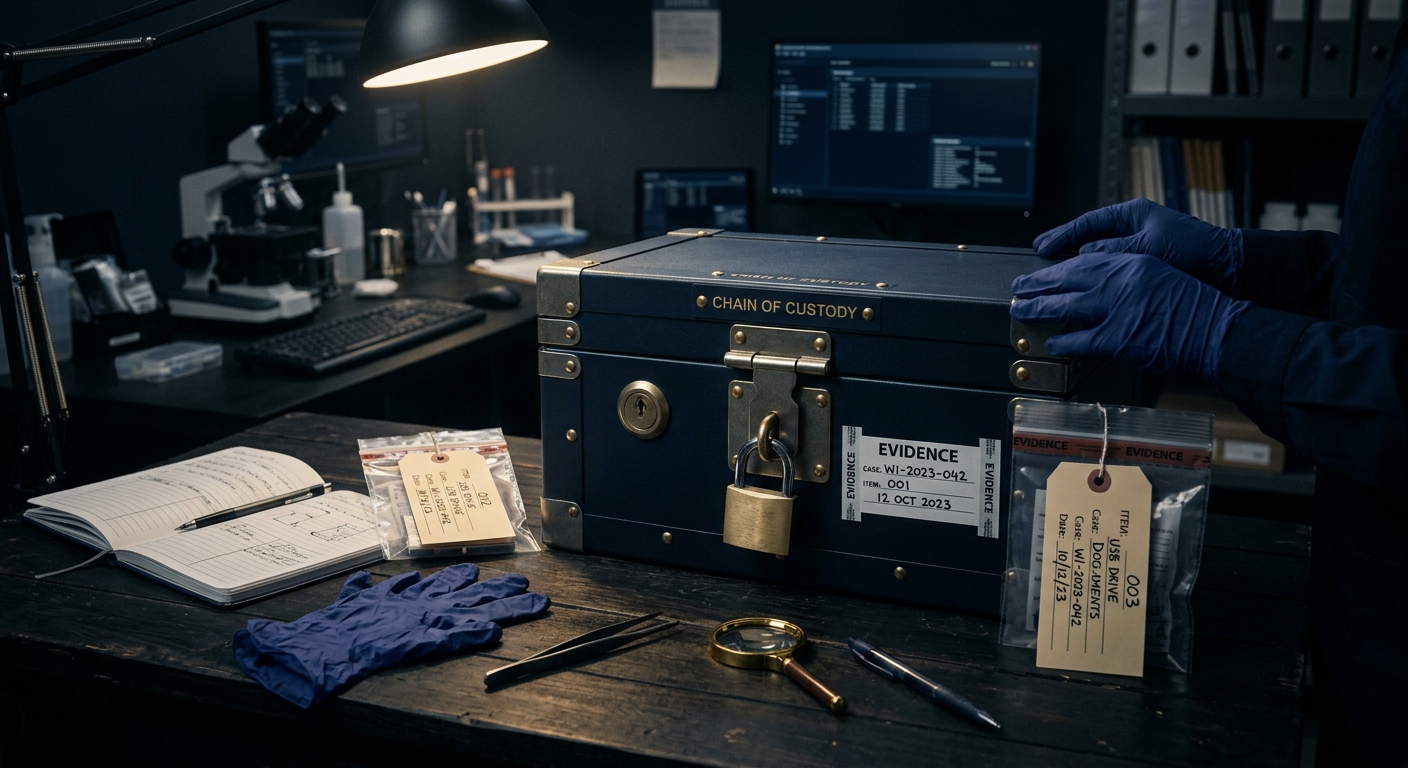
IP-theft investigations are a race against deletion. Once a departing employee’s device is returned, reissued, or wiped through a routine IT process, the forensic window closes — often permanently. The correct sequence is to forensically image the device and any company cloud accounts the employee accessed before the exit interview concludes, not after. From there, a certified digital forensics review reconstructs file-access timestamps, USB and external-drive connection history, cloud-sync activity (Google Drive, Dropbox, OneDrive), and email attachments sent to personal addresses in the weeks preceding resignation. That timeline is then matched against the company’s documented trade-secret protections — access controls, confidentiality agreements, marking practices — because Arizona’s Uniform Trade Secrets Act protections only attach to information the company actually treated as secret. Honeybadger’s digital forensics team handles this evidence layer in-house nationwide, with the chain-of-custody documentation built in from image capture forward, so findings are usable in a temporary-restraining-order filing, not just an internal memo.
Where Does Due Diligence Fit Alongside Internal Investigations?
A closely related, but distinct, engagement type is due-diligence-adjacent investigation: verifying an executive candidate, a proposed partner, a franchisee, or a target company’s leadership before a transaction, promotion, or partnership closes. This work draws on the same investigative discipline — public-record research, litigation history, licensing verification, and, where appropriate, background checks — but it is prospective rather than reactive. Companies that build this step into their M&A and executive-hiring process consistently catch the same red flags — undisclosed litigation, licensing lapses, prior termination-for-cause history — that show up as embezzlement or misconduct cases eighteen months later if left unchecked at intake.
In-House HR vs. a Licensed Outside Investigator: Who Should Run It?
Not every matter needs an outside firm, but the threshold is lower than most companies assume. The comparison below reflects how Honeybadger scopes intake calls with Arizona businesses and their counsel.
| Factor | Handle Internally (HR/Management) | Bring In a Licensed Outside Investigator |
|---|---|---|
| Dollar exposure | Low, clearly bounded, single low-level policy violation | Material loss, unclear scope, or potential for criminal referral |
| Subject’s position | Line employee, no financial system access | Manager, officer, or anyone with financial/system authority |
| Independence available | A truly neutral internal party with no relationship to either side | No internal party is free of a reporting-line or personal conflict |
| Evidence type | Simple policy-violation documentation | Digital forensics, financial reconstruction, or contested testimony |
| Likely downstream use | Coaching or a documented write-up | Termination for cause, civil recovery, insurance claim, or law enforcement referral |
As a practical rule: if the matter could plausibly end in a lawsuit, a criminal referral, or an insurance claim, it should not be run entirely in-house. The cost of a licensed investigation is a fraction of the cost of a mishandled one.
What Happens After the Investigation Concludes?
A completed investigation produces a written report — findings, evidence summary, and a factual conclusion stated to the applicable standard of proof — delivered to the client and, where privilege applies, routed through counsel. From there, the company’s options typically branch four ways: termination for cause supported by documented findings; a civil demand or lawsuit to recover diverted funds or misappropriated property; a fidelity-bond or crime-insurance claim, which almost always requires an investigative report meeting the carrier’s proof-of-loss standard; and a referral to local law enforcement or the county attorney for criminal prosecution. Honeybadger structures every report to support whichever combination of these paths the client and their counsel choose, rather than assuming only one will be pursued.
What Separates an Elite Corporate Investigations Firm from a Mediocre One?
Three things, consistently. First, licensing and actual investigative discipline — not a background-check mill that emails a template report. Second, in-house forensic and financial capability, so the digital and financial evidence is not outsourced to a third party who breaks the chain of custody. Third, a report built for the legal system it will actually face — arbitration, an unemployment hearing, a civil court, or a criminal referral — rather than a generic summary. A firm that cannot explain, in the first phone call, how it will preserve evidence before day one of the engagement is not ready for a matter with real financial or legal exposure.
Frequently Asked Questions
How long does a corporate embezzlement investigation take?
Most single-employee embezzlement investigations in Arizona resolve in two to six weeks, depending on the volume of financial records to reconstruct and how many interview subjects are involved. Straightforward inventory-theft or single-incident misconduct cases often close faster; multi-year financial fraud with dozens of vendor accounts can take longer.
Can we fire an employee based on the investigation findings alone?
Arizona is an at-will employment state, so a properly documented investigation report is typically sufficient grounds for termination for cause. The report’s defensibility — neutral process, contemporaneous documentation, unbroken chain of custody — is what protects the company if the termination is later challenged.
Do we need to involve the police, or can this stay internal?
That decision belongs to the company and its counsel, not the investigator. A licensed investigation preserves the option either way: the same evidentiary package supports a purely internal personnel action or, if the company chooses, a criminal referral to local law enforcement or the county attorney.
What if the employee under investigation is a manager or officer with system-wide access?
This is precisely the scenario where an outside investigator is not optional. No internal party can credibly claim independence when investigating someone with authority over their own reporting line, and evidence preservation has to happen before the subject can alter access logs, delete files, or influence witnesses.
About Honeybadger Solutions
Honeybadger Solutions is a licensed Arizona security and investigations firm operating from three offices — Casa Grande (HQ), Phoenix, and Oro Valley — with in-house digital forensics, financial investigation, and background intelligence capability serving clients nationwide, remotely, with full chain-of-custody handling. Arizona field and interview work is conducted by our own licensed in-house investigators; outside Arizona, physical and on-site work is coordinated through our vetted partner network. For a confidential consultation on an internal fraud, theft, misconduct, or IP-theft matter, call 602-725-2818.
Related services: corporate and private investigations, background checks, and digital forensics. For questions on Arizona’s criminal theft statutes, see the Arizona Revised Statutes, Theft, A.R.S. § 13-1802. To report suspected fraud involving online or wire-based schemes, see the FBI Internet Crime Complaint Center (IC3).