
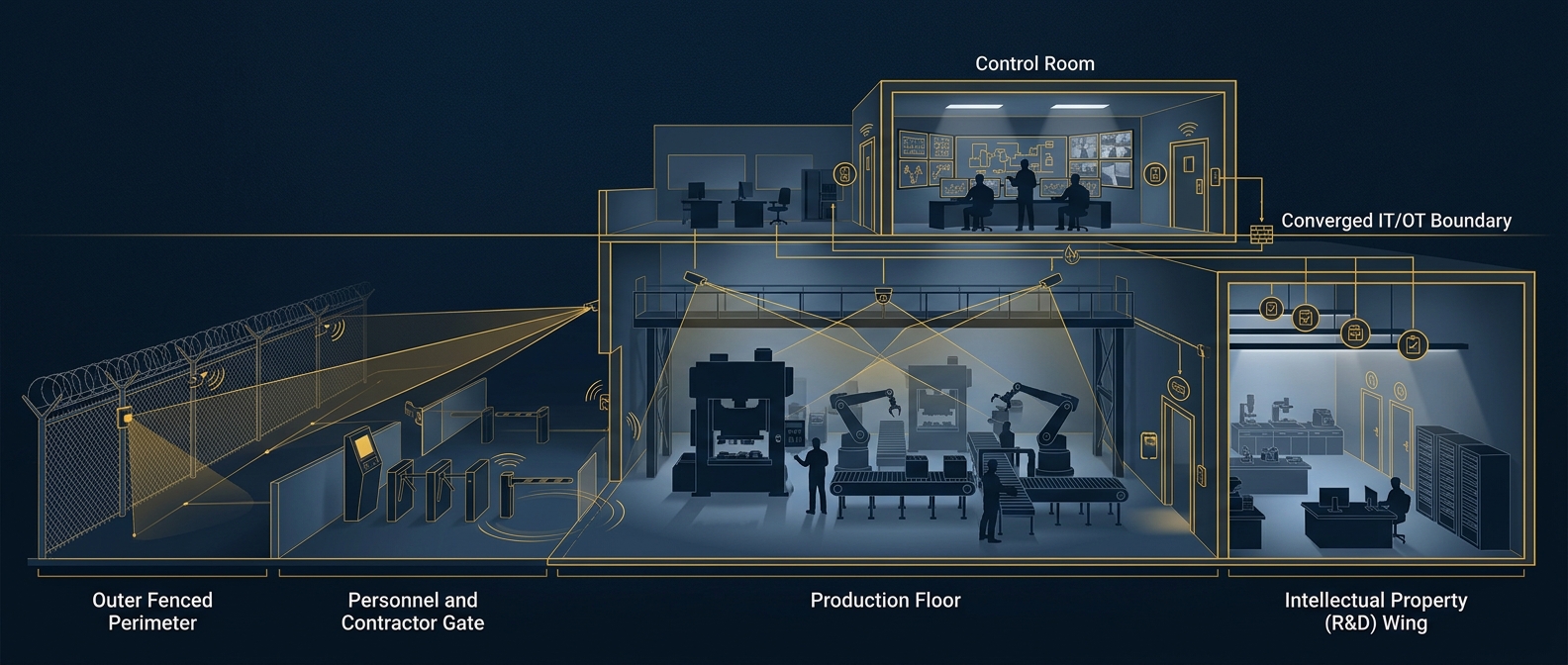
A manufacturing plant security assessment is a structured, expert-led evaluation of a facility’s physical, personnel, operational-technology, and continuity risks against a defined threat model and recognized standards. It examines the perimeter, access control, intellectual-property and process protection, IT/OT convergence, workplace-violence exposure, and contractor risk, then delivers a prioritized, evidence-based roadmap of findings, remediation, and cost so leadership can defend the plant and its production.
A manufacturing plant is not an office with machines in it. It is a high-value, high-consequence environment where a single security failure can halt a production line, expose a trade secret worth more than the building, injure a worker, or bridge from a phishing email to a programmable logic controller that governs a physical process. Yet many manufacturers still assess their sites the way they assess a warehouse or a headquarters — a walk-through, a camera count, a checklist — and mistake activity for assurance. This guide is written for the plant manager, chief security officer, general counsel, and operations executive who need to understand what a rigorous assessment actually involves: its methodology, the risk domains it must cover, and the deliverables that distinguish a defensible engagement from a superficial one. It reflects how elite firms conduct these assessments, where the real gaps hide, and what separates a world-class evaluation from a report that gathers dust.
What is a manufacturing plant security assessment?
A manufacturing plant security assessment is a systematic diagnostic of everything that could allow a plant to be attacked, entered, disrupted, or robbed of its value — physical and human as well as digital — measured against a defined threat model and against recognized frameworks. It is a point-in-time evaluation, not a standing program: the assessment tells you where you are, why it matters, and what to do; the program is the ongoing system of controls you build from its findings. The two are complementary, and the best assessments are explicitly designed to seed a program rather than to end with a filed report.
What sets a credible assessment apart is discipline. It begins with a threat model tailored to the plant — is the realistic adversary an opportunistic thief, a departing engineer taking process know-how, an activist group, a disgruntled employee, a criminal ransomware crew, or a nation-state interested in the industrial control system? Each implies a different set of controls, and an assessment that does not first define who and what it is defending against is guessing. From that model, the assessor tests each risk domain, gathers evidence rather than impressions, and produces findings that are prioritized by likelihood and consequence, not by whichever door happened to be unlocked on the day of the visit.
Why do manufacturing plants need a different assessment than an office or warehouse?
Manufacturing carries a distinct, converged risk surface that generic corporate or logistics assessments routinely miss. The Cybersecurity and Infrastructure Security Agency designates Critical Manufacturing as one of the nation’s critical infrastructure sectors precisely because a disruption cascades — into supply chains, into other sectors, and into public safety. Three characteristics drive the difference.
First, the value is often intangible. A plant’s most valuable asset may not be its inventory but its process — the formulation, the tooling, the parameters, the know-how that competitors cannot replicate. Second, the physical and cyber domains are fused. Machinery is governed by operational technology (OT) and industrial control systems (ICS) that increasingly touch the corporate network, so a security gap is rarely purely physical or purely digital. Third, the consequence of failure is operational and human, not merely financial: an intrusion or sabotage event can stop production, damage equipment, breach environmental controls, or endanger workers. An assessment methodology imported wholesale from an office building will secure the lobby and miss the control room. Manufacturing demands a converged discipline that treats the guard force, the badge reader, the PLC, and the departing-employee process as parts of one system.
How does the assessment methodology work?
A rigorous assessment follows a repeatable methodology so that its conclusions are defensible and its coverage is complete. The sequence below reflects how elite firms structure the engagement from scoping to delivery.
- Scope and threat modeling. Define the facility boundary, the assets to be protected (people, product, process, IP, and continuity), the credible adversaries, and the standards the assessment will measure against. Agree on rules of engagement, especially for any active testing.
- Document and intelligence review. Examine existing policies, prior incidents and loss history, guard post orders, access-control records, network diagrams, emergency and continuity plans, and open-source intelligence on the site and its threat environment — before setting foot on the floor.
- On-site physical survey. Walk the perimeter, gates, receiving and shipping, production floor, high-value and R&D areas, control rooms, utilities, and server spaces. Evaluate barriers, lighting, locks, cameras, and the four functions every layer must serve: deter, detect, delay, and respond.
- Access-control and personnel evaluation. Test credentialing, least-privilege enforcement, visitor and contractor management, tailgating exposure, and the joiner-mover-leaver process that governs how access is granted and — critically — revoked.
- OT/ICS and IP-protection review. Assess the boundary between the corporate network and the plant floor, segmentation, remote access to control systems, and the physical and procedural controls around proprietary processes and data.
- Human and continuity assessment. Evaluate workplace-violence prevention, threat-management and reporting, emergency response, and the business-continuity and disaster-recovery posture that determines how fast the plant recovers from a disruption.
- Analysis, prioritization, and validation. Rate each finding by likelihood and consequence, validate observations against evidence, and sequence remediation by risk reduction per dollar.
- Reporting and executive briefing. Deliver a written report with an executive summary and a technical annex, and brief leadership directly so the findings drive decisions rather than sit in a drawer.
How is the perimeter and physical access evaluated?
The physical layers are assessed as a defense-in-depth system, working from the property line inward. At the perimeter, the assessor evaluates barriers, clear zones, lighting engineered to eliminate shadow and glare, and detection — intrusion sensors, thermal cameras, or analytics that flag a human crossing a line after hours. The number and control of gates matter: every additional entry point is another thing to defend, and receiving and shipping are frequent weak points where the controlled interior meets the outside world.
Access control is tested, not merely observed. The assessor verifies that credentials are individual and revocable rather than shared, that least privilege is enforced so a line worker cannot enter the R&D wing or the control room, and that the joiner-mover-leaver process actually deactivates access when roles change or employment ends — one of the most common and dangerous gaps in manufacturing. Tailgating exposure at main entrances is probed directly, because a single authorized badge-in followed by several unbadged entries nullifies the entire access-control investment. Camera coverage is judged against purpose: a gate camera must read a plate, a floor camera must resolve who touched what, and retention must outlast the interval at which a loss or incident is typically discovered. A camera that produces unusable footage at the decisive moment is worse than none, because it manufactured false confidence.
How does the assessment protect intellectual property and proprietary processes?
For most manufacturers, the crown jewel is the process — the formulation, the machine settings, the tooling designs, the yield-optimizing know-how. IP protection is therefore a first-class domain of the assessment, not a footnote to physical security. The assessor maps where proprietary information lives in physical form (prototypes, drawings, samples, tooling) and in digital form (design files, recipes, PLC logic), then evaluates the controls that segregate and monitor it: access-controlled R&D and cleanroom areas, restrictions on cameras and personal devices on sensitive lines, controls on removable media and data egress, and the visitor and contractor escorting that governs who ever sees the process at all.
The highest-consequence IP threat in manufacturing is rarely a break-in; it is the trusted insider and the departing employee. A world-class assessment therefore examines the seam between physical security, HR, and digital forensics: whether privileged access is logged, whether anomalous data movement can be detected, and whether the organization is positioned to investigate and prove misappropriation if it occurs. When a process secret walks out the door, the ability to reconstruct what left, when, and by whom — through access logs, device forensics, and financial-flow analysis — determines whether the loss is recoverable in court or merely regrettable. Designing the program so its own records become evidence is a deliberate choice the assessment should recommend.

What does OT/ICS convergence mean for plant security?
Operational technology — the programmable logic controllers, human-machine interfaces, and SCADA systems that run the physical process — was historically isolated from the corporate IT network. That air gap is largely gone. Modern plants connect the floor to the enterprise for monitoring, efficiency, and remote support, and that connection is now the single most dangerous and least-assessed pathway in manufacturing. An intrusion that begins with a phishing email on the business side can, without proper segmentation, reach the systems that govern motors, valves, and safety instrumented functions — turning a data breach into a physical event.
A competent assessment evaluates this convergence against recognized guidance such as the NIST Guide to Operational Technology (OT) Security (SP 800-82) and CISA’s ICS resources. It examines network segmentation between IT and OT (often modeled on the Purdue reference architecture), how remote access to control systems is authenticated and controlled, whether default and shared credentials persist on control equipment, how patching is handled on systems that cannot simply be rebooted, and the physical security of control rooms and network cabinets — because unrestricted physical access to an HMI defeats every digital control. The assessment does not stop at the corporate firewall; in manufacturing, the firewall and the fence line are two halves of the same boundary.
How is workplace-violence risk assessed?
Manufacturing environments concentrate risk factors for workplace violence: large workforces, shift work, high-stress production pressure, and heavy machinery. A serious assessment treats workplace violence as a security domain with its own methodology rather than an HR afterthought. It evaluates whether the organization has a documented prevention program consistent with recognized guidance such as the Occupational Safety and Health Administration’s workplace-violence resources, whether a behavioral threat-assessment and management capability exists to act on early warning signs, and whether employees have a trusted, non-retaliatory way to report concerns.
The physical and procedural controls are assessed in tandem: access control that keeps terminated or barred individuals out, lockdown and mass-notification capability, coordination with local law enforcement, and response plans that are trained and drilled rather than merely written. The most dangerous gap is a plant that has a policy binder but no capability — no team to evaluate a threatening employee, no drilled response, no integration between the people who would first hear a warning and the people who control the doors. The assessment’s job is to surface that gap before an incident does.
How does the assessment handle contractor and vendor risk?
Plants run on outside labor — maintenance crews, integrators, cleaning services, temporary workers, and equipment vendors — many of whom receive deep physical and sometimes network access with far less vetting than employees. This third-party population is a recurring source of loss, IP compromise, and OT intrusion, and it is routinely under-assessed. The assessor evaluates how contractors are vetted and background-screened, how their access is scoped and time-limited, whether they are escorted in sensitive areas, and how their remote connections to plant systems are controlled and monitored.
Equally important is the offboarding of third parties: a contractor whose project ended six months ago but whose badge still works, or whose VPN account remains active, is an open door. The assessment checks whether third-party access is inventoried, reviewed, and revoked on schedule, and whether vendor security obligations are contractually enforced rather than assumed. In converged environments, the vendor who services a control system remotely is effectively an extension of the plant’s attack surface, and must be assessed as one.
How does the assessment address business continuity and resilience?
For a manufacturer, downtime is the dominant cost of any security event. The assessment therefore extends beyond preventing intrusion to evaluating how quickly and completely the plant recovers when prevention fails. It reviews the business-continuity and disaster-recovery plans against realistic disruption scenarios — a ransomware event that encrypts the systems scheduling production, a physical incident that closes a line, the loss of a single-source input — and tests whether those plans are current, resourced, and exercised.
Concretely, the assessor examines identified critical processes and single points of failure, backup and restoration capability for both IT and OT systems (including whether backups are isolated from the network so ransomware cannot reach them), crisis-management and communication protocols, and dependencies on utilities, suppliers, and key personnel. Resilience is where security and operations meet most directly: a plant that can restore production in hours rather than weeks has turned a potential catastrophe into an incident, and that difference is designed in advance, not improvised during the crisis.
Checklist audit versus enterprise-grade assessment: what is the difference?
Many manufacturers believe they have been assessed because a vendor walked the site with a clipboard. The table below contrasts that superficial exercise with a genuine enterprise-grade assessment so a buyer can tell which one they actually received.
| Dimension | Checklist / walk-through | Enterprise-grade assessment |
|---|---|---|
| Starting point | Generic checklist | Facility-specific threat model |
| Scope | Physical only | Physical, personnel, OT/ICS, IP, continuity |
| Evidence | Impressions on the day | Tested, documented findings |
| OT/ICS | Not covered | IT/OT boundary, segmentation, remote access |
| IP / process | Overlooked | Insider and departing-employee focus |
| Prioritization | Undifferentiated list | Ranked by likelihood and consequence |
| Standards | None cited | CISA, NIST SP 800-82, ASIS, OSHA |
| Output | Pass/fail checklist | Roadmap with cost and sequencing |
| Follow-through | Report filed | Executive briefing, seeds a program |
What deliverables should a world-class assessment produce?
The value of an assessment is realized in its deliverables, and thin engagements are exposed here. A world-class assessment delivers, at minimum: an executive summary that states the plant’s overall risk posture and the handful of decisions leadership must make; a detailed findings register in which every finding is described, evidenced, rated by likelihood and consequence, and tied to a specific asset and threat; a prioritized remediation roadmap that sequences fixes by risk reduction and includes indicative cost and effort, separating no-cost procedural fixes from capital projects; and a gap analysis against recognized standards so the posture is benchmarked, defensible, and legible to insurers and counsel.
Strong engagements add supporting artifacts: annotated site diagrams showing coverage and gaps, a threat-model summary, and — where the client intends to act — the outline of the standing program the assessment recommends. Just as important is the executive briefing itself: findings delivered verbally to decision-makers, in business terms, so that the organization acts on them. An assessment that ends with a PDF and no conversation has failed regardless of how thorough the analysis was.
How does Honeybadger conduct manufacturing plant security assessments?
Honeybadger Solutions conducts manufacturing plant security assessments as a converged discipline, evaluating physical, personnel, operational-technology, IP, and continuity risk as one system rather than as disconnected checklists. Our industrial and manufacturing security practice leads the engagement, working alongside our commercial and corporate security and security consulting capabilities to benchmark the site against CISA, NIST, ASIS, and OSHA guidance and to deliver a prioritized, costed remediation roadmap.
Because our cyber services — including OT/ICS security and digital forensics — and our investigations and financial-investigation capabilities are handled in-house, we assess the IT/OT boundary and the insider and departing-employee IP threat with the same team that would investigate an incident, and we design programs whose own records stand up as evidence when misappropriation or sabotage must be proven. Headquartered in Arizona with offices in Casa Grande, Phoenix, and Oro Valley, we serve manufacturers across all of Arizona, nationwide, and internationally; physical guarding and protective operations are delivered through our commanded, vetted-partner network — with established theaters in California, Texas, and Florida and other regions served on a mandate basis — all directed to a single, consistent standard so multi-plant operators are secured the same way in every location.
Frequently asked questions
How long does a manufacturing plant security assessment take?
It depends on plant size, complexity, and scope, but a rigorous single-site assessment typically runs from a few days of on-site work to several weeks end to end — scoping and document review, an on-site survey of one to several days, and then analysis, prioritization, and reporting. Larger sites, multiple facilities, or a deep OT/ICS review extend the timeline. Beware of an assessment that promises to be done in an afternoon; that is a walk-through, not an evaluation of a plant’s converged risk surface.
What is the most overlooked risk in manufacturing security?
The IT/OT boundary and the trusted insider. Most legacy assessments cover physical security competently but ignore the network pathway from the corporate side to the control systems that run the process, and they underweight the departing employee or contractor who can walk out with proprietary process know-how. In manufacturing, an intrusion can become a physical event, and the crown-jewel asset is often the process itself — so both must be assessed as first-class domains, not afterthoughts.
What standards should a manufacturing security assessment reference?
A credible assessment benchmarks against recognized frameworks: CISA’s Critical Manufacturing sector and ICS guidance, NIST SP 800-82 for operational-technology security, ASIS physical-security standards for the deter-detect-delay-respond model, and OSHA guidance for workplace-violence prevention. Citing standards makes findings defensible and legible to insurers, customers, and counsel, and turns the abstract goal of “secure the plant” into concrete, auditable controls.
Is a security assessment the same as building a security program?
No. The assessment is a point-in-time diagnostic that identifies risks and prioritizes fixes; the program is the ongoing system of controls, technology, and personnel you build and operate afterward. The best assessments are explicitly designed to seed a program — their remediation roadmap becomes the program’s build plan — but the two are distinct engagements, and an assessment that stops at a filed report without driving action has not delivered its value.
About Honeybadger Solutions
Honeybadger Solutions is an Arizona-licensed security and investigations firm delivering intelligence-led physical security, security consulting, investigations, protection, and cyber services to manufacturers, industrial operators, and organizations nationwide and internationally. Digital forensics, cybersecurity, financial investigations, and background intelligence are handled in-house and delivered globally. Physical security and guard operations are delivered through a commanded, vetted-partner network with established theaters in California, Texas, and Florida, directed from Arizona home command.
Offices: Casa Grande (HQ), Phoenix, and Oro Valley, Arizona.
Phone: 602-725-2818
Confidential consultation: discuss a manufacturing plant security assessment with our team.