

Surveillance evidence holds up in Arizona courts when it is lawfully obtained and properly authenticated. Under Arizona Rule of Evidence 901, the proponent must show the video or log is a fair and accurate depiction of what it claims. That requires continuous, timestamped recording, a contemporaneous log, native-file preservation with hash verification, an unbroken chain of custody, and an investigator who can testify to the vantage point, equipment, and method—so the material survives a motion to exclude and cross-examination.
A surveillance operation can be flawless in the field and still fail in the courtroom. Judges do not admit video because it looks compelling; they admit it because a proponent has satisfied two independent requirements—lawful acquisition and proper foundation. Arizona counsel who have watched persuasive footage get excluded know the pattern: the problem is almost never the images themselves, but a trespass that tainted them, a gap that invited an editing argument, or a chain of custody that could not be proven. This guide explains, at the standard an Arizona litigator expects, exactly how surveillance video and investigative logs are made admissible in Arizona courts, where cases get thrown out, and how elite investigators build a record that withstands challenge. It is general information for attorneys, claims professionals, and litigants, not legal advice—confirm specifics with Arizona counsel.
What does it take to admit surveillance evidence in Arizona?
Two hurdles must both be cleared, and they are analytically distinct. The first is legality: evidence obtained through unlawful means—trespass onto private property, interception of private conversations in violation of Arizona’s wiretap statute, or conduct amounting to stalking or harassment—can be excluded and can expose the investigator and the party who commissioned the work to civil and even criminal liability. The second is foundation: even perfectly lawful footage is worthless unless the proponent can authenticate it and establish its reliability under the Arizona Rules of Evidence.
Authentication is governed by Arizona Rule of Evidence 901, which requires the proponent to produce evidence \”sufficient to support a finding that the item is what the proponent claims it is.\” For surveillance video, that claim is straightforward: this recording fairly and accurately depicts the events, at the time and place, that it purports to show. The proponent satisfies Rule 901 through the testimony of a witness with knowledge—typically the investigator who recorded the footage—supported by a contemporaneous log and preserved original files. Related rules on the completeness of recordings and the treatment of duplicates reinforce why native, unedited files matter.
Where do Arizona cases actually get thrown out?
Evidence rarely fails for one dramatic reason. It fails at predictable pressure points that opposing counsel is trained to attack. The table below maps the most common failure modes to the discipline that prevents each.
| Failure point | How the case is attacked | Preventive discipline |
|---|---|---|
| Unlawful acquisition | Trespass, illegal audio, or harassment taints the footage | Public-vantage only; no private audio; licensed investigator; no confrontation |
| Broken chain of custody | “Who had this, and could it have been altered?” | Logged transfers; native files; recorded hash values |
| Editing / gaps | “What happened in the missing minutes?” | Continuous recording that keeps the dead time |
| No authentication witness | Investigator cannot credibly testify to the method | In-house investigator available to lay foundation |
| Metadata / timestamp doubts | “Is this really when and where you say?” | Timestamped capture; metadata preserved and validated |
| Screenshot-only social media | “This image is undated and could be fabricated” | Full-page + metadata capture; source URLs; hashing |
The lesson across the table is consistent: admissibility is engineered at capture, not reconstructed at trial. Every shortcut in the field becomes a cross-examination opening months later.
Why is chain of custody the backbone of admissibility?
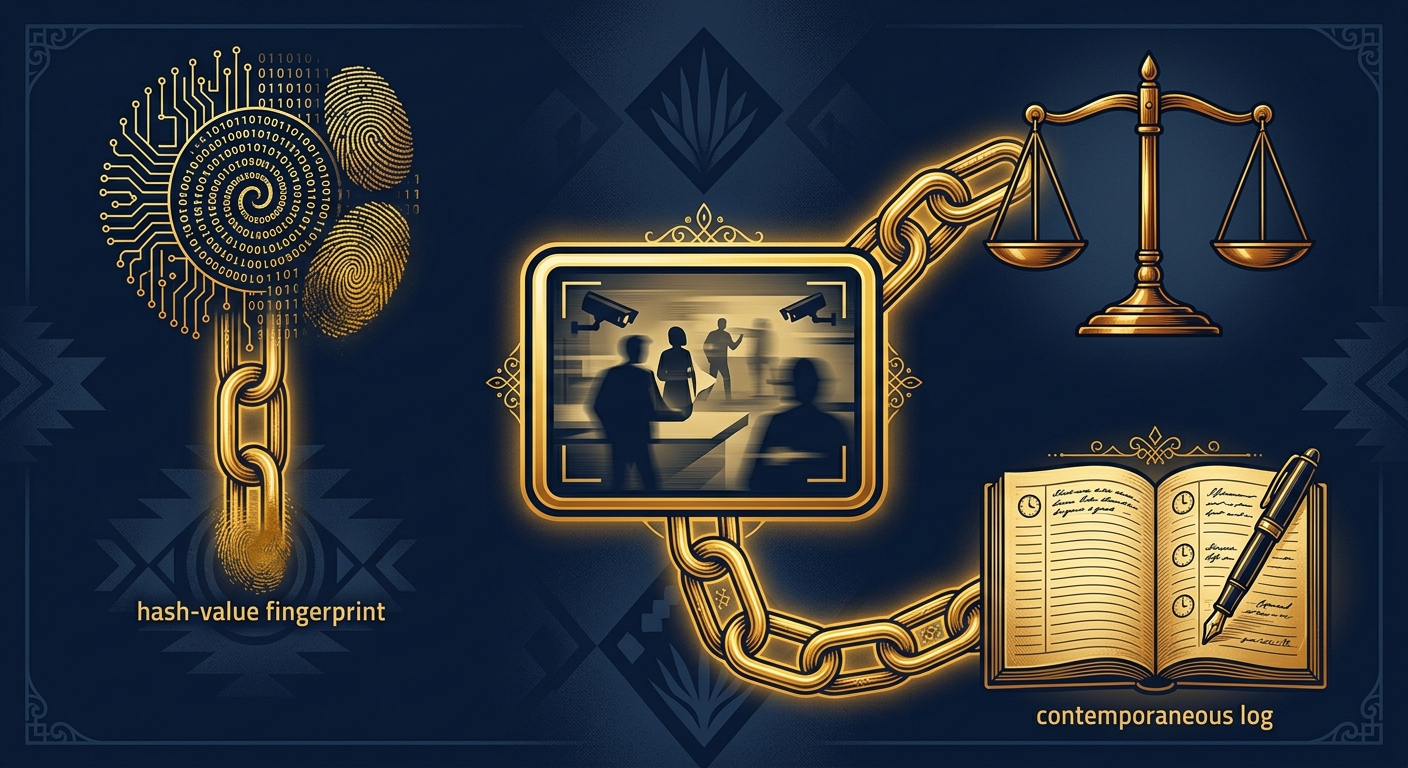
Chain of custody is the documented, unbroken record of everyone who handled an item of evidence, when, and how, from capture to courtroom. It exists to answer a single skeptical question: how do we know this is the same footage, unaltered, that the investigator recorded? A clean chain lets the proponent prove integrity; a broken one hands the other side a ready-made argument that the evidence is unreliable or was manipulated.
At an elite standard, chain of custody for surveillance means preserving the original native files exactly as captured—never a re-encoded or \”cleaned up\” copy—recording cryptographic hash values so integrity can be mathematically demonstrated, logging every transfer and access, and storing evidence securely. This is where surveillance and digital forensics converge: the same acquisition rigor a forensic examiner applies to a hard drive applies to a surveillance clip or a captured social-media page. When digital evidence such as messages, images, or device data is part of the record, forensic handling is what makes it authenticable. For a focused treatment, see our guide on chain of custody in digital evidence.
How does Arizona’s recording law shape what is admissible?
Arizona is a one-party-consent state. Under A.R.S. § 13-3005 and the exceptions in § 13-3012, a person may lawfully record a conversation they are a party to, but may not secretly intercept communications between others. This distinction has a direct effect on surveillance evidence. Professional visual surveillance from a public vantage point is generally silent—investigators do not capture the audio of a subject’s private conversations—because doing so can both taint the evidence and create wiretap liability. Importantly, video and audio are analyzed separately: lawful video is not rendered inadmissible simply because audio would have been unlawful, which is a core reason disciplined operators keep their surveillance silent by design.
Two adjacent Arizona rules complete the picture. Field investigators must be licensed by the Arizona Department of Public Safety (A.R.S. Title 32, Chapter 24); using an unlicensed operator is both unlawful and an easy target for exclusion. And surveillance must never cross into conduct prohibited by the stalking and harassment statute (A.R.S. § 13-2923)—observation is passive; confrontation, aggressive pursuit, or conduct that would make a reasonable person fear for their safety is not.
How do we build surveillance evidence that survives challenge?
The difference between evidence that anchors a case and evidence that gets excluded is process applied from the first frame. This framework reflects how Honeybadger’s own Arizona-licensed investigators build a court-ready record.
- Establish lawful authority and vantage. Confirm licensing and identify public vantage points; commit no trespass and capture no private audio.
- Record continuously. Roll unbroken, timestamped video—including the uneventful stretches—so there are no gaps to exploit.
- Log contemporaneously. Note date, time, location, weather, equipment, and every observed activity as it happens, in a report the investigator can defend on the stand.
- Preserve native files. Retain the original recordings in native format; never present a re-encoded or edited copy as the evidence.
- Hash and validate. Record cryptographic hash values and preserve metadata so integrity and timing can be proven and independently checked.
- Document every transfer. Maintain an unbroken, written chain of custody for all footage, captures, and derivative reports.
- Handle social media forensically. Capture full pages with metadata and source URLs, not bare screenshots, and hash the captures.
- Prepare the authenticating witness. Ensure the investigator who captured the evidence is available to lay the Rule 901 foundation and withstand cross-examination.
The single greatest structural advantage in this process is using an investigator’s own in-house personnel. When the same licensed professional who captured the footage can also testify to how it was obtained and preserved, the foundation is clean and continuous. A subcontracted operator who is unavailable, unlicensed, or unfamiliar with Arizona rules is exactly the seam opposing counsel needs.
How does an investigator testify to authenticate surveillance?
When surveillance is offered into evidence, the investigator typically lays the foundation through direct testimony: identifying themselves and their license, describing the assignment and the public vantage points used, explaining the equipment and that recording was continuous, confirming the accuracy of the timestamps, and affirming that the footage presented is the original, unaltered recording preserved under a documented chain of custody. Cross-examination probes for exactly the failure points in the earlier table—gaps, edits, unclear provenance, or any hint of trespass or unlawful recording. A prepared, credible investigator who can speak precisely to method is the difference between admission and exclusion. For a deeper look at the witness role, see our guide on how forensic examiners testify as experts.
Representative scenario: the gap that never opened
Consider a representative matter. In a contested Arizona civil case, surveillance was central to contradicting a party’s sworn description of their physical limitations. Anticipating a motion to exclude, the AZ-licensed investigator had recorded continuously from public vantage points—keeping every minute of driving and waiting rather than trimming to the \”good\” clips—maintained a contemporaneous log, preserved the native files, and recorded hash values at acquisition. When opposing counsel argued the footage must have been edited, the investigator testified to the continuous method, and the preserved hashes and unbroken chain of custody demonstrated the files were unaltered. The evidence was admitted. This is an illustrative scenario, not a named client or claimed outcome, but it captures the principle: the case was won not by the drama of the images but by the discipline of the record behind them.
Honeybadger Solutions supports attorneys, carriers, and litigants across every Arizona venue and nationwide—coordinated from our Casa Grande, Phoenix, and Oro Valley offices—building investigations and evidence that stay lawful and admissible from the first frame.
Frequently asked questions
Is surveillance video admissible in Arizona courts?
Yes, when it is lawfully obtained and properly authenticated. Under Arizona Rule of Evidence 901, the proponent must show the video is what they claim—a fair and accurate depiction of the events recorded. In practice that means continuous, timestamped recording without deceptive editing, a contemporaneous surveillance log, native-file preservation with an unbroken chain of custody, and an investigator available to testify to the equipment, vantage point, and method. Footage obtained through trespass or unlawful audio interception can be excluded.
What is chain of custody and why does it matter for surveillance?
Chain of custody is the documented, unbroken record of who handled a piece of evidence, when, and how, from the moment it was captured to its presentation in court. For surveillance, it establishes that the video or data has not been altered, swapped, or tampered with. A clean chain—native files preserved, hash values recorded, transfers logged—lets the proponent prove integrity and defeats the common defense argument that footage was edited or fabricated. A broken chain is one of the most frequent reasons evidence is challenged or excluded.
Does Arizona’s recording law affect surveillance evidence?
Yes. Arizona is a one-party-consent state under A.R.S. § 13-3005 and § 13-3012, meaning you may record a conversation you are a party to but may not secretly intercept conversations between others. Professional visual surveillance from a public vantage point is generally silent for exactly this reason—capturing private audio you are not part of can render evidence inadmissible and expose the investigator to wiretap liability. Video and audio are analyzed separately, so lawful video is not tainted merely because audio would have been unlawful.
Can the other side get surveillance evidence thrown out?
They can try, and they will attack the two weakest points: legality and foundation. If footage was obtained by trespass, unlawful audio recording, or harassment, opposing counsel will move to exclude it. If the chain of custody is broken, the log is missing, files were re-encoded, or the investigator cannot testify credibly to the method, they will argue the evidence is unreliable or manipulated. The defense is discipline from the first frame—lawful acquisition, native preservation, hashing, contemporaneous logging, and a witness who can lay the foundation.
About Honeybadger Solutions
Honeybadger Solutions is an Arizona-licensed security and investigations firm delivering full-spectrum investigations and digital forensics to attorneys, carriers, general counsel, and litigants across Arizona and nationwide. In Arizona, our surveillance is performed by our own in-house, AZ-licensed investigators—not subcontractors—so the professional who captures the evidence can also authenticate it and lay the foundation in court. We operate three Arizona offices—Casa Grande (headquarters), Phoenix, and Oro Valley—and support engagements across every Arizona venue.
Need surveillance or investigative evidence that will hold up in an Arizona court? Call 602-725-2818 to brief an investigations lead and scope a lawful, admissible approach with your counsel. Confidential. Defensible. Court-ready.
This article is general information, not legal advice; Arizona law and rules of evidence change over time—confirm specifics with qualified counsel. Authoritative references: Arizona Rules of Court (Arizona Judicial Branch) and Arizona Revised Statutes Title 13.