
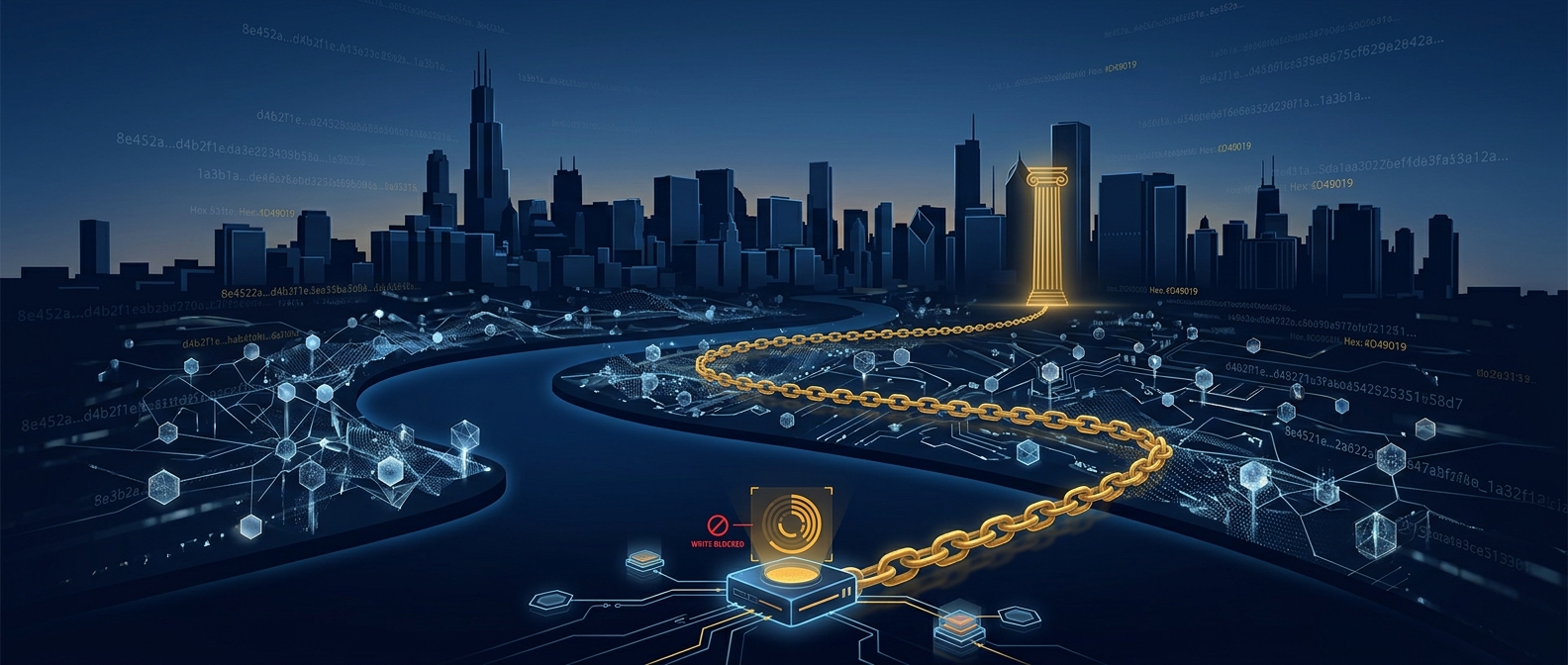
Digital forensics in Chicago is the forensically sound recovery and preservation of electronically stored information so it survives challenge in the Circuit Court of Cook County and the U.S. District Court for the Northern District of Illinois. The city’s courts apply two different gatekeeping tests — Illinois’s Frye general-acceptance standard in state court and the federal Daubert standard in the Northern District — but both reward the same discipline: write-blocked acquisition, hash verification, an unbroken chain of custody, and an examiner who can explain the method under cross-examination.
Chicago concentrates a distinctive mix of disputes that live or die on electronic proof. It is a global derivatives and futures center, the corporate seat of a dense cluster of Fortune 500 companies, a manufacturing and logistics hub, and a major healthcare and professional-services market — and it sits inside the state with the most aggressive biometric-privacy statute in the country. When a proprietary trading strategy walks out with a departing quant, when a manufacturer chases diverted designs, when misconduct surfaces across Slack, Teams, and email, or when a company faces a biometric-privacy class action, the decisive record is digital. This guide is written for the general counsel, litigation partner, compliance officer, and principal who need to know what makes electronic evidence court-ready in Illinois, where cases collapse, and how an elite forensic partner differs from a commodity vendor.
What must be true for evidence to hold up in Cook County or the Northern District?
Every admissibility fight begins with authentication. Under Illinois Rule of Evidence 901 — and its federal twin — the proponent must show the item is what it claims to be: genuine, complete, and unaltered. For electronically stored information that requires a provable path from source to exhibit, cryptographic proof the copy matches the original bit for bit, and a competent witness to the method. A screenshot or an exported PDF, standing alone, rarely satisfies a sophisticated opponent.
The two forums then diverge on how they screen scientific method, and a Chicago forensic partner has to be fluent in both. Illinois state courts apply the Frye general-acceptance test through Illinois Rule of Evidence 702: a technique is admissible only if it is generally accepted in the relevant scientific community. Established forensic methods clear that bar precisely because they are the accepted standard. The U.S. District Court for the Northern District of Illinois instead applies Daubert under Federal Rule of Evidence 702, and it lets a hash-verified copy be self-authenticated under FRE 902(14) when a qualified person certifies it. Federal practice also polices preservation with teeth: Federal Rule of Civil Procedure 37(e) authorizes sanctions when a party fails to take reasonable steps to preserve ESI. The table contrasts the two regimes.
| Question | Circuit Court of Cook County (state) | N.D. Illinois (federal) |
|---|---|---|
| Scientific-method test | Frye general acceptance (ILRE 702) | Daubert reliability (FRE 702) |
| Self-authentication of ESI | Foundation via testimony / certification | FRE 902(14) hash-verified copy |
| Preservation enforcement | Illinois Supreme Court Rule 219 sanctions | FRCP 37(e) reasonable-steps standard |
| Effect on forensic method | Use accepted, validated techniques | Show tested, reproducible methodology |
Why do Chicago’s finance, manufacturing, and privacy sectors raise the stakes?
Three pressures compound here. First, the opponents are formidable: derivatives firms, national manufacturers, and their outside counsel scrutinize every collection decision, so evidence must be built for adversarial review from the first hour, and it may travel between the Circuit Court of Cook County and federal court mid-dispute. Second, the data is voluminous and heterogeneous — trading and order-management systems, plant and ERP records, personal devices, and multiple cloud tenants.
Third, Illinois carries privacy exposure few states impose. The Biometric Information Privacy Act (BIPA, 740 ILCS 14) has driven a wave of class litigation in which the forensic question is exactly what biometric data a system collected, retained, and shared, and when — a question answered from application logs, databases, and vendor integrations, not from policy documents. Trade-secret disputes run under the Illinois Trade Secrets Act (765 ILCS 1065) alongside the federal Defend Trade Secrets Act, so the exfiltration timeline is often dispositive. And lawful collection is not optional: self-help access to an employee’s or spouse’s account can violate the Illinois computer-tampering statute (720 ILCS 5/17-51), while the state’s all-party-consent Eavesdropping Act (720 ILCS 5/14-2) makes surreptitious recording of private conversations unlawful.
Which Chicago matters turn on digital forensics?
Engagements in this market cluster into recognizable patterns, each with its own evidentiary center of gravity. These are representative scenarios, not case files, but the fact patterns are familiar to any litigator practicing in Cook County or the Northern District.
| Matter type | Where the evidence lives | What forensics establishes |
|---|---|---|
| Trading-strategy & source-code theft | Laptops, USB history, repositories, cloud sync | Exfiltration path and timeline under the ITSA and DTSA |
| Manufacturing IP & design diversion | Engineering workstations, ERP/PLM systems, personal cloud | What proprietary data moved and to whom |
| Executive misconduct & internal probes | Corporate mail, Slack/Teams, mobile devices | Conduct, communications, and concealment |
| BIPA & data-privacy class actions | Application logs, databases, vendor integrations | What biometric data was collected, retained, and shared |
| Financial fraud & regulatory exposure | Order-management systems, email, accounting records | Transactions, intent, and who knew what and when |
| High-net-worth family & marital matters | Phones, personal laptops, iCloud/Google/Microsoft | Hidden assets and authenticity of records |
Across all of these the value is not merely what the data says but whether it can be proven authentic and lawfully obtained — the difference between an interesting internal finding and an admissible exhibit.
Mobile, cloud, and email forensics: what can actually be recovered?
Most Chicago disputes no longer live on a single desktop drive. The decisive evidence sits on smartphones, in cloud accounts, and inside enterprise messaging — and each source has its own recovery profile and its own admissibility traps. Knowing what is realistically recoverable keeps strategy honest.
Mobile forensics often recovers far more than the on-screen view: deleted texts and chat threads, call and location history, encrypted-messenger artifacts, photos with intact metadata, and traces of side-loaded or surveillance apps. The critical discipline is isolating the device from cellular and Wi-Fi immediately — a Faraday enclosure or airplane-mode-plus-network-off posture — so a remote wipe cannot destroy the evidence before it is imaged with validated tools rather than thumbed through by hand.
Cloud forensics reaches iCloud, Google Workspace, and Microsoft 365 through lawful, authenticated collection, capturing files, version history, login and device records, and sharing activity that frequently expose an exfiltration route a local device alone would hide. Email forensics examines full message headers, server logs, and mailbox artifacts to establish when a message was truly sent, whether it was altered, and who had access — analysis that routinely surfaces fabricated or back-dated correspondence. This is also where self-collection quietly kills cases: a custodian who forwards screenshots or an administrator who exports a mailbox strips metadata, breaks custody, and hands the opponent an authenticity challenge. In every source the rule is the same — collection must be authenticated, hashed, and logged.
How is a multi-source Chicago collection actually executed?
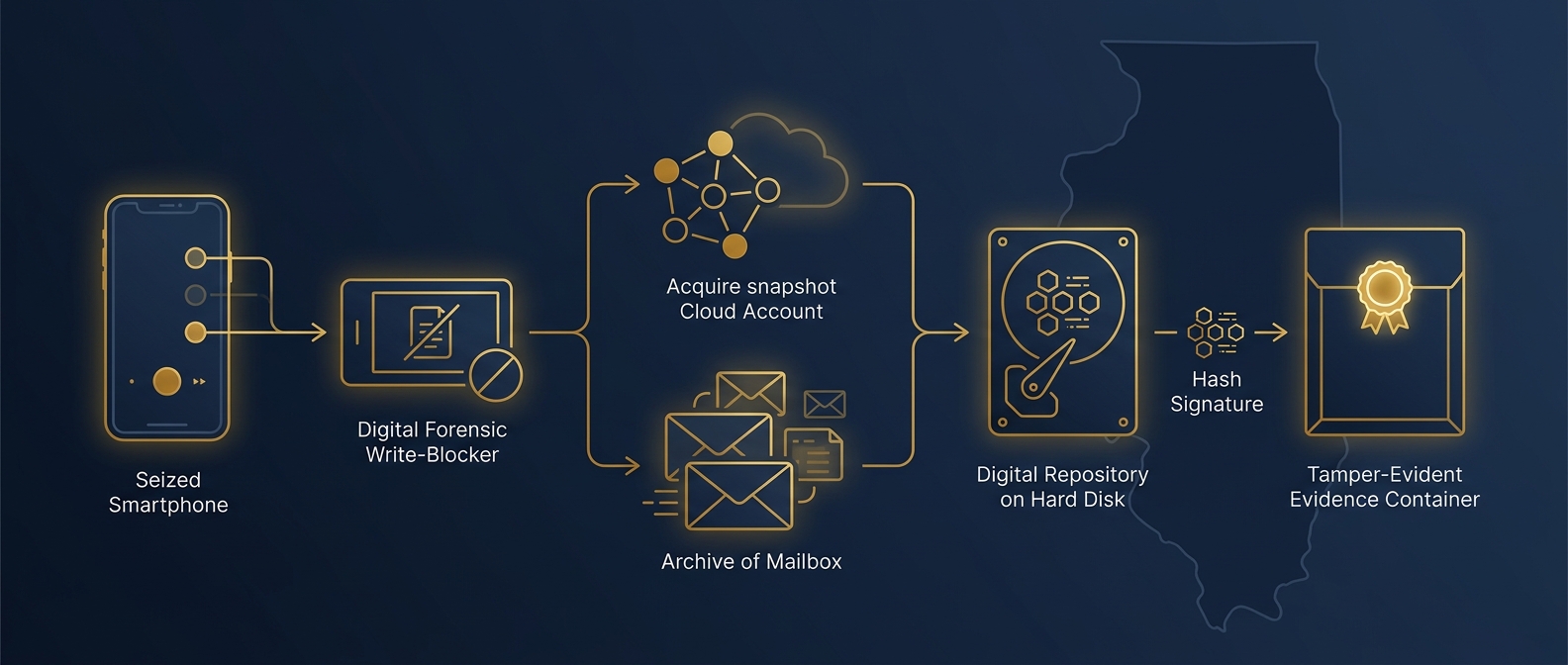
Because the evidence spans phones, clouds, and mailboxes, elite collection follows a documented, source-aware workflow rather than a single disk-imaging routine. The steps below track the tool-validation reference maintained by the NIST Computer Forensics Tool Testing program and are built to satisfy both Frye and Daubert.
- Confirm authority and scope with counsel. Fix the custodians, devices, and accounts, and verify the legal right to collect so nothing runs afoul of 720 ILCS 5/17-51 or the Eavesdropping Act.
- Trigger the litigation hold and suspend auto-deletion. Stop retention purges, chat expiration, and device recycling before FRCP 37(e) exposure attaches.
- Isolate mobile devices. Place phones in a Faraday enclosure or disable all radios to defeat remote wipe and continued sync.
- Image local media through a write-blocker. Capture bit-for-bit images of laptops and workstations without booting the originals.
- Collect cloud and email under authenticated access. Preserve files, version history, headers, server logs, and sharing records with their provenance intact.
- Hash everything and record the values. Compute and verify SHA-256 for each acquired source and copy.
- Document custody and store under seal. Log every transfer and keep masters encrypted and access-controlled.
- Analyze on working copies and re-verify. Confirm the hash before analysis and again before production, ready to certify under FRE 902(14) or testify under Frye.
The workflow is deliberately methodical. It looks tedious because every step is engineered to be explained and reproduced in front of a hostile examiner long after the fact.
What separates an elite forensic partner in Chicago?
Providers diverge under pressure, and sophisticated buyers weigh capability over price. For an Illinois matter, look for:
- Fluency in both Frye and Daubert. The same evidence may move between Cook County and the Northern District, so the method must satisfy general-acceptance review and federal reliability review alike.
- One accountable chain. When acquisition, analysis, and testimony sit with a single in-house team, custody does not fragment across subcontractors and privilege is easier to protect.
- Multi-source depth. Real matters demand mobile, cloud, email, and enterprise-system capability, not just disk imaging.
- BIPA and privacy literacy. A partner who understands biometric-data flows can answer the exact question a BIPA case asks without over-collecting personal data.
- Speed on perishable data. Phones can be wiped remotely; the right partner isolates and preserves immediately, without cutting a corner.
- Full-spectrum reach. Investigations, cyber, and financial-intelligence capability let the team follow the evidence without a hand-off to a stranger.
The common denominator is defensibility — work built from the first hour to be explained and survived on the record, not merely to reach an answer.
How does Honeybadger deliver court-ready forensics to Chicago?
Honeybadger Solutions delivers digital forensics to Chicago through in-house, remote-by-design laboratories, so the team that scopes a matter carries it through acquisition, analysis, and production under one chain of custody and command. Our forensic work is handled internally rather than farmed out, which keeps evidence from fragmenting across vendors and lets us protect privilege and confidentiality end to end — as decisive in a trading-strategy or BIPA matter as in a high-net-worth family dispute.
Because our forensic, cyber, financial-investigation, and background-intelligence capabilities are global and remote-by-design, we serve Chicago and the broader Illinois market without a hand-off, mobilizing quickly to isolate and preserve perishable mobile, cloud, and email evidence before it is overwritten, and coordinating any on-the-ground steps through vetted resources while the chain of custody and command stays intact. Our examiners build methodology and documentation meant to be defended on the record — by FRE 902(14) certification or live testimony — whether the matter sits in the Circuit Court of Cook County under Frye or in the Northern District under Daubert. That discipline supports the full arc of a dispute through our investigations practice. Operating from Arizona home command, with offices in Casa Grande, Phoenix, and Oro Valley, we close the gap between what the evidence shows and what a Chicago court will actually admit.
Frequently asked questions
Does Illinois state court use Frye or Daubert?
Illinois state courts, including the Circuit Court of Cook County, apply the Frye general-acceptance test through Illinois Rule of Evidence 702 — a technique is admissible if it is generally accepted in the relevant scientific community. Federal cases in the Northern District of Illinois apply the Daubert reliability framework under Federal Rule of Evidence 702 instead. Established forensic methods such as write-blocked imaging and hash verification satisfy both, so a sound methodology should be built to clear either forum.
How does BIPA change a forensic investigation in Illinois?
The Biometric Information Privacy Act (740 ILCS 14) makes the precise handling of biometric data the central factual question in a large category of Illinois litigation. Forensically, that means reconstructing from application logs, databases, and vendor integrations exactly what biometric identifiers a system collected, how long it retained them, and whether it shared them — while scoping the collection to avoid over-gathering unrelated personal data. It is an evidence question answered from the systems themselves, not from written policies.
Can deleted text messages be recovered from a phone?
Often, yes — deleted texts, chat threads, call and location history, and encrypted-messenger artifacts are frequently recoverable through a forensic extraction, depending on the device, operating system, and how long ago the data was deleted. The decisive factor is speed and handling: the phone must be isolated from networks immediately so it cannot be remotely wiped or overwritten, then imaged with validated tools rather than browsed by hand, which can destroy the very artifacts at issue.
What is FRE 902(14) and why does it matter in federal court?
Federal Rule of Evidence 902(14) lets electronic data be self-authenticated when a qualified person certifies that a copy was verified by a hash value or other reliable digital identification. In the Northern District of Illinois it can spare a party from calling a live witness merely to establish that a forensic copy is genuine — provided the collection was actually hashed and documented at acquisition. It is one more reason casual, un-hashed self-collection is a liability rather than a shortcut.
About Honeybadger Solutions
Honeybadger Solutions is an Arizona-licensed security and investigations firm delivering intelligence-led forensics, investigations, and cyber services to executives, general counsel, financial firms, manufacturers, families, and organizations across Chicago, Illinois, and worldwide. Digital forensics, cybersecurity, financial investigations, and background intelligence are handled in-house and remote-by-design, so every step from preservation through production runs under a single accountable chain of custody and command.
Offices: Casa Grande (HQ), Phoenix, and Oro Valley, Arizona.
Phone: 602-725-2818
Confidential consultation: discuss a Chicago forensic-collection or evidence-preservation matter with our command team.