

Hiring a private investigator in Chicago means engaging a state-licensed professional, regulated by the Illinois Department of Financial and Professional Regulation, to gather facts that hold up in Cook County courts. The strongest engagements pair licensed local field work—surveillance, service, records—with in-house digital forensics, financial investigation, and background intelligence, so evidence is collected lawfully under Illinois’ strict recording and privacy statutes and arrives litigation-ready.
Chicago is a demanding market for investigative work, and not only because of its size. It sits inside one of the largest unified court systems in the country, under an Illinois statutory regime that treats recording, tracking, and data with unusual severity, and inside a business ecosystem—commodities and derivatives, logistics, manufacturing, real estate, professional services—where a single unresolved question can cost a principal a marriage, a partnership, a nine-figure deal, or a lawsuit. The difference between a useful investigator and a liability is rarely charisma or bravado. It is licensing, legal discipline, and the ability to turn a suspicion into evidence a judge will admit. This guide explains what an executive, general counsel, or private client in the Chicago area should understand before making the call.
What Kinds of Cases Do Private Investigators in Chicago Handle?
Serious investigative demand in the Chicago area clusters into five recurring mandates. They share a methodology—preserve first, build the record before memory, document every step—but each has a distinct objective, evidence base, and typical client. The table below maps how the work actually breaks down.
| Case type | Typical client | Core work | What a defensible result looks like |
|---|---|---|---|
| Corporate investigations | General counsel, boards, HR, business owners | Misconduct and theft inquiries, IP and trade-secret loss, competitive intelligence, internal fraud | An impartial, documented factual record that survives litigation and regulatory review |
| Matrimonial & family | Divorce and family-law counsel, individuals | Asset discovery, cohabitation and lifestyle evidence, parenting-time concerns, marital-property tracing | Admissible, lawfully obtained evidence for a Cook County dissolution or parenting matter |
| Fraud investigations | Businesses, insurers, investors, counsel | Financial-fraud tracing, insurance and claims fraud, embezzlement, asset searches and recovery support | The scheme proven, the loss quantified, and recoverable assets identified |
| Background & due diligence | Employers, funds, partners, family offices | Executive vetting, counterparty and partner diligence, litigation and lien history, undisclosed conflicts | A decision-grade risk picture before a hire, investment, or commitment |
| Litigation support | Trial and litigation attorneys | Witness location and interviews, service of process, evidence preservation, expert testimony | Court-ready exhibits, sworn declarations, and defensible chain of custody |
What unites the credible operators is not the breadth of the menu but the standard behind it: everything is collected to be used, whether that use is a boardroom decision, a settlement, or a courtroom exhibit two years later.
Is a Private Investigator Required to Be Licensed in Illinois?
Yes—and this is the single most important thing to verify before you hire anyone. Illinois regulates private detectives and detective agencies under the Private Detective, Private Alarm, Private Security, Fingerprint Vendor, and Locksmith Act of 2004, administered by the Illinois Department of Financial and Professional Regulation (IDFPR). Operating as a private detective without the proper license is a criminal violation, and evidence gathered by an unlicensed operator can be attacked—and excluded—on exactly that basis. In Illinois there are three credentials that matter, and they are not interchangeable.
- Licensed Private Detective. The individual professional license. It requires qualifying experience or education, examination, and a background check, and it authorizes the holder to conduct investigations for the public.
- Private Detective Agency license. The firm-level license under which a business offers investigative services. An agency must employ a licensed detective-in-charge who is accountable for the work performed under the agency’s authority.
- PERC — Permanent Employee Registration Card. The credential carried by agency employees who work under a licensed agency’s supervision but are not themselves licensed detectives. A PERC is issued by IDFPR only after a state and federal fingerprint-based criminal background check. It does not authorize someone to run their own investigations—it authorizes them to work for a licensed agency.
The practical takeaway for a client: a PERC alone is not a license to investigate. Ask who holds the agency license, who the licensed detective-in-charge is, and confirm that anyone performing field work is either licensed or carries a valid PERC under that agency. A firm that cannot answer those questions cleanly should not be trusted with a matter you intend to take to court.
How Do You Verify a Chicago Investigator’s License and Fit?
Use this checklist before signing an engagement. It takes minutes and prevents the most common—and most expensive—mistakes.
- Confirm licensure on the state record. Verify the individual detective and the agency through IDFPR’s public license lookup, and confirm the license is active and unencumbered.
- Identify the detective-in-charge. Know who is legally accountable for the work and that they will actually oversee your matter, not simply lend a license number.
- Confirm PERC status for field staff. Anyone conducting surveillance or field inquiry under the agency should be licensed or hold a valid PERC. Ask directly.
- Verify insurance and bonding. Illinois agencies are expected to carry appropriate liability coverage; confirm it in writing.
- Test legal fluency. Ask how they handle Illinois’ all-party recording law and vehicle-tracking restrictions. A competent operator answers precisely; an amateur waves it away.
- Match the discipline to the case. A matrimonial surveillance specialist is not automatically equipped for financial-fraud tracing or phone forensics. Confirm the specific capability your matter requires.
- Demand a court-ready standard. Ask whether the deliverable will include documented chain of custody and a willingness to testify. If the answer is vague, the evidence probably will be too.
What Do Investigators Actually Do in a No-Fault Divorce State?
Illinois abolished fault-based divorce grounds effective January 1, 2016. Dissolution now proceeds on irreconcilable differences alone, and the old exercise of “catching” a spouse to prove adultery no longer wins a case. Clients frequently assume this makes an investigator irrelevant to a divorce. The opposite is true—the value simply moved from proving why a marriage ended to proving what it is worth and who is telling the truth about money and children.
In a Cook County dissolution, the decisive fights are usually about marital versus non-marital property, hidden or dissipated assets, income that a self-employed spouse understates, and the allocation of parental responsibilities and parenting time. Investigators support family-law counsel by tracing undisclosed accounts, business interests, and transfers; documenting a lifestyle that contradicts a sworn financial affidavit; and—where maintenance is at issue—establishing whether a former spouse is cohabiting on a “resident, continuing conjugal basis,” which under Illinois law can terminate maintenance. In parenting disputes, lawful surveillance and background work can substantiate genuine safety or fitness concerns. The through-line is that every product must be admissible, so the how matters as much as the what. Financial tracing of this kind sits squarely within our financial investigation practice, and digital evidence is handled by our digital forensics examiners rather than improvised in the field.
How Are Corporate and Fraud Matters Handled in Chicago?
Chicago’s economy runs on movement—goods, capital, contracts—and where value moves quickly, fraud and misconduct follow. Corporate clients bring three recurring problems: employees or insiders stealing assets or intellectual property, business partners and counterparties who are not what they represented, and internal misconduct that carries litigation or regulatory exposure. A credible corporate investigation answers those with method, not guesswork.
Financial fraud rarely announces itself; it surfaces as a ledger that never quite reconciles, a vendor nobody can explain, or a departing employee whose new venture looks suspiciously familiar. The response follows the money and the metadata in parallel. Financial forensics reconstructs the transaction record—bank flows, journal entries, invoices, and transfers—to expose the mechanism: misappropriation, related-party self-dealing, kickbacks, or inflated books. In parallel, digital forensics establishes who created, altered, or deleted the relevant records and when, converting a suspicious pattern into an evidenced timeline. Where data was exfiltrated to a personal device or a competitor, our cybersecurity team addresses the access and system-integrity questions. For occupational fraud in particular, the Association of Certified Fraud Examiners reports that schemes typically run for months before detection and that internal controls alone routinely miss them—a specialist changes that math. The objective is threefold: prove the scheme to a defensible standard, quantify the loss, and identify what can realistically be recovered.
Why Does Background and Due-Diligence Work Matter Before You Commit?
The cheapest investigation is almost always the one that happens before the deal, the hire, or the partnership closes. Investigative due diligence answers the question a résumé, a pitch deck, or a data room never will: who is actually on the other side of this, and what are they not telling us? For a Chicago family office, fund, or employer, that means verifying identity and true corporate structure, surfacing litigation, lien, judgment, and bankruptcy history, mapping beneficial ownership and undisclosed conflicts, and screening against sanctions and adverse media. Our background and due-diligence work is built to a defensible standard—distinguishing what is verified, what is unverifiable, and what is a red flag serious enough to condition, restructure, or walk. It is also governed by federal and state law: when a background check is used for employment, the federal Fair Credit Reporting Act and Illinois-specific limits on the use of criminal and credit history apply, so the process must be lawful as well as thorough.
How Does Illinois Law Change the Playbook?
Illinois is one of the strictest states in the country for how investigators may gather information, and a method that is lawful in another state can be a crime here. A competent Chicago operator designs around these realities from the first hour.
- All-party consent for recording. Illinois is an all-party (two-party) consent state under its eavesdropping statute. Recording a private conversation without the consent of every participant is generally illegal, and unlawfully recorded audio is both inadmissible and a source of criminal and civil liability. This is the opposite of one-party-consent states, and it is the mistake amateurs make most often.
- Vehicle tracking is restricted. Illinois law limits placing an electronic tracking device on a vehicle without the owner’s consent. GPS tracking is not a casual tool here; it is a legal decision that must be made with counsel.
- No trespass, no pretext into protected records. Legitimate surveillance occurs from lawful vantage points; pretexting to obtain financial, phone, or protected personal records is unlawful and taints everything downstream.
- Data and privacy exposure. Illinois has aggressive privacy statutes, including the Biometric Information Privacy Act, so techniques touching biometric or sensitive personal data demand disciplined scoping.
An investigation that ignores these features can win the facts and lose the case. Statutory text for the recording and tracking rules is published by the Illinois General Assembly, and any surveillance or recording plan in an active matter should be confirmed with counsel before execution.
What Makes Evidence Actually Usable in Cook County Court?
Most matters that begin with a private investigator end, if they end anywhere formal, in the Circuit Court of Cook County—one of the largest unified court systems in the world—with domestic-relations and civil matters heard at the Richard J. Daley Center and elsewhere across the county. Judges and opposing counsel there are experienced, and thin or improperly gathered evidence is challenged aggressively. Litigation support is therefore less about drama than about defensibility.
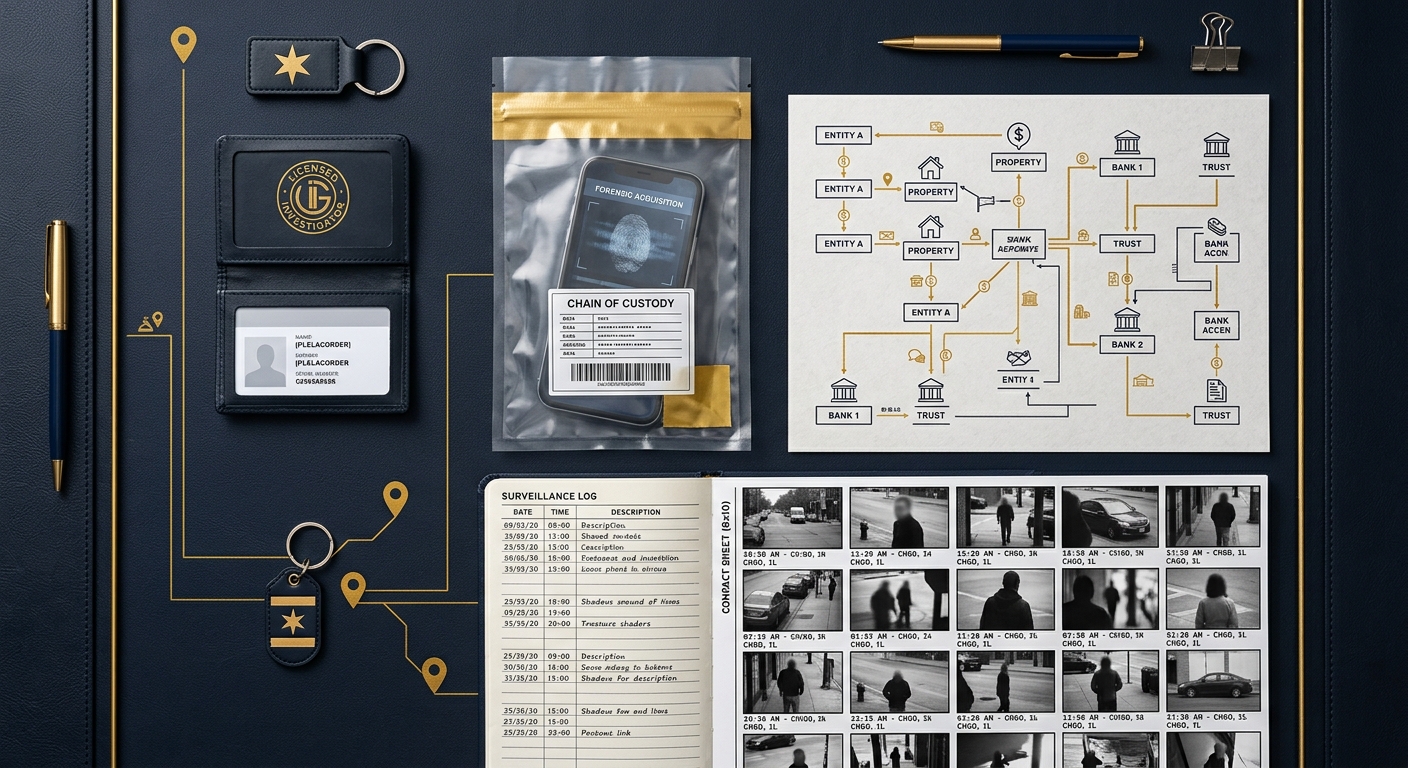
Court-ready work means documented chain of custody from acquisition to production, forensically sound collection of digital evidence (a phone or account is imaged before it is browsed, because opening a file changes its metadata), witness statements taken and preserved properly, service of process executed and provable, and an investigator prepared to testify and withstand cross-examination. The Circuit Court of Cook County is the venue those exhibits must satisfy. This is where the difference between a licensed professional and a cut-rate operator becomes decisive: screenshots and hearsay collapse under challenge, while a properly built record—sworn, sourced, and traceable—holds.
How Do You Choose the Right Firm—and Spot the Wrong One?
Beyond licensing, a few signals separate a world-class provider from a risky one. The best firms lead with legal discipline rather than promises, decline unlawful methods without hesitation, and are candid about what an investigation can and cannot deliver. They preserve evidence before they interview, follow the record wherever it leads, and treat discretion as an operational requirement—no rumor, no tipping the subject, no collateral damage. They also field genuine technical depth: digital forensics, financial investigation, cybersecurity, and background intelligence under one command, so nothing critical is improvised at the moment it matters.
The warning signs are equally consistent. Be wary of any operator who guarantees a specific outcome, is vague about licensing or who supervises the work, offers to obtain phone records or bank data with no lawful basis, dismisses Illinois’ recording and tracking laws, or cannot describe how their evidence would be authenticated and admitted. In this field, the cheapest quote is frequently the one that produces evidence you cannot use—or liability you did not expect.
National Command, Licensed on the Ground in Chicago
Honeybadger Solutions serves clients in the Chicago area and nationwide with a model built for exactly this environment. Our digital forensics, cybersecurity, financial investigations, and background-intelligence functions are in-house and remote-by-design, so preservation and analysis can begin within hours of a call regardless of where the accounts, devices, or counterparties sit. Field investigation in the Chicago market—surveillance, interviews, service, and local records—is delivered through vetted, Illinois-licensed local partners under our direction and standard, with Arizona as home command. We do not operate an owned armed protective theater in Illinois; our established partner-delivered protective theaters are California, Texas, and Florida, and Chicago engagements are scoped accordingly. Whether the matter is a contested Cook County dissolution, an internal-fraud inquiry, pre-transaction diligence, or litigation support for trial counsel, the standard does not change—explore our full investigations capabilities and request a confidential consultation.
Frequently Asked Questions
Does a private investigator have to be licensed in Illinois? Yes. Private detectives and detective agencies must be licensed by the Illinois Department of Financial and Professional Regulation under the Private Detective, Private Alarm, Private Security, Fingerprint Vendor, and Locksmith Act. Employees working under an agency but not licensed as detectives must carry a Permanent Employee Registration Card (PERC), issued after a fingerprint-based background check. Verify licensure before you hire.
Can I record a conversation as evidence in Chicago? Usually not without consent. Illinois is an all-party-consent state under its eavesdropping law, meaning recording a private conversation generally requires the consent of everyone involved. Unlawfully recorded audio is inadmissible and can expose you to criminal and civil liability, so any recording or surveillance plan should be designed with counsel before you act.
Is a private investigator still useful in a no-fault divorce? Very. Since 2016 Illinois divorces proceed on irreconcilable differences, so proving fault no longer decides a case. Investigators now focus on what drives the outcome: tracing hidden or dissipated assets, documenting understated income, establishing cohabitation that can terminate maintenance, and substantiating genuine parenting-fitness concerns—all gathered to be admissible in Cook County court.
How much does hiring a private investigator in Chicago cost? Cost scales with scope, urgency, and technical depth, not drama. Surveillance is typically billed hourly, often with a two-investigator team for contested matters, while forensic, financial, and diligence work is scoped to the mandate. The false economy is under-scoping: cheap, thin work that cannot be used in court costs far more than a proper investigation. Request a written scope and estimate up front.
About Honeybadger Solutions
Honeybadger Solutions is an Arizona-licensed security and investigations firm serving all of Arizona, the nation, and international clients, with a dedicated capability for the Chicago market. We combine in-house digital forensics, cybersecurity, financial investigations, and background intelligence with vetted, Illinois-licensed local partners for field work, delivering discreet, court-ready investigations built to withstand Cook County litigation and regulatory scrutiny.
Three offices: Casa Grande (HQ), Phoenix, and Oro Valley. To discuss a confidential matter, book a consultation online. Learn more about our investigations capabilities and request a discreet consultation.
Browse by topic
Security guard services · Private investigations · Cybersecurity · Digital forensics · Financial fraud investigation · Executive protection · All articles