

Digital forensics in Los Angeles is the disciplined recovery, preservation, and analysis of electronically stored information so it survives challenge in California courts. Court-ready evidence turns on forensically sound acquisition, an unbroken chain of custody, cryptographic hash verification, and a methodology an examiner can defend on the stand under the state’s Kelly and Sargon standards. Done right, a recovered message, deleted file, or device image is admitted; done casually, it is excluded.
Los Angeles concentrates more high-stakes disputes turning on digital evidence than almost any venue in the country. Studios and streamers litigate leaked scripts and pre-release piracy; talent, agencies, and production companies fight over contracts and confidential material; venture-backed firms in Santa Monica and Culver City pursue departing engineers who left with source code; and family offices and UHNW principals contend with contentious separations where the truth lives on phones, laptops, and cloud accounts. In every one of these matters, the evidence is only as valuable as its admissibility. This guide is written for the general counsel, litigation partner, studio executive, and principal who need to understand what makes digital evidence court-ready in California, where cases fail, and what separates an elite forensic partner from a commodity vendor.
What makes digital evidence “court-ready” in California?
Court-ready is not a marketing phrase; it is a specific evidentiary threshold. Before a California judge will let a fact-finder consider what a file, text thread, or drive image says, the proponent must first prove the evidence is genuine and unaltered. That is the authentication requirement, and for digital evidence it demands more than a printout. It requires a demonstrable path from the original source to the exhibit, mathematical proof the copy is identical to the source, and a witness who can explain how the evidence was obtained and preserved without altering it.
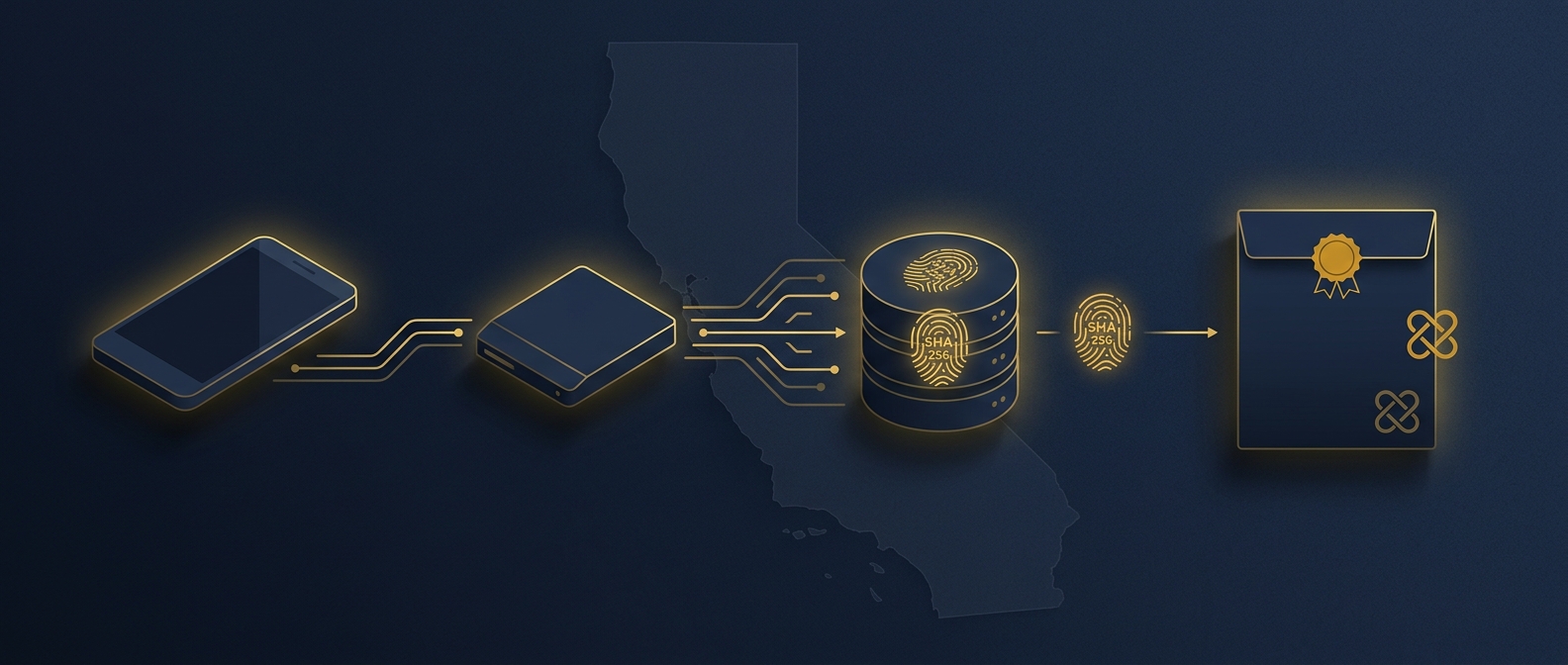
Four pillars carry that burden. First, forensically sound acquisition: capturing a bit-for-bit image through a write-blocker so the original is never modified. Second, integrity proof: calculating a cryptographic hash such as SHA-256 at acquisition and re-verifying it at every step, so any change of even a single bit is detectable. Third, an unbroken chain of custody documenting who handled the evidence, when, and why, with no unexplained gaps. Fourth, a qualified examiner whose methodology is standardized, repeatable, and defensible under cross-examination. Miss any one and opposing counsel has an opening to move for exclusion, and in a material matter that motion often succeeds.
Which California standards govern digital-evidence admissibility?
California does not follow the federal Daubert framework, and that distinction matters for anyone litigating here. For the admissibility of new scientific techniques, California applies the Kelly test, drawn from People v. Kelly (1976), which asks whether the method is generally accepted in the relevant scientific community and was correctly applied. Established forensic methods, write-blocked imaging, hash verification, and validated extraction tools, clear that bar comfortably precisely because they are the accepted standard, which is exactly why improvised or unvalidated handling is so dangerous.
Authentication is governed by the California Evidence Code, which defines a “writing” broadly enough to include electronically stored information and requires the proponent to introduce evidence sufficient to sustain a finding that the item is what it purports to be (Evid. Code §§ 250, 1400–1401). The Secondary Evidence Rule (Evid. Code § 1521) then allows the content of a writing to be proved by an accurate copy, which is exactly what a verified forensic image is, so long as its authenticity is not genuinely in dispute. In civil matters, trial courts also act as gatekeepers of expert testimony under Sargon Enterprises v. USC (2012), excluding opinions built on unreliable methodology or leaps of logic. Together these authorities reward rigor and punish shortcuts: a clean, hashed image with a documented chain authenticates almost routinely, while a self-collected folder of files invites a fight over whether it is real.
Why does Los Angeles litigation put unique pressure on digital forensics?
The Superior Court of California, County of Los Angeles is the largest unified trial court in the nation, and the disputes filed there are disproportionately data-intensive. Entertainment and technology are the region’s economic engines, and both run on intellectual property, confidential deal terms, and contractual relationships that live entirely in electronic form. When something goes wrong, the proof is digital: an email showing when a script left the building, chat logs revealing who accessed an unreleased cut, cloud-storage records mapping the exfiltration of a codebase, or metadata establishing when a document was really created.
Three pressures compound in Los Angeles. The stakes are large, so opponents are sophisticated and well-funded and will scrutinize every step of collection. The data is voluminous and heterogeneous, spanning corporate systems, personal devices, encrypted messaging apps, and multiple cloud platforms. And confidentiality is paramount, whether the matter involves a public company, a celebrity principal, or a studio protecting a franchise, which means the forensic work must be discreet, privilege-aware, and coordinated tightly with counsel. A provider that treats an LA matter like a routine drive copy is a liability. The work has to be built for adversarial scrutiny from the first hour.
What kinds of Los Angeles matters turn on digital forensics?
The recurring engagements in the LA market cluster into a handful of patterns, each with its own evidentiary center of gravity. The table below maps the most common matter types to the digital evidence that typically decides them and the standard that governs it. These are representative scenarios, not case files, but the fact patterns are familiar to any litigator practicing here.
| Matter type | Where the evidence lives | What forensics establishes |
|---|---|---|
| Entertainment IP & pre-release leaks | Email, file-transfer logs, cloud storage, personal devices | Who accessed, copied, or transmitted protected content, and when |
| Trade-secret & source-code theft | Laptops, USB history, repositories, cloud sync records | Exfiltration path and timeline under CUTSA and the federal DTSA |
| Departing-employee & non-compete disputes | Company devices, personal cloud accounts, messaging apps | What data left, how, and whether obligations were breached |
| Executive misconduct & internal probes | Corporate mail, chat, financial systems, mobile devices | Conduct, communications, and concealment, preserved for regulators or litigation |
| High-net-worth family & marital matters | Phones, personal laptops, iCloud/Google accounts | Hidden assets, communications, and authenticity of records |
| Business & contract disputes | Documents, metadata, accounting systems, email | When records were created or altered, and by whom |
Two California-specific wrinkles run through several of these. Trade-secret matters are governed by the California Uniform Trade Secrets Act (Civil Code § 3426) alongside the federal Defend Trade Secrets Act, so the forensic timeline of exfiltration is often dispositive. And lawful collection is not optional: self-help “hacking” of a spouse’s or employee’s account can violate California’s Comprehensive Computer Data Access and Fraud Act (Penal Code § 502) and California’s two-party-consent wiretap statute, tainting the evidence and exposing the client. A disciplined examiner keeps collection inside legal boundaries so the proof holds.
How is court-ready evidence actually collected?
Elite forensic collection follows a repeatable sequence, documented as the work is performed rather than reconstructed afterward. The steps below are the operational discipline that produces evidence able to withstand a Los Angeles cross-examination. They align with internationally recognized handling standards and with the tool-validation reference maintained by the NIST Computer Forensics Tool Testing program.
- Scope with counsel and confirm legal authority. Define the custodians, devices, and data at issue, and confirm the right to collect, so nothing is gathered unlawfully under Penal Code § 502 or California privacy law.
- Identify and isolate sources. Locate every relevant device and account and prevent further change, including disconnecting from networks that could trigger a remote wipe or cloud sync.
- Document the original state. Photograph and record the condition, connections, and status of each device before anything is touched.
- Acquire forensically. Use a write-blocker to capture a bit-for-bit image; never analyze the original and never boot or browse it.
- Hash and verify. Calculate the cryptographic hash of the source and image, confirm they match, and record both values.
- Log every transfer. Record who received the evidence, when, why, and in what condition, leaving no gap in the timeline.
- Store under seal. Keep evidence access-controlled, encrypted, and logged, with the access record itself preserved.
- Analyze on working copies. Conduct all examination on verified copies, keeping the original image pristine.
- Re-verify before production. Confirm the hash still matches before analysis and before the exhibit is offered, proving nothing changed in between.
- Preserve documentation for testimony. Maintain contemporaneous notes and the full custody record so the methodology can be defended on the record.
None of this is glamorous, and that is precisely the point. Court-ready work looks methodical and even tedious because every step is engineered to be explained, reproduced, and defended months or years later in front of a hostile examiner.
Self-collection versus forensic acquisition: why the difference decides cases
The most common way strong evidence dies is well-intentioned self-collection. A custodian drags files into a folder, an IT administrator copies a mailbox, or a client forwards screenshots to counsel. Each of these destroys metadata, breaks the chain, and hands the opponent an authenticity challenge. The contrast with forensically sound acquisition is stark.
| Dimension | Self-collection / IT copy | Forensic acquisition |
|---|---|---|
| Source handling | Original opened, copied, or booted | Write-blocked; original untouched |
| Metadata | Altered or destroyed | Preserved intact |
| Integrity proof | No hash to verify | Hash captured and re-verified at each step |
| Deleted data | Missed entirely | Recoverable from unallocated space |
| Chain of custody | Gaps; unaccounted access | Continuous, documented log |
| Witness | Cannot defend methodology | Qualified examiner, defensible under Kelly/Sargon |
| Courtroom posture | Vulnerable to exclusion | Withstands adversarial scrutiny |
The practical lesson for Los Angeles counsel is to involve forensic expertise before anyone touches the data. Once a device has been booted or a mailbox exported by untrained hands, some damage cannot be undone, and the argument shifts from the merits of the case to the reliability of the evidence, exactly where a sophisticated opponent wants it.
What separates a world-class forensic partner in Los Angeles?
Not all providers are equal, and the gap becomes visible under pressure. When evaluating a digital forensics partner for an LA matter, sophisticated buyers weigh a specific set of criteria rather than price alone.
- In-house, single-chain command. When acquisition, analysis, and testimony run under one accountable team rather than a chain of subcontractors, the chain of custody does not fragment and privilege is easier to protect.
- Validated tools and methodology. The provider should use industry-standard, independently tested tools and be able to cite their validation, which is what satisfies the Kelly acceptance inquiry.
- Testimony experience. An examiner who has withstood cross-examination writes reports and keeps records with the courtroom in mind from the outset.
- Discretion and privilege awareness. Elite work is structured to operate at the direction of counsel, protect confidentiality, and preserve privilege where it applies, which matters acutely for public companies and high-profile principals.
- Speed without shortcuts. Evidence is perishable; the right partner can mobilize immediately to preserve data before it is overwritten, without cutting a single procedural corner.
- Full-spectrum capability. Forensics rarely stands alone. A partner that also brings investigations, cybersecurity, and financial-intelligence capability can follow the evidence wherever it leads without handing off to a stranger.
The distinguishing trait across all of these is defensibility. A world-class partner produces work that is designed, from the first hour, to be explained and survived on the record, not merely to find the answer.
How does Honeybadger deliver court-ready forensics to Los Angeles?
Honeybadger Solutions delivers digital forensics to Los Angeles through in-house, remote-by-design laboratories, so the same accountable team that scopes a matter carries it through acquisition, analysis, and production under a single chain of custody and command. Our forensic work is handled internally rather than farmed out, which keeps evidence from fragmenting across vendors and lets us protect privilege and confidentiality end to end, an advantage that matters as much in an entertainment or trade-secret dispute as it does in a family-office matter.
Because our forensic, cybersecurity, financial-investigation, and background-intelligence capabilities are global and remote-by-design, we serve Los Angeles and the broader California market without a handoff, mobilizing quickly to preserve perishable data before it is overwritten. California is an established operational theater for the firm, and our forensic examiners build methodology and documentation intended to be defended on the record, by written certification or live testimony, under the state’s Kelly and Sargon standards. That same discipline supports the full arc of a dispute through our investigations practice, from IP theft and data exfiltration to executive misconduct and contentious separations. Operating from Arizona home command, with offices in Casa Grande, Phoenix, and Oro Valley, we close the gap between what the evidence shows and what a Los Angeles court will actually admit.
Frequently asked questions
Does California follow the Daubert standard for digital forensic evidence?
No. California applies the Kelly test, derived from People v. Kelly, which asks whether a new scientific technique is generally accepted in the relevant scientific community and was correctly applied, not the federal Daubert factors. Established forensic methods such as write-blocked imaging and hash verification meet that standard because they are the accepted practice. In civil cases, courts also screen expert opinions for reliable methodology under Sargon Enterprises v. USC.
Can our IT team or a custodian collect the data to save time?
It is rarely worth the risk. Copying files, exporting a mailbox, or booting a device with ordinary tools alters metadata, misses deleted data, and creates no chain of custody, which invites an authenticity challenge. The safest path is to isolate the device, avoid powering it on or browsing it, note who has had access, and have a trained examiner acquire it forensically. Preserving the evidence properly the first time is far cheaper than defending a broken collection later.
Do you need to be physically in Los Angeles to handle the matter?
For most digital forensic work, no. Our labs are remote-by-design and in-house, so acquisition, analysis, and reporting are handled by the same accountable team regardless of where the data sits, and we mobilize quickly to preserve perishable evidence. California is an established theater for the firm, and we coordinate any needed on-the-ground steps while keeping the chain of custody and command intact.
Is evidence obtained by accessing someone’s account without permission admissible?
Usually not, and pursuing it can create serious exposure. Accessing another person’s device or account without authorization can violate California Penal Code § 502 and the state’s two-party-consent recording laws, which can taint the evidence and expose the client to civil and criminal liability. A disciplined forensic engagement confirms legal authority before collection so the resulting evidence is both lawful and admissible.
About Honeybadger Solutions
Honeybadger Solutions is an Arizona-licensed security and investigations firm delivering intelligence-led forensics, investigations, and cyber services to executives, general counsel, studios, families, and organizations across Los Angeles, California, and worldwide. Digital forensics, cybersecurity, financial investigations, and background intelligence are handled in-house and remote-by-design, so every step from evidence preservation through production runs under a single accountable chain of custody and command.
Offices: Casa Grande (HQ), Phoenix, and Oro Valley, Arizona.
Phone: Book a consultation online
Confidential consultation: discuss a Los Angeles forensic-collection or evidence-preservation matter with our command team.
Browse by topic
Security guard services · Private investigations · Cybersecurity · Digital forensics · Financial fraud investigation · Executive protection · All articles