

Cross-border digital forensics in Miami is the lawful preservation, acquisition, and analysis of electronically stored information that sits in more than one jurisdiction so it survives challenge in Florida courts. Evidence on foreign phones, offshore cloud accounts, and encrypted messaging is court-ready only when it is collected under proper legal authority, imaged forensically, hash-verified, and carried under an unbroken chain of custody by an examiner who can defend the method under Florida’s Daubert standard. Done right, it is admitted; done casually, it is excluded or unlawful.
Miami is the commercial gateway between the United States, Latin America, and the Caribbean, and its disputes reflect it. Trade-finance fraud routed through Central and South America, family-office matters spanning Latin American capitals and Coral Gables, private-equity diligence on targets with servers in São Paulo, and marital or estate contests where a principal’s life lives on a phone bought abroad all converge here. In each, the decisive proof is digital and it rarely sits neatly inside one country. This guide is written for the general counsel, litigation partner, family-office principal, and compliance officer who need to understand what makes multi-jurisdictional digital evidence court-ready in Florida, where cross-border collection goes wrong, and what separates an elite forensic partner from a commodity vendor.
What makes cross-border digital evidence court-ready in Florida?
Court-ready is an evidentiary threshold, not a slogan. Before a Florida judge lets a fact-finder consider what a text thread, a WhatsApp export, or a cloud image says, the proponent must prove the item is genuine, unaltered, and lawfully obtained. Authentication under section 90.901 of the Florida Evidence Code requires evidence sufficient to support a finding that the matter is what its proponent claims. For a cross-border matter, that burden is heavier, because the opponent can attack not only the integrity of the copy but the legality of how it left another country.
Four pillars carry the weight. First, forensically sound acquisition: a bit-for-bit image captured through a write-blocker so the original is never modified. Second, integrity proof: a cryptographic hash such as SHA-256 calculated at acquisition and re-verified at every step, so a single changed bit is detectable. Third, an unbroken chain of custody with no unexplained gaps, even when data crosses borders and hands. Fourth, lawful authority to collect in every jurisdiction the data touches, because evidence gathered in violation of a foreign privacy or interception law can be tainted, suppressed, or expose the client to liability. Miss any one and a sophisticated opponent has an opening to move for exclusion.
Which admissibility standard governs digital evidence in Florida?
Florida is a Daubert state. After years of movement between standards, the Florida Supreme Court adopted the Daubert framework codified at Florida Statutes section 90.702, which requires that expert testimony rest on sufficient facts or data, be the product of reliable principles and methods, and that those methods be applied reliably to the facts of the case. Trial courts act as gatekeepers, screening methodology before an opinion reaches the jury. Established forensic practice, write-blocked imaging, validated extraction tools, and hash verification, clears that bar precisely because it is reliable and repeatable, which is exactly why improvised or undocumented handling is so dangerous.
Two Florida statutes shape lawful collection alongside admissibility. The Florida Security of Communications Act (chapter 934) is a two-party-consent regime, so recording or intercepting communications without the required consent can be unlawful and taint the evidence. And the Florida Computer Crimes Act (chapter 815) criminalizes unauthorized access, which is the trap that swallows self-help “hacking” of a spouse’s, partner’s, or employee’s account. A disciplined examiner confirms authority before touching data so the proof is both reliable under section 90.702 and lawfully obtained.
What makes evidence “cross-border,” and why does that change everything?
Evidence is cross-border the moment the data, the custodian, or the provider sits outside the forum. In a Miami matter that is the norm rather than the exception: a device purchased and used in Venezuela, an email account hosted on servers in Ireland, a messaging backup stored in a foreign iCloud region, or corporate records held by a subsidiary in Mexico. The technical acquisition may be routine; the legal path to the data is not. Three complications recur.
First, sovereignty and legal process. Compelling records from a foreign provider or witness often requires formal channels, a Mutual Legal Assistance Treaty request, a letter rogatory, or the Hague Evidence Convention, rather than a domestic subpoena. Second, foreign data-protection law. The EU’s General Data Protection Regulation restricts transferring personal data for use in foreign proceedings, and its Article 48 posture means a U.S. discovery order does not by itself authorize an EU transfer; several Latin American countries now have comparable regimes. Third, provider law. Data held by U.S.-based platforms is governed by the Stored Communications Act and, for lawful government requests reaching data stored abroad, the CLOUD Act, which affects what a provider will and will not release and to whom. The result is that a competent examiner has to sequence the legal path and the technical path together, or the evidence is unusable no matter how cleanly it is imaged.
Where does the evidence actually live: mobile, cloud, and messaging?
Most cross-border matters resolve on three data sources, and each behaves differently across jurisdictions. Mobile devices carry the richest record of a principal’s life, including deleted content recoverable from unallocated space, but foreign handsets, region-locked backups, and encrypted app containers complicate extraction. Cloud accounts hold the durable copy, often replicated across data centers in multiple countries, which is why the legal basis for access matters as much as the technical one. Encrypted messaging, from WhatsApp and Signal to Telegram and iMessage, dominates Latin American business communication and is frequently the center of gravity, recoverable in practice through the endpoint device or an authorized account backup rather than by breaking encryption.
| Source | What it typically yields | Cross-border wrinkle |
|---|---|---|
| Mobile devices | Messages, call logs, location, app data, deleted content | Foreign handsets, region-locked backups, encrypted app containers |
| Cloud accounts | Mail, files, contacts, synced backups, access logs | Data replicated across countries; access requires lawful basis, not just a subpoena |
| Encrypted messaging | Chats, media, group membership, timestamps | Recovered via endpoint or authorized backup; consent and interception law apply |
| Corporate systems abroad | Email, ERP, financial and transaction records | MLAT, letters rogatory, or Hague requests; local data-protection limits |
| Financial and trade records | Wire trails, invoices, beneficial-ownership links | Bank-secrecy regimes; documents held by foreign counterparties |
The practical lesson is that no single source is complete, and the strongest cross-border cases triangulate: a message on a device is corroborated by the cloud backup and the provider’s access log, so the timeline holds even if one source is challenged.
How is evidence preserved across jurisdictions without breaking the chain?
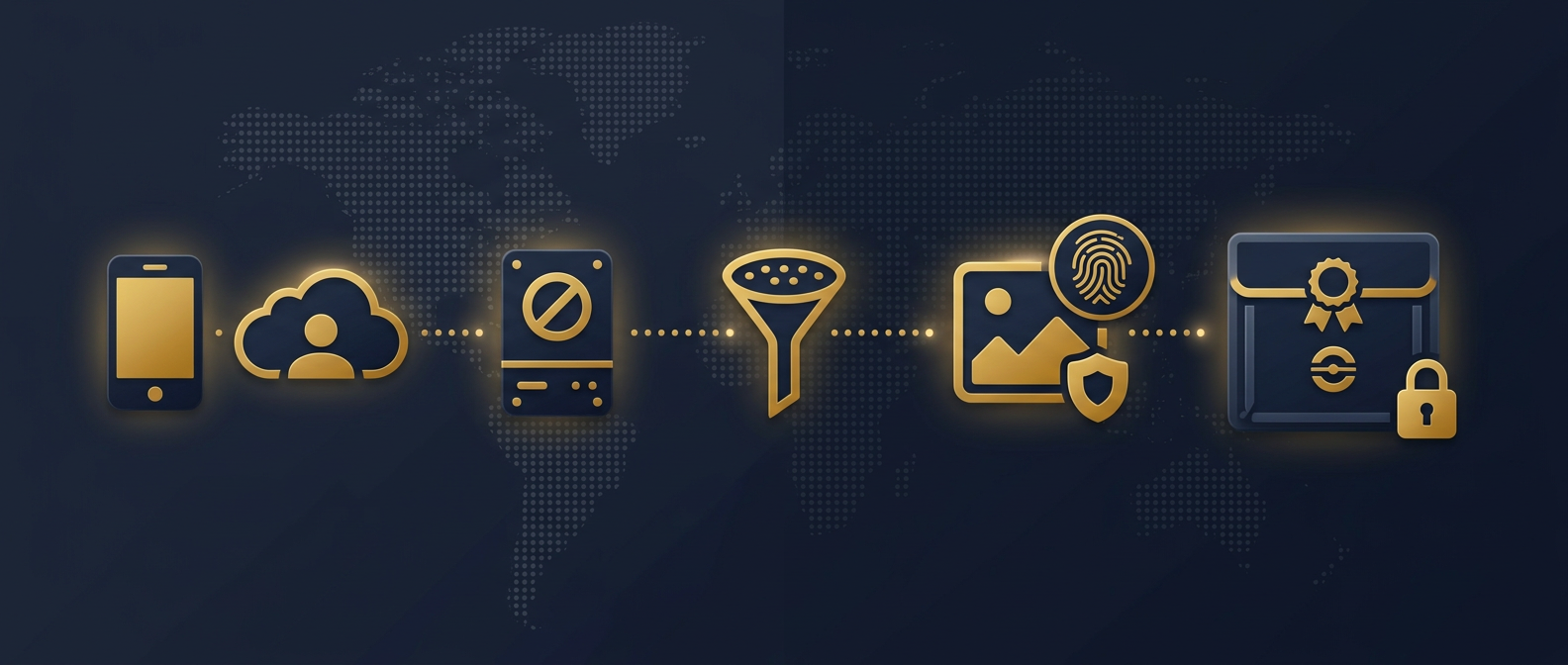
Elite cross-border preservation follows a repeatable sequence, documented as the work is performed rather than reconstructed later. The steps below produce evidence able to withstand a Miami cross-examination even when the data originated thousands of miles away. They align with internationally recognized handling standards and with the tool-validation reference maintained by the NIST Computer Forensics Tool Testing program.
- Map the data and the law together. Identify every device, account, and custodian and where each physically resides, then confirm the lawful path to each, domestic process, consent, MLAT, letter rogatory, or Hague request.
- Confirm authority before acquisition. Verify the right to collect under both Florida law (chapters 815 and 934) and the law of the source jurisdiction, so nothing is gathered unlawfully abroad.
- Issue preservation notices early. Put custodians and providers on formal legal hold before data is deleted, rotated, or overwritten; cross-border data is perishable and provider retention windows are short.
- Isolate and document the original state. Prevent remote wipe and cloud sync, and photograph or record each source’s condition before anything is touched.
- Acquire forensically. Capture a bit-for-bit image through a write-blocker; never analyze, boot, or browse the original.
- Hash and verify. Calculate and record the cryptographic hash of source and image, confirm they match, and re-verify at each handoff.
- Log every transfer across borders. Record who received the evidence, when, why, and in what condition, leaving no gap, including transfers between countries or vendors.
- Store under seal and analyze on copies. Keep evidence encrypted, access-controlled, and logged, and conduct all examination on verified working copies.
- Reconcile with data-protection obligations. Document the lawful basis and any minimization applied so a foreign transfer is defensible if challenged.
- Preserve documentation for testimony. Maintain contemporaneous notes and the full custody record so the methodology can be defended on the record under section 90.702.
None of this is glamorous, and that is the point. Cross-border work looks methodical because every step is engineered to be explained, reproduced, and defended months or years later in front of a hostile examiner and, sometimes, a skeptical foreign authority.
Which Miami matters turn on cross-border digital forensics?
The recurring engagements in the Miami market cluster into a handful of patterns, each with an evidentiary center of gravity that reaches beyond Florida. Trade and trade-finance fraud, where invoices, shipping records, and wire instructions are manipulated across counterparties in Latin America. International asset tracing and judgment enforcement, where hidden accounts and shell structures span multiple countries. Cross-border commercial and shareholder disputes involving foreign subsidiaries. Investment and Ponzi-style fraud marketed to a diaspora investor base. Corporate internal investigations and FCPA-adjacent matters touching foreign operations. And UHNW family, marital, and estate matters where a principal’s records live on devices and cloud accounts held abroad.
What unites them is that the forensic timeline, when a file was created, altered, sent, or exfiltrated, and from where, is frequently dispositive, and it can only be built by correlating device, cloud, messaging, and financial evidence across jurisdictions. These are representative scenarios, not case files, but the fact patterns are familiar to any litigator or family office operating through Miami.
Self-collection versus forensic acquisition: why the difference decides cases
The most common way strong cross-border evidence dies is well-intentioned self-collection. A principal forwards WhatsApp screenshots from a foreign phone, a local manager copies a mailbox in another country, or a client logs into a spouse’s account “just to check.” Each destroys metadata, breaks the chain, and, in a cross-border matter, can also violate a foreign interception or data-protection law. The contrast with forensically sound acquisition is stark.
| Dimension | Self-collection / local copy | Forensic acquisition |
|---|---|---|
| Source handling | Original opened, copied, or logged into | Write-blocked; original untouched |
| Metadata | Altered or destroyed | Preserved intact |
| Integrity proof | No hash to verify | Hash captured and re-verified at each step |
| Deleted data | Missed entirely | Recoverable from unallocated space |
| Legal basis abroad | Often unlawful under foreign or Florida law | Authority confirmed in every jurisdiction first |
| Chain of custody | Gaps; unaccounted cross-border transfers | Continuous, documented log across borders |
| Courtroom posture | Vulnerable to exclusion and challenge | Withstands adversarial scrutiny under Daubert |
The practical lesson for Miami counsel is to involve forensic expertise before anyone touches the data, and before anyone reaches across a border. Once a foreign device has been booted or an account exported by untrained hands, some damage cannot be undone, and the fight shifts from the merits to the reliability and legality of the evidence, exactly where a sophisticated opponent wants it.
What separates a world-class cross-border forensic partner?
Providers are not equal, and the gap becomes visible under pressure. When evaluating a digital forensics partner for a Miami matter with international reach, sophisticated buyers weigh a specific set of criteria rather than price alone.
- In-house, single-chain command. When acquisition, analysis, and testimony run under one accountable team rather than a chain of subcontractors, the chain of custody does not fragment across borders and privilege is easier to protect.
- Legal-path fluency. The partner should understand MLATs, letters rogatory, the Hague Evidence Convention, and foreign data-protection limits, and sequence them with the technical work so the evidence is lawfully obtained.
- Validated tools and methodology. Independently tested, industry-standard tools and documented validation are what satisfy the section 90.702 reliability inquiry.
- Testimony experience. An examiner who has withstood cross-examination writes reports and keeps records with the courtroom in mind from the first hour.
- Discretion and privilege awareness. Elite work operates at the direction of counsel, protects confidentiality, and preserves privilege, which matters acutely for public companies, family offices, and high-profile principals.
- Full-spectrum capability. Cross-border matters rarely stay in one lane; a partner that also brings investigations, cybersecurity, and financial-intelligence capability can follow the evidence wherever it leads without handing off to a stranger.
The distinguishing trait across all of these is defensibility. A world-class partner produces work designed, from the first hour, to be explained and survived on the record, and to hold up when a foreign authority or an opposing expert examines how the data crossed a border.
How does Honeybadger deliver cross-border forensics to Miami?
Honeybadger Solutions delivers digital forensics to Miami through in-house, remote-by-design laboratories, so the same accountable team that scopes a matter carries it through preservation, acquisition, analysis, and production under a single chain of custody and command, even when the data spans several countries. Our forensic work is handled internally rather than farmed out, which keeps evidence from fragmenting across vendors and lets us protect privilege and confidentiality end to end, an advantage that matters as much in a trade-finance dispute as it does in a family-office matter.
Because our forensic, cybersecurity, financial-investigation, and background-intelligence capabilities are global and remote-by-design, we serve Miami and the broader Florida market without a handoff, coordinating the legal path, from preservation notices to letters rogatory and Hague requests, alongside the technical work so evidence is both lawfully obtained and admissible. Florida is an established operational theater for the firm, and our examiners build methodology and documentation intended to be defended on the record, by written certification or live testimony, under Florida’s Daubert standard at section 90.702. That same discipline supports the full arc of a dispute through our investigations practice, from international asset tracing and trade fraud to corporate internal probes and contentious cross-border separations. Operating from Arizona home command, with offices in Casa Grande, Phoenix, and Oro Valley, we close the gap between what the evidence shows and what a Miami court will actually admit.
Frequently asked questions
Does Florida follow the Daubert or Frye standard for digital forensic evidence?
Florida follows Daubert. Expert testimony must satisfy Florida Statutes section 90.702, which requires that opinions rest on sufficient facts or data, use reliable principles and methods, and apply those methods reliably to the facts, with the trial court acting as gatekeeper. Established forensic practice, such as write-blocked imaging, validated extraction tools, and hash verification, meets that standard because it is reliable and repeatable. Improvised or undocumented handling is what invites a successful challenge.
Can we just download data from a foreign account or phone ourselves?
It is rarely safe. Logging into someone’s account or exporting data yourself alters metadata, misses deleted content, creates no chain of custody, and can violate Florida’s computer-crime and two-party-consent laws or a foreign interception or data-protection statute. That can taint the evidence and expose the client to liability. The safe path is to preserve the source, confirm lawful authority in every jurisdiction involved, and have a trained examiner acquire it forensically.
How do you get evidence held by a provider or witness in another country?
Through formal legal channels sequenced with the technical work. Depending on the country and data type, that may mean a Mutual Legal Assistance Treaty request, a letter rogatory, a request under the Hague Evidence Convention, or process directed at a U.S.-based provider under the Stored Communications Act and CLOUD Act. Foreign data-protection laws such as the GDPR can restrict transfers for foreign proceedings, so the lawful basis is documented before data moves.
Do you need to be physically in Miami or abroad to handle the matter?
For most cross-border digital forensic work, no. Our labs are remote-by-design and in-house, so acquisition, analysis, and reporting are handled by the same accountable team regardless of where the data sits, and we move quickly to preserve perishable evidence. Florida is an established theater for the firm, and we coordinate any needed on-the-ground or in-country steps while keeping the chain of custody and command intact.
About Honeybadger Solutions
Honeybadger Solutions is an Arizona-licensed security and investigations firm delivering intelligence-led forensics, investigations, and cyber services to executives, general counsel, family offices, and organizations across Miami, Florida, and worldwide. Digital forensics, cybersecurity, financial investigations, and background intelligence are handled in-house and remote-by-design, so every step from cross-border evidence preservation through production runs under a single accountable chain of custody and command.
Offices: Casa Grande (HQ), Phoenix, and Oro Valley, Arizona.
Phone: Book a consultation online
Confidential consultation: discuss a Miami cross-border forensic-collection or evidence-preservation matter with our command team.
Browse by topic
Security guard services · Private investigations · Cybersecurity · Digital forensics · Financial fraud investigation · Executive protection · All articles