
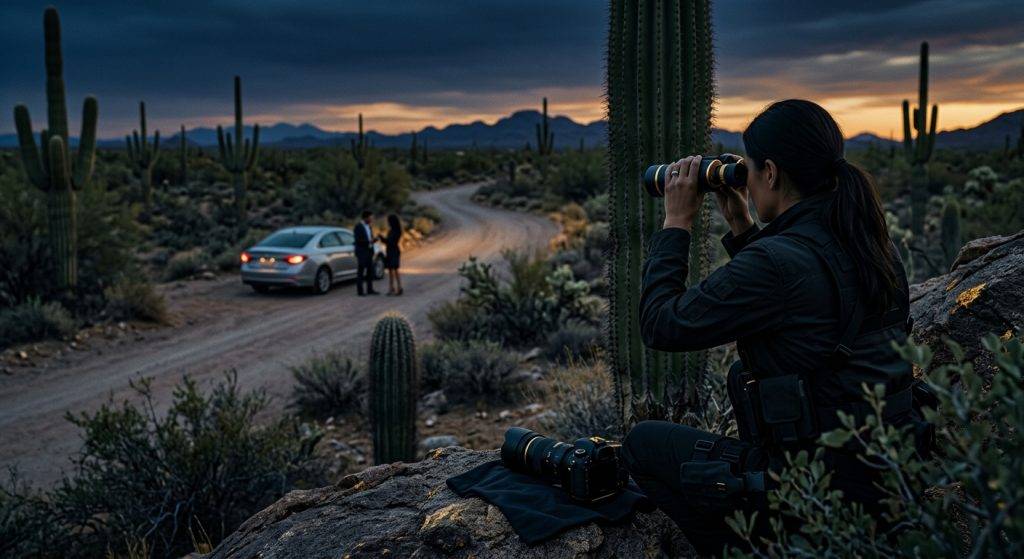
Surveillance rarely changes the outcome of an Arizona divorce by itself, but it can be decisive on the issues that actually turn on facts: child safety, dissipation of marital assets, and cohabitation affecting spousal maintenance. Arizona is a no-fault state, so proving an affair alone will not move a judge. Understanding where surveillance genuinely helps — and where it can expose you to legal risk — is the first decision to get right.
If you suspect your spouse is having an affair, the instinct to find out for certain is human and understandable. But in Phoenix, the path from suspicion to a decision that protects you — legally, financially, and emotionally — is narrower than most people assume. This guide is written directly for the spouse doing the suspecting, and for the family-law attorney who will eventually read whatever evidence surfaces. It covers what Arizona’s no-fault divorce law actually means for an infidelity case, the specific situations where lawful surveillance genuinely matters, the legal boundaries a suspicious spouse must not cross, and how a properly run engagement is conducted, documented, and handed to counsel. It is general information, not legal advice; confirm specifics with a licensed Arizona family-law attorney before you act.
Does infidelity actually matter in an Arizona divorce?
Less than most people expect. Arizona is a no-fault divorce state. A court dissolving a marriage does not ask who cheated, who was cruel, or who caused the breakdown — it asks only whether the marriage is irretrievably broken. A judge will not award you a larger share of the community estate, more parenting time, or a more favorable maintenance order simply because you can prove your spouse had an affair. That single fact disappoints a great many people who come to us right after finding out, and we would rather tell you that on day one than let you spend money chasing a legal outcome that Arizona law does not deliver.
That does not mean the underlying facts are irrelevant — it means they matter for different, narrower reasons than “proving the affair.” An affair can become legally significant when it intersects with something the court does care about: the safety and welfare of a child, the couple’s community property, or the conditions attached to spousal maintenance. Surveillance earns its cost only when it is aimed at one of those specific, provable issues — not at the affair itself. Our companion article on infidelity surveillance in Arizona covers the statewide legal framework in more depth; this guide focuses on what that means practically for a Phoenix-based spouse deciding whether, and how, to move forward.
So why do Phoenix spouses hire an investigator at all?
Four reasons come up again and again in our Phoenix casework, and only one of them is simply “peace of mind.”
- Child safety and exposure. If your spouse’s new partner has a documented history that could put your children at risk — substance abuse, violence, a criminal record, or simply reckless conduct while your children are present — that is a custody-relevant fact, not an infidelity fact. Arizona courts decide legal decision-making and parenting time based on the child’s best interests, and evidence of unsafe conditions during the other parent’s time is squarely within that inquiry. See our dedicated guide on child custody surveillance in Arizona for how this evidence is gathered and used.
- Dissipation of community assets. Arizona is a community-property state. If your spouse is spending marital funds on hotels, gifts, trips, or an apartment for an affair partner, that spending can be characterized as waste or dissipation of community assets — and a court can account for it when dividing the estate, effectively crediting the innocent spouse for money spent outside the marriage. This is a financial claim, documented with receipts, bank records, and corroborating observation — not a morality argument.
- Cohabitation and spousal maintenance. If you are already paying — or expect to pay — spousal maintenance, and your former spouse is cohabiting with a new partner in a marriage-like relationship, that can be a basis to modify or terminate maintenance under Arizona law. Proving genuine cohabitation (shared residence, shared finances, a settled domestic routine) requires sustained, lawful observation over time, not a single photograph.
- Certainty to make a decision. Sometimes the honest answer is that you need to know, one way or the other, before you can decide whether to stay, separate, or file. That is a legitimate reason to engage an investigator — but it should be sized and priced as what it is: information for your own decision-making, not evidence for a legal claim that Arizona’s no-fault framework does not recognize.
Before any engagement, we ask which of these four categories actually applies to your situation. It changes the scope of work, the documentation standard, and — candidly — whether surveillance is worth the cost at all.
What can surveillance establish — and what can’t it?
Setting expectations correctly up front prevents a wasted engagement. The table below reflects how we scope conversations with Phoenix clients and their attorneys.
| Surveillance CAN reasonably establish | Surveillance CANNOT establish (or shouldn’t be relied on for) |
|---|---|
| That your spouse and another person meet, travel together, or share a residence over time (observed publicly) | The legal fact of “adultery” as a basis for a different divorce outcome — Arizona’s no-fault standard makes this largely moot |
| Patterns consistent with cohabitation relevant to a maintenance modification | The content of private conversations, texts, or app messages you were not part of |
| Spending patterns and locations consistent with dissipation of community funds (paired with financial records) | What happens inside a private residence, behind closed doors or fences — no video or photography into private interiors |
| Whether a new partner’s public conduct exposes your children to unsafe conditions during the other parent’s time | Definitive proof of “why” a divorce is happening — courts don’t require or weigh a cause under no-fault rules |
| A neutral, time-stamped, chain-of-custody record an attorney can actually use in negotiation or court | Anything obtained by trespass, hacking, GPS tracking of a vehicle you don’t own or control, or intercepting a private call you weren’t part of — this evidence can be inadmissible and can expose you to liability |
The common thread: surveillance is powerful when it documents observable, public conduct tied to a real legal or safety question. It is worthless — or worse, a liability — when it’s obtained unlawfully or aimed only at proving the affair happened.
What are the legal do’s and don’ts for a suspicious spouse in Phoenix?
This is the section we ask every client to read before they do anything themselves. Spouses in distress frequently take matters into their own hands, and the well-intentioned mistakes below are the single biggest reason good cases get compromised.
- You may record your own conversations — one-party consent. Arizona is a one-party-consent state under A.R.S. § 13-3005, and the consent exception at A.R.S. § 13-3012 confirms that a participant in a conversation may lawfully record it. So you may record a phone call or in-person conversation you are personally part of. What you may not do is plant a recording device to capture a private conversation between your spouse and someone else that you are not a party to — that crosses into unlawful interception.
- Do not place a GPS tracker on a vehicle titled solely to your spouse. This is one of the most common mistakes we see. If the car is titled only in your spouse’s name, attaching a tracking device without their knowledge can expose you to civil and potentially criminal liability, and any resulting evidence is likely to be excluded — or used against you. Our dedicated guide on GPS vehicle surveillance and Arizona law walks through exactly where the line falls, including situations involving jointly titled vehicles.
- Do not access your spouse’s phone, email, or online accounts. Even if you know the password, logging into an account that is not jointly owned or that you are not authorized to access can implicate state and federal computer-access laws. This includes cloud backups, shared-but-separately-owned devices, and social media accounts.
- Do not trespass, and do not record where there is a reasonable expectation of privacy. Arizona’s criminal trespass statute and its privacy protections mean you cannot enter your spouse’s separate residence, a hotel room, or a fenced yard to observe or record, and you cannot photograph into bedrooms, bathrooms, or similarly private spaces even from a vantage point you reached lawfully.
- Do not confront, contact, or engage the other party. Confronting a suspected affair partner can escalate quickly, can constitute harassment depending on conduct, and — most practically — tips off your spouse before any lawful documentation exists.
- Do preserve what you already lawfully have. Screenshots of your own conversations, joint financial statements, and shared calendars you already have legitimate access to are typically fine to preserve — but keep copies and let your attorney advise on how they can be used.
- Do loop in a family-law attorney early — before you spend money on investigation. An attorney can tell you, given your specific facts, whether any of the four categories in the section above actually applies to your case, and can direct the scope of any investigation so it produces something usable.
The rule that ties all of this together: a licensed investigator operating from public vantage points, with no trespass and no device planted on property that isn’t theirs, produces evidence that can actually be used. A spouse acting alone, however justified the motive, risks producing evidence that cannot be used and exposure that can be used against them.
How does Honeybadger conduct this work in Phoenix?
In Arizona, this work is performed by Honeybadger Solutions’ own in-house, Arizona-licensed private investigators — never subcontractors. Arizona is our home command: the investigator who sits on a Phoenix engagement is our employee, trained under our methodology, supervised under our chain-of-custody controls, and available to authenticate the work if your attorney ever needs testimony. Private investigators in Arizona are licensed and regulated through the Arizona Department of Public Safety, and that licensing is the floor for work your attorney can actually rely on.
Phoenix presents its own operational demands: wide, fast arterials with sparse cover for a stationary post, HOA neighborhoods with limited public parking, extreme summer heat that limits how long an operator can sit undetected in a vehicle, and a metro area large enough that a mobile follow may cross from Phoenix into Scottsdale, Tempe, or Glendale within a single observation window. A discreet, patient, well-resourced operation accounts for all of it — and knows when to break off a follow rather than risk being made, because a spouse who suspects they’re being watched simply stops the behavior you’re trying to document.
Discretion runs both directions in these engagements. We do not contact the other party, we do not involve extended family or mutual friends, and we structure billing, scheduling, and communication so that nothing about the engagement itself becomes visible to your spouse before you’re ready to act on it.
What do you actually receive, and how does it support your attorney?
A surveillance engagement is only worth what its output can do in your attorney’s hands. Our Phoenix deliverables are built with that endpoint in mind:
- A chronological activity log recorded contemporaneously in the field, in neutral factual language — times, locations, and observed conduct, without speculation.
- Time-stamped photographs and video captured from lawful public vantage points, preserved in original form with an evidentiary working copy.
- An investigator declaration identifying the licensed investigator who performed the work and who can authenticate it under Ariz. R. Evid. 901 if your attorney needs the evidence formally admitted.
- A summary memo tying observations to the specific issue your attorney flagged — cohabitation, dissipation, or child-safety exposure — without overreaching into conclusions the record doesn’t support.
- Chain-of-custody documentation establishing an unbroken record of how media was captured, stored, and transferred.
We route the final product to you and, when you authorize it, directly to your family-law attorney, so the record reaches counsel intact and without gaps in custody. If the matter also involves recovered messages, financial records, or device activity, we can integrate that work through our broader investigations practice so the full evidentiary picture is handled to the same standard.
Representative scenario: cohabitation and a maintenance question
Consider a representative Phoenix matter. A spouse paying court-ordered spousal maintenance believed his former wife had moved a new partner into her home and was, in effect, remarried in every way but paperwork — which, if true, could support a petition to terminate maintenance. Rather than confront her or search her accounts, he engaged a licensed investigator. Over several weeks, from public streets and lawful vantage points, the investigator documented the same vehicle parked overnight on a consistent basis, the partner’s regular departure for work each morning, joint grocery runs, and shared yard maintenance — a pattern consistent with a shared household. No entry onto the property, no audio recording, no contact with either party. The chronological log and time-stamped photographs gave his attorney a documented, lawfully obtained basis to raise the issue with the court. This is an illustrative, representative scenario — not a named client or a guaranteed outcome — but it reflects how narrowly targeted, lawful surveillance can support a specific legal question rather than a general suspicion.
Frequently asked questions
If I prove my spouse cheated, will I get a better divorce settlement?
Generally, no. Arizona is a no-fault divorce state, so a court does not divide community property, set spousal maintenance, or allocate parenting time based on who caused the marriage to end. Proof of an affair, standing alone, typically does not change the outcome. It can become relevant indirectly — for example, if marital funds were spent on the affair (dissipation), if a new partner’s conduct creates an unsafe environment for your children, or if cohabitation affects maintenance — but those are distinct legal questions your attorney evaluates on their own facts, not consequences of the affair itself.
Can I put a GPS tracker on my spouse’s car to find out where they’re going?
Not if the vehicle is titled solely in your spouse’s name — doing so without authorization can expose you to civil and potentially criminal liability, and the resulting evidence is unlikely to help you and may hurt you. If the vehicle is jointly titled or community property, the analysis is more nuanced and depends on the specific facts; talk to a family-law attorney before acting, and see our detailed breakdown of GPS vehicle surveillance and Arizona law. A licensed investigator can lawfully document a vehicle’s movements through visual surveillance from public vantage points without ever touching the vehicle.
Can I record my spouse’s phone calls or read their texts?
You may lawfully record a phone call or conversation that you are personally a party to, since Arizona is a one-party-consent state under A.R.S. § 13-3005 and § 13-3012. You may not record a private conversation between your spouse and someone else that you’re not part of, and you should not log into your spouse’s phone, email, or online accounts without authorization, even if you know the password — that can implicate computer-access laws separate from the recording statutes. If you already have lawful, joint access to a shared account or device, preserve what you have and let your attorney advise on how it can be used.
How much does spousal surveillance in Phoenix cost, and how long does it take?
Cost depends on the specific legal question you’re building toward. Confirming a single instance of contact might take a short observation window; establishing a cohabitation pattern for a maintenance modification typically requires observation spread across several weeks to show a settled routine rather than a one-off event. We scope every engagement around the actual question your attorney needs answered — child safety, dissipation, or cohabitation — so you aren’t paying for open-ended surveillance aimed only at confirming an affair the court won’t weigh anyway. Call to discuss your specific situation and we’ll help you and your attorney determine whether surveillance is the right tool at all.
About Honeybadger Solutions
Honeybadger Solutions is an Arizona-licensed security and investigations firm providing full-spectrum investigations, surveillance, digital forensics, and security services to individuals and family-law counsel across Arizona. In Arizona, our surveillance and field investigations are performed by our own in-house, AZ-licensed investigators — not subcontractors — supervised under documented methodology with chain-of-custody controls and court-ready reporting. We operate three Arizona offices — Casa Grande (headquarters), Phoenix, and Oro Valley — serving the greater Phoenix metro and every Arizona venue.
Suspect infidelity and need a lawful, discreet way to get clarity? Call 602-725-2818 to speak confidentially with an investigations lead. We’ll help you understand whether surveillance actually serves your situation before you spend a dollar on it, and we’ll coordinate directly with your family-law attorney if you have one.
This article is general information, not legal advice. Arizona family law, evidence rules, and privacy statutes are fact-specific and subject to change — consult a licensed Arizona family-law attorney before taking any action based on suspected infidelity. Authoritative references: A.R.S. § 13-3005, interception of communications (Arizona State Legislature) and Arizona Department of Public Safety — Licensing (private investigators).