
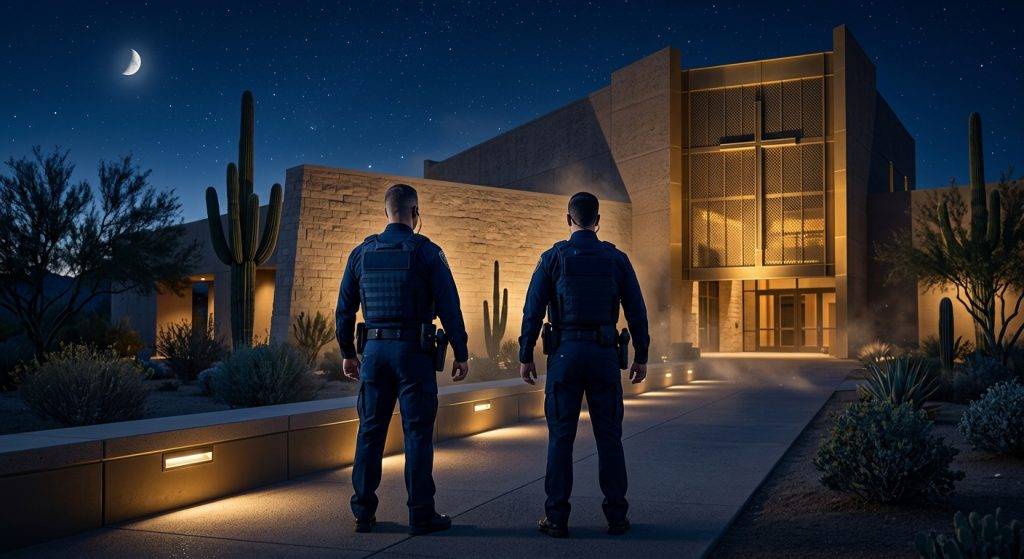
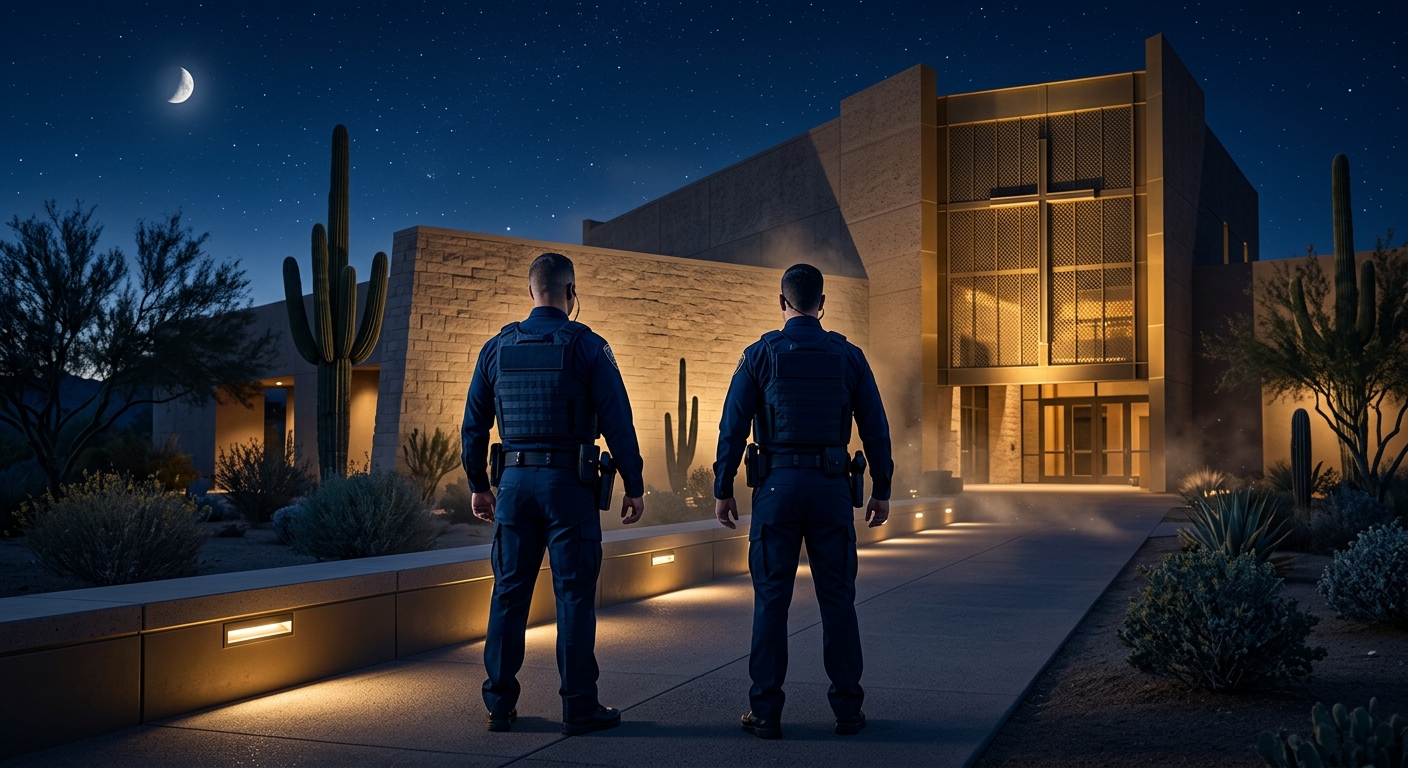
Church security guards in Phoenix, AZ protect congregations by pairing Arizona DPS-licensed officers with trained volunteer safety ministries, layering coverage across parking, entrances, nursery, and sanctuary. The goal is a warm, non-intimidating presence backed by real capability: threat detection, de-escalation, medical response, and coordinated evacuation. Honeybadger Solutions fields its own in-house licensed officers statewide. Call 602-725-2818.
Why do Phoenix houses of worship need dedicated security guards?
A house of worship is one of the few institutions that deliberately opens its doors to strangers, gathers hundreds of people on a predictable weekly schedule, handles cash offerings, cares for children in dedicated spaces, and asks its members to be trusting rather than suspicious. Every one of those virtues is also a security consideration. Faith communities in Phoenix face a realistic spectrum of risk that has little to do with fear-mongering and everything to do with prudent stewardship of the people entrusted to your care.
The federal government treats faith-based organizations as a distinct protection category for good reason. The Cybersecurity and Infrastructure Security Agency (CISA) maintains dedicated resources for houses of worship precisely because the threat picture is real and the operating environment is unique. The most common incidents at faith communities are not headline-grabbing acts of mass violence. They are disruptive persons in crisis, domestic disputes that follow a family member onto church property, medical emergencies during services, theft from unattended purses and offering counts, custody conflicts in childcare areas, and traffic and pedestrian hazards in crowded lots. A credible security program has to be built for the frequent and the catastrophic at the same time.
What distinguishes elite guarding from a warm-body vendor is the discipline to plan for all of it without turning your sanctuary into a checkpoint. The presence has to read as hospitality, not occupation. That balance is a craft, and it is the entire premise of church security done well.
What threats should a church security plan actually address?
A serious plan names its threats plainly and assigns each one a response. Generic “security” that cannot articulate what it is defending against is theater. Below is the threat spectrum most Phoenix congregations should map to their own facility, schedule, and demographics.
- Targeted violence. The rare but catastrophic scenario. Response depends on early detection, controlled entry points, clear lines of sight, and a rehearsed lockdown and evacuation plan coordinated with local law enforcement.
- Domestic-dispute spillover. Statistically far more common. An estranged partner or family member follows someone to services. Requires awareness of protective-order situations, discreet monitoring, and a plan to shield the targeted individual.
- Disruptive or mentally distressed persons. Someone in crisis who interrupts a service or fixates on staff. The correct tool is de-escalation, not force, delivered by someone trained to recognize the difference between disruption and danger.
- Theft of offerings and property. Cash handling, unattended belongings, and equipment. Addressed through offering-count protocols, two-person rules, and visible presence during vulnerable windows.
- Childcare and nursery security. Check-in and check-out integrity, custody-dispute readiness, and access control to children’s areas — often a congregation’s single highest priority.
- Parking, traffic, and medical events. The most frequent real-world incidents. Lot management, pedestrian safety, and rapid medical response during surge arrivals and departures.
The FBI and organizations like ASIS International both emphasize that effective protection begins with a documented risk assessment rather than a product purchase. You defend the specific building, congregation, and rhythm you actually have. For a broader view of how layered guarding works across facilities, our overview of security services explains the discipline that underpins every deployment.
How do professional officers and volunteer safety teams work together?
The most resilient house-of-worship programs are not “guards instead of volunteers” or “volunteers instead of guards.” They are integrated. A volunteer safety ministry knows the congregation intimately — who belongs, who is new, who is struggling, which family is navigating a difficult separation. Licensed professional officers bring training, legal standing, de-escalation and use-of-force discipline, medical response, and the authority and composure to manage a genuine emergency. Fused correctly, each covers the other’s blind spots.
The volunteer team becomes the eyes and relational layer; the professional officer becomes the trained response layer and the interface with law enforcement. The professional also trains, drills, and mentors the volunteers, raising the whole program’s floor. This model lets a congregation extend meaningful coverage across a large campus without stationing paid officers at every door — while ensuring that when something serious develops, a qualified professional is already on site and in command.
What roles belong to volunteers versus licensed officers?
| Function | Volunteer Safety Ministry | Licensed Professional Officer |
|---|---|---|
| Greeting & congregation familiarity | Primary — knows members by name | Supporting |
| Threat detection & reporting | Primary observation layer | Assessment & verification |
| De-escalation of disruptive persons | Initial, low-level only | Primary — trained response |
| Physical intervention / use of force | Avoid — not their role | Primary — trained & accountable |
| Medical emergency response | Supporting (if certified) | Primary coordination |
| Law-enforcement liaison | Supporting | Primary — professional interface |
| Nursery & child check-in integrity | Primary — relational trust | Access-control oversight |
| Training & drills | Participate | Design & lead |
Should church security guards be uniformed or plainclothes?
This is the question that most defines a congregation’s security posture, and the honest answer is: usually both. A uniformed officer is a deterrent and a reassurance. Would-be bad actors see a visible, capable presence and think twice; anxious members see someone clearly responsible for their safety and relax. But a uniform can also feel heavy in a worship setting and can signal to a determined attacker exactly who to neutralize first.
Plainclothes officers preserve the welcoming, unguarded atmosphere many faith communities cherish while maintaining full protective capability. They blend into the congregation, observe without projecting suspicion, and retain the element of surprise if a threat materializes. The tradeoff is reduced deterrence — a threat may not perceive any security at all.
The elite approach is a deliberate mix calibrated to the congregation’s culture, campus layout, and threat assessment: a visible uniformed presence at entrances and parking for deterrence and traffic management, and plainclothes officers seated within the sanctuary and stationed near children’s areas for discreet, ready response. Congregations that want to understand the distinction in depth can review our guidance on unarmed security guards in Phoenix, which covers presence, posture, and when armed coverage is warranted.
How is Sunday-service surge and special-event coverage planned?
Church security is a surge problem. A campus that is nearly empty midweek fills with hundreds of people, dozens of vehicles, and a compressed arrival-and-departure window on Sunday morning. Holidays, funerals, weddings, and large community gatherings create their own spikes — and funerals in particular can carry elevated risk when family tensions or the circumstances of a death are volatile. Coverage has to scale to the event, not the empty building.
A disciplined provider builds a staffing model around the actual calendar: baseline coverage for routine services, augmented coverage for high-attendance holidays such as Christmas and Easter, and bespoke plans for special events with their own access, parking, and crowd dynamics. The framework below is how a professional team approaches a service or event from the ground up.
- Risk assessment. Document the facility, congregation profile, known concerns (protective orders, prior incidents), and event specifics before assigning a single officer.
- Perimeter and parking. Establish lot management, pedestrian safety, and an outer observation layer where problems are detected earliest.
- Access control. Define entry points, reduce unmonitored doors, and set nursery and children’s-area check-in protocols.
- Interior coverage. Position plainclothes and uniformed officers with clear sightlines to entrances, the platform, and vulnerable groups.
- Communication plan. Radios, code words, and a defined chain from volunteer observation to professional response to a 911 call.
- Medical and evacuation readiness. Pre-stage response for the far more common medical event and rehearse lockdown and evacuation routes.
- Law-enforcement coordination. Know response times, share your plan, and establish contact before an incident, not during one.
- After-action review. Debrief every notable event and refine the plan continuously.
This is the same layered methodology used to protect corporate campuses and public venues, adapted to the sensitivities of a worship environment. Our commercial and corporate security practice details how surge and event coverage is engineered at scale.
What does Arizona law require of church security guards?
In Arizona, private security is regulated under A.R.S. Title 32, Chapter 26, administered by the Arizona Department of Public Safety (AZ DPS). Guards must be properly licensed, and armed officers carry additional requirements for firearms training and certification. This matters enormously for a house of worship: a well-meaning volunteer with a personal firearm and no professional training is a legal and safety liability, not a security program. Licensing exists to ensure that anyone acting in a protective, and especially an armed, capacity has met a defined standard of training, background vetting, and accountability.
Congregations should verify that any officer on their property holds a valid AZ DPS license appropriate to their role, and that the provider carries proper insurance and supervision. You can review the state’s requirements directly through the Arizona DPS licensing resources. Federal guidance for developing a comprehensive plan is available through the CISA faith-based organizations and houses of worship program, which offers assessments, training, and planning tools at no cost.
Honeybadger Solutions fields its own in-house, AZ DPS-licensed, supervised officers throughout Arizona — not subcontracted labor sourced from whoever is available. That distinction is the difference between accountability and a warm body in a shirt. Congregations comparing options for guarding in the broader metro can also review our security guard services in Phoenix and, for institutions with youth programs, our school security guards practice, which shares the same child-protection discipline nurseries require.
How does elite guarding differ from a warm-body vendor?
The private security industry has a wide quality range. At the low end, a vendor dispatches an untrained, minimally screened individual to stand in a corner and satisfy a checkbox. That is not protection; it is the appearance of protection, and in a crisis it can make matters worse. Elite guarding is defined by what happens before and around the deployment: rigorous background vetting, role-specific training in de-escalation and emergency response, active supervision, documented protocols, integration with your volunteer team, and continuous refinement based on after-action review.
For a faith community, the tell is temperament. The right officer for a sanctuary is not the most intimidating one; it is the one who can stand calmly at a door greeting families for two hours, notice the single person who does not fit the pattern, defuse a distressed visitor with words rather than force, and still be ready to act decisively in the rare moment that demands it. That combination of warmth and capability cannot be improvised. It is selected for, trained, and supervised.
Frequently asked questions about church security in Phoenix
Do church security guards in Phoenix have to be armed?
No. Many congregations are best served by unarmed licensed officers whose role is observation, de-escalation, access control, and emergency coordination. Whether armed coverage is appropriate depends on your risk assessment, congregation culture, and comfort level. In Arizona, armed officers must hold the additional AZ DPS armed certification under A.R.S. Title 32, Chapter 26. A professional provider will recommend a posture based on your specific facility and threat picture, not a one-size-fits-all default.
Can we use our volunteer safety team instead of hiring guards?
A trained volunteer safety ministry is valuable, but it should complement licensed officers, not replace them. Volunteers provide relational awareness and an early observation layer; licensed professionals provide trained de-escalation, use-of-force accountability, medical coordination, and a proper law-enforcement interface. The strongest programs integrate both, with the professional officer training and mentoring the volunteers to raise the entire team’s readiness.
How do we keep security from feeling intimidating to guests?
By designing for hospitality first. A calibrated mix of a welcoming uniformed presence at entrances and discreet plainclothes officers inside preserves an open, non-threatening atmosphere while maintaining real capability. Officers selected for a worship environment are trained to read as greeters and helpers, engaging warmly with families while quietly maintaining awareness. Security and welcome are not opposites; done well, protection is what makes genuine openness possible.
What should we prioritize first if our budget is limited?
Start with a documented risk assessment — it is free through CISA and tells you where to spend. From there, most congregations prioritize access control and nursery security, a trained response presence during peak services, and a communication and emergency plan coordinated with local law enforcement. These address the most frequent real-world incidents. A professional provider can phase a program so protection scales responsibly with your resources.
About Honeybadger Solutions
Honeybadger Solutions is an Arizona-licensed security and investigations firm protecting houses of worship, schools, corporate campuses, and communities across the state. Our Arizona guarding is delivered by our own in-house, AZ DPS-licensed, supervised officers — accountable, trained, and integrated with your team. We also field in-house global capabilities in digital forensics, cybersecurity, financial investigations, and background intelligence, and serve clients throughout Arizona, nationwide, and internationally.
Three Arizona offices: Casa Grande (headquarters), Phoenix, and Oro Valley. Explore our Phoenix location to learn how we serve the Valley.
Ready to protect your congregation without compromising your welcome? Call our team at 602-725-2818 for a confidential consultation and risk assessment.