
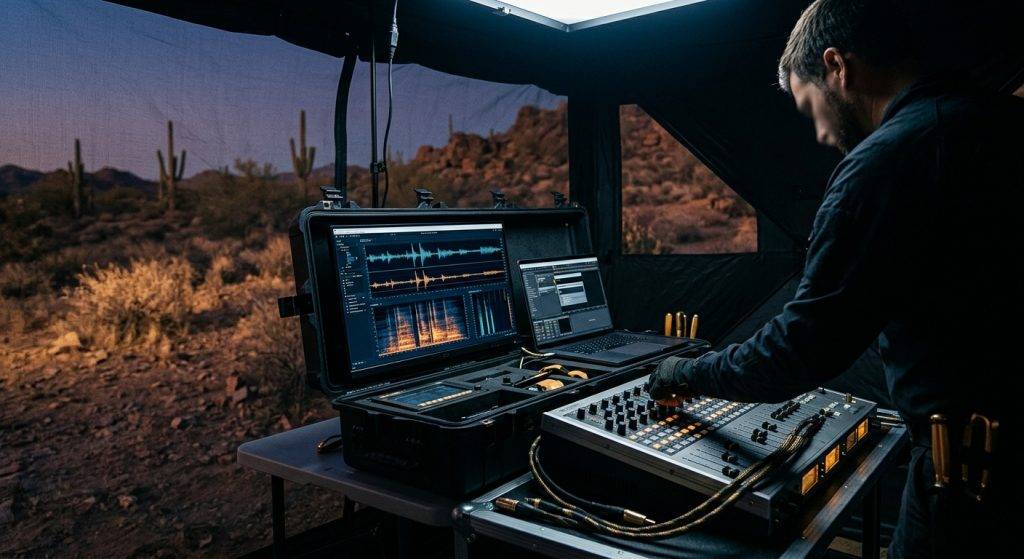
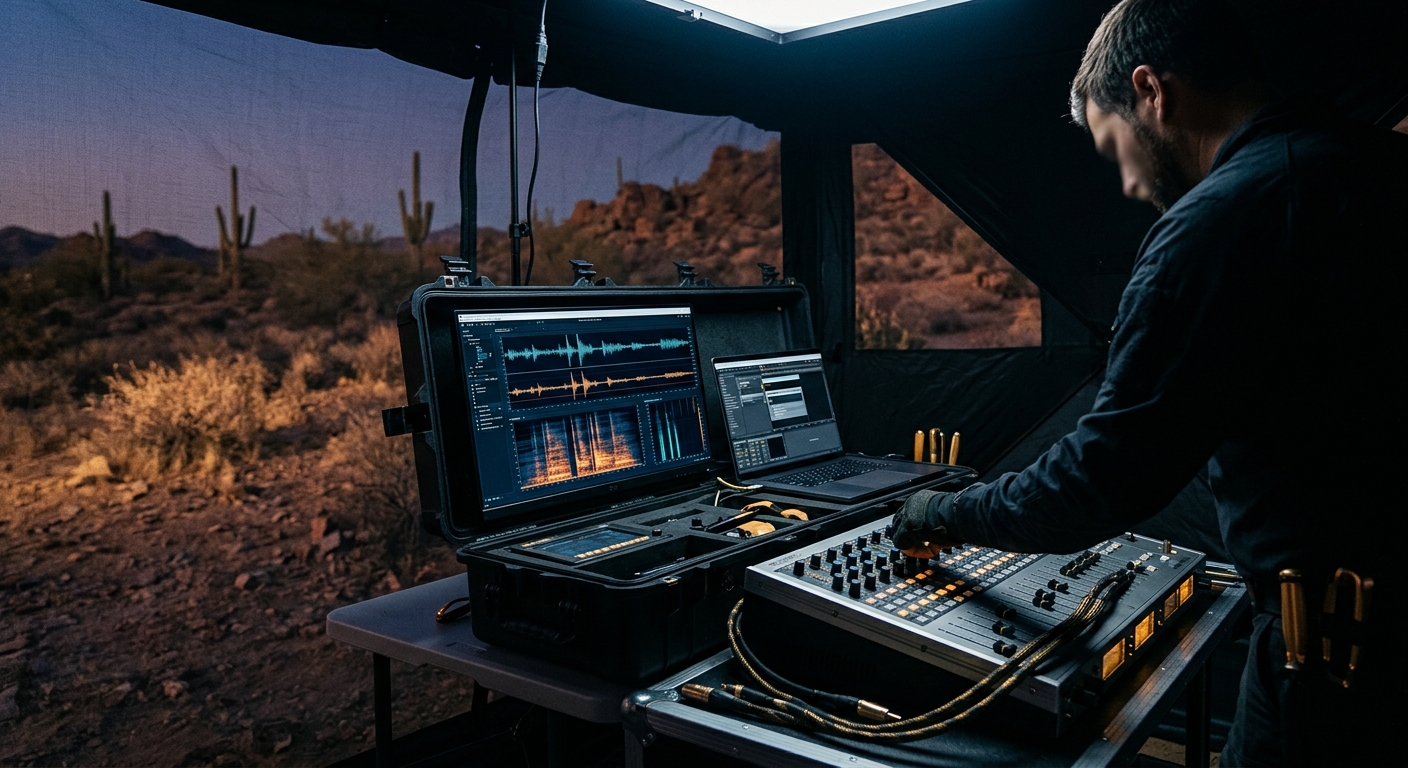
Audio forensics is the scientific examination of recorded sound to answer four distinct questions: is the recording authentic and unaltered, can degraded speech be clarified without fabricating words, does a voice match a known speaker within the real limits of that science, and what do background sounds reveal about events, distances, or timing. Honeybadger Solutions applies all four disciplines, plus emerging AI voice-clone screening, for counsel, insurers, and courts nationwide.
A recording rarely arrives in a case file with its provenance intact. It comes off a cracked phone, a voicemail server, a body-worn camera, a 911 dispatch console, or a device someone concealed in a shirt pocket. Before that audio can carry weight with a judge, a jury, an adjuster, or opposing counsel, someone has to answer a harder question than “what does it say” — namely, can this recording be trusted at all, and does the analysis meeting it hold up under cross-examination. That is the discipline of audio forensics, and it is far narrower, and far more rigorous, than the waveform-cleanup effects seen in television procedurals.
Honeybadger Solutions runs its digital forensics practice in-house, from an Arizona home command with certified examiners serving clients nationwide and internationally. Every audio engagement follows the same evidentiary discipline as our device and network examinations: hash-verified acquisition of the original media, a documented chain of custody, and a report built to survive a Daubert or Frye challenge — not a persuasive-sounding conclusion built to please the party who hired us.
What Does Audio Forensics Actually Cover?
Audio forensics is not one skill; it is four, and a competent engagement often uses only one or two of them, never all four, because the questions a case actually needs answered are usually narrow. The four core disciplines are authentication (is this the original, continuous, unedited recording), enhancement and intelligibility (can we recover speech buried in noise without inventing words that were never spoken), speaker and voice comparison (does this voice belong to a known individual, and how confidently can that be stated), and acoustic event analysis (what do gunshots, engine sounds, sirens, or spatial cues reveal about distance, sequence, or environment). A fifth, newer concern threads through all of them: is the recording itself a synthetic or AI-manipulated artifact rather than a captured acoustic event at all.
Each discipline has its own methods, its own error rates, and — critically — its own limits. A responsible examiner states those limits as plainly as the findings. A recording that cannot be authenticated to a scientific standard is reported as such, not massaged into a stronger-sounding conclusion because a client wants one.
Can We Prove a Recording Hasn’t Been Edited?
Authentication is usually the first and most consequential question, because if a recording has been spliced, has missing segments, or was re-recorded from another source, everything downstream — enhancement, speaker comparison, event analysis — inherits that doubt. Examiners look for discontinuities in the noise floor, abrupt phase shifts, compression artifacts inconsistent with a single continuous encoding pass, and file-container metadata that does not match the claimed recording device or software version. Deletions frequently leave a signature: a micro-gap in ambient room tone, a change in electrical hum characteristics, or an editing-software fingerprint embedded in the container format.
What Is Electric Network Frequency (ENF) Analysis, and When Does It Apply?
Mains-powered recording environments — a landline handset, a device plugged into an outlet, or one near mains-powered equipment — can pick up a faint hum from the electrical grid’s alternating current. That frequency drifts in small, continuously logged fluctuations across a power grid over time. Where a reference database of that drift exists for the relevant grid and timeframe, an examiner can compare the embedded hum in a recording against the historical signature and assess whether the recording’s timeline is continuous or whether a splice interrupts it. ENF analysis is a real, peer-reviewed technique — but it depends entirely on a detectable hum signal being present in the recording and on access to (or independent capture of) a matching reference database. Where either is absent, ENF analysis is simply not available, and an honest report says so rather than reaching for a weaker substitute and calling it ENF.
What Other Edit-Detection Techniques Matter?
Beyond ENF, examiners rely on spectrographic inspection for unnatural transitions, double-compression analysis (a file re-encoded after editing often carries two generations of lossy-compression artifacts instead of one), waveform-continuity checks at the sample level, and file-system and container-metadata review to detect whether the file’s internal structure matches an unmodified original from the claimed source device. None of these techniques work in isolation; authentication conclusions are built from convergence across several independent indicators, not a single test.
Can a Muffled or Noisy Recording Be Made Clear — And Where Is the Ethical Line?
Enhancement is the discipline most often misunderstood. Spectral noise reduction, adaptive filtering, equalization, and de-reverberation can meaningfully improve the intelligibility of speech buried under road noise, HVAC hum, wind, or a poor microphone placement. Done well, enhancement lets a listener hear speech that was always present in the signal but masked by interference.
What enhancement cannot legitimately do is reconstruct words that were never captured. Aggressive AI-based “audio upscaling” or generative restoration tools can produce plausible-sounding speech in gaps where the original signal simply was not present — and that is fabrication, not forensic enhancement, regardless of how convincing it sounds on playback. A forensically sound enhancement workflow preserves the original file untouched, documents every filter and parameter applied to the working copy, and never uses generative or predictive audio synthesis to fill silence or noise. Any transcript produced from enhanced audio is verified word-by-word against the processed recording and flagged everywhere the examiner’s confidence is less than certain — inaudible, indiscernible, and disputed passages are marked as such rather than guessed at.
Can an Expert Really Identify Who Is Speaking on a Recording?
Speaker comparison — sometimes called voice identification — is the discipline courts and counsel most often overestimate. Forensic speaker comparison examines acoustic-phonetic features (pitch, formant structure, speech rhythm, articulation habits) between a known exemplar and a questioned recording and expresses the result as a likelihood along a scale, not a fingerprint-style match or exclusion. Reputable examiners report findings using bounded, qualified language — for example, that features are “consistent with” or “not consistent with” the same speaker at a stated confidence level — because unlike fingerprints or DNA, voice is not a fixed biometric. It changes with illness, stress, microphone quality, recording bandwidth, intoxication, and simple vocal effort, and no validated statistical population model exists for voice comparison at the level DNA analysis enjoys.
This is precisely the territory Federal Rule of Evidence 702 was written to police: an expert’s methodology has to be reliable and its application has to fit the facts, or the testimony does not come in. A responsible report states sample quality, exemplar comparability, and the limits of the comparison as plainly as the finding itself — and refuses to overstate a match where the underlying science cannot support one.
What Can Audio Reveal About Gunshots, Distances, and Background Events?
Acoustic event analysis examines what a recording’s non-speech content reveals: the number and timing of gunshots, the acoustic signature distinguishing a gunshot from a firework or a vehicle backfire, approximate distance from source to microphone based on sound attenuation and reverberation characteristics, sequence-of-events reconstruction from overlapping sounds (sirens, doors, vehicles, screams), and cross-referencing timestamps across multiple independent recordings — body cameras, 911 lines, bystander phones, security systems — to build a synchronized timeline. This work is frequently the difference between a disputed narrative and a defensible sequence of events in officer-involved-shooting reviews, workplace-violence investigations, and insurance claims involving contested incident timing.
How Do We Screen for AI Voice Cloning and Synthetic Audio?
Consumer-grade voice-cloning tools have made convincing synthetic speech cheap and fast to produce, and that has changed the authentication question itself. It is no longer sufficient to ask whether a recording was edited; it is now necessary to ask whether the recording was ever a real acoustic event at all. Screening for synthetic or AI-manipulated audio looks for the absence of natural micro-variation in pitch and breath patterns, unnaturally clean phase and noise-floor characteristics inconsistent with any real recording environment, generative-model artifacts in the spectrogram, and inconsistency between claimed recording conditions (a phone call, a room, a street) and the acoustic fingerprint actually present in the file. This is an active, fast-moving area — detection techniques and generation techniques are in a genuine arms race — and Honeybadger treats every high-stakes voice recording as a candidate for synthetic-media screening before any other analysis proceeds, consistent with the same methodology our team applies in deepfake and synthetic media forensics engagements more broadly.
How Do the Four Disciplines Compare, and What Are Their Limits?
| Discipline | What It Answers | Key Techniques | Scientific Limits |
|---|---|---|---|
| Authentication | Is the recording original, continuous, and unaltered? | ENF analysis, spectrographic edit detection, double-compression analysis, metadata/container review | ENF requires a detectable hum and a matching reference database; absence of edit indicators is not absolute proof of originality |
| Enhancement / Intelligibility | Can masked or degraded speech be made clearer? | Spectral noise reduction, adaptive filtering, de-reverberation, equalization | Cannot recreate words never captured; generative “restoration” risks fabrication and must be excluded |
| Speaker / Voice Comparison | Is this voice consistent with a known speaker? | Acoustic-phonetic feature comparison, formant and pitch analysis, likelihood-scale reporting | Voice is not a fixed biometric; no fingerprint-level population statistics exist; findings are qualified, never absolute |
| Acoustic Event Analysis | What do gunshots, distances, and background sounds reveal? | Signature classification, attenuation/reverberation modeling, multi-source timeline synchronization | Distance and sequence estimates carry margins of error tied to recording quality and environment |
| Synthetic-Audio Screening | Was this recording ever a real acoustic event? | Micro-variation analysis, generative-artifact detection, acoustic-environment consistency checks | Detection and generation methods evolve continuously; findings are time-stamped to current detection capability |
What Recording Sources Most Often Need This Analysis?
The sources vary by matter type, and each carries its own acquisition challenges. Smartphone voice memos and call recordings are frequently proprietary-format and cloud-synced, which affects how an original can be verified. Voicemail systems often re-encode and compress audio on the carrier or platform side, complicating authentication. Body-worn camera footage typically includes embedded metadata and companion video that must be preserved together, not extracted as an isolated audio clip. 911 dispatch recordings usually exist on a multi-channel logging system with independently time-stamped call legs that should be pulled directly from the public-safety answering point rather than a secondary copy. Covert or consumer recording-app captures carry the least inherent provenance and require the most rigorous authentication work before any conclusion about their content can be defended.
In every case, the rule is the same one that governs our broader digital forensics practice: acquire from the most original available source, verify with a cryptographic hash at collection, and never analyze a working copy without a preserved, untouched original sitting behind it.
How Should Counsel Prepare Audio Evidence for Admissibility?
Federal Rule of Evidence 901 requires proponents to produce evidence sufficient to support a finding that an item is what it is claimed to be, and audio recordings face that hurdle more often than most exhibit types because they are so easy to alter and so hard to visually inspect for tampering. Rule 702 then governs whether any expert testimony interpreting that audio — authentication findings, enhanced transcripts, speaker-comparison conclusions — is reliable enough, and reliably applied enough, to reach the jury. Preparing audio evidence well means addressing both rules from the start of an engagement, not after a motion to exclude has already been filed.
- Identify and preserve the most original available copy of the recording — the source device or system, not a screenshot, a re-recording, or a forwarded file — before any other step.
- Acquire that original with a forensic tool that generates a cryptographic hash at collection, and verify the hash again before any analysis begins.
- Document chain of custody from the moment of collection, naming every person and system that has touched the file since.
- Determine which of the four disciplines the case actually requires — authentication, enhancement, speaker comparison, event analysis — rather than requesting a blanket “full audio forensic workup” that adds cost without answering the question at issue.
- Where synthetic-audio concerns exist, request screening before any other analysis proceeds, since a finding of manipulation changes every downstream question.
- Require that any enhancement work preserve the untouched original alongside a fully parameter-logged working copy.
- Insist that any speaker-comparison or transcript finding be reported with explicit confidence qualifiers, not absolute language a cross-examiner can dismantle in ten minutes.
- Build the expert report and supporting methodology documentation to Rule 702 standards from the outset — reliable principles, reliably applied, clearly disclosed — rather than retrofitting them after a Daubert challenge is filed.
Authorities like the Scientific Working Group on Digital Evidence (SWGDE) publish the methodology standards examiners are measured against, and the underlying legal thresholds are set out directly in Federal Rule of Evidence 901 and Federal Rule of Evidence 702. Building an engagement around those standards from day one, rather than treating them as a hurdle to clear later, is what separates audio evidence that survives appeal from audio evidence that collapses under a well-prepared cross-examination.
Consider a representative scenario: a workplace-dispute matter turns on a covertly recorded conversation submitted by one party, with the opposing party disputing both its completeness and the identity of a second voice on the tape. A rigorous engagement would authenticate the file for continuity and edit indicators, enhance the noisiest segments without altering their evidentiary status, and qualify — not overstate — any speaker-comparison finding, delivering a report that holds up whether it supports the retaining party’s position or contradicts it. That discipline, not the answer either side wants, is what a defensible audio forensics engagement produces.
Our examiners routinely testify to exactly this kind of methodology in deposition and at trial; the same standards that govern authenticating social media evidence for litigation apply to audio, and the expert-witness posture our teams take is described in full at how digital forensic examiners testify as experts.
Frequently Asked Questions
Can audio forensics prove a recording is 100% unaltered?
No examiner can certify a negative with absolute certainty. What a rigorous authentication analysis can do is identify specific indicators of alteration — or the absence of them — across multiple independent tests (ENF continuity where available, spectrographic review, compression-generation analysis, metadata review) and report a scientifically defensible conclusion about continuity and originality, qualified to the evidence actually present.
Is voice identification as reliable as a fingerprint or DNA match?
No. Voice is not a fixed biometric — it varies with health, stress, recording quality, and effort — and no population-level statistical model exists for voice comparison at the standard fingerprint or DNA analysis achieves. Reputable forensic speaker comparison is reported on a qualified likelihood scale, and any expert overstating a voice match as a certain identification invites exclusion under Rule 702.
Will enhancement ever add words that weren’t originally there?
It should never happen in a forensically sound workflow. Legitimate enhancement clarifies speech that is present but masked by noise; it does not synthesize or predict words absent from the original signal. Generative or AI-based “audio upscaling” that fills gaps with plausible-sounding speech is fabrication, not forensic enhancement, and a defensible report discloses every processing step so opposing counsel can independently verify that no synthesis occurred.
How do you screen for AI-generated or voice-cloned audio?
Examiners look for the absence of natural micro-variation in pitch and breathing, unnaturally clean noise-floor and phase characteristics inconsistent with any real recording environment, generative-model artifacts visible in spectrographic analysis, and mismatches between the claimed recording conditions and the acoustic fingerprint the file actually contains. Because detection and generation technology both evolve quickly, findings are time-stamped to current detection capability and re-examined if new methods emerge.
About Honeybadger Solutions
Honeybadger Solutions is an Arizona-licensed security and investigations firm delivering in-house digital forensics — including audio authentication, enhancement, speaker comparison, acoustic event analysis, and synthetic-media screening — to counsel, insurers, corporations, and courts nationwide and internationally. Our certified examiners operate from a home command with offices in Casa Grande (headquarters), Phoenix, and Oro Valley, and we work remote-by-design so distance is never a barrier to hash-verified acquisition, documented chain of custody, and court-ready reporting. If a recording’s authenticity, content, or origin is in dispute, Book a consultation online to speak with our digital forensics team about your matter.
Browse by topic
Security guard services · Private investigations · Cybersecurity · Digital forensics · Financial fraud investigation · Executive protection · All articles