

Cloud account forensics is the disciplined acquisition, preservation, and analysis of data held in accounts such as iCloud, Google, and Microsoft, obtained through one of three lawful pathways: the account holder’s informed consent, compelled legal process (subpoena, court order, or search warrant), or enterprise administrative authority. Because the data sits on a provider’s servers rather than a seized device, the governing questions are legal before they are technical: who is authorized to access it, what the provider will actually disclose, and how the evidence is preserved and documented so it survives challenge in court.
The center of gravity in modern investigations has moved off the device and into the cloud. Messages, photos, location history, documents, search activity, and full device backups now live in remote accounts that a suspect, adversary, or opposing party can alter or delete in seconds from anywhere in the world. That reality makes cloud acquisition both indispensable and legally treacherous. Reach for the data the wrong way and you have not gathered evidence — you have committed a federal crime, poisoned the record, or handed the other side a suppression motion. This guide is written for the sophisticated buyer of these services — the general counsel, litigation partner, family-office principal, or executive facing fraud, misconduct, IP theft, or a contentious separation — who needs to understand how elite teams obtain cloud evidence lawfully, what each major provider retains and produces, and how chain of custody is maintained when the evidence never physically existed in your hands.
What is cloud account forensics, and how does it differ from device forensics?
Device forensics acquires data from hardware you physically possess — a phone, laptop, or drive — through write-blocked imaging. Cloud account forensics targets data you do not physically hold, sitting on infrastructure owned by a third party and governed by that provider’s terms, the law, and the account holder’s rights. The distinction is not academic. On a seized device, the primary controls are technical: write-blocking, imaging, and hashing. In the cloud, the primary controls are legal: authorization and process. Get the legal foundation wrong and the finest technical acquisition in the world is inadmissible, or worse, unlawful.
Cloud data is also volatile in a way device data is not. A forensic image of a drive is a frozen snapshot; a live cloud account keeps changing, syncing, and expiring. Backups roll over, logs age out, and a single remote command can wipe an account or trigger provider-side deletion. That combination — third-party custody plus constant mutation — is why the first move in a cloud matter is almost never collection. It is preservation, and it is a legal act as much as a technical one.
What are the three lawful pathways to cloud data?
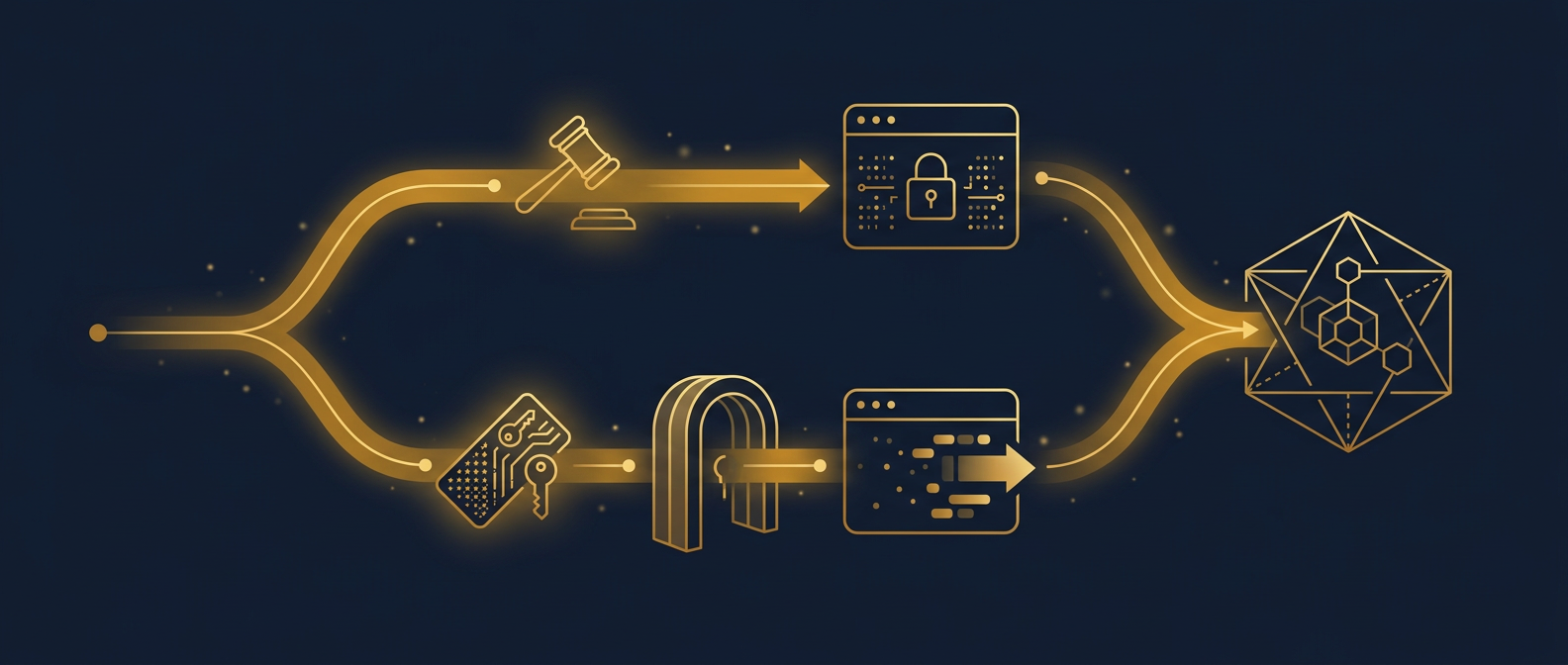
There are exactly three defensible ways to obtain cloud account data, and every legitimate engagement runs through one of them. Choosing the right pathway is the single most consequential decision in a cloud matter, because it dictates what data is reachable, how long it takes, and whether the result is admissible.
- Consent-based acquisition. The lawful account holder authorizes access and provides credentials, a session token, or a provider-generated export. This is the workhorse of civil litigation, internal investigations, and cooperative matters — a former executive’s company account, a client authorizing collection of their own iCloud, an employee consenting under a signed acknowledgment.
- Compelled legal process. A subpoena, a court order, or a search warrant compels the provider to produce data directly. The level of process required scales with the sensitivity of the data, and this pathway is available in its full form primarily to law enforcement and, in a constrained way, to civil litigants.
- Enterprise administrative authority. For business accounts, an organization that owns the tenant — Google Workspace or Microsoft 365 — can lawfully collect its own users’ data through admin and eDiscovery tooling, subject to its policies and applicable employment and privacy law.
The pathway that is never available is unauthorized access. Logging into someone else’s account with a guessed, shared, or purloined password — even a spouse’s, even a subordinate’s — can violate the federal Computer Fraud and Abuse Act and the Stored Communications Act, expose the client and the investigator to criminal and civil liability, and render everything found inadmissible as fruit of unlawful access. A world-class provider is defined as much by the doors it refuses to open as the ones it does.
| Pathway | Who uses it | Data reachable | Key constraint |
|---|---|---|---|
| Consent (credentials / token / export) | Civil litigants, internal investigators, cooperating parties | Everything the account holder can access | Requires genuine, documented authorization |
| Subpoena | Litigants, grand juries, agencies | Basic subscriber and transactional records | Cannot compel content of communications |
| Court order (SCA § 2703(d)) | Law enforcement | Non-content records and metadata | Requires specific and articulable facts |
| Search warrant | Law enforcement | Full content: messages, files, backups | Requires probable cause and a magistrate |
| Enterprise admin / eDiscovery | Organizations on their own tenant | Company-owned mailboxes, drives, logs | Bounded by policy and employment law |
What does the Stored Communications Act allow, and why can’t a civil subpoena reach content?
The Stored Communications Act (SCA), part of the Electronic Communications Privacy Act and codified at 18 U.S.C. § 2703, is the statute that governs when a provider may disclose account data. It draws a bright line that surprises many first-time buyers: the level of legal process required rises with the sensitivity of the data, and the actual content of communications sits at the top of that ladder.
Under the statutory scheme, basic subscriber information — name, account creation, associated addresses — can be reached with a subpoena. Non-content transactional records and metadata generally require a court order supported by specific and articulable facts. The content of communications — the actual text of emails, messages, documents, and photos — requires a search warrant based on probable cause, a standard reinforced by federal case law holding that users retain a reasonable expectation of privacy in the content of their stored email. Only law enforcement can obtain a warrant.
The critical consequence for civil matters is that the SCA generally prohibits providers from disclosing the content of communications in response to a civil subpoena. A litigant cannot simply subpoena Google, Apple, or Microsoft for an opposing party’s emails or files and expect them handed over. Providers routinely and correctly object. This is why, in civil litigation, cloud content is obtained from the account holder — through discovery, a preservation obligation, and consent-based collection — not from the provider directly. Counsel who plan a case around subpoenaing the provider for content are planning around a door the statute keeps locked, and experienced forensic partners redirect that strategy toward the custodian before time and credibility are wasted.
What does each provider actually retain and produce?
The three dominant ecosystems retain different data, expose different self-service exports, and respond to legal process on their own published terms. Understanding the differences before you act prevents the two classic failures: assuming data exists that the provider never kept, and missing data the provider retains but you never requested.
Apple / iCloud
Apple stores iCloud backups, photos, iCloud Drive files, mail, contacts, calendars, notes, and Find My data, and it publishes detailed Legal Process Guidelines describing exactly what it will disclose against each level of process. Two nuances dominate practice. First, iMessage and FaceTime are end-to-end encrypted in transit, so Apple cannot produce their content from the wire — but messages captured inside an iCloud backup are recoverable, which makes the backup the center of gravity. Second, Apple’s Advanced Data Protection, when a user enables it, extends end-to-end encryption to most iCloud categories, meaning Apple holds no key and cannot produce that content to anyone. When ADP is on, the account holder’s own credentials become the only route, which pushes the matter firmly toward the consent pathway.
Google retains one of the richest data footprints in the industry: Gmail, Drive, Photos, Chat, search and browsing activity, YouTube history, and, where enabled, granular location and Web & App Activity. For consent-based collection, Google Takeout lets an authenticated account holder export nearly the entire footprint in structured form. Google publishes its own law-enforcement request process and periodic transparency reporting, and it distinguishes sharply between consumer Gmail accounts and Google Workspace tenants, where an organization’s administrator controls collection through Vault and admin tooling.
Microsoft
Microsoft spans consumer Outlook and OneDrive accounts and the enterprise Microsoft 365 ecosystem. For consumer accounts, legal process and account-holder export are the routes. For organizations, Microsoft Purview eDiscovery gives an authorized administrator a powerful, defensible way to place holds on and collect Exchange mailboxes, OneDrive, SharePoint, and Teams content across the tenant — making enterprise administrative authority the dominant pathway for corporate M365 matters. Knowing which world an account lives in — consumer or enterprise — determines the entire acquisition plan.
| Provider | High-value data | Consent export | Encryption wrinkle |
|---|---|---|---|
| Apple / iCloud | Device backups, photos, Drive, mail, Find My | Data & Privacy download | iMessage E2E in transit; Advanced Data Protection removes Apple’s key |
| Gmail, Drive, Photos, activity, location | Google Takeout | Workspace vs. consumer changes who controls collection | |
| Microsoft | Outlook mail, OneDrive, SharePoint, Teams | Account export / Purview | Consumer vs. M365 tenant changes the pathway |
How do you preserve cloud data before it disappears?
Preservation is the first act, not the last, because cloud data is the most perishable evidence in any investigation. The moment a matter is reasonably anticipated, the duty to preserve attaches, and in the cloud that duty must reach every place relevant data actually lives. Three moves happen in parallel and fast. Counsel issues a documented legal hold to custodians, suspending any personal deletion and instructing that accounts, backups, and devices be left intact. Where the provider is a lawful destination for process, a preservation request — law enforcement uses the SCA’s 90-day preservation mechanism — freezes the account’s current state while process is prepared. And the forensic team moves to capture the volatile, expiring data first: connection logs, recent activity, and rolling backups that overwrite on a short cycle.
The silent failures here are the expensive ones. A backup cadence that overwrites the only copy of a deleted message thread. A two-factor prompt that locks out a consent-based collection because no one captured the recovery path while the custodian was cooperative. An account the adversary still controls and quietly purges. Speed and sequence are everything: preserve broadly, then collect deliberately.
How is chain of custody maintained when the evidence was never in your hands?
The hardest conceptual leap in cloud forensics is that chain of custody must be established for evidence that never physically existed in the examiner’s possession. It is done through disciplined documentation and cryptographic verification at the moment of acquisition, so that the copy in evidence can be proven to be a complete, unaltered record of what the account held at a specific time. An elite team follows a repeatable protocol:
- Document authorization first. Record the legal basis — signed consent, the subpoena or warrant, or the administrative authority — before a single byte is touched. Authorization is the foundation of admissibility.
- Capture with forensic tooling, not screenshots. Purpose-built cloud acquisition platforms authenticate through credentials, tokens, or provider APIs and pull structured data with its metadata intact, rather than relying on manual browsing that alters state and proves nothing.
- Hash at acquisition. Calculate cryptographic hash values (such as SHA-256) for the acquired data set so its integrity can be re-verified later; a matching hash is mathematical proof the evidence has not changed.
- Record the acquisition metadata. Log the account identifier, the exact timestamps, the tool and version, the examiner, and the scope of what was and was not collected.
- Preserve the original, work from copies. The master acquisition is sealed and untouched; analysis runs on verified working copies.
- Maintain an unbroken custody log. Every transfer, handler, and action is recorded from acquisition through production, so provenance is provable end to end.
- Prepare for authentication in court. Structure the record so the evidence can be authenticated under the rules — Federal Rule of Evidence 902(14) allows electronic data to be self-authenticated by a qualified person’s hash-based certification, and the examiner must be able to testify to the methodology.
Warrant returns versus consent acquisition: how do they compare?
The two pathways that dominate serious matters — a provider’s warrant return to law enforcement and a consent-based acquisition in a civil or internal matter — produce different evidence in different forms, and knowing the trade-offs prevents false expectations. A warrant return is comprehensive and provider-certified, but it is available only to law enforcement, takes time, and arrives as a large, unstructured production that must be parsed and normalized before it means anything. Consent acquisition is fast, available to civil and corporate investigators, and captured with full forensic control, but it reaches only what the account holder can access and depends entirely on genuine, documented authorization.
Neither is superior in the abstract; each is correct for its context. The failure is using the wrong one — a civil litigant chasing a warrant they can never obtain, or an investigator improvising unauthorized access because consent felt slow. The professional discipline is matching the pathway to the mandate, then executing it with a documentation trail that holds up under adversarial scrutiny.
How does Honeybadger deliver cloud account forensics?
Honeybadger Solutions delivers cloud account forensics led by in-house digital forensics, the capability that decides whether cloud evidence survives challenge. Because our forensic, cybersecurity, financial-investigation, and background-intelligence work is handled internally and delivered nationwide and internationally, a cloud matter never fragments across disconnected vendors: the same command that establishes the lawful pathway, preserves the account, and acquires the data understands the investigative narrative it is meant to prove. We begin with authorization and preservation, execute consent-based, administrative, or process-supported collection with forensic tooling and hash verification, and maintain a documented chain of custody built to be authenticated on the record.
Our work supports litigation, internal and regulatory investigations, and the broader intelligence picture behind a dispute — fraud, employee misconduct, IP and data exfiltration, and contentious separations — all under a single accountable chain of command and structured to operate at the direction of counsel so privilege is preserved where it applies. Critically, we are defined by the pathways we refuse to take: we do not access accounts without lawful authority, and we redirect clients away from strategies the law forecloses. From Arizona home command — with offices in Casa Grande, Phoenix, and Oro Valley — we serve clients across the United States and abroad, closing the gap between what an account holds and what can be proven in a proceeding.
Frequently asked questions
Can I access my spouse’s or employee’s cloud account if I know the password?
No — knowing a password is not authorization. Accessing another person’s iCloud, Google, or Microsoft account without lawful authority can violate the Computer Fraud and Abuse Act and the Stored Communications Act, expose you to criminal and civil liability, and render anything found inadmissible. Even in a divorce or a workplace matter, cloud data must be obtained through documented consent, proper discovery, or legal process. A reputable forensic firm will decline to access an account it is not authorized to access.
Can I subpoena Google, Apple, or Microsoft for the other side’s emails in a civil case?
Generally not for content. The Stored Communications Act bars providers from disclosing the content of communications in response to a civil subpoena, and they routinely object. Basic subscriber information may be reachable, but the actual emails, messages, and files must be obtained from the account holder through discovery and consent-based collection. Planning a civil case around subpoenaing the provider for content usually leads to a dead end.
What happens if the account uses Advanced Data Protection or end-to-end encryption?
When a user enables end-to-end encryption such as Apple’s Advanced Data Protection, the provider holds no key and cannot produce that content to anyone, including in response to legal process. The only route becomes the account holder’s own authenticated access, which pushes the matter firmly toward consent-based acquisition. Identifying whether such protection is enabled early is essential, because it reshapes the entire collection plan.
How do you prove cloud evidence is authentic if it was never on a device you held?
Through cryptographic hashing and documented chain of custody at the moment of acquisition. Forensic tools capture the account data with its metadata intact and compute hash values that let integrity be re-verified later; the examiner records authorization, timestamps, tooling, and scope, and works only from sealed copies. Under Federal Rule of Evidence 902(14), electronic data can be self-authenticated by a qualified person’s hash-based certification, and the examiner is prepared to testify to the methodology.
About Honeybadger Solutions
Honeybadger Solutions is an Arizona-licensed security and investigations firm delivering intelligence-led forensics, investigations, and cyber services to executives, general counsel, families, and organizations nationwide and internationally. Digital forensics, cybersecurity, financial investigations, and background intelligence are handled in-house, so cloud account acquisition runs under a single accountable chain of command from authorization and preservation through defensible production.
Offices: Casa Grande (HQ), Phoenix, and Oro Valley, Arizona.
Phone: Book a consultation online
Confidential consultation: discuss a cloud preservation or acquisition matter with our command team.
Browse by topic
Security guard services · Private investigations · Cybersecurity · Digital forensics · Financial fraud investigation · Executive protection · All articles