
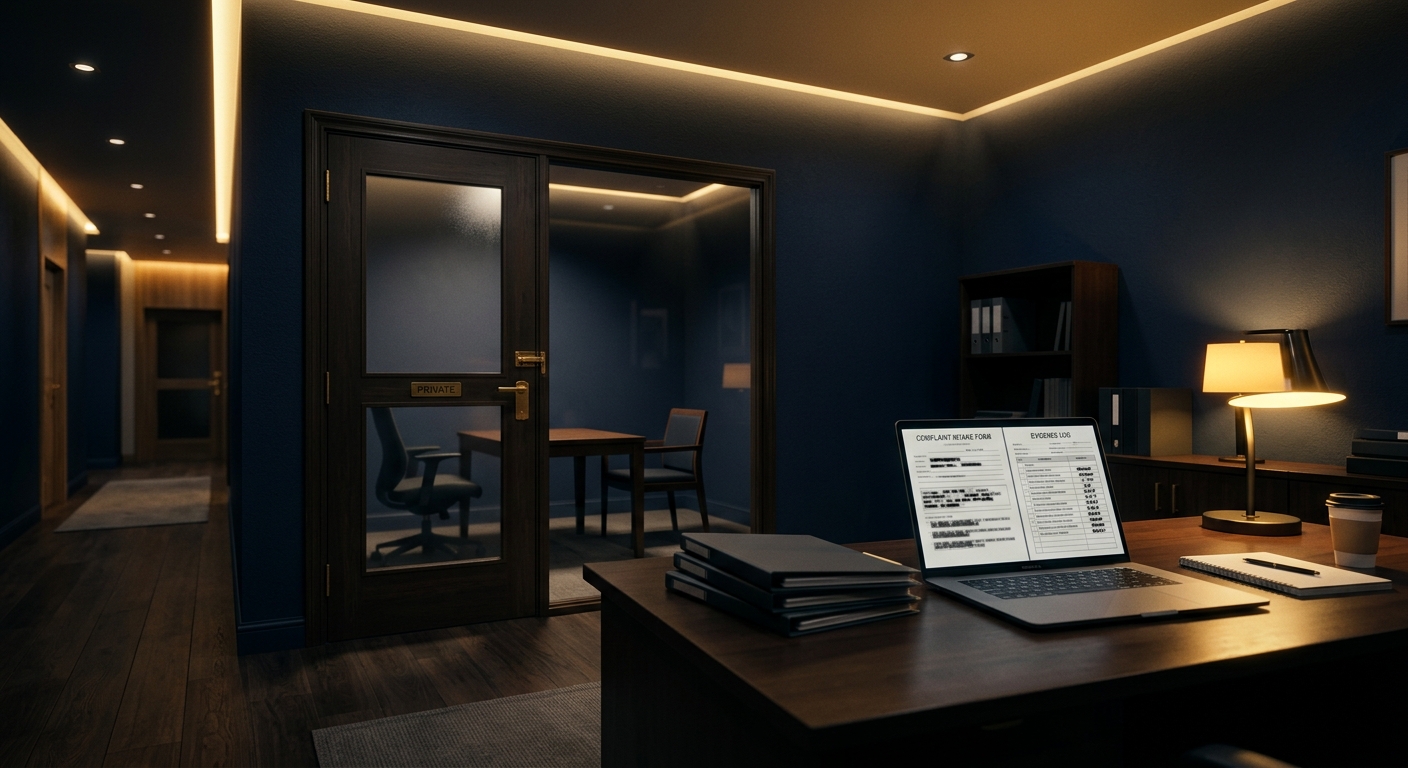
A workplace harassment investigation is an impartial, legally defensible inquiry into allegations of unlawful harassment—sexual, discriminatory, or hostile-environment conduct—designed to establish the facts, stop any ongoing misconduct, and preserve the employer’s affirmative defense under Title VII. HR should retain an independent, licensed investigator whenever the accused is senior, the facts are sharply contested, digital evidence is central, or litigation is foreseeable. The response, not the allegation, usually decides the company’s exposure.
Why a Harassment Complaint Is a Distinct Legal Event—Not Ordinary Employee Relations
Harassment complaints sit in their own category of risk. When an employee alleges harassment, the employer’s legal position is often decided less by whether the underlying conduct occurred than by how the organization responded to learning of it. In the paired decisions Faragher v. City of Boca Raton and Burlington Industries v. Ellerth, the U.S. Supreme Court established that an employer facing a hostile-environment claim based on a supervisor’s conduct may raise an affirmative defense only if it (1) exercised reasonable care to prevent and promptly correct harassing behavior, and (2) the employee unreasonably failed to take advantage of the complaint process. The investigation is the operational proof of the first prong.
That is why a prompt, impartial, thoroughly documented harassment inquiry is frequently the single most important exhibit in defeating—or losing—a claim. A jury does not see the harassment; it sees the file. If the file shows a company that took the complaint seriously, moved quickly, followed the evidence, and acted proportionately, the defense is strong. If it shows delay, a fact-finder with an obvious stake in the outcome, or a conclusion that preceded the interviews, the investigation itself becomes the plaintiff’s best evidence of indifference. For HR leaders and general counsel, the discipline below exists to make that record an asset rather than an admission.
What Kinds of Harassment Warrant a Formal Investigation?
The U.S. Equal Employment Opportunity Commission’s 2024 Enforcement Guidance on Harassment in the Workplace reaffirmed a broad view of what unlawful harassment covers and how modern conduct spreads. HR should open a formal, documented investigation—not an informal manager conversation—whenever a complaint touches any of the following:
- Quid pro quo harassment: a supervisor conditioning a job benefit, promotion, shift, or continued employment on submission to sexual or other unwelcome conduct.
- Hostile work environment: conduct based on a protected characteristic—sex, race, national origin, religion, age, disability, pregnancy, or genetic information—that is severe or pervasive enough to alter the conditions of employment.
- Online and remote harassment: unwelcome messages over email, chat platforms, text, or social media that spill into the working environment—now expressly within scope under the EEOC’s current guidance.
- Third-party and off-site conduct: harassment by clients, vendors, or contractors, and conduct at conferences, business travel, or company events.
- Retaliation: adverse action against someone who reported harassment or participated in an inquiry—treated as a separate, independently actionable wrong.
A practical threshold for HR: if the allegation, assumed true, would describe unlawful harassment, would justify discipline of a supervisor, or would plausibly appear in an EEOC charge, treat it as a formal investigation from the first hour. Under-triaging is how the “reasonable care” defense quietly evaporates.
When Should HR Bring in an Independent, Licensed Investigator?
Internal HR handles the majority of routine complaints competently. But harassment matters carry a structural problem: HR is part of the institution being accused of tolerating the conduct, and the department that manages the accused’s career is rarely perceived as neutral. Certain fact patterns therefore demand an outside, independent fact-finder—and in several jurisdictions, that fact-finder must be a licensed professional. The matrix below is how experienced HR and legal leaders decide.
| Fact-finder | Independence | Forensic & testimony capability | Best used when |
|---|---|---|---|
| Internal HR | Limited—part of the institution | Documentary review; not equipped for device imaging or expert testimony | Routine, low-exposure, non-supervisor complaints with no digital-evidence dispute |
| Outside employment counsel | High; can structure privilege | Legal analysis strong; forensic collection typically subcontracted | Privilege is paramount and litigation is likely or already filed |
| Independent licensed investigator | High; visibly neutral third party | In-house digital forensics, evidence handling, and credible expert testimony | Senior subject, contested facts, digital evidence, or a finding that must satisfy a board, insurer, or court |
The recurring signals that HR must step aside are: the accused is an executive, a board member, or someone HR reports to; the complaint alleges a pattern rather than an isolated incident; the credibility contest turns on electronic evidence such as texts or direct messages; a prior internal attempt was challenged as biased; or the matter is likely to reach the EEOC or a courtroom. In each case, a visibly neutral third party converts a vulnerable process into a defensible one.
Why Licensing Matters More Than HR Teams Realize
Retaining any competent outsider is not the same as retaining a properly licensed one. In a number of states, conducting a workplace investigation for another company, for a fee, meets the statutory definition of investigative work that requires a private investigator license. California, for example, treats external fact-finders as investigators subject to licensure under its Private Investigator Act, with a carve-out for licensed attorneys; other states maintain parallel regimes. Engaging an unlicensed outside investigator can taint the findings, create a distracting side-issue in litigation, and in some jurisdictions expose the vendor—and by extension the client—to enforcement. A licensed investigator also brings a chain-of-custody discipline and a familiarity with courtroom standards that an unlicensed consultant typically lacks. When the point of going external is defensibility, licensure is not a technicality; it is part of the defense.
Impartiality and the “Sham Investigation” Trap
Plaintiff’s counsel does not need to prove the harassment was ignored; often it is enough to persuade a jury that the investigation was theater. The “sham investigation” argument—that the employer went through the motions to manufacture cover—succeeds most often where a handful of avoidable errors appear in the file. Impartiality is protected by structural choices made before the first interview:
- No stake in the outcome. The investigator should have no reporting relationship to either party and no career interest in the result. Document that independence explicitly.
- No prejudgment. Scope and interview questions are written to test allegations, not to confirm a preferred conclusion. The file should show that exculpatory evidence was pursued as diligently as inculpatory evidence.
- A fair hearing for the subject. The accused must receive the specific allegations in enough detail to respond meaningfully. A rushed or one-sided subject interview is the most common foundation for a sham-investigation claim.
- Consistency with past practice. Treating a favored executive more gently than a line employee for comparable conduct is disparate treatment on a platter.
- A defined standard of proof. Findings rest on a preponderance of the evidence—more likely than not—stated as substantiated, not substantiated, or inconclusive, never as criminal guilt.
How Do You Conduct Harassment Interviews That Hold Up?
Interviews are where harassment investigations most often succeed or fail. The subject matter is sensitive, memories are emotional, and the record must be both humane and precise. The following sequence reflects elite practice:
- Prepare from the evidence first. Reconstruct the timeline from documents, messages, and access records before speaking to anyone. Interviews should test facts, not generate speculation.
- Interview outward-in. Start with the reporting party, then witnesses, then the subject last, once the documentary picture is clear. Interviewing the accused first tips the case and invites evidence destruction.
- Use a trauma-informed, non-leading approach. Let the reporting party narrate in their own words, then confirm specifics. Avoid leading questions and avoid signaling belief or disbelief.
- Maintain a two-person or fully recorded record. A second note-taker—or a properly consented recording where lawful—creates a corroborated account of exactly what was asked and answered.
- Frame confidentiality carefully. Ask participants to protect the integrity of the process, but avoid blanket gag directives; the National Labor Relations Board scrutinizes overbroad confidentiality rules that could chill protected concerted activity. Tie any confidentiality request to a specific, case-by-case justification.
- Never promise absolute confidentiality. The employer’s duty to act and, potentially, to disclose in litigation means secrecy cannot be guaranteed. Promising it and breaking it is its own liability.
- Give the subject the allegations with specificity. Present dates, conduct, and context sufficient for a genuine response, and record that response fully.
- Close each interview by locking the facts. Summarize what was said, confirm accuracy, and ask whether there are other witnesses or evidence you should review.
Evidence: Why Digital Forensics Decides Modern Harassment Cases
Harassment used to live in hallways and closed offices. Today it lives in text threads, direct messages, chat platforms, email, and social media—exactly the evidence that a manager’s screenshots cannot authenticate and that a subject may try to delete once they sense an inquiry. This is where a firm with in-house digital forensics changes the outcome.
Handled correctly, electronic evidence is forensically imaged before anyone is alerted, preserving the metadata that establishes who sent what, when, and from where. Deleted messages can frequently be recovered; timestamps can corroborate or contradict a witness; and a proper collection survives an authenticity or Daubert challenge in a way informal captures never will. Handled carelessly—by opening files on a live device, or by relying on a party’s own curated screenshots—the very evidence that would prove the case is altered or discredited. Sophisticated employers separate the roles accordingly: HR owns the conduct question, and certified examiners own the acquisition and analysis of the digital record, consistent with the forensic-collection discipline described by the National Institute of Standards and Technology. Honeybadger Solutions runs digital forensics, cybersecurity, financial investigations, and background intelligence in-house and remote-by-design, so nothing is outsourced at the moment it matters most.
Documentation That Survives an EEOC Charge and Litigation
When a charge is filed, the employer must produce a position statement and, ultimately, the investigation file. Documentation built for that moment shares a set of characteristics that a hastily assembled HR folder does not:
- A dated intake record capturing the complaint verbatim and the immediate triage decisions, including any interim measures such as separation of the parties or paid administrative leave.
- A written scope and plan defining the allegations tested, the policies implicated, and the witnesses and evidence identified—evidence that the inquiry was proportionate, not a fishing expedition.
- Contemporaneous interview memoranda that record questions and answers rather than conclusions, with witness statements attributed and dated.
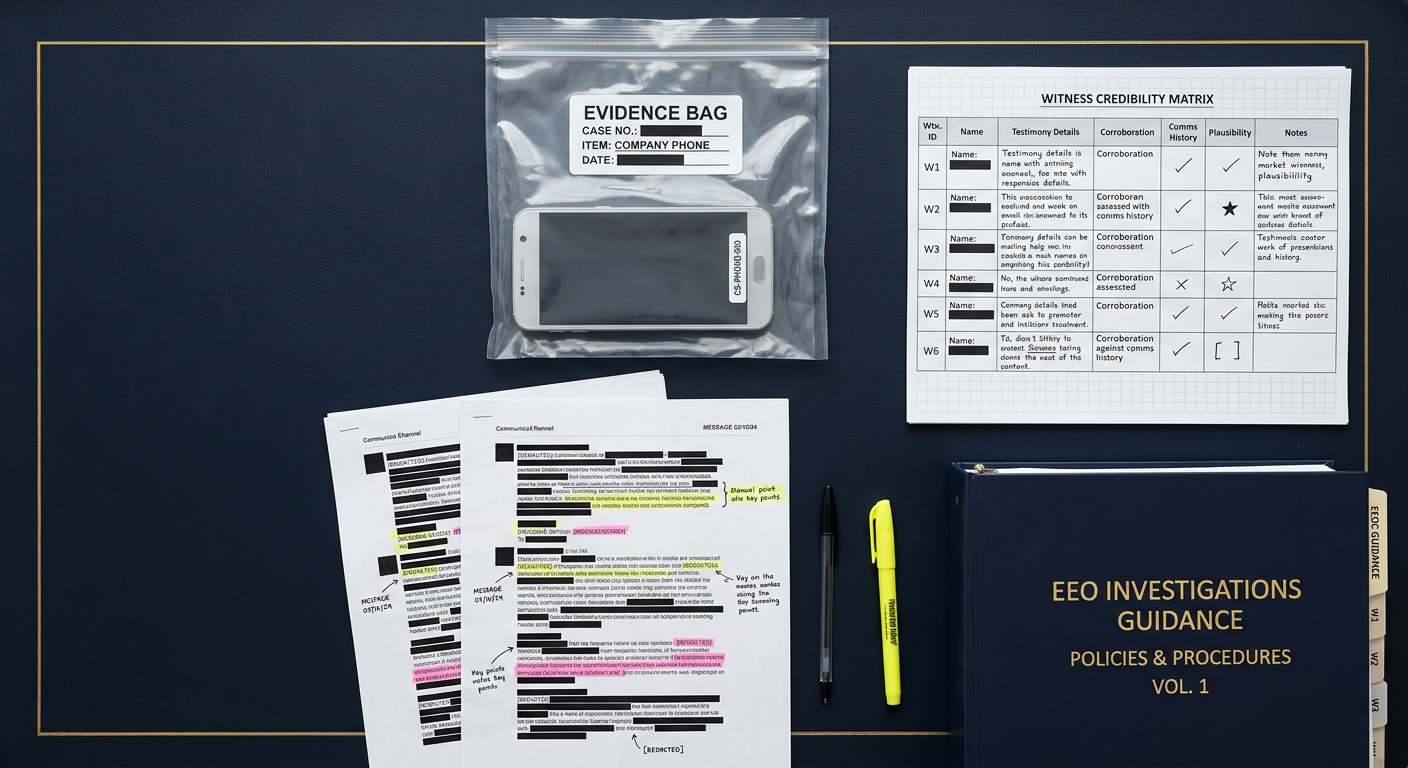
- A chain-of-custody log for every piece of physical and digital evidence, traceable from acquisition to production.
- A findings memorandum that names the standard of proof, explains each credibility determination, addresses alternative explanations, and states outcomes as substantiated, not substantiated, or inconclusive.
- A remediation and closure record showing proportionate corrective action and confirmation to the reporting party that the matter was addressed—without over-disclosing.
One decision must be made at intake, not after the report is drafted: whether the investigation is intended to be privileged. Attorney-client privilege attaches to a harassment investigation only when it is conducted at the direction of counsel for the purpose of legal advice, with investigators acting as counsel’s agents. But note the tension unique to harassment defense—if the employer intends to rely on the adequacy of its investigation as part of the Faragher/Ellerth affirmative defense, it will likely have to disclose the report, waiving privilege over it. Deciding up front how the report will be used prevents a costly, irreversible mistake.
Retaliation: The Exposure That Multiplies Everything
Retaliation is now the most frequently alleged basis of charge filed with the EEOC, and harassment investigations are a common trigger. Even where the underlying harassment claim fails, an employer can lose badly if a complainant or witness is disadvantaged—subtly or overtly—for participating. The protective measures matter: keep interim actions neutral and reversible, insulate compensation and scheduling decisions from anyone named in the complaint, monitor for informal ostracism, and document that the reporting party’s standing was protected throughout. An investigation that resolves the complaint but produces a retaliation claim has simply traded one liability for another.
National Reach, Discreet Command
Honeybadger Solutions supports employers across Arizona, nationwide, and internationally. Because our digital forensics, cybersecurity, financial investigations, and background intelligence functions are in-house and remote-by-design, an independent harassment inquiry can be stood up quickly regardless of where the conduct occurred or where the workforce sits. Field and protective operations are commanded through a vetted-partner network, with Arizona as home command and established theaters in California, Texas, and Florida. Whether the matter is a single executive complaint or a pattern spanning multiple locations, the standard is the same: impartial, licensed, and built to withstand an EEOC charge or a courtroom.
Frequently Asked Questions
Can HR investigate a harassment complaint against a senior executive on its own? Rarely without risk. When the accused outranks HR or influences its budget and careers, an internal inquiry looks—and often is—compromised. For senior subjects, contested facts, or foreseeable litigation, an independent, licensed external investigator provides the neutrality a board, insurer, or court will expect.
Do we legally need a licensed investigator for an outside harassment investigation? In several states, yes. Conducting a workplace investigation for a fee can meet the statutory definition of investigative work requiring a private investigator license, with an attorney carve-out in some jurisdictions. Using an unlicensed outsider can taint findings and create a side-issue in litigation, so confirm licensure before engaging.
How quickly must we begin a harassment investigation? Promptly—ideally within days of learning of the complaint. Promptness is itself a legal factor in the employer’s affirmative defense. Most single-complaint matters resolve within two to four weeks; complex, multi-witness or digital-evidence cases take longer, but any delay should be documented and justified.
Will the investigation report be confidential if litigation follows? Not automatically. Privilege attaches only when the inquiry is run at the direction of counsel for legal advice—and even then, an employer that relies on the investigation’s adequacy as a defense will typically have to disclose the report, waiving privilege. Decide the intended use at intake.
About Honeybadger Solutions
Honeybadger Solutions is an Arizona-licensed security and investigations firm serving all of Arizona, the nation, and international clients. We combine in-house digital forensics, cybersecurity, financial investigations, and background intelligence with a vetted network for field and protective operations. Our teams conduct discreet, impartial workplace harassment investigations built to preserve the employer’s legal defenses and withstand EEOC and litigation scrutiny.
Three offices: Casa Grande (HQ), Phoenix, and Oro Valley. To discuss a confidential matter, book a consultation online. Learn more about our corporate and workplace investigations capabilities and request a discreet consultation.
Browse by topic
Security guard services · Private investigations · Cybersecurity · Digital forensics · Financial fraud investigation · Executive protection · All articles