
Surveillance services in Mesa, Arizona are performed by Honeybadger Solutions’ own in-house, Arizona-licensed investigators—never subcontractors—using lawful, one-party-consent methods suited to Mesa’s sprawling residential grid, the US-60 and Loop 202 corridors, and master-planned communities like Eastmark. Engagements produce court-ready documentation for insurance defense, family law, employment, and fraud matters across Mesa and the broader East Valley, built to withstand cross-examination under Arizona evidence rules.
Arizona’s third-largest city presents a surveillance environment unlike its neighbors. Mesa spans roughly 138 square miles of low-density subdivisions, retirement and active-adult communities, retail corridors along Southern Avenue and Superstition Springs, and newer master-planned developments pushing east toward Apache Junction. Getting proof here—clean, lawful, admissible proof—requires investigators who know the terrain, respect the legal boundaries, and document every observation to a standard that survives scrutiny. This guide covers who does that work, what the law allows, the field realities specific to Mesa and the East Valley, the methods and equipment involved, what you actually receive, and where surveillance earns its cost. It is general information, not legal advice; confirm specifics with counsel before acting.
Who performs Honeybadger’s surveillance in Mesa?
In Arizona, surveillance is conducted by Honeybadger Solutions’ own in-house, Arizona-licensed private investigators—personnel we employ, train, and supervise directly. We do not broker Mesa fieldwork out to unknown contractors the way many firms that merely advertise in the East Valley do. Arizona is our home command, so the investigator sitting on your subject in Mesa, Gilbert, or Queen Creek is a Honeybadger employee operating under our documented methodology and chain-of-custody controls, and available to authenticate the work if testimony is ever required.
That distinction matters more in Mesa than in denser urban cores. The city’s low-rise, low-density layout—wide arterials, cul-de-sac subdivisions, and gated or HOA-governed communities—rewards investigators who already understand local traffic patterns, parking realities, and the rhythm of each neighborhood. An unfamiliar subcontractor burns a case fast in a community where every unfamiliar vehicle gets noticed. Private investigators in Arizona are licensed and regulated by the Arizona Department of Public Safety, and confirming that licensing is the first thing any Mesa client or attorney should verify before engaging a firm.
Is private surveillance legal in Mesa, Arizona?
Yes, within firm boundaries. Lawful surveillance in Mesa relies on observing and recording only what is visible from a public vantage point or a location where the investigator has a legal right to be. The rules that govern our work here are not optional guidelines—they define whether the resulting record can be used at all.
- One-party consent for recorded conversations. Arizona is a one-party-consent state under A.R.S. § 13-3005, with the consenting-party exception codified at A.R.S. § 13-3012. A participant to a conversation may lawfully record it; recording a private conversation between third parties without any participant’s consent is not permitted. Our default posture is to avoid capturing private audio at all and to let video speak for itself.
- No reasonable expectation of privacy. Observation is confined to what is visible from streets, public rights-of-way, and commercial areas open to the public. We do not photograph into homes, backyards, or fenced private space where a person has a reasonable expectation of privacy.
- No trespass. Arizona’s criminal trespass statute governs entry onto private property, and investigators never cross fences, enter gated common areas without right, or use pretext to gain physical access. This is especially relevant in Mesa’s many HOA-governed subdivisions and age-restricted communities, where common areas and clubhouses are often private property despite feeling public.
- No GPS tracker on a subject’s vehicle. Attaching a tracking device to a vehicle we do not control is not part of standard covert surveillance and raises separate legal questions we do not take on as a default field technique.
- Licensed personnel. Every investigator fielding a Mesa case holds current Arizona licensure, which underpins both the legality of the work and its credibility once challenged.
The through-line is simple: document only what any person standing in a lawful place could see, and capture it in a form a court will accept. When surveillance video or photographs are offered as evidence, Arizona practice looks to the authentication standard in Ariz. R. Evid. 901—establishing that the record is what it purports to be. A licensed investigator who followed a documented method and can testify to it is what makes that authentication possible.
What makes surveillance in Mesa different from other East Valley cities?
Mesa is not Phoenix or Scottsdale with a different zip code—its field conditions demand a distinct approach. Four realities shape almost every engagement here:
Scale and sprawl. As Arizona’s third-largest city, Mesa’s residential grid stretches from the historic downtown core out through Dobson Ranch, Eastmark, and the emerging communities near Elliot Road, with subjects routinely commuting the length of the city. Mobile follows frequently run the full length of the US-60 Superstition Freeway or transition onto Loop 202 Red Mountain to reach job sites, medical appointments, or secondary residences—corridors that demand disciplined vehicle spacing and planned hand-offs to avoid detection at highway speed.
Master-planned communities and retirement neighborhoods. Large-format developments like Eastmark, and long-established active-adult and retirement communities throughout Mesa, present their own challenges: guard gates, resident-only amenities, HOA patrol vehicles that notice repeat unfamiliar cars, and a demographic of neighbors who are frequently home during the day and quick to report anything unusual. Surveillance in these settings depends on blending in—an area-appropriate vehicle, a plausible reason to be parked, and short observation windows rather than an all-day stakeout.
Limited street parking. Many Mesa subdivisions restrict on-street parking, enforce HOA parking rules, or simply lack the shoulder space that makes stationary posts easy in other metros. Investigators plan alternate observation points—retail lots, adjacent public streets, or mobile positioning—rather than relying on parking directly outside a target address.
Extreme desert heat. Mesa summers regularly exceed 110 degrees, and a vehicle idling for hours with a driver inside is both physically taxing and operationally conspicuous—running air conditioning draws attention, and a parked vehicle with no visible occupant activity for hours is exactly the kind of thing a vigilant neighbor calls in. Professional surveillance in Mesa builds in shorter sit-times, rotation between investigators, and heat-management protocols that keep an operation both safe and undetected.
What surveillance methods work in Mesa’s neighborhoods and corridors?
Method selection follows the terrain. A stationary post outside a Fiesta District apartment complex looks nothing like coverage of a subject commuting from Eastmark to a downtown Phoenix office. The table below outlines how we match method to environment across Mesa and the East Valley.
| Method | Best used for | Mesa-specific considerations |
|---|---|---|
| Stationary (fixed observation post) | Confirming presence, routines, and visitors at a residence | Restricted HOA street parking and heat-limited sit-time; area-appropriate vehicles required for master-planned subdivisions |
| Mobile (vehicle follow) | Documenting destinations and activity along commute routes | Long, straight arterials and the US-60/Loop 202 corridors require multiple hand-offs to avoid a single vehicle being made |
| Foot surveillance | Retail corridors, medical complexes, event venues | Used selectively along Southern Avenue and Superstition Springs-area retail, blending into pedestrian and shopper flow |
| Covert photography / video | Producing the visual record that anchors the report | Long-lens capture from lawful public distance; no capture into gated common areas or private yards |
| Multi-investigator team | High-value subjects or complex, multi-stop routes | Reduces detection risk in tight-knit retirement communities and gated developments; enables continuous coverage through rotation |
Discipline beats aggression every time. A follow that risks exposure is broken off rather than pressed for one more frame, because a subject who realizes they are being watched changes behavior—and the case is often lost the moment that happens.
What equipment supports court-ready surveillance in Mesa?
Equipment exists to serve the evidence, not to impress a client. The goal is a record that is clear, continuous, accurately time-stamped, and defensible as to when and where it was captured. Mesa engagements typically rely on:
- High-resolution cameras with long telephoto reach, so subjects can be documented from a lawful public distance without approaching gated communities or private property.
- Stabilized video that holds a usable image from a moving vehicle on freeway-speed corridors like the US-60, with reliable performance in the early-morning and dusk light common to summer surveillance windows chosen to avoid peak heat.
- Verifiable timestamps and, where appropriate, location metadata, tying every clip to a specific time and place along the route.
- Discreet, area-appropriate vehicles matched to the specific Mesa neighborhood—a vehicle that fits a retirement community reads very differently from one that belongs near a retail corridor, and investigators rotate vehicles rather than reuse one a subject may have already seen.
- Secure field storage and transfer, preserving original media unaltered from capture through to the final report.
What do you actually receive? The deliverables.
A Mesa surveillance engagement is only as valuable as the record it produces for counsel, an adjuster, or a courtroom. Every engagement follows the same structured delivery framework:
- Chronological activity log. A contemporaneous, minute-by-minute narrative of observed activity—times, locations, movements, and events—written in neutral, factual language in the field.
- Time-stamped video and photographs. The visual record, keyed to the log, preserved in original form with a reviewable evidentiary copy.
- Investigator declaration and identification. The licensed investigator who conducted the fieldwork can be identified and, if required, testify to methodology and authenticate the footage under Ariz. R. Evid. 901.
- Summary report. A concise, objective overview tying the observations to the engagement’s original questions—no speculation, no conclusions the record does not support.
- Chain-of-custody documentation. A continuous, auditable record of how media was captured, stored, and transferred, so its integrity can be verified end to end.
Objectivity is a feature, not a limitation. A report that overreaches invites impeachment; a disciplined factual record is far harder to attack. When a Mesa matter also involves digital evidence—text threads, geolocation data, device activity—we integrate that work so the complete evidentiary picture is preserved to the same standard, referenced through our broader investigations practice.
When is surveillance the right tool for a Mesa matter?
Surveillance is resource-intensive, so it should be deployed where direct observation is genuinely the most efficient path to proof. Across Mesa and the East Valley, the recurring engagements include:
- Insurance and workers’ compensation defense—documenting physical activity inconsistent with a claimed injury or disability for carriers and defense counsel, a use case detailed further in our guide on workers’-comp fraud surveillance that holds up.
- Family law and domestic matters—establishing patterns relevant to custody arrangements, cohabitation, or, where lawful and case-relevant, suspected infidelity.
- Corporate and employment investigations—confirming moonlighting, policy violations, or activity connected to an internal workplace inquiry.
- Fraud and financial matters—observing lifestyle or activity inconsistent with a claimed financial position, corroborating a broader financial investigation.
Honeybadger Solutions covers Mesa, Gilbert, Chandler, Tempe, Queen Creek, Apache Junction, and the rest of the East Valley through our own licensed personnel—coordinated with our Mesa-area coverage team and statewide alongside our Casa Grande headquarters, Phoenix office, and Oro Valley office. For clients working the Phoenix side of the metro, our companion guide on surveillance services in Phoenix covers that market’s specific field conditions and also details our security service line for engagements that combine protective and investigative needs.
Representative scenario: the retirement-community claim that didn’t hold up
Consider a representative matter. An insurer was defending a workers’-compensation claim involving a subject who had relocated to a Mesa active-adult community and reported an ongoing total disability limiting all physical activity. Rather than approach the claimant, an investigator scouted the community’s public-facing streets and identified a legal, unobtrusive observation point outside the guarded perimeter. Over several early mornings—timed to beat both the heat and the community’s daytime foot traffic—the operator documented the subject performing yard work, loading a truck bed with tools, and making repeated trips to a detached garage, each sequence time-stamped and tied to a contemporaneous field log. No entry past the community gate, no audio capture, no contact with the subject. The clean, lawfully obtained record gave counsel a documented basis to resolve the claim on the strength of the evidence itself. This is an illustrative scenario, not a named client or claimed outcome, but it reflects how patient, lawful, and well-documented fieldwork produces proof that stands on its own in exactly the kind of community Mesa is known for.
Which private-surveillance engagements come up most often for Mesa businesses and insurers?
| Engagement type | Typical objective | Mesa wrinkle |
|---|---|---|
| Workers’ comp / FMLA surveillance | Confirm claimed physical restrictions match observed daily activity | Retirement and active-adult density near Dobson Ranch and Leisure World means flexible routines to document |
| Departing-employee / competitive-intel surveillance | Document contact with a competitor or removal of property before a resignation | Aerospace and defense corridor near Falcon Field raises export-control and trade-secret stakes |
| Vendor / contractor integrity surveillance | Verify billed hours, material handling, or subcontractor compliance | Elliot Road data-center build-out relies on layered subcontractors with limited direct oversight |
| Internal theft / organized retail crime surveillance | Document employee or organized-crew theft patterns | Riverview and Fiesta District retail corridors see event-driven traffic spikes around Sloan Park |
| Executive / vendor due-diligence surveillance | Corroborate background findings with lawful field observation | Supports vetting for aerospace, healthcare, and data-center contractor relationships |
No two of these engagements are scoped the same way. A workers’ comp file lives or dies on documenting activity inconsistent with a specific claimed restriction; a departing-employee matter turns on timing and corroboration with digital evidence; a vendor-integrity case is really an audit conducted in the field. We scope every Mesa engagement to the specific objective, not a generic surveillance package.
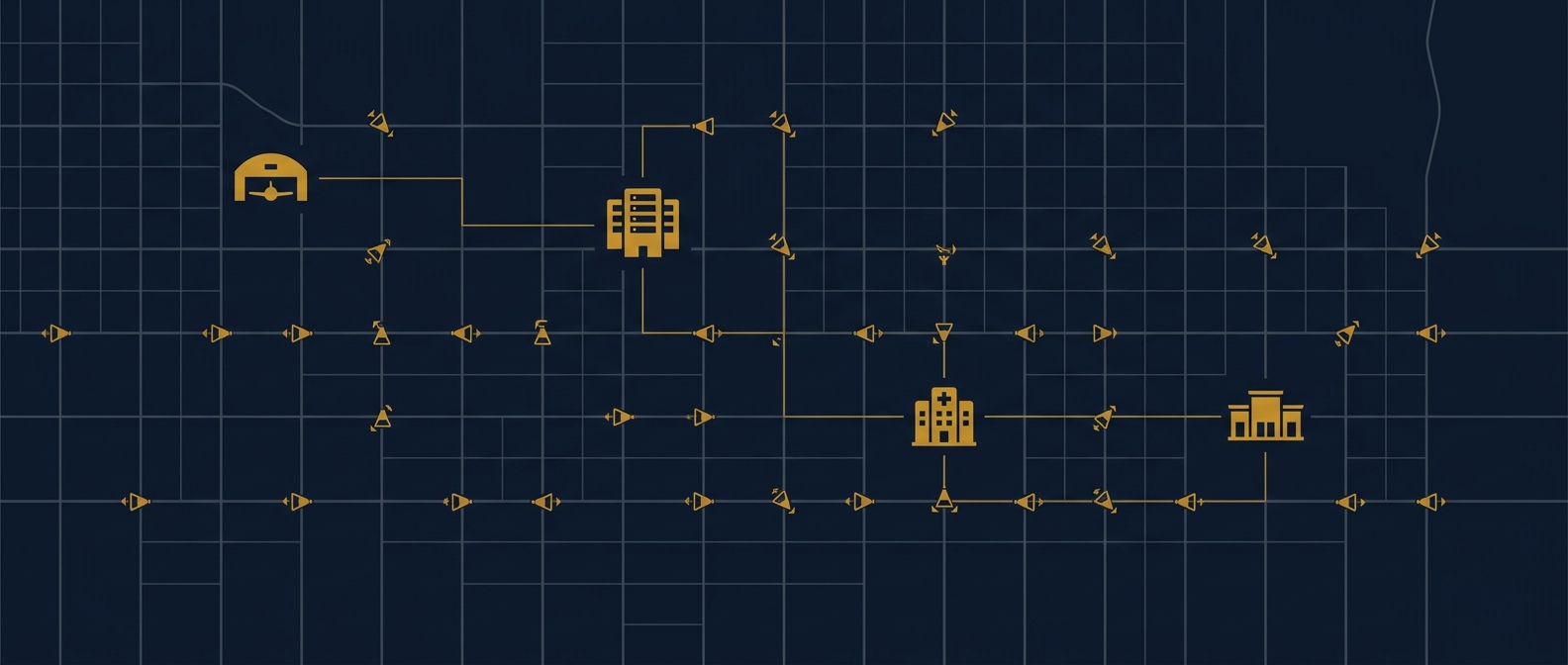
How does Honeybadger scope and run a private surveillance engagement in Mesa?
Every engagement opens with an intake call to define the legal basis for surveillance — a workers’ comp claim under review, a suspected policy violation, a pre-resignation trade-secret concern — because the objective determines what is lawful to observe and where. From there we confirm the subject’s known address, workplace, and routine, and build an observation plan around public vantage points and lawful sightlines, never trespass onto private property or intrusion into a space carrying a reasonable expectation of privacy. Field investigators document every observation with timestamped video and photography, and every report is built to the same evidentiary standard whether it will support an internal HR decision, a claims denial, or courtroom testimony.
Because Mesa spans roughly 138 square miles from Falcon Field to the edge of Apache Junction, we plan routes and hand-offs around the specific corridor a case requires — US-60, Loop 202, or the surface-street grid feeding a subdivision or business park — rather than treating the city as a single uniform footprint. That planning is what keeps an operation both effective and undetected.
How should a Mesa employer or insurer vet a private surveillance company?
Surveillance work is easy to advertise and hard to do well. The checklist below reflects the questions a risk manager, HR director, claims adjuster, or general counsel should ask before engaging any firm for Mesa fieldwork.
- Verify the license. Confirm the firm holds an active Arizona Department of Public Safety agency license under A.R.S. Title 32, Chapter 24, and that individual investigators are properly registered.
- Ask who is actually watching the subject. Determine whether the investigator is an in-house employee or a brokered subcontractor you have never vetted.
- Define the legal basis and objective in writing. A workers’ comp claim, a misconduct policy, or a litigation hold each supports a different lawful scope.
- Confirm the legal boundaries up front. Public vantage points only, no trespass, and compliance with Arizona’s one-party consent rule for any recorded audio.
- Ask how evidence is authenticated. Timestamps, chain of custody, and an investigator willing and able to testify to the methodology.
- Request a sample report format before engaging, so you know what deliverable you are actually buying.
- Understand the cost structure. Hourly rates, minimum blocks, and travel across the East Valley versus a retainer arrangement for recurring referrals.
- Confirm the coordination process. How the firm communicates with HR, claims, or outside counsel during an active engagement.
- Set a review checkpoint. Agree in advance when the engagement will be reassessed, extended, or closed.
- Ask about escalation. Whether the same firm can move into digital forensics or a deeper background investigation if new evidence surfaces.
Frequently asked questions
Are Honeybadger’s Mesa surveillance investigators employees or subcontractors?
They are our own in-house, Arizona-licensed private investigators—not subcontractors or brokered field agents. Arizona is our home command, so the person conducting surveillance in Mesa, Gilbert, or anywhere in the East Valley is a Honeybadger employee operating under our training, supervision, methodology, and chain-of-custody controls, and able to authenticate the work if testimony is required. Outside Arizona we combine in-house personnel with vetted field partners, but in-state the work is owned entirely by us.
Can surveillance footage from Mesa be used as evidence in Arizona court?
Yes, when it is lawfully obtained and properly documented. Footage captured from a public or otherwise lawful vantage point, without trespass onto private property or intrusion into spaces carrying a reasonable expectation of privacy, and preserved with accurate timestamps and an unbroken chain of custody, is generally admissible. Admissibility also turns on authentication under Ariz. R. Evid. 901—establishing the footage is what it purports to be—which is why a licensed investigator who followed a documented method and can testify to it is essential to every engagement we run.
How does Mesa’s layout affect the cost or difficulty of a surveillance case?
Mesa’s scale works both ways. A subject confined to a single master-planned community or retirement neighborhood can sometimes be documented efficiently once a lawful observation point is identified, while a subject commuting the length of the US-60 or Loop 202 corridors, or splitting time between multiple East Valley addresses, requires more investigators, more hours, and more coordinated hand-offs. HOA parking restrictions and extreme summer heat can also add planning time. We scope every engagement to the specific address, route, and objective rather than quoting a flat rate—call to discuss your situation.
Will a subject in a Mesa neighborhood notice they’re being watched?
Not if the operation is run correctly. Remaining undetected is the entire discipline of covert surveillance—using an area-appropriate vehicle, keeping sit-times short in heat-exposed and HOA-monitored neighborhoods, rotating investigators on longer follows, and breaking off before a follow risks exposure rather than pressing for one more frame. A professional operation prioritizes staying invisible over capturing every moment, because once a subject knows they are being watched, their behavior changes and the evidentiary value of the surveillance collapses.
About Honeybadger Solutions
Honeybadger Solutions is an Arizona-licensed security and investigations firm delivering full-spectrum investigations and security services. In Arizona, our surveillance and field investigations are performed by our own in-house, AZ-licensed investigators—not subcontractors—supervised under documented methodology with chain-of-custody controls and court-ready reporting. We operate three Arizona offices—Casa Grande (headquarters), Phoenix, and Oro Valley—serving Mesa and the entire East Valley, all Arizona venues, and, through in-house teams and vetted partners, engagements nationwide and internationally.
Need discreet, lawful, court-ready surveillance in Mesa? Book a consultation online to brief an investigations lead and scope an approach with your counsel. Confidential. Defensible. Arizona-owned.
This article is general information, not legal advice; laws vary and change—confirm specifics with qualified counsel before initiating any surveillance activity. Authoritative references: A.R.S. § 13-3005, interception of communications (Arizona State Legislature), A.R.S. § 13-3012, consent exception (Arizona State Legislature), and Arizona Department of Public Safety — Licensing (private investigators).
Browse by topic
Security guard services · Private investigations · Cybersecurity · Digital forensics · Financial fraud investigation · Executive protection · All articles