
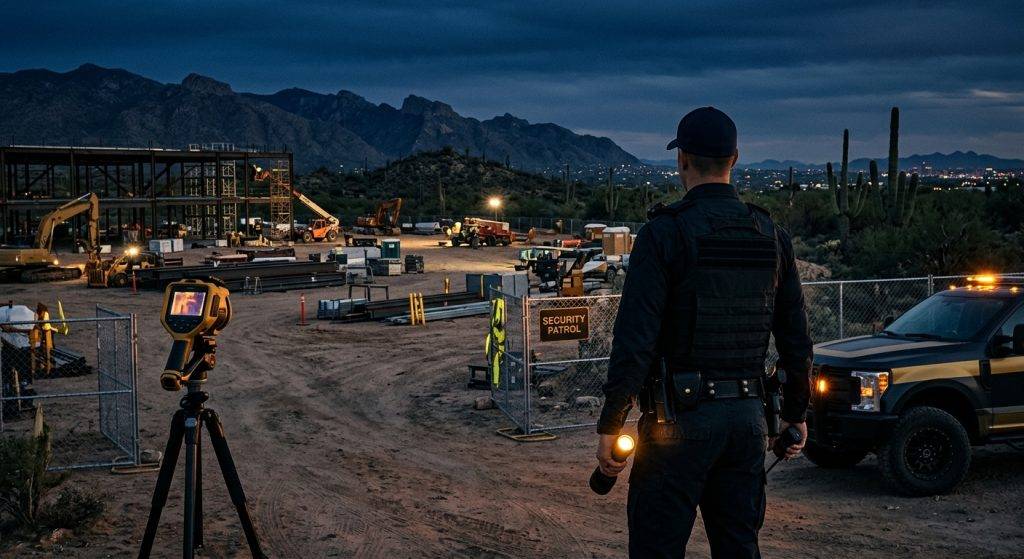
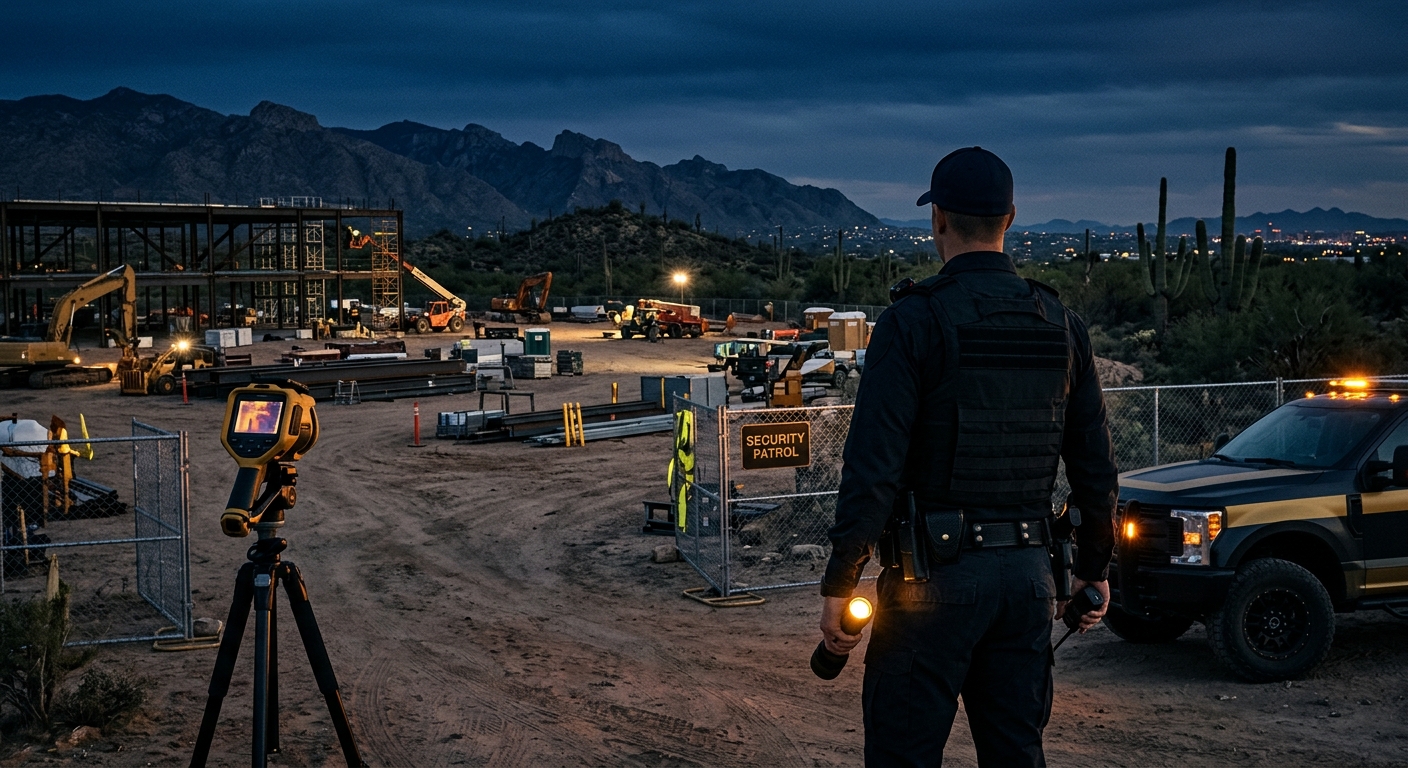
Construction site security in Tucson protects unfinished builds from equipment theft, copper and wire loss, vandalism, arson, and trespass liability by combining hardened perimeters, controlled gate access, lighting, cameras, and licensed guards with GPS-verified patrols. In remote southern Arizona and Oro Valley builds, layered on-site guarding is the most reliable deterrent. Honeybadger Solutions provides Arizona-licensed officers. Book a consultation online.
Covering a Tucson or Southern Arizona project? See our construction site security services in Arizona.
Why is construction theft such a costly problem in Tucson and southern Arizona?
An active construction site is one of the highest-value, lowest-defended targets in any commercial environment. For weeks or months, hundreds of thousands of dollars in heavy equipment, copper wire, lumber, tools, fuel, HVAC units, and pre-installed appliances sit exposed behind nothing more than temporary fencing. The National Insurance Crime Bureau has long documented equipment and cargo theft as a persistent, multi-billion-dollar drain on the construction industry, with heavy machinery recovery rates far lower than for stolen passenger vehicles. When a skid steer or generator disappears from a Tucson jobsite, the direct replacement cost is only the beginning.
The real damage compounds. A stolen piece of equipment idles an entire trade crew, cascades into schedule delays, triggers liquidated-damages clauses, spikes insurance premiums, and erodes the general contractor’s margin on a fixed-price contract. Southern Arizona faces a specific set of pressures: sustained residential and commercial expansion across Tucson, Oro Valley, Marana, Sahuarita, and Vail; a robust market for resale copper and scrap metal; and a landscape of remote desert parcels where a site can sit miles from the nearest occupied structure. Distance is the thief’s ally. A crew that packs up at 4 p.m. leaves a target unwatched for fourteen hours, and on a rural build that isolation is measured in response minutes law enforcement simply cannot deliver.
Which phases of a build are most vulnerable, and what changes at each stage?
Security is not static. The threat profile of a construction project shifts dramatically as the build progresses, and a program that treats month one like month six wastes money early and exposes the owner late. The most expensive losses cluster around the transitions.
During sitework and foundation, the primary targets are diesel fuel, heavy equipment, and GPS-trackable machinery left on site overnight. During framing and structure, lumber and structural steel arrive in bulk and vanish just as easily. The peak-risk window is rough-in through finish: this is when copper wire, HVAC condensers, water heaters, tankless units, plumbing fixtures, and eventually cabinetry and appliances are all on site simultaneously, often unsecured in units that do not yet lock. Copper theft in particular escalates the moment wire is pulled and before drywall closes it in. A single overnight strip-out of copper from a multi-unit project can cost more than the entire security program for the job.
How should a security plan scale across the project timeline?
The correct model is a phased escalation. Below is a representative framework showing how coverage typically intensifies as installed value climbs, then tapers as units are locked and occupied.
| Build Phase | Primary Targets | Recommended Security Posture |
|---|---|---|
| Sitework / foundation | Fuel, heavy equipment, generators | Perimeter fence, equipment immobilization, camera trailer, roving patrol |
| Framing / structure | Lumber, structural steel, hand tools | Gate access control, delivery logging, overnight patrol verification |
| Rough-in (peak risk) | Copper wire, HVAC, plumbing, fixtures | Dedicated overnight guard, analytics-linked cameras, restricted access |
| Finish / punch-out | Appliances, cabinetry, flooring, fixtures | On-site guard, per-unit lockdown, subcontractor access management |
| Turnover / occupancy | Model units, common-area assets | Reduced patrol, alarm response, tapering coverage |
What does layered construction site security actually look like?
No single measure secures a jobsite. Fencing without eyes is climbed. Cameras without response record the crime rather than stopping it. Guards without technology cannot watch a forty-acre parcel alone. Effective protection is layered so that each control compensates for the weaknesses of the others, and so that a determined intruder has to defeat several systems in sequence rather than one. This defense-in-depth philosophy is codified in the standards work of ASIS International, the leading professional body for security management.
- Hardened perimeter. Anti-climb temporary fencing with secured, driven anchor posts, gated at defined entry points only, with materials laydown positioned away from public sightlines and access roads.
- Gate and access control. A single controlled point of entry with a staffed or logged check-in for every person and vehicle, so trade crews, deliveries, and inspectors are all accounted for.
- Lighting. Deterrent-grade illumination across storage areas, entry points, and equipment parking, eliminating the shadow lines intruders rely on.
- Cameras and analytics. Construction camera trailers with motion analytics and after-hours line-crossing alerts, self-powered by solar for remote desert sites without utility drops.
- Licensed on-site and mobile guards. Overnight officers during peak phases and roving mobile patrol across the timeline, providing the human judgment and immediate response that technology alone cannot.
- GPS tour verification. Guards scan checkpoints on documented, timestamped patrol routes, so the owner receives proof of coverage rather than a promise of it.
- Equipment controls. Immobilization, keyed-alike lockups, GPS asset tags, and end-of-day staging that consolidates high-value items into a single defensible zone.
The linchpin is the guard tied to the technology. Analytics generate the alert; the officer verifies and intervenes. For an in-depth look at how staffed protection fits a broader program, see our overview of Honeybadger security services and our approach to industrial and manufacturing site security, which shares much of the same layered logic.
How do you control material deliveries and subcontractor access without slowing the build?
Most jobsite loss is not a masked stranger climbing a fence at 2 a.m. A significant share of shrinkage occurs during daylight hours, through the front gate, mixed into the legitimate churn of trades, deliveries, and vendors. A busy Tucson project may see dozens of subcontractors and material drops in a single day. Without a control layer, no one can say with certainty who was on site, when they arrived, what they brought, and what left with them.
Access management solves this without becoming a bottleneck. Deliveries are scheduled and logged against the purchase order so quantities are verified on arrival rather than assumed. Subcontractor crews check in against the day’s approved trade list. Vehicles exiting with materials are matched to a documented reason. This is not bureaucracy for its own sake; it is the difference between a defensible chain of custody and a black hole. When a shortage surfaces, an access log turns an unsolvable mystery into a narrow, answerable question. Honeybadger officers manage this gate function as a service to the project, not an obstacle to it, keeping trades moving while closing the daylight gap.
What liability does an unsecured Tucson jobsite create beyond stolen property?
Theft is the visible cost. The liability exposure is the one that ends companies. An open construction site is, in the language of premises law, an attractive nuisance — a hazardous environment with trenches, unguarded edges, heavy equipment, and stored materials that predictably draws children and trespassers. When someone is injured on an unsecured site, the property owner and general contractor can face substantial liability even when the entrant had no right to be there. Documented access control and active deterrence are not only loss-prevention tools; they are evidence of the reasonable care that a defense depends on.
Vandalism, arson, and trespass compound the picture. A vandalized electrical rough-in or a set fire does not merely destroy materials — it can trigger re-inspection, structural review, and weeks of delay, and on a desert site far from a fire station, a small fire has time to become a total loss. Guards enforce the perimeter, but they also serve as the presence that keeps casual trespass, squatting, and after-hours dumping from ever escalating. A visible, licensed officer is the single most effective signal that a site is watched and consequences are real.
How does the Sonoran Desert change how security operates around Tucson?
Southern Arizona conditions shape every element of the program. Remote builds in the desert corridors around Oro Valley, Marana, and the outlying Tucson metro often lack utility power, cellular coverage can be marginal, and the nearest patrol car may be twenty minutes out. That environment favors self-sufficient, solar-powered camera trailers, officers equipped and provisioned for isolation, and patrol plans built around genuine response realities rather than urban assumptions.
Then there is the heat. Guarding a Tucson site in July is a genuine occupational hazard, and it is governed by real standards. The Occupational Safety and Health Administration sets expectations for heat-illness prevention — hydration, shade, acclimatization, and work-rest cycles — that a professional security provider must build into overnight and daytime shifts. A warm-body vendor that posts an unprepared officer in 108-degree conditions is creating a safety incident, not preventing one. Honeybadger plans desert deployments with heat mitigation as a first-class requirement, because an officer who is safe and alert is the only officer worth posting.
What about fire watch and hot-work risk on active builds?
Construction involves welding, cutting, torching, and roofing work — collectively “hot work” — that introduces ignition risk into an environment full of combustible materials and, frequently, without functioning fire suppression yet installed. A dedicated fire watch monitors these operations during the work and for the critical period afterward when smoldering ignition can flare. On southern Arizona sites, dry conditions and the distance to emergency response make disciplined fire watch a serious risk-management function, not a formality. Honeybadger integrates fire-watch awareness into its guarding scope; see our fire watch security services in Arizona for how that coverage is structured.
Why does licensing and “elite versus warm-body” guarding matter in Arizona?
Not all guarding is equal, and in Arizona the floor is set by law. Security guards and agencies are regulated under A.R.S. Title 32, Chapter 26, administered by the Arizona Department of Public Safety (AZ DPS), which governs guard registration, agency licensing, and training standards. Any officer on your Tucson site should be properly registered under that framework. Verifying licensing is the baseline of due diligence before a single shift is posted.
Above that legal floor sits an enormous quality gap. A “warm-body” vendor fills a post with the cheapest available headcount, minimal supervision, high turnover, and no accountability layer — the officer who is asleep, absent, or untrained is the one you discover after the loss. Elite guarding means vetted, supervised, and equipped officers, GPS-verified patrols that prove coverage, real field supervision, and a provider that owns the outcome. On a project where a single overnight failure can cost six figures, the price difference between the two models is trivial against the exposure. This is precisely why guarding in Arizona is delivered by Honeybadger’s own in-house, AZ DPS-licensed, supervised officers rather than subcontracted out.
Tucson and southern Arizona builds are served directly from our Oro Valley office, giving projects across the metro a genuine local presence with regional command. For related coverage, see our Tucson security services, and if your project sits in the Valley instead, our dedicated resource on construction site security in Phoenix addresses that market specifically.
Frequently asked questions about construction site security in Tucson
Do I need on-site guards or are cameras enough for my Tucson build?
Cameras deter casual intruders and provide evidence, but on their own they record theft rather than prevent it, and on remote desert sites the response gap means a crime is often complete before anyone arrives. During peak-risk phases — copper rough-in through finish — a licensed on-site or overnight guard paired with analytics-linked cameras is the combination that actually stops loss. The right mix depends on your phase, site isolation, and installed value.
Are Honeybadger’s Tucson construction guards licensed in Arizona?
Yes. Guarding in Arizona is performed by Honeybadger’s own in-house, supervised officers, licensed and registered under A.R.S. Title 32, Chapter 26 as administered by the Arizona Department of Public Safety. Tucson and southern Arizona projects are supported directly from our Oro Valley office, so you get a local presence backed by full agency oversight rather than subcontracted warm-body coverage.
How do you protect a remote desert construction site with no power or reliable cell service?
Remote southern Arizona builds are secured with self-sufficient, solar-powered camera trailers, officers provisioned for isolation, and patrol plans built around real response times rather than urban assumptions. Heat mitigation per OSHA guidance is built into every desert deployment. The program is designed for the distance and conditions of the site, not adapted from a downtown model.
When in the construction timeline should I bring in security?
Ideally before the first high-value equipment or fuel arrives on site. Establishing perimeter, access control, and patrol early sets the deterrent tone and captures the sitework and framing phases. Coverage then escalates through the peak copper and finish phases and tapers as units are locked and occupied. Engaging a provider during planning lets the program be phased to your budget and schedule from day one.
About Honeybadger Solutions
Honeybadger Solutions is an Arizona-licensed security and investigations firm protecting construction, industrial, and commercial sites across Arizona, nationwide, and internationally. Guarding in Arizona is delivered by our own in-house, AZ DPS-licensed, supervised officers. We also provide in-house digital forensics, cybersecurity, financial investigations, and background intelligence. We operate three offices: Casa Grande (headquarters), Phoenix, and Oro Valley — giving Tucson and southern Arizona builds a strong local presence with enterprise-grade command.
Protect your Tucson jobsite before the next delivery arrives. Book a consultation online for a site security assessment.
Browse by topic
Security guard services · Private investigations · Cybersecurity · Digital forensics · Financial fraud investigation · Executive protection · All articles