

Church Security Services Goodyear AZ – House of Worship Protection
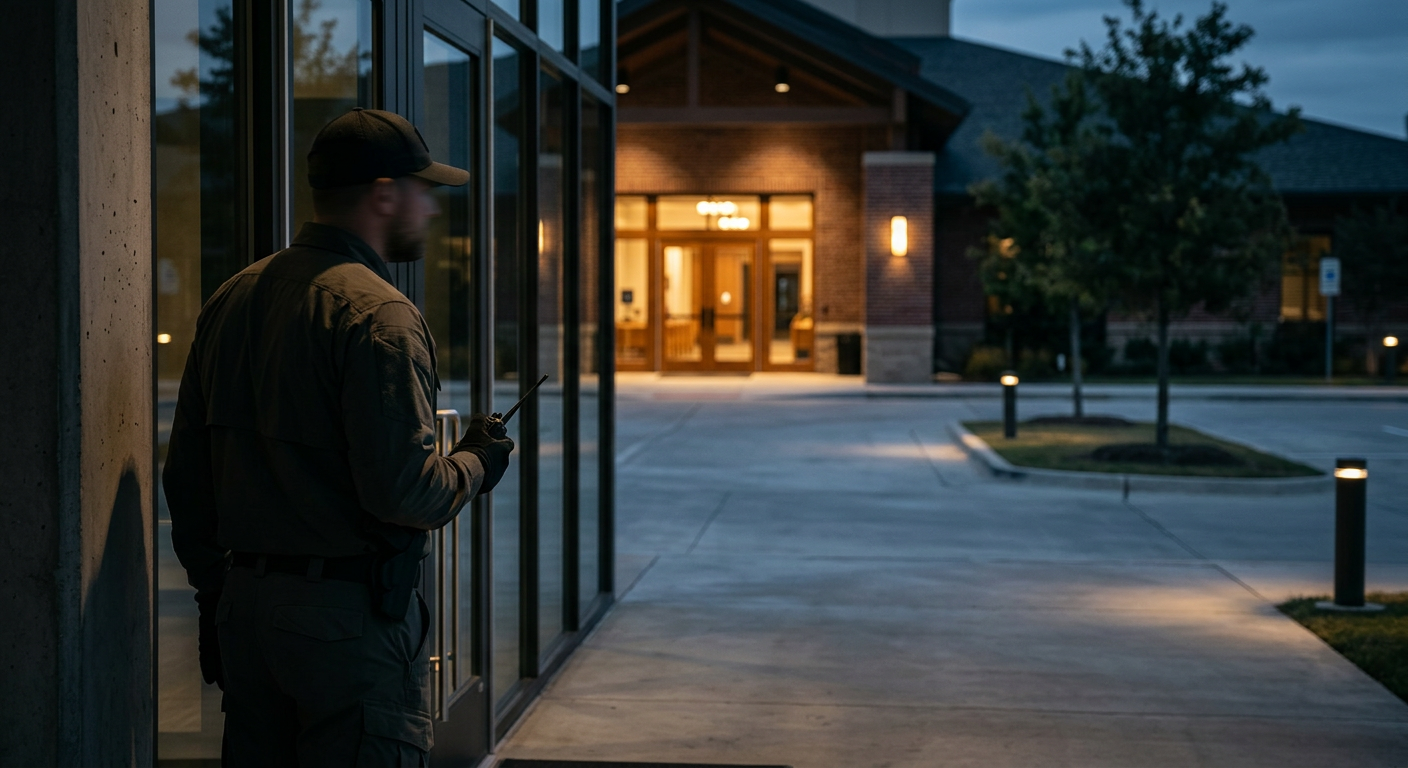
Effective church security in Goodyear, Arizona pairs a trained congregational safety team with licensed professional protection built around a written emergency plan. The goal is layered, discreet coverage—access control, parking-lot and perimeter watch, children’s-ministry safeguards, and a rehearsed medical and active-threat response—that hardens the facility without disrupting worship or making a welcoming faith community feel like a fortress.
Houses of worship occupy a uniquely difficult position in the security landscape. By doctrine and design they are open, welcoming, and predictable—published service times, unlocked doors, and a culture that assumes goodwill from every visitor. Those same qualities are what a determined attacker, a domestic-violence spillover, or an opportunistic thief exploits. For Goodyear’s growing congregations across the Southwest Valley, the mandate is not to abandon that openness but to protect it intelligently. This guide explains how a house-of-worship protection program is actually built and run at a professional standard, what separates a credible provider from a warm body in a polo shirt, and how a Goodyear faith community can stand up a safety program that a court, an insurer, and its own members will respect.
Why do houses of worship face a distinct security challenge?
Faith facilities carry a threat profile that ordinary commercial security playbooks do not address. Federal guidance from the Cybersecurity and Infrastructure Security Agency (CISA) classifies faith-based organizations as soft targets and crowded places precisely because they combine open access, dense occupancy, emotional and family gatherings, and limited on-site protective presence. The risks a Goodyear congregation must plan for are broader than the active-assailant scenario that dominates headlines:
- Targeted violence — the low-probability, catastrophic-consequence event that drives most program funding and training.
- Domestic and relational spillover — a member’s estranged partner or a custody dispute that follows a family onto the property, statistically the most common serious threat a church confronts.
- Disruptive or mentally-distressed individuals — persons in crisis who require de-escalation, not force.
- Child safety — nursery and children’s-ministry check-in integrity, custodial interference, and abuse prevention.
- Property and financial crime — offering and donation theft, vehicle break-ins during services, copper and catalytic-converter theft, and burglary of AV equipment.
- Medical emergencies — cardiac events in an aging congregation are far more frequent than violence and demand a rehearsed response.
A serious program plans for the full spectrum, weighted by probability, not just the scenario that generates fear. The discipline of professional protection is proportionality: putting the most resources against the most likely and most consequential events while preserving the sacred, welcoming character of the space.
What does professional church security look like in Goodyear, Arizona?
Goodyear sits at the fast-growing western edge of the Phoenix metropolitan area, and its faith communities reflect that growth—new campuses in Estrella and Palm Valley, established congregations near Litchfield Park and Avondale, and multi-service churches drawing worshippers from Buckeye, Tolleson, and the wider Southwest Valley. That growth changes the security calculus: larger, less-familiar congregations mean fewer members who recognize a stranger, larger parking footprints to monitor, and higher-attendance holiday services that concentrate risk on a handful of predictable dates.
Arizona is Honeybadger Solutions’ home command, and physical protective operations across the state are directed directly by our leadership rather than brokered out. A Goodyear engagement typically blends licensed, professionally trained officers with the congregation’s own volunteer safety team, coordinated under one written plan and one incident-command structure. The professional element supplies the capabilities a volunteer team cannot reliably self-generate—armed or unarmed licensed coverage, active-threat training to a defensible standard, and liaison with the Goodyear Police Department—while the volunteer team supplies the irreplaceable advantage of members who know the congregation, recognize regulars, and can spot the anomaly a contract officer never would.
Which security staffing model is right for your congregation?
Congregations generally choose among three staffing models. There is no universally correct answer—the right choice is driven by congregation size, budget, risk assessment findings, and the maturity of any existing volunteer team. The table below compares the models against the capabilities that matter.
| Capability | Volunteer team only | National guard-only vendor | Integrated program (professional + trained volunteers) |
|---|---|---|---|
| Congregational familiarity | High | Low | High |
| Licensed armed capability | None / uninsured | Yes | Yes, licensed & insured |
| Active-threat & de-escalation training | Variable / ad hoc | Baseline | Documented to defensible standard |
| Legal & liability protection | Weak — personal exposure | Vendor-covered | Vendor-covered + program governance |
| Continuity when volunteers travel | Fragile | Stable | Stable |
| Cost | Lowest | Highest (full coverage) | Moderate — scaled to risk |
| Local law-enforcement liaison | Rare | Inconsistent | Structured |
For most Goodyear congregations, the integrated model delivers the strongest protection per dollar: professional officers anchor the high-risk positions and provide the licensed, insured armed capability, while a trained volunteer team extends coverage across the campus at a cost the church can sustain year-round. A volunteer-only program is better than nothing but carries real liability exposure; a guard-only program is capable but expensive and can feel impersonal in a worship setting.

How do you build a church security program? A seven-step framework
A protection program is not a guard schedule—it is a governed system that a leadership board can defend and an insurer will recognize. Elite providers follow a repeatable sequence, and any congregation can use this framework to evaluate whether a vendor is selling a genuine program or just bodies.
- Risk and vulnerability assessment. A walk-through of the campus documenting entrances and sightlines, parking-lot lighting, children’s-ministry check-in flow, cash-handling procedures, and gaps against the congregation’s specific threat profile. Everything downstream depends on this baseline.
- Written emergency operations plan. Documented procedures for medical events, fire, severe weather, lost or abducted child, disruptive person, and active assailant—each with clear roles, communication triggers, and evacuation or lockdown decisions.
- Access and layered controls. Managing which doors are open during services, greeter-integrated screening at primary entrances, secured children’s areas, and controlled after-hours access.
- Safety team formation and training. Recruiting, vetting, and training a volunteer team, integrated with professional officers under a single chain of command.
- Law-enforcement and medical liaison. Coordination with the Goodyear Police Department, pre-planned emergency access, and AED placement with trained responders.
- Drills and rehearsal. Tabletop and live exercises so that on the day it matters, the response is muscle memory, not improvisation.
- Review and improvement. Post-incident and post-event debriefs, annual reassessment, and plan updates as the campus and congregation change.
The Federal Emergency Management Agency’s Nonprofit Security Grant Program can offset the cost of many of these hardening measures for eligible faith-based organizations, and a knowledgeable provider will help a congregation understand whether it qualifies. Ask any prospective vendor to show you their assessment methodology and a redacted sample plan—if they cannot, they are not running a program.
How are congregational safety teams trained the right way?
The volunteer safety team is the backbone of sustainable church security, but an untrained team is a liability, not an asset. Professional training converts well-meaning volunteers into a disciplined, legally-aware capability. A defensible curriculum covers:
- Observation and behavioral awareness — recognizing pre-incident indicators and anomalies without profiling, and the practice of reporting concerns through a clear channel.
- De-escalation and conflict management — the single most-used skill, resolving the disruptive-person situation verbally before it escalates.
- Medical response — CPR, AED use, and Stop the Bleed, because cardiac and trauma events are the most frequent life-safety emergencies a team will face.
- Lockdown, evacuation, and reunification — moving a congregation safely and accounting for children and vulnerable members.
- Use-of-force law and documentation — a sober understanding of legal authority, restraint, and the reporting that follows any intervention.
- Communication discipline — radio protocol and the escalation triggers that bring professional officers or police into an unfolding situation.
Training is not a one-time seminar. It is recurring, documented, and rehearsed—because the value of a safety team is realized only in the moments its members have practiced. A provider that certifies a team once and disappears has sold a certificate, not a capability.
How do you protect high-attendance services and special events?
Risk concentrates on predictable dates. Easter and Christmas services, weddings and funerals, festivals, revivals, and community outreach events all draw larger, less-familiar crowds—precisely when a congregation’s ordinary volunteer coverage is thinnest and most distracted. These occasions demand event-grade planning: additional licensed officers, deliberate crowd-flow and parking management, controlled entry points, and a command structure that does not depend on the same volunteers who are also participating in the service.
This is where house-of-worship protection converges with disciplined hospitality and event security: managing a crowd’s arrival and departure, coordinating with venue staff and caterers, and maintaining a discreet but ready protective presence throughout. For funerals involving contentious family dynamics, or weddings for high-profile members, the same principles that govern executive event protection apply—advance planning, defined roles, and a low-visibility posture that keeps the focus on the occasion, not the security.
What separates a world-class house-of-worship protector?
Any agency can post a guard at a door. The difference at the elite level is program discipline and judgment under pressure. A world-class provider assesses before it staffs, trains to a documented standard, carries proper licensing and insurance, and integrates with—rather than replaces—the congregation’s own people. It understands that in a worship setting, a de-escalated situation is a better outcome than a handled one, and that the officer who is never noticed has often done the best work of the day.
Honeybadger Solutions approaches church security as a governed protection program, not a staffing transaction. Our Arizona physical operations run under home command, and a Goodyear engagement can draw on integrated firm capabilities that most guard vendors cannot offer: threat assessment and program design through our security consulting practice, discreet on-site coverage under protective services, and—when a specific threat involves a named individual, a custody dispute, or a credible stalking concern—licensed investigations and background intelligence to understand the actual risk before it reaches the sanctuary doors. That integration lets a congregation address a threat at its source rather than only reacting to it at the property line.
Which Goodyear and Southwest Valley communities do you serve?
From our Arizona home command and three offices—Casa Grande (headquarters), Phoenix, and Oro Valley—Honeybadger Solutions provides house-of-worship protection throughout Goodyear and the surrounding Southwest Valley, including Avondale, Buckeye, Litchfield Park, Tolleson, and the Estrella and Palm Valley communities. Coverage extends across the greater Phoenix metropolitan area and all of Arizona, with the same program discipline whether the congregation is a small community church, a religious school, or a multi-service campus. Consultations are discreet, and every engagement begins with an assessment—never a boilerplate quote.
Frequently asked questions
Does armed security belong in a church?
It is a decision each congregation makes based on its risk assessment, culture, and leadership judgment. Where armed coverage is chosen, it should be provided by licensed, insured, properly trained officers operating under a written use-of-force policy—not by well-meaning but uninsured volunteers carrying personally. Many congregations opt for a blend: discreet armed professional coverage at key positions, supported by an unarmed volunteer safety team focused on observation, hospitality, and de-escalation.
Can a volunteer safety team replace professional security?
A trained volunteer team is valuable and, for many small congregations, a sound foundation—but it cannot fully replace professional capability. Volunteers rarely carry the licensing, insurance, active-threat training, and legal protection that a professional program provides, and coverage becomes fragile when members travel or are unavailable. The strongest model integrates a trained volunteer team with professional officers under one plan, combining congregational familiarity with professional discipline.
How much does church security cost in Goodyear?
Cost is driven by the level of coverage (armed versus unarmed), the number of officers, hours and service frequency, campus size, and whether the engagement includes program design and safety-team training. Many congregations start with a risk assessment and event-based coverage for high-attendance services, then scale to a sustained program. Eligible faith-based organizations may offset hardening costs through the federal Nonprofit Security Grant Program, which a knowledgeable provider can help you navigate.
How quickly can you provide security for a special service or event?
For a specific event such as a holiday service, wedding, or funeral, professional coverage can typically be arranged on short notice from our Arizona home command, subject to scheduling and a brief planning conversation. Standing programs, by contrast, begin with a risk assessment and plan so that coverage is designed rather than improvised. We recommend engaging as early as possible for high-attendance services, when advance planning materially improves the outcome.
About Honeybadger Solutions
Honeybadger Solutions is an Arizona-licensed security and investigations firm serving Goodyear, the Southwest Valley, all of Arizona, and clients nationwide and internationally. Arizona is our home command for physical protective operations. We pair in-house, remote-by-design digital forensics, cybersecurity, financial investigations, and background intelligence with our own in-house, AZ-licensed field investigators and protective officers in Arizona, extended by a commanded network of vetted partners for protective operations outside the state. Our house-of-worship practice is built as a governed program—assessed, documented, trained, and rehearsed—so faith communities can protect what matters without sacrificing the welcome at their doors.
Three offices: Casa Grande (headquarters), Phoenix, and Oro Valley. Discreet consultations available.
Call: 602-725-2818
This article is educational and not legal advice. Security decisions, use-of-force policy, and firearms carry in places of worship are governed by law that varies by jurisdiction; consult qualified counsel and licensed professionals about your congregation’s specific situation.