
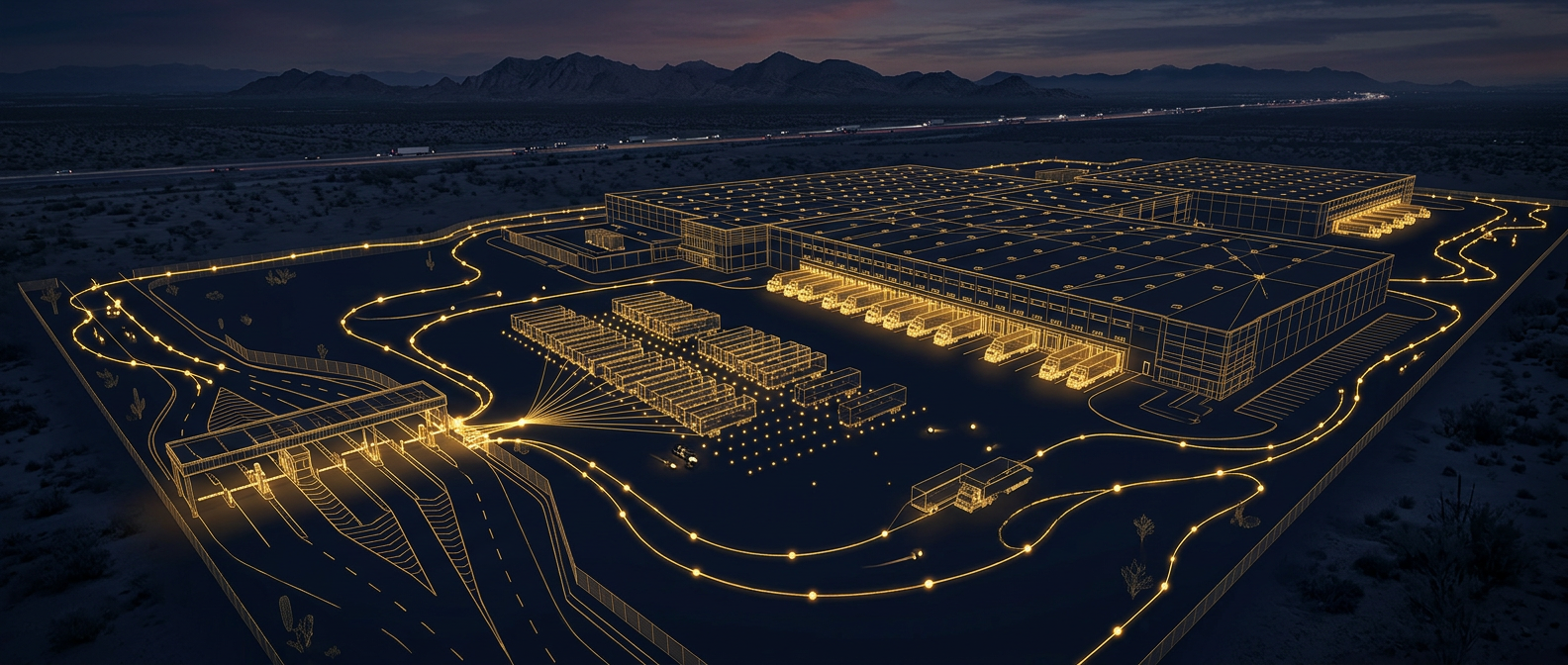
Warehouse and distribution-center security services in Phoenix protect cargo, inventory, people, and property across the gate, dock, yard, and floor of a facility. Honeybadger Solutions deploys its own in-house, Arizona-licensed uniformed officers for access control, dock and yard supervision, and mobile patrol, paired with CCTV integration and in-house investigations for shrink, cargo theft, and internal diversion along the Valley’s I-10 and Sky Harbor logistics corridor.
Phoenix has become one of the most important logistics markets in the United States, and with that growth comes a concentrated, high-value theft target. For distribution-center directors, 3PL operators, cold-storage managers, and loss-prevention leaders, the question is no longer whether a facility needs professional security, but how to build a program that actually reduces loss without slowing throughput. This guide explains how enterprise-grade warehouse security is designed and delivered in the Phoenix metro: why the corridor concentrates risk, where cargo and internal theft occur, how gate, dock, and yard controls work, and how uniformed guarding connects to the investigations that recover value when loss happens anyway. It is general operational guidance, not legal advice.
Why is Phoenix a logistics hub, and what does that mean for risk?
The Valley of the Sun sits at the intersection of Interstate 10 and Interstate 17, on the primary freight lane between the Ports of Los Angeles and Long Beach and the interior of the country. Add Phoenix Sky Harbor International Airport’s air-cargo operations, a rapidly expanding base of e-commerce fulfillment centers, refrigerated and cold-storage facilities serving grocery and pharma, and a dense cluster of third-party logistics (3PL) providers, and you have millions of square feet of high-velocity inventory moving through the metro every day. West Valley submarkets around Goodyear, Buckeye, Tolleson, and the I-10 corridor, along with the Deer Valley and Sky Harbor cargo zones, hold some of the largest distribution footprints in the Southwest.
Concentration of goods is concentration of risk. A single trailer of consumer electronics, pharmaceuticals, or branded apparel can be worth six or seven figures, and freight sitting in a staging yard is a static, high-value target. National authorities including the CISA Transportation Systems Sector and the National Insurance Crime Bureau (NICB) track cargo theft as a persistent and evolving threat, including a sharp rise in strategic theft — fictitious pickups and identity fraud, not just physical break-ins. For a Phoenix facility, that means the perimeter, the gate, the dock, and the paperwork are all attack surfaces that a serious security program has to cover at once.
What are the biggest external cargo and inventory theft threats?
External theft against a distribution center rarely looks like a movie heist. The most damaging losses tend to be quiet and procedural. The recurring external threats we design against in Phoenix include:
- Straight (physical) cargo theft — trailers or containers stolen from an unsecured yard, or product taken during a break-in through a fence line, roof, or dock door after hours.
- Strategic theft and fictitious pickups — criminals using stolen or spoofed carrier identities, forged paperwork, and social-engineering to arrive at the gate and drive off with a full load that was released to them because the controls failed, not the fence.
- Pilferage in transit and at the dock — cartons skimmed from pallets during loading, seals broken and re-applied, or product diverted during the handoff between yard and truck.
- Perimeter and after-hours intrusion — fence breaches, tailgating through vehicle gates, and exploitation of blind spots along large, poorly lit footprints.
- Organized retail crime (ORC) sourcing — professional crews targeting specific high-theft SKUs for resale, treating a DC as a wholesale source.
The countermeasure to strategic theft is not more muscle at the fence — it is verification at the gate. A trained, Arizona-licensed officer who confirms carrier identity, checks the pickup number against the shipping system, validates the driver and tractor against the appointment, and refuses to release a load on paperwork that does not reconcile stops the single most expensive class of modern cargo loss. Physical guarding and procedural discipline have to work together, which is why our uniformed post and our investigative teams are part of one program. See our broader transportation and cargo security capability for how this extends across the supply chain.
How do internal theft, collusion, and diversion happen?
Industry loss-prevention data has long held that a large share of warehouse shrink originates inside the fence — employees, temporary labor, and insiders working in collusion with drivers or outside crews. Internal loss is harder to see than a broken fence because it hides inside normal operations. Common patterns include:
- Collusion at the dock — a loader and a driver agreeing to put extra, unmanifested product on a truck, or to under-count a return.
- Systemic diversion — falsified receiving counts, manipulated cycle-count adjustments, or “damaged/destroyed” write-offs that mask product walking out the door.
- Sweethearting and grazing — small, repeated, low-visibility theft that compounds into major annual loss.
- Data and access abuse — misuse of the warehouse management system (WMS) to hide shortages, reroute inventory, or create ghost adjustments.
- Vendor and temp-labor fraud — short shipments, inflated invoices, or planted insiders during peak-season staffing surges.
This is where a security provider that is also an investigations firm changes the outcome. When shrink patterns emerge, Honeybadger’s in-house financial investigations, digital forensics, cybersecurity, and background-intelligence teams can support a discreet internal inquiry — reconciling WMS records, examining device and access-log activity, and reconstructing how product and paperwork diverged — while our uniformed officers maintain daily deterrence at the physical control points. Employee and vendor background checks, run in-house, close the gap before a bad actor is ever placed near high-value inventory.
What do gate, dock, and yard controls actually cover?
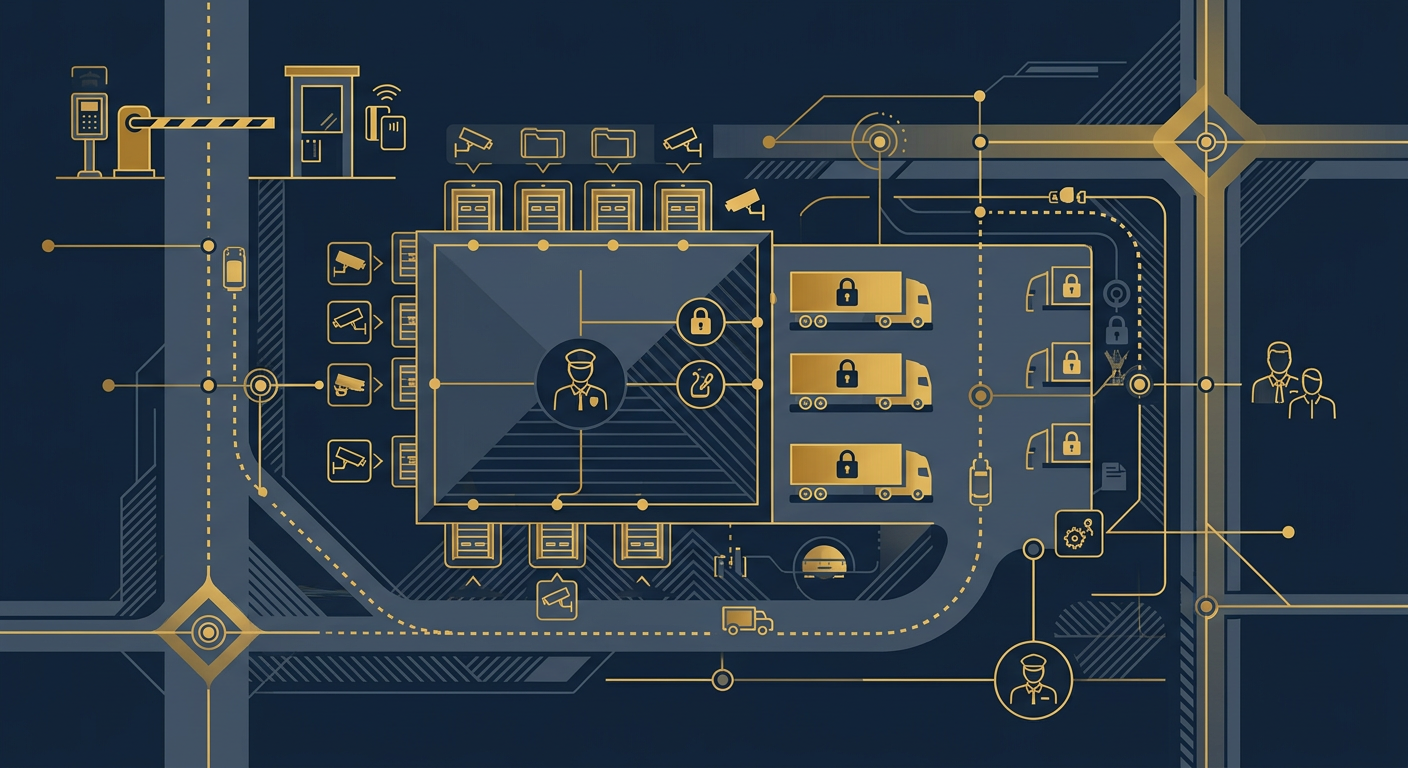
A distribution center is not one environment but several, each with a different dominant threat and a different control. Effective security assigns the right measure to the right zone rather than treating the whole footprint as a single perimeter. The table below maps the primary warehouse zones to their leading threat and the controls Honeybadger deploys.
| Warehouse zone | Primary threat | Primary control |
|---|---|---|
| Vehicle gate / entry | Fictitious pickups, tailgating, unauthorized entry | Manned access post, carrier and appointment verification, inbound/outbound log, seal checks |
| Loading docks | Collusion, pilferage, seal tampering, over-loading | Dock supervision, load/seal verification against manifest, CCTV coverage of every door |
| Trailer / container yard | Trailer theft, unsecured high-value freight | Mobile patrol, yard checks, king-pin/landing-gear locks, lighting and camera sweeps |
| Warehouse floor | Internal grazing, diversion, WMS manipulation | Access zoning, supervised high-value cage, cycle-count integrity, investigation support |
| Office / admin | Data abuse, credential misuse, social engineering | Visitor management, badge control, cyber and forensic support for insider cases |
The gate is the single highest-leverage post. Every load that leaves and every visitor who enters passes through it, so a disciplined, well-trained officer there prevents more loss per hour than any other measure. Docks and yards are where value is most exposed and most in motion, which is why they get continuous supervision rather than periodic checks.
How does access control and visitor and driver management work?
Access control is the backbone of a defensible warehouse. The goal is simple to state and hard to execute: only authorized people and vehicles enter, everyone is accounted for, and every high-value movement is verified against a record. In practice, a Honeybadger-managed access program covers:
- Driver and carrier verification — matching the driver, tractor, and trailer to the scheduled appointment and pickup authorization before any load is released, the core defense against fictitious pickups.
- Visitor management — pre-registration where possible, positive ID on arrival, badging, escort rules for non-employees, and a complete visitor log that survives audit.
- Employee and contractor access zoning — restricting floor, cage, and dock access to those whose role requires it, so a high-value area is never a general-traffic area.
- Inbound and outbound logging — a reconcilable record of every vehicle, seal number, and load, integrated with the client’s WMS or TMS where available.
- Credential and badge discipline — deactivation on termination, no shared badges, and prompt escalation of anomalies.
Because our officers are our own employees, access procedures are enforced consistently across every shift rather than varying with whichever contract body happened to be posted that day. That consistency is what turns a written policy into an actual control.
Why does a large yard need mobile patrol?
Phoenix distribution facilities routinely span dozens of acres with long fence lines, extensive trailer yards, and multiple building faces. A single fixed post cannot see all of it, and the summer heat and extended after-hours periods create long windows of low activity that intruders exploit. Mobile patrol closes that gap. Our Arizona-licensed patrol officers conduct randomized, logged sweeps of the perimeter, trailer yard, dock aprons, and parking areas, checking trailer locks and seals, verifying gates are secured, identifying lighting and fence failures, and providing a visible, unpredictable deterrent that a static camera alone cannot. Randomized timing matters: a patrol that arrives at the same minute every hour is a schedule a thief can plan around, while an unpredictable one is a genuine risk. This capability parallels the perimeter work in our industrial and manufacturing security programs.
How does CCTV, alarm, and technology integration fit in?
Technology multiplies officers; it does not replace them. A camera records a theft, but a trained officer prevents one and a reviewed alarm dispatches a response. Honeybadger integrates the human post with the technology stack so each strengthens the other. That means officers who actively monitor CCTV covering every dock door, gate, and yard lane rather than treating cameras as an after-the-fact archive; alarm and access-control response protocols so an intrusion or forced-door event triggers a verified, documented reaction instead of a false-alarm shrug; and camera coverage designed to eliminate the blind spots along blind corners, high-value cages, and trailer rows. When an incident does occur, our digital-forensics team can preserve and analyze video and system data to an evidentiary standard, so footage supports recovery, insurance, and, if needed, prosecution rather than being lost or overwritten.
How do loss prevention and investigations connect?
Guarding reduces the probability of loss; investigations recover value and close the vulnerability when loss happens anyway. Most security vendors can only do the first. Honeybadger is a licensed investigations firm as well as a guarding provider, so the same organization that runs your gate can run the inquiry when shrink spikes, a load goes missing, or a diversion pattern surfaces. Our in-house financial investigators trace the money and the inventory discrepancy; our digital-forensics examiners recover device, WMS, and access-log evidence; our background-intelligence team vets the people and vendors involved; and our cybersecurity specialists address the system abuse that often accompanies insider diversion. Because it is all one firm, findings from an investigation feed directly back into the physical program — tightening the exact control that failed. Explore the full range of our security services to see how guarding and investigations combine.
What does Arizona licensing and liability require?
Security guard agencies and their officers in Arizona are licensed and regulated by the Arizona Department of Public Safety under Arizona Revised Statutes Title 32, Chapter 26. That framework establishes agency licensing, guard registration, training, and background-qualification requirements, and it is the baseline for a defensible, insurable operation. Using properly licensed officers is not a formality — it directly affects liability. If an incident leads to a claim or litigation, a program staffed by trained, registered, supervised officers operating under documented post orders stands on very different footing than one relying on unvetted or improperly licensed labor. In Arizona, Honeybadger’s officers are our own in-house, AZ-licensed, supervised personnel, which keeps accountability and the standard of care under our direct control.
How does Honeybadger deliver a Phoenix warehouse security program?
We build each program to the facility, the inventory value, and the throughput it has to protect, aligned with recognized physical-security practice such as the standards and guidelines published by ASIS International. A world-class distribution-center security and loss-prevention program follows a repeatable sequence:
- Risk and site assessment. Walk the gate, docks, yard, floor, and perimeter; map high-value SKUs, choke points, blind spots, and current loss data.
- Threat and shrink analysis. Distinguish external, internal, and procedural exposure, and quantify where loss is actually occurring versus where it is assumed.
- Post orders and access design. Write specific, enforceable procedures for gate verification, dock supervision, visitor management, and load release.
- Officer deployment. Staff the gate, docks, and mobile patrol with our own AZ-licensed, trained, supervised officers matched to the facility’s hours and risk.
- Technology integration. Align CCTV, alarms, and access control with the human posts so cameras are monitored and alarms are answered.
- Background screening. Vet employees, temporary labor, and vendors before they reach high-value inventory.
- Continuous logging and reporting. Maintain reconcilable inbound/outbound, visitor, and patrol records that survive audit and support claims.
- Incident response and investigation. Trigger a documented response to intrusions and losses, with in-house forensic and financial investigation on standby.
- Metrics and review. Track shrink, incidents, and near-misses against a baseline, and report to management on a fixed cadence.
- Program refinement. Feed investigation findings and metrics back into post orders and controls, closing the specific gaps that produced loss.
Consider a representative scenario: a West Valley 3PL near the I-10 corridor noticed recurring shortages on outbound electronics loads. A reconcilable gate log and dock supervision were introduced, carrier verification was enforced before any release, and mobile patrol began randomized yard sweeps. When a pattern still pointed inward, an internal inquiry reconciled WMS adjustments against dock video and access logs and isolated where product and paperwork diverged. This is an illustrative example, not a named client, but it reflects how physical posts and investigative capability together resolve loss that guarding alone would only slow.
Honeybadger serves distribution centers, fulfillment operations, cold-storage sites, and 3PL yards across the entire Phoenix metro — including the I-10 West Valley corridor, the Sky Harbor air-cargo district, Deer Valley, Goodyear, Buckeye, Tolleson, Chandler, and Mesa — directed from our Phoenix office and coordinated statewide alongside our Casa Grande headquarters and Oro Valley office. For staffing detail specific to guarding, see our Phoenix security guard services and our dedicated warehouse and distribution-center security overview.
Frequently asked questions
Does Honeybadger use its own officers for Phoenix warehouse security?
Yes. In Arizona, our uniformed security officers, gate and dock posts, and mobile patrol are our own in-house, Arizona-licensed, supervised personnel — not subcontractors or a brokered guard network. Arizona is our home command, so the officers protecting your distribution center operate under our training, post orders, supervision, and accountability, which keeps quality and the standard of care under our direct control across every shift.
How do you stop fictitious pickups and cargo theft at the gate?
The gate is the highest-leverage control point. Our officers verify the driver, tractor, and trailer against the scheduled appointment and pickup authorization, confirm the pickup number in the client’s shipping system, check seals, and log every inbound and outbound movement. A load is not released on paperwork that does not reconcile. This procedural discipline is the primary defense against strategic theft and fictitious pickups, which now account for a large share of modern cargo loss.
Can you investigate internal theft and inventory shrink, not just guard the site?
Yes. Honeybadger is a licensed investigations firm as well as a guarding provider. When shrink or diversion surfaces, our in-house financial investigators, digital-forensics examiners, cybersecurity specialists, and background-intelligence team can support a discreet internal inquiry — reconciling WMS records, examining device and access-log activity, and vetting people and vendors — while our officers maintain physical deterrence. Findings feed back into the security program to close the control that failed.
Are your Arizona security officers licensed?
Yes. Security agencies and guards in Arizona are licensed and regulated by the Arizona Department of Public Safety under A.R.S. Title 32, Chapter 26, which sets agency licensing, guard registration, training, and background requirements. Our Phoenix warehouse officers are our own AZ-licensed, registered, supervised personnel operating under documented post orders — a baseline that directly supports both operational quality and defensible liability posture.
About Honeybadger Solutions
Honeybadger Solutions is an Arizona-licensed security and investigations firm. In Arizona, our uniformed security officers, gate and dock posts, and mobile patrol are our own in-house, Arizona-licensed, supervised personnel — not subcontractors. Digital forensics, cybersecurity, financial investigations, and background intelligence are run in-house and delivered worldwide, supporting shrink and diversion investigations. We serve all of Arizona and support clients nationwide and internationally.
Offices: Casa Grande (HQ), Phoenix, and Oro Valley, Arizona.
Phone: 602-725-2818
Confidential consultation: speak with our command team about a Phoenix warehouse or distribution-center security program.