
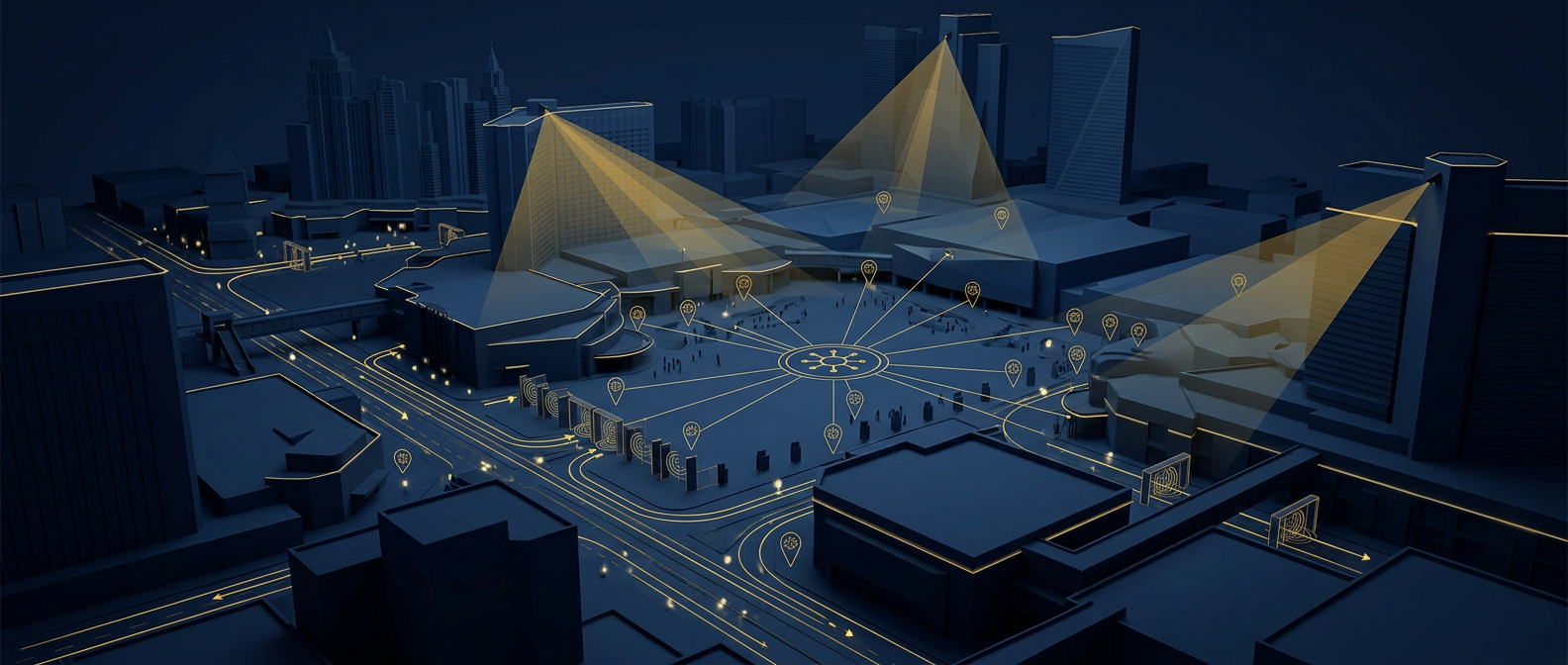
Corporate, casino, and event security in Las Vegas is the coordinated protection of guests, executives, and assets across the city’s integrated resorts, convention halls, arenas, and outdoor event footprints. It brings crowd management, layered credentialing and access control, integrated surveillance, protective intelligence, and executive protection together under a single accountable command — purpose-built for a destination that packs enormous transient crowds, high-value principals, cash-intensive gaming, and world-scale conventions into a few square miles of the Strip.
No American city runs on density and spectacle the way Las Vegas does. The Las Vegas Convention Center anchors the busiest trade-show market in the United States, and the Consumer Technology Association’s CES alone draws well over a hundred thousand attendees to the city each January. The Strip stacks tens of thousands of hotel rooms, gaming floors, nightclubs, and showrooms into a single corridor, and the modern event calendar now runs from a Formula 1 street circuit to a domed stadium that has hosted the Super Bowl, arena residencies, and the Sphere. For counsel, an events director, a family office, or a resort risk committee, that concentration is at once the draw and the danger. This guide sets out what elite corporate and event security actually looks like in the Las Vegas market, the Nevada gaming and licensing framework that governs it, and how a sophisticated buyer should scope and procure it.
Why is Las Vegas its own security environment?
Las Vegas is not a conventional venue market that happens to have casinos bolted on; it is an engineered visitor economy running at a scale and tempo that rewrites the underlying security math. On a peak convention weekend, the transient population circulating through the resort corridor can rival a major metropolitan area — and almost none of those people could find an emergency exit if pressed. Visitors are overwhelmingly from out of town, moving around the clock, frequently celebrating or intoxicated, and often carrying meaningful cash and valuables. That profile inflates every crowd-dynamics, theft, and medical risk before a single deliberate threat enters the calculation.
Sitting on top of that is a vertical geometry unique to the Strip. Integrated resorts stack thousands of guest rooms directly above open gaming floors, pool decks, and outdoor event spaces, producing elevated sightlines and access-control problems that flat convention venues never encounter. Then add the desert itself — triple-digit summer heat that converts crowd density into a mass-medical emergency, along with the wind and monsoon bursts that jeopardize outdoor staging. Extreme density, a disoriented visitor population, cash-heavy gaming, marquee principals, and stacked vertical real estate combine into an operating picture with no equivalent in a routine guard posting elsewhere.
What threats define corporate and casino event security in Las Vegas?
A serious program prepares for the entire range, not just the headline scenario. Crowd crush and progressive-density failures — statistically the most probable route to mass casualties at any large gathering — head the list, and they stem from design and management shortcomings rather than acts of violence. Beneath them sit targeted attacks on a soft target, intoxication-driven altercations, heat-driven medical surges, organized theft and fraud aimed at high-spend guests, credential forgery and intrusion into back-of-house and VIP zones, protective-intelligence threats against executives or performers, and the reputational and legal wreckage that trails any of them.
The U.S. Cybersecurity and Infrastructure Security Agency places hotels, casinos, arenas, and mass gatherings squarely in the category of soft targets and crowded places — environments that are inviting to an attacker for the same reason they are commercially successful: they gather large numbers of people in accessible space. For a corporate host or a resort operator, the takeaway is blunt. A uniformed guard at the entrance is not a security program. Protection in this market is a chain: protective intelligence and advance assessment before the event, credentialing and trained personnel across the footprint, surveillance coverage overhead, and drilled medical and evacuation capability for the seconds when something breaks.
How does Nevada gaming regulation shape security on and off the floor?
What sets Las Vegas apart is that a large share of its security posture is not discretionary — it is compelled by one of the most exacting gaming-regulatory regimes on earth. The Nevada Gaming Control Board and the Nevada Gaming Commission require licensed establishments to run surveillance systems that monitor and record gaming activity, cash-handling areas, and the cage and count room to prescribed technical standards. Because of that mandate, a corporate event, convention, or private function hosted inside an integrated resort takes place on top of a permanent, professionally staffed surveillance and security backbone — the famous “eye in the sky” — that freestanding venues in other cities simply do not have behind them.
For a discerning buyer, that cuts in two directions. It is a genuine asset: the host property already operates continuous surveillance, trained security staff, and rigorous cash-protection controls, so a well-designed event program plugs into that backbone instead of rebuilding it. But it also elevates the standard of care. Regulators, insurers, and plaintiffs’ experts all judge operators against a documented, auditable benchmark, so an event layered onto a licensed floor has to interlock cleanly with the resort’s surveillance room, security command, and compliance obligations. The discipline that protects the games — written procedures, defined controls, and audit-readiness — is exactly the discipline that should govern the event on top of them.

What did October 1, 2017 permanently change about Strip event planning?
On October 1, 2017, a gunman firing from a high floor of a Strip hotel into an outdoor festival crowd inflicted the deadliest mass shooting in modern U.S. history. It permanently altered how professionals approach open-air events in Las Vegas. The lesson was never that outdoor events cannot be made safe; it was that any threat model for a Strip venue has to reckon with elevated firing positions, adjacent towers, and lines of sight that ground-level venues never face. Advance work here now routinely inventories overlooking buildings and floors, grades line-of-sight exposure across a footprint, and feeds those findings into stage placement, crowd orientation, overwatch, and evacuation routing.
The tragedy also hardened two disciplines that preserve life regardless of the threat vector: fast, rehearsed evacuation and pre-negotiated coordination with public safety. When thousands of unfamiliar people have to clear a space in seconds, survival hinges on whether egress routes were engineered and staffed, whether every worker knew their assignment, and whether command relationships with law enforcement and EMS were locked down before the gates opened. A credible Las Vegas program treats these as baseline requirements, not contingencies — and records them, so the duty of care can be evidenced long after the event closes.
How do Strip venue types change the security priority?
The Las Vegas event landscape is anything but uniform, and the strongest programs tailor controls to the specific venue and format rather than reusing one template. A convention floor, a casino ballroom, an arena or domed stadium, an outdoor festival or street-circuit footprint, and a private high-profile function each present a different dominant hazard, a different relationship to the licensed gaming floor beneath or beside them, and a different point where resources should concentrate. The matrix below frames the distinctions a sophisticated buyer should absorb before scoping a detail.
| Venue / format | Defining Las Vegas challenge | Relationship to the licensed floor | Where the program concentrates |
|---|---|---|---|
| CES-scale convention (LVCC) | Colossal throughput, credential forgery, prototype and IP exposure | Adjacent to, not on, the gaming floor — own screening posture required | Credential lifecycle, zoned circulation, exhibitor-booth asset protection |
| Casino ballroom / resort gala | Intoxication incidents, VIP exposure, valuables and cash on hand | Runs directly on top of the surveilled floor | Tight integration with the eye-in-the-sky, discreet close protection |
| Arena / domed stadium residency | Concentrated mass density, screening bottlenecks, targeted violence | Separate secured envelope with its own command | Metered ingress, weapons screening, overwatch, reunification staging |
| Outdoor festival / F1 street circuit / pool deck | Elevated sightlines, crowd surge, desert heat and wind | Open footprint overlooked by guest towers | Line-of-sight survey, density metering, heat and weather triggers |
| Executive residency / private high-profile function | Directed threat, intrusion, discretion and reputational risk | Movement across public gaming space between private zones | Advance work, access vetting, counter-surveillance, secure transport |
The costly mistake is a mismatch between posture and hazard — ringing an event with visible guards when the real exposure is an ingress bottleneck, or staffing one greeter for a principal who needed a vetted protective detail. Fitting the control to the actual risk is what divides a defensible program from expensive theater.
How do you plan security for a CES-scale convention or major Strip event?
Elite event security is an advance-planning craft, not a day-of headcount. The work that keeps incidents from happening is done in the weeks before the doors open. The checklist below reflects how a world-class program is assembled for the specific realities of the Las Vegas environment, sequenced the way the work actually unfolds and aligned with recognized practice for crowded places and life safety.
- Protective intelligence and threat picture. Build a profile of the event, the audience, the principals, and the site, then run open-source and social monitoring for named or emerging threats, contentious speakers or brands, and any incident history at the property.
- Elevated-threat and line-of-sight survey. The Strip signature step — map every overlooking tower, floor, and structure, grade sightline exposure across any open footprint, and let those findings dictate stage placement, crowd orientation, and overwatch positions.
- Integration with the eye-in-the-sky. Sit down with the resort surveillance room, security command, and compliance team early so the event plan reinforces the licensed floor’s permanent infrastructure rather than running blind alongside it.
- Occupancy, density, and egress engineering. Compute capacity, density, and flow; identify entrances, exits, and choke points; and lay out ingress, circulation, and emergency egress against life-safety capacity — the discipline codified in the NFPA 101 Life Safety Code.
- Credentialing and zoned access. Establish zones spanning public, attendee, exhibitor, gaming, back-of-house, and VIP space; issue tamper-resistant credentials; and staff verification and screening points scaled to the threat and the expected throughput.
- Heat, hydration, and mass-medical staging. Size medical resources for both the crowd and the desert climate, position hydration and cooling for high-heat windows, and pre-stage transport for a heat-driven medical surge.
- Metro, fire, and EMS liaison. Set command relationships and communications with Las Vegas Metropolitan Police, Clark County Fire, and EMS before the event, so the response is unified rather than improvised when seconds count.
- Staffing model and post assignments. Fix the number, placement, and skill mix of personnel — uniformed presence, plainclothes, supervisors, and specialist roles — with defined posts, rotations, and clear spans of control.
- Executive and celebrity-principal protection. Layer close protection, secure arrival and departure, counter-surveillance, and protective intelligence for principals whose profile demands it, woven into the venue plan rather than bolted on afterward.
- Command post, communications, and after-action record. Operate from one command point on resilient communications, log every decision and incident in real time, and produce an after-action review that both sharpens the program and documents the duty of care.
What ties the checklist together is proof and practice. A plan that lives only in a single manager’s memory, or that has never been walked end to end with EMS and the resort’s surveillance command, collapses the moment it is stressed — and leaves nothing to stand on when the exposure is examined afterward.
How do Nevada premises liability and licensing set the legal standard?
In Nevada, a hotel, casino, or venue operator owes its guests — business invitees — a duty to exercise reasonable care to keep the premises safe, and that duty can reach as far as protecting them against foreseeable criminal acts by third parties. Negligent-security claims hinge on foreseeability: where prior incidents, the surrounding environment, or the nature of the event made harm reasonably foreseeable and the operator failed to act reasonably, liability can follow. For a high-occupancy Strip property or a large ticketed event, that threshold is easily crossed, and the exposure from one serious incident can be existential. Documented, reasonable security is therefore both the best safeguard for guests and the sturdiest defense in litigation.
Licensing carries just as much weight and is routinely overlooked by out-of-state buyers. Private investigators, security guards, and protective agents working in Nevada must be licensed under the state’s Private Investigators Licensing framework, administered by the Nevada Private Investigator’s Licensing Board under NRS Chapter 648. A corporate host that imports an unlicensed detail, or a vendor that cannot prove proper Nevada licensing, is purchasing legal exposure in place of protection. Confirming that every agent on the ground holds the correct Nevada credentials is a non-negotiable procurement check — and one a credible partner documents before being asked.
Where do surveillance integration and cyber risk converge at Las Vegas events?
Corporate and event security no longer ends at the physical perimeter. Registration and ticketing platforms hold attendee and payment data; event apps and venue Wi-Fi are live attack surfaces; surveillance and access-control systems are networked and exploitable; and a threat aimed at a speaker or principal often surfaces online days before it appears on the ground. In a convention economy organized around product launches and intellectual property, the theft risk is at least as digital as physical — a breached exhibitor network or a leaked executive itinerary can do more damage than a prototype lifted off a booth.
For that reason, the most capable programs unify physical and digital under one command rather than running them as separate contracts. Honeybadger’s cybersecurity and digital services — run in-house and delivered globally — let an event program close the reconnaissance gaps that physical-only vendors never see: an exposed executive itinerary, a compromised registration database, a leaked seating chart, or hostile chatter building around a keynote. Pulling cyber and open-source intelligence into the physical plan is what elevates Las Vegas event security from reactive guarding to actual risk management.
How does Honeybadger deliver corporate and event security in Las Vegas?
Honeybadger Solutions delivers hospitality and event security as an intelligence-led, single-accountability discipline. Threat work and background intelligence, event planning, line-of-sight and egress design, tradecraft standards, and command all originate from our Arizona home command, while protective operations in Las Vegas are executed on the ground by rigorously vetted, Nevada-licensed teams. Nevada is served on a mandate and expansion basis through our commanded vetted-partner network — scoped engagement by engagement and held to the identical elite standard we enforce everywhere, never improvised through an unvetted local subcontractor.
This structure hands a corporate host, resort, or family office a single accountable partner across the whole program: advance threat and background intelligence, physical and executive protection through the commanded vetted-partner network, crowd management and access control synchronized with the host property, and in-house cyber and digital support — all answering to one command point. Our in-house capabilities in digital forensics, cybersecurity, financial investigations, and background intelligence are borderless by design; physical protection beyond our established California, Texas, and Florida theaters — Nevada included — runs on that mandate-and-expansion footing, while Arizona stays home command across our Casa Grande headquarters and our Phoenix and Oro Valley offices. See our Las Vegas security services for local context, or review how we approach resort and casino security operations.
Frequently asked questions
Must protective agents hold a Nevada license to work a Las Vegas event?
They must. Anyone operating as a private investigator, security guard, or protective agent in Nevada is required to be licensed under the state’s Private Investigators Licensing framework (NRS Chapter 648), overseen by the Nevada Private Investigator’s Licensing Board. Deploying an unlicensed detail buys legal exposure instead of protection. Every Las Vegas engagement we run is staffed exclusively with vetted, Nevada-licensed teams, and that licensing is documented as part of the engagement.
When should planning for a Strip convention or event begin?
For anything at the scale of CES, a resort gala, or a high-profile production, the runway is weeks to months. Protective intelligence, elevated-threat and line-of-sight survey, occupancy and egress engineering, credentialing design, integration with the eye-in-the-sky, heat and medical staging, Metro and fire liaison, and any executive-protection advance all get resolved before the doors open. The staffing you see on event day is only the surface of a far deeper planning process.
How does casino surveillance change security for an event held inside a resort?
Nevada gaming regulation obliges licensed properties to keep surveillance over gaming and cash-handling areas, so any event inside an integrated resort sits on top of a permanent, professionally staffed surveillance and security backbone. The right approach interlocks with that surveillance room and security command — sharing coverage, communications, and incident response — rather than standing up a duplicate, disconnected operation running in parallel.
Can you provide executive protection for principals at Las Vegas events?
Yes. For principals whose profile or threat picture calls for it, we build in close protection, secure arrival and departure, counter-surveillance, and protective intelligence around the venue plan. In Nevada that capability is delivered through our commanded vetted-partner network on a mandate-and-expansion basis, staffed by vetted, jurisdiction-licensed teams and directed to one consistent standard from Arizona home command.
About Honeybadger Solutions
Honeybadger Solutions is an Arizona-licensed security and investigations firm providing intelligence-led hospitality and event security, executive protection, investigations, and cyber services to venues, corporate hosts, families, and organizations across the nation and internationally. Physical and executive protection is commanded through a vetted-partner network — with established theaters in California, Texas, and Florida and expansion coverage elsewhere, Nevada included — all directed from Arizona home command. Digital forensics, cybersecurity, financial investigations, and background intelligence are run in-house and delivered worldwide.
Offices: Casa Grande (HQ), Phoenix, and Oro Valley, Arizona.
Phone: 602-725-2818
Confidential consultation: speak with our command team about a Las Vegas event security plan or a venue risk assessment.