
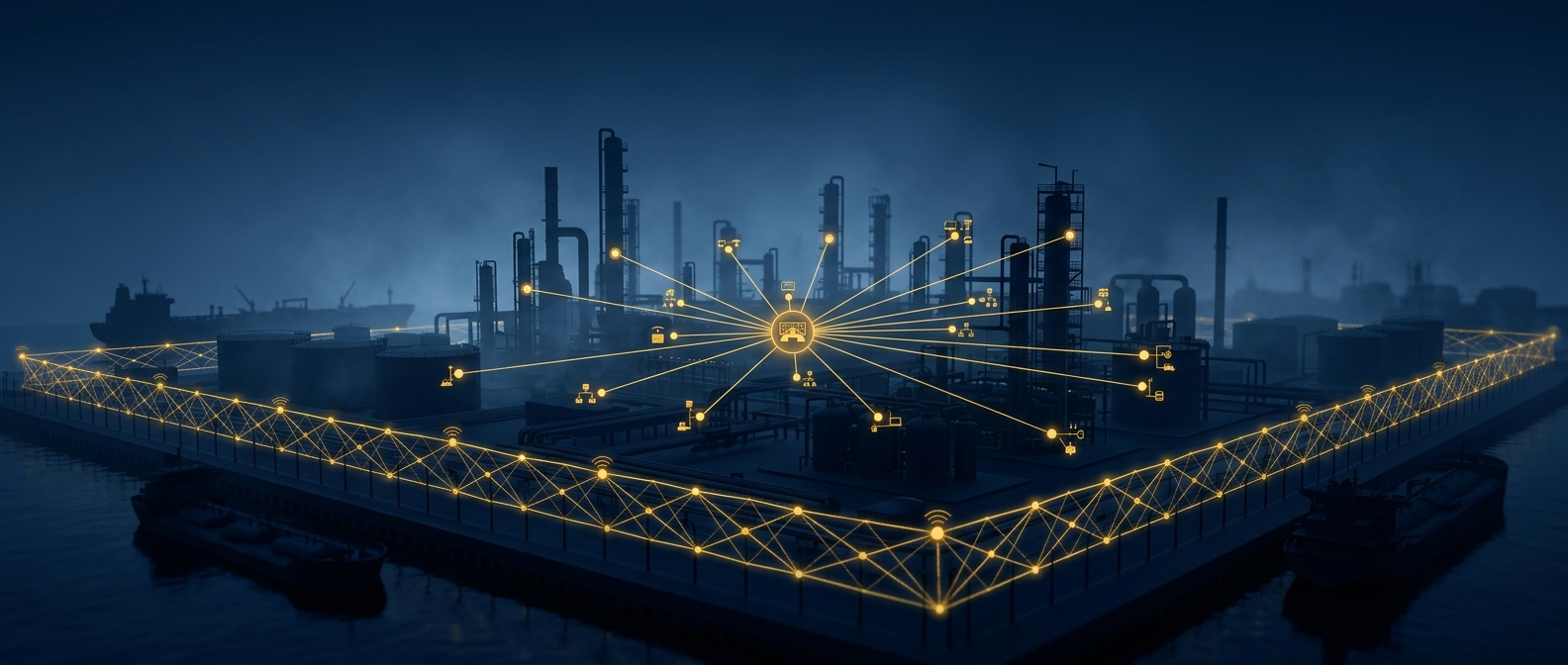
Corporate security for a Houston oil and gas facility is an intelligence-led program that protects the plant across four converging domains at once: physical perimeter, operational-technology (OT/ICS) systems, people, and continuity of operations. A refinery, petrochemical plant, or terminal concentrates catastrophic-hazard process units, thousands of transient contractors, and safety-critical control systems on a sprawling waterfront site. Effective security means defending the seam where a fence-line breach, a compromised control network, and an insider all meet — not stacking guards and firewalls in separate silos.
The Houston Ship Channel and the wider Gulf Coast petrochemical corridor form the densest concentration of energy and chemical processing capacity in the Western Hemisphere. Along a single stretch of water sit refineries, olefins crackers, LNG and product terminals, tank farms, and the pipelines that knit them together — assets that are simultaneously commercial crown jewels, community hazard sources, and named priorities in the U.S. critical-infrastructure threat picture. They are defended by lean site-security organizations that were often designed around theft and trespass, then asked to absorb cyber-physical attack, drone incursion, activist sabotage, and hurricane-driven continuity risk without a corresponding redesign. This guide is written for the plant manager, corporate security director, general counsel, or operating-company executive who has to make that security real before an incident, a regulator, or an insurer forces the issue: what actually threatens a Houston oil and gas facility, how to secure a massive industrial perimeter, why OT/ICS convergence changes the entire model, how to manage contractor and insider risk on a site with a churning workforce, and how to build a program that holds through a Category 4 landfall.
Why do Houston oil and gas facilities face a distinct security problem?
The Gulf Coast threat environment is not the generic corporate one, and treating it as such is the first mistake. Several regional dynamics compound the risk. First, consequence density: a single Ship Channel complex can hold enormous stored energy — volatile hydrocarbons, high-pressure process units, hazardous-materials inventories — so a security failure is not just a loss event but a potential process-safety and public-safety event with off-site consequences. Second, footprint: refineries and tank farms cover hundreds or thousands of acres with waterfront frontage, rail and pipeline rights-of-way, and miles of fence line that cannot be watched by presence alone.
Third, targeting: energy infrastructure is an explicit collection and disruption priority for nation-state actors, and the U.S. Cybersecurity and Infrastructure Security Agency (CISA) has repeatedly warned that the energy and chemical sectors face persistent probing of both corporate and control-system networks. Fourth, workforce dynamics: a plant runs on a large, rotating population of contractors, and during a turnaround or major shutdown the headcount inside the fence can multiply overnight, dissolving the assumption that everyone on site is known. Fifth, environment: the Gulf Coast is a hurricane and storm-surge zone, so any security program that cannot survive evacuation, flooding, and extended power loss is incomplete. A program designed for a fenced warehouse in a temperate market does not fit this picture. The threat model has to be built for the corridor.
What are the top security threats to a refinery or petrochemical plant?
Site-security teams tend to picture the fence-jumper and the copper thief; the material risks are broader and more consequential. The dominant threats to a Houston oil and gas facility, in rough order of impact, are the OT/ICS cyberattack aimed at process control or safety systems; the malicious or negligent insider — an employee or contractor with legitimate access who exfiltrates data, sabotages a process, or enables an outside actor; the physical intrusion or sabotage of critical process units, pipelines, and storage; the theft of high-value product, catalyst precious metals, and copper; the unauthorized drone overflight conducting surveillance or worse over restricted process areas; and the disruption or continuity event — from activist blockade to hurricane — that halts operations.
What ties these together is that each is a convergence risk — it lives in the seam between physical, cyber, and personnel security. A contractor badge cloned in a parking lot becomes an unescorted foothold near a control room. A spear-phished engineering laptop becomes a bridge from the corporate network into the process-control environment. A drone mapping tank-farm layout becomes reconnaissance for a physical attack. A departing process engineer’s data theft is simultaneously an HR matter, a trade-secret event, and an access-control failure. Programs that assign these to separate silos — IT owns cyber, a guard force owns the gate, HR owns the badge — miss them by design, because no single silo sees the whole attack path.
How do you secure the perimeter and physical footprint of a sprawling plant?
Perimeter security for a refinery or petrochemical site is not a taller fence; it is a layered, intelligence-informed system that buys detection and response time across a vast, irregular boundary. Elite programs build in concentric rings — deter, detect, delay, deny, respond — and concentrate the heaviest controls around the highest-consequence assets rather than spreading them evenly. The checklist below reflects how a world-class site approaches its physical footprint.
- Consequence-driven zoning. Identify the assets whose loss or sabotage would create catastrophic process-safety, environmental, or business impact, and build the security rings outward from those — not uniformly around the property line.
- Layered fence-line detection. Combine physical barriers with fence-mounted or buried sensors, thermal and analytics-enabled video, and lighting so intrusion is detected early enough to interdict, not discovered after the fact.
- Access control and identity assurance. Enforce credentialed, auditable access at every gate, with separate escalating tiers for admin areas, process areas, and critical-asset zones — and reconcile physical access against the workforce roster continuously.
- Waterfront and marine security. Secure dock, jetty, and channel-facing approaches, coordinate with facility security officer duties under maritime rules, and treat the waterfront as a live perimeter, not a back edge.
- Pipeline and right-of-way protection. Extend monitoring to gathering lines, transfer lines, and rights-of-way where tapping, tampering, and third-party damage occur out of sight of the main gate.
- Counter-drone awareness. Establish detection and response protocols for unauthorized UAS over process areas, and align them with lawful authority and reporting obligations.
- Guard force integration. Treat officers as the mobile, thinking layer of a sensor-and-response system — trained on this site’s hazards and escalation paths — rather than as static presence.
The common failure is a barbell: a fortified main gate and a guardhouse at the front, while miles of fence line, the waterfront, and the pipeline right-of-way go effectively unwatched. A rigorous security assessment tells you where the next dollar buys the most delay and detection, rather than the most visible reassurance.
What is OT/ICS convergence, and why does it change the security model?
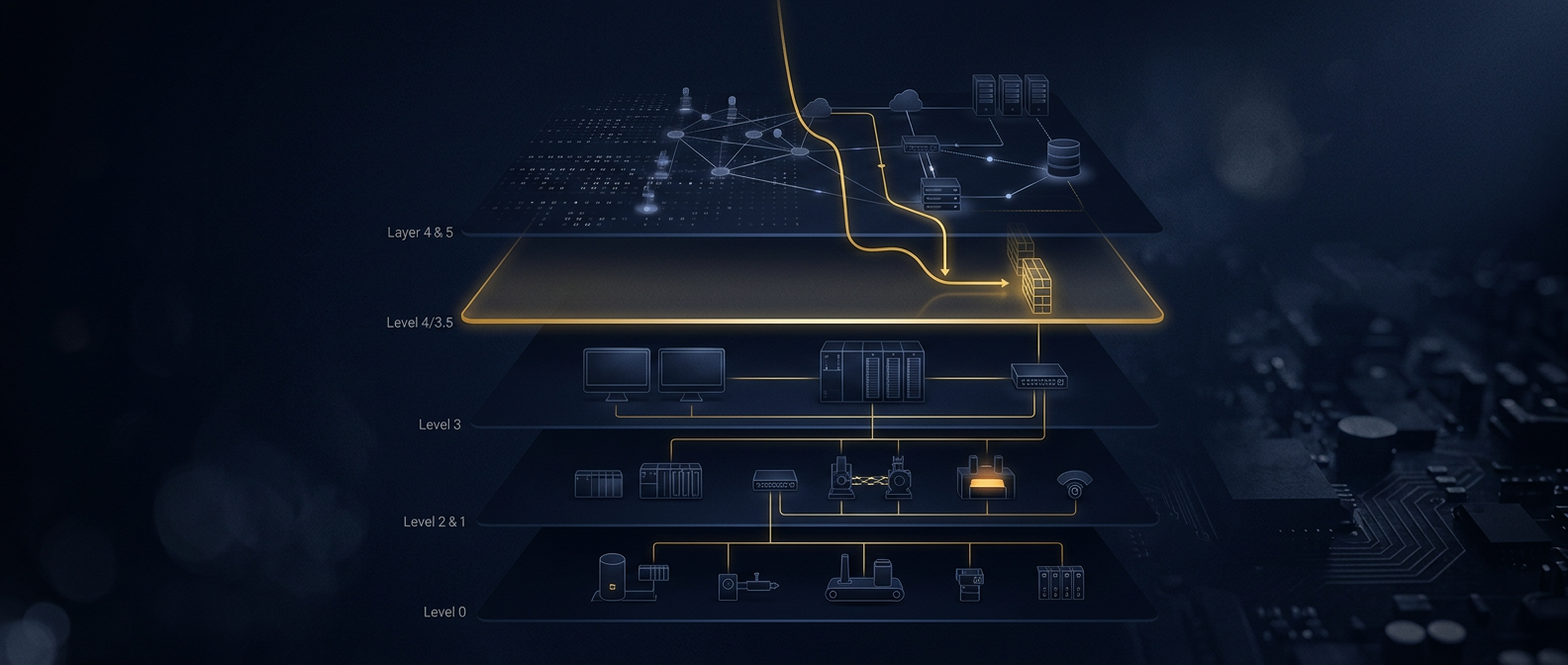
For decades, the process-control systems that run a refinery — the distributed control systems, programmable logic controllers, and safety-instrumented systems collectively called operational technology (OT) or industrial control systems (ICS) — were air-gapped, proprietary, and physically isolated from the corporate IT network. That isolation is gone. Digitalization, remote monitoring, predictive maintenance, and data historians have stitched OT and IT together, and with the connection came exposure. The Colonial Pipeline shutdown of 2021 — a corporate-side ransomware event that halted fuel delivery across the U.S. Southeast — and control-system-specific malware families demonstrated that an attack need not touch a valve directly to stop production; it only has to reach the seam.
OT security is not IT security relabeled. The priorities invert: where IT protects data confidentiality above all, OT protects availability and physical safety, because a false trip or a manipulated setpoint can injure people and damage assets. The table below contrasts the two environments and explains why a control-system defense cannot be lifted from the corporate playbook.
| Dimension | Corporate IT | Plant OT / ICS |
|---|---|---|
| Top priority | Confidentiality of data | Availability & physical safety |
| Patch cadence | Frequent, routine | Rare — tied to turnarounds; legacy systems |
| Asset lifespan | 3–5 years | 15–25+ years, often unsupported |
| Downtime tolerance | Hours acceptable | Near-zero; a trip is a safety event |
| Primary failure impact | Data loss, fraud | Process release, injury, environmental harm |
| Defensive model | Detect, patch, rebuild | Segment, monitor, protect the boundary |
Practically, defending the converged environment means enforcing rigorous network segmentation between enterprise IT and the control network — the Purdue-model layers and a hardened demilitarized zone at the boundary — along with passive OT monitoring that never disrupts a live process, strict control of vendor and remote-maintenance access, and disciplined removable-media hygiene on the plant floor. The framework in NIST’s guidance on operational-technology security and the sector directives issued by the Transportation Security Administration for pipelines both stress the same core: know your assets, segment the network, and be able to detect and respond inside the OT environment, not just at the corporate edge. When an intrusion or suspected compromise does occur, the ability to perform forensically sound analysis of control-system and engineering-workstation artifacts — while preserving chain of custody and without tripping the process — is what separates a contained event from a shutdown and a regulatory reckoning.
How do you manage contractor and insider risk at a plant?
The single most underestimated exposure at a Gulf Coast facility is the person already inside the fence. Refineries and petrochemical plants depend on a large, rotating contractor workforce — and during a turnaround, that population can swell dramatically, with specialty crews, vendors, and day labor moving through gates in volume and under schedule pressure. Every one of those badges is a trust decision. The insider risk is not only the classic disgruntled saboteur; it is the negligent contractor who props a door, the recruited employee who photographs a control-room screen, the vendor technician with unmonitored remote access, and the departing engineer who walks out with process designs, catalyst formulations, or customer and pricing data.
Managing it is a discipline that spans hiring, access, monitoring, and offboarding. It starts with proportionate, lawful background vetting of employees and, critically, of the contractor and vendor population that legacy programs often wave through. It continues with least-privilege physical and logical access tied to role and duration, reconciliation of who is actually on site against who is authorized, and behavioral and access monitoring calibrated to catch anomalies — a badge used at an odd hour in a zone outside a worker’s scope, bulk data pulled from an engineering system, an escort quietly dropped. It ends with instrumented offboarding: when an employee or contractor leaves, access is revoked cleanly across physical and digital systems, and where the departure is suspicious, endpoints and accounts are preserved for forensic review before anything is wiped. A mature insider-threat program is cross-functional by design — security, HR, legal, and IT/OT working from one picture — because the signals of insider risk never sit in a single system.
How do you build a critical-infrastructure security program that holds?
A credible program is a sequence, not a shopping list. The framework below is the order elite advisors follow to stand up or mature security at an energy facility without disrupting production or process safety.
- Characterize consequence and identify critical assets. Define the units, systems, and data whose loss, release, or sabotage would be catastrophic. Everything downstream protects these first, not everything equally.
- Model the threats to this site. Profile the credible adversaries — nation-state and criminal cyber actors, insiders, thieves, activists, and natural hazards — against this facility’s geography, process, and workforce, rather than a generic checklist.
- Baseline and test the current state. Assess physical, OT/ICS, personnel, and continuity controls together and test them — a camera nobody monitors and a firewall rule nobody audits are gaps, not controls.
- Segment IT from OT. Establish and enforce the network boundary, DMZ, and monitoring between corporate and control systems as the highest-leverage cyber-physical fix.
- Harden the perimeter by consequence. Layer detection, delay, and response around critical assets, the waterfront, and rights-of-way — not uniformly around the fence.
- Lock down access and the contractor population. Enforce identity assurance, least-privilege, roster reconciliation, and vendor/remote-access control across the whole workforce.
- Stand up insider-threat and offboarding discipline. Run a cross-functional program with anomaly monitoring and evidence-preserving departures.
- Prepare incident response and forensics. Write and rehearse an IR plan that spans cyber and physical, and put an investigative and forensic capability on retainer before it is needed.
- Integrate business continuity and hurricane resilience. Plan for evacuation, ride-out crews, power loss, flooding, and re-entry security so the program survives a Gulf storm.
- Assign ownership and reassess on cadence. Name an accountable owner and reassess after every material change — a turnaround, an acquisition, a new interconnection, or a serious incident.
Notice how little of this is hardware. The value is in consequence modeling, the IT/OT boundary, the contractor and insider discipline, and the continuity plan — the exposures that visible spending tends to skip.
How does business continuity fit into Gulf Coast facility security?
On the Gulf Coast, business continuity is a security function, not a separate binder. A hurricane forces evacuation, and evacuation is the moment a facility is most exposed: skeleton ride-out crews, degraded monitoring, power and communications loss, storm surge, and then a chaotic re-entry when thousands of workers and contractors return at once. A security program that assumes normal staffing and intact systems is not a program — it is a fair-weather one. Elite operators plan the security of each continuity phase deliberately: pre-storm hardening and asset accountability, controlled access for essential ride-out personnel, contingency monitoring that survives power loss, and a re-entry protocol that verifies identity and integrity before the site repopulates. The same rigor applies to non-weather disruptions — an activist blockade, a supply interruption, a cyber-driven shutdown — where security and continuity planning determine whether the facility degrades gracefully or fails hard. Continuity, in short, is where physical, cyber, and personnel security are tested at once.
How does Honeybadger deliver corporate security for Houston oil and gas facilities?
Honeybadger Solutions delivers industrial and critical-infrastructure security for energy and petrochemical operators as an integrated program rather than a single-domain service, drawing on our corporate security, investigations, cyber, digital forensics, and intelligence practices. Because our digital forensics, cybersecurity, financial-investigation, and background-intelligence capabilities are handled in-house and delivered globally, we assess and defend the seam where facility risk actually lives — connecting an OT intrusion to a forensic investigation, a contractor badge to an access-control and insider-risk gap, and a supply-chain weakness to a fraud and sabotage pathway.
Based in Arizona with offices in Casa Grande, Phoenix, and Oro Valley, we serve operators across all of Arizona, nationwide, and internationally — including Houston, the Ship Channel, and the wider Gulf Coast corridor. Where an engagement surfaces a physical, guarding, or protective requirement, it feeds directly into operations executed through our commanded, vetted-partner network, for which Texas is an established theater directed from Arizona home command. For a Houston facility, the result is a single, coherent security program — perimeter and physical protection, OT/ICS defense, contractor and insider-risk management, and continuity — that is defensible to your board, your insurer, your regulators, and, if it ever comes to it, a court.
Frequently asked questions
What regulations govern security at a Houston oil and gas facility?
Energy and chemical facilities operate under a layered set of federal and industry requirements rather than one statute. Pipeline operators are subject to TSA security directives issued after the Colonial Pipeline incident; maritime-facing terminals fall under Coast Guard facility-security rules; and CISA administers chemical-sector security programs and voluntary guidance, alongside industry standards from bodies such as the American Petroleum Institute and NIST’s operational-technology framework. Because coverage depends on the specific assets on site, a facility should map its obligations deliberately rather than assume a single regime applies. Security controls should satisfy the applicable rules and stand on their own merits.
Why is OT/ICS security different from regular corporate cybersecurity?
Because the priorities invert. Corporate IT protects the confidentiality of data and can patch and reboot freely; a plant’s control systems protect availability and physical safety, run on equipment that may be decades old and rarely patched, and cannot tolerate an unplanned trip, which is itself a safety event. Defending OT relies on network segmentation between IT and the control environment, passive monitoring that never disrupts a live process, strict control of vendor and remote access, and removable-media hygiene — not simply applying the corporate security stack to the plant floor.
How do you manage contractor risk during a turnaround?
A turnaround multiplies the on-site population and the schedule pressure, which is exactly when access discipline erodes. The controls that hold are proportionate, lawful vetting of contractor and vendor crews, credentialed least-privilege access tied to role and duration, continuous reconciliation of who is on site against who is authorized, escort and zone discipline around critical assets, and clean, verified de-badging when crews leave. Where suspicious activity surfaces, the ability to preserve evidence and investigate discreetly — without disrupting the turnaround — converts a suspicion into a defensible finding.
How does hurricane season affect facility security planning?
A Gulf Coast facility is most exposed during and after a storm, when it evacuates to skeleton crews and loses power, communications, and monitoring. Security has to be planned into each continuity phase: pre-storm hardening and asset accountability, controlled access for ride-out personnel, contingency monitoring that survives power loss, and a re-entry protocol that verifies identity and site integrity before thousands of workers return. Continuity planning that ignores security — or security planning that assumes normal staffing — leaves the facility exposed precisely when adversaries and opportunists expect it to be.
About Honeybadger Solutions
Honeybadger Solutions is an Arizona-licensed security and investigations firm delivering intelligence-led corporate and critical-infrastructure security, OT and insider-threat protection, investigations, and cyber and forensic services to energy, industrial, and enterprise clients nationwide and internationally. Digital forensics, cybersecurity, financial investigations, and background intelligence are handled in-house and delivered globally. Physical and protective operations are delivered through a commanded vetted-partner network with established theaters in California, Texas, and Florida, directed from Arizona home command.
Offices: Casa Grande (HQ), Phoenix, and Oro Valley, Arizona.
Phone: 602-725-2818
Confidential consultation: discuss a private security program for your Houston oil and gas facility with our team.